Methyl Phenyl Silicone Resin Market Size, Share & Demand Report By Type (Solvent-Based Methyl Phenyl Silicone Resin), By Application (Protective Coatings, Electrical Insulation Materials, Adhesives and Sealants, Release Coatings, Others), By End-Use Industry ( Automotive and Transportation, Aerospace, Construction, Renewable Energy Systems), By Region & Segment Forecasts, 2026–2034
USD 3950
Market Overview
The global Methyl Phenyl Silicone Resin Market size was valued at USD 1.38 billion in 2026 and is projected to reach USD 2.41 billion by 2034, registering a CAGR of 7.2% during 2026–2034. The market continues to witness stable expansion due to the increasing use of high-performance silicone materials across coatings, electrical insulation, electronics, automotive, aerospace, and industrial manufacturing applications. Methyl phenyl silicone resins are widely recognized for their thermal stability, weather resistance, dielectric properties, and chemical durability, making them suitable for demanding operating environments.
A major factor supporting global market growth is the rising demand for heat-resistant and long-lasting materials in advanced industrial systems. Manufacturers are increasingly replacing conventional organic resins with silicone-based alternatives to improve operational efficiency and product lifespan. Growing investments in electric vehicles, renewable energy systems, industrial automation, and high-performance electronics are creating sustained demand for specialty silicone resins. In addition, infrastructure modernization projects and the expansion of electronics manufacturing facilities across emerging economies are contributing to market development.
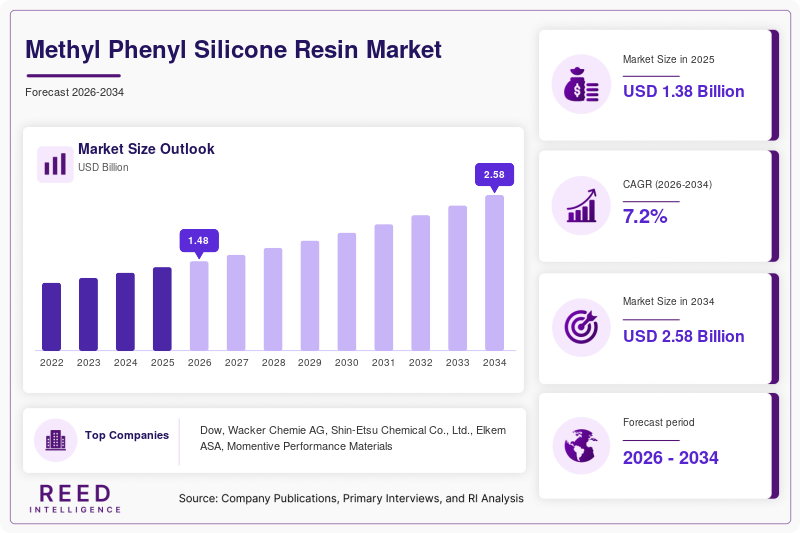
Key Highlights
- North America dominated the market with a 35.1% share in 2025.
- while Asia Pacific is expected to grow at the fastest CAGR of 8.8% during 2026–2034.
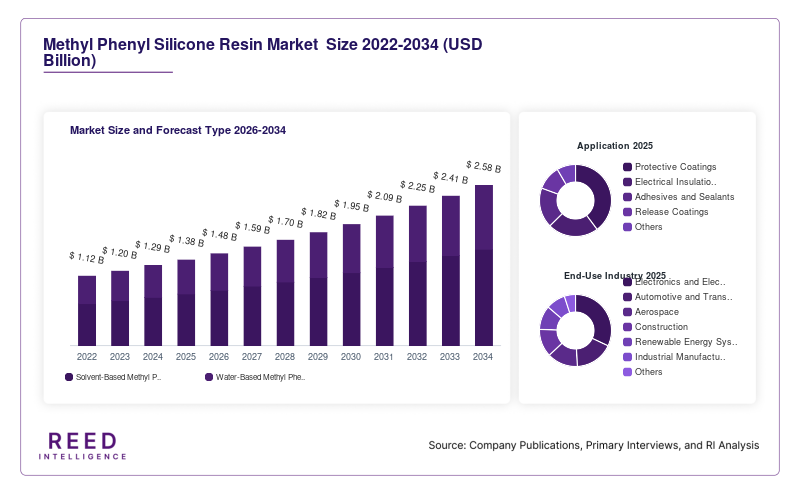
- By type, solvent-based methyl phenyl silicone resin accounted for the largest share of 57.4%.
- while water-based methyl phenyl silicone resin is projected to grow at a CAGR of 8.9%.
- By application, protective coatings led the market with a 39.6% share.
- whereas electrical insulation materials are expected to expand at a CAGR of 8.7%.
- By end-use industry, electronics and electricals accounted for the largest share of 31.8%.
- while renewable energy systems are projected to grow at a CAGR of 9.4%.
- The United States remained the dominant country, with market values of USD 328 million in 2024 and USD 355 million in 2025.
Market Trends
Rising Integration of Silicone Resins in Advanced Electronics Manufacturing
The increasing complexity of electronic devices is driving demand for high-performance materials capable of maintaining stability under elevated temperatures and challenging operating conditions. Methyl phenyl silicone resin is becoming an important component in electronic assemblies because of its excellent dielectric properties, thermal resistance, and long service life. Manufacturers of semiconductors, printed circuit boards, sensors, and power electronics are increasingly utilizing these resins to improve reliability and product durability. As miniaturization trends continue across consumer electronics and industrial automation equipment, material performance requirements are becoming more stringent. This trend is encouraging producers to develop specialized resin grades that provide enhanced insulation, moisture resistance, and operational stability for next-generation electronic products.
Growing Adoption in Sustainable Industrial Coating Solutions
Industrial manufacturers are increasingly seeking coating materials that provide long-term protection while supporting sustainability objectives. Methyl phenyl silicone resin is gaining attention because of its ability to extend equipment lifespan, reduce maintenance frequency, and improve energy efficiency through thermal management. Industries such as power generation, transportation, construction, and heavy machinery are incorporating silicone-based coatings into critical infrastructure assets. The trend is further supported by regulatory pressure to improve product durability and reduce lifecycle costs. As industrial facilities prioritize operational reliability and asset protection, demand for advanced silicone resin coatings continues to expand. Manufacturers are also investing in lower-emission and environmentally compatible formulations to align with evolving environmental standards and customer expectations.
Market Drivers
Expanding Demand from Electric Vehicle and Transportation Industries
The rapid growth of electric vehicles and advanced transportation technologies is significantly contributing to the expansion of the Methyl Phenyl Silicone Resin Market. Electric vehicles require materials capable of withstanding high temperatures generated by batteries, power electronics, and charging systems. Methyl phenyl silicone resins offer superior thermal stability, electrical insulation, and resistance to environmental degradation, making them suitable for these applications. Automotive manufacturers are increasingly incorporating silicone-based materials into battery modules, wiring systems, sensors, and protective coatings. Furthermore, rising investments in electric mobility infrastructure across developed and developing economies are supporting long-term demand. The transition toward cleaner transportation solutions is expected to create substantial opportunities for silicone resin suppliers throughout the forecast period.
Increasing Industrial Requirement for Heat-Resistant Materials
Industries operating in high-temperature environments are actively adopting materials that can maintain performance under severe conditions. Methyl phenyl silicone resin is widely used in industrial coatings, insulation systems, and specialty formulations because of its exceptional heat resistance and durability. Sectors such as aerospace, power generation, metallurgy, and manufacturing rely on these properties to improve operational efficiency and reduce maintenance costs. Growing industrial automation and modernization initiatives are increasing demand for durable materials capable of supporting continuous production processes. In addition, infrastructure projects requiring long-lasting protective systems are contributing to broader market adoption. As industries seek solutions that improve reliability and asset longevity, the demand for methyl phenyl silicone resin continues to strengthen.
Market Restraint
Volatility in Raw Material Costs and Production Economics
The Methyl Phenyl Silicone Resin Market faces challenges associated with fluctuations in raw material prices and manufacturing costs. Silicone resin production depends on specialized chemical intermediates whose availability and pricing can be influenced by supply chain disruptions, energy costs, regulatory changes, and geopolitical developments. Significant variations in input costs create uncertainty for manufacturers and can affect profit margins, particularly for small and medium-sized producers. The impact is often reflected in pricing strategies, procurement planning, and investment decisions across the value chain.
High production costs may also limit adoption in price-sensitive industries where alternative materials remain available. For example, certain industrial users may continue utilizing lower-cost organic resins despite performance limitations, especially when budget constraints outweigh durability requirements. Additionally, compliance with environmental regulations can increase operational expenditures associated with production processes and waste management. These factors collectively create challenges for market participants attempting to maintain competitive pricing while investing in product innovation. Although long-term demand fundamentals remain positive, raw material volatility continues to represent a significant restraint affecting market expansion and operational planning.
Market Opportunities
Expansion of Renewable Energy Infrastructure Worldwide
The global transition toward renewable energy presents substantial opportunities for methyl phenyl silicone resin manufacturers. Solar power systems, wind turbines, energy storage facilities, and grid modernization projects require materials capable of delivering long-term reliability under varying environmental conditions. Methyl phenyl silicone resins offer excellent weatherability, thermal resistance, and electrical insulation characteristics, making them suitable for renewable energy applications. Governments across multiple regions are increasing investments in clean energy infrastructure to support sustainability objectives and energy security. As deployment of renewable energy technologies accelerates, demand for advanced silicone materials is expected to increase significantly. Manufacturers that develop application-specific solutions for renewable energy systems may benefit from expanding commercial opportunities during the forecast period.
Development of High-Performance Water-Based Resin Technologies
The growing focus on environmentally responsible manufacturing practices is creating opportunities for innovative water-based methyl phenyl silicone resin formulations. Industrial customers are increasingly seeking products that reduce emissions while maintaining performance standards comparable to conventional solvent-based systems. Advances in material science are enabling manufacturers to improve water-based resin properties, including adhesion, durability, and thermal stability. These developments are opening new application areas across coatings, electronics, and construction sectors. As environmental regulations become more stringent and sustainability goals gain importance, demand for low-emission silicone resin technologies is expected to rise. Companies investing in research and development of advanced water-based products are likely to strengthen their competitive positioning and access emerging market segments.
Segmental Analysis
By Type
Solvent-based methyl phenyl silicone resin represented the dominant subsegment, accounting for 57.4% market share in 2024. This leadership position is attributed to its widespread use across industrial coatings, electrical insulation systems, and high-temperature applications. Manufacturers prefer solvent-based formulations because they provide excellent adhesion, durability, and resistance to extreme environmental conditions. These products are extensively utilized in industrial machinery, transportation equipment, and infrastructure projects where long-term performance is critical. Established manufacturing processes and broad compatibility with existing application technologies have also supported adoption. Furthermore, industries requiring superior thermal stability and chemical resistance continue to rely heavily on solvent-based silicone resin solutions, reinforcing their substantial contribution to overall market revenue.
Water-based methyl phenyl silicone resin is projected to be the fastest-growing subsegment, expanding at a CAGR of 8.9% through 2034. Growth is being driven by increasing demand for environmentally responsible materials and stricter regulations regarding industrial emissions. End users are actively seeking alternatives that reduce environmental impact while maintaining comparable performance characteristics. Advances in formulation technology have improved durability, adhesion, and thermal resistance, enabling broader application across multiple industries. Construction, electronics, and industrial coating manufacturers are increasingly evaluating water-based products as part of sustainability initiatives. As technological improvements continue and regulatory pressures intensify, demand for water-based silicone resin products is expected to increase steadily throughout the forecast period.
By Application
Protective coatings emerged as the largest application segment, capturing 39.6% of market share in 2024. The extensive use of methyl phenyl silicone resin in protective coatings is driven by its excellent resistance to heat, weathering, moisture, and chemical exposure. Industrial facilities, transportation infrastructure, power generation equipment, and manufacturing assets require durable protective systems capable of extending operational lifespan. Silicone-based coatings help reduce maintenance costs and improve asset reliability, making them attractive across numerous industries. In addition, increasing investments in infrastructure modernization and industrial expansion have contributed to growing demand for advanced coating solutions. The combination of performance benefits and long-term cost advantages continues to support the segment's dominant position within the market.
Electrical insulation materials are expected to register the fastest growth, with a projected CAGR of 8.7% during 2026–2034. The increasing deployment of sophisticated electrical systems, renewable energy infrastructure, and advanced electronics is creating strong demand for high-performance insulation materials. Methyl phenyl silicone resin provides excellent dielectric properties and thermal stability, making it suitable for demanding electrical applications. Manufacturers are increasingly incorporating these materials into transformers, motors, generators, and power electronics systems. The transition toward electrification across transportation and industrial sectors further enhances growth prospects. Rising investments in smart grids, energy storage technologies, and modern power distribution networks are expected to sustain strong demand for silicone resin-based insulation solutions throughout the forecast period.
By End-Use Industry
Electronics and electricals held the dominant position among end-use industries, accounting for 31.8% market share in 2024. The sector's leadership is linked to the increasing requirement for reliable insulation materials, encapsulants, and protective coatings in electronic devices and electrical systems. Manufacturers of semiconductors, sensors, consumer electronics, and industrial automation equipment rely on methyl phenyl silicone resin to enhance product durability and operational stability. The growing complexity of electronic devices has intensified demand for materials capable of withstanding elevated temperatures and harsh operating conditions. Continuous innovation within the electronics industry, combined with expanding global production capacity, has further strengthened the segment's contribution to overall market revenue.
Renewable energy systems are projected to be the fastest-growing end-use subsegment, recording a CAGR of 9.4% through 2034. Rapid investments in solar energy, wind power, and energy storage infrastructure are creating substantial demand for durable and high-performance materials. Methyl phenyl silicone resin is increasingly used in applications requiring weather resistance, electrical insulation, and long-term reliability. Governments worldwide are implementing policies that encourage renewable energy adoption, resulting in large-scale infrastructure development. Equipment manufacturers are also focusing on improving operational efficiency and reducing maintenance requirements through advanced material selection. These trends are expected to drive significant growth in renewable energy-related applications over the forecast period.
Regional Analysis
North America
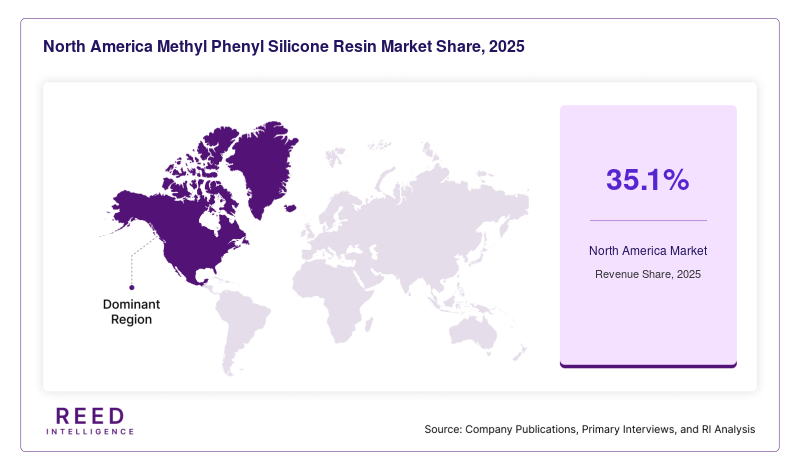
North America accounted for 35.1% of the global Methyl Phenyl Silicone Resin Market in 2025 and is expected to register a CAGR of 6.8% through 2034. The region benefits from a mature industrial base, advanced manufacturing capabilities, and strong adoption of specialty materials across electronics, aerospace, and transportation sectors. Consistent investments in research and development activities are supporting innovation in silicone resin technologies. Demand remains particularly strong in applications requiring high thermal stability, weather resistance, and electrical insulation performance. The presence of established chemical manufacturers further strengthens regional market growth.
The United States represents the dominant country within North America. A major growth factor is the increasing adoption of advanced materials in electric vehicle production and energy infrastructure modernization projects. Manufacturers are actively investing in technologies that improve efficiency, durability, and safety. Growing demand for high-performance coatings and insulation materials across industrial facilities also contributes to sustained market expansion. Furthermore, strong collaboration between research institutions and industry participants supports the development of innovative silicone resin applications.
Europe
Europe held approximately 26.7% market share in 2025 and is projected to grow at a CAGR of 6.9% during the forecast period. The region's focus on sustainable manufacturing, industrial efficiency, and technological innovation continues to drive demand for methyl phenyl silicone resin products. Several industries, including automotive, construction, and electrical equipment manufacturing, are increasingly utilizing advanced silicone materials to improve product performance and regulatory compliance. Market participants are also emphasizing environmentally compatible formulations to align with evolving sustainability requirements.
Germany remains the leading country in the European market. One unique growth factor is the country's strong industrial engineering sector, which consistently demands high-performance materials for precision manufacturing applications. German companies are investing in automation technologies, advanced machinery, and energy-efficient production systems that require reliable thermal and electrical insulation solutions. This ongoing industrial transformation supports demand for specialty silicone resins across multiple end-use industries while fostering continued innovation in product development.
Asia Pacific
Asia Pacific represented 24.8% of the global market in 2025 and is expected to record the fastest CAGR of 8.8% between 2026 and 2034. Rapid industrialization, expanding electronics manufacturing, and increasing infrastructure investments are key factors supporting regional growth. The region has emerged as a major production hub for consumer electronics, semiconductors, automotive components, and industrial equipment. These industries require advanced materials capable of delivering durability and performance under demanding conditions. Rising urbanization and manufacturing expansion continue to generate strong demand for silicone resin products.
China dominates the Asia Pacific market due to its extensive manufacturing ecosystem and large-scale industrial output. A unique growth factor is the country's substantial investment in semiconductor fabrication and advanced electronics production facilities. As domestic and international companies expand manufacturing operations, demand for high-performance insulation materials and specialty coatings continues to increase. Government initiatives supporting technological advancement and industrial modernization further strengthen market growth opportunities across the region.
Middle East & Africa
The Middle East & Africa accounted for 7.2% of the global market share in 2025 and is forecast to grow at a CAGR of 6.4% through 2034. Industrial diversification initiatives, infrastructure development programs, and energy sector investments are supporting regional demand for methyl phenyl silicone resin products. Several countries are investing in manufacturing expansion and industrial modernization to reduce dependence on traditional economic sectors. These efforts are increasing the need for durable materials capable of performing in challenging environmental conditions, including extreme temperatures and exposure to harsh climates.
Saudi Arabia is the leading country within the region. A distinctive growth factor is the country's large-scale industrial diversification strategy, which includes investments in manufacturing, renewable energy, and advanced materials industries. Industrial projects often require high-performance coatings and insulation systems capable of maintaining reliability in demanding operating environments. As these initiatives continue to progress, demand for specialty silicone resins is expected to increase steadily across multiple application sectors.
Latin America
Latin America captured 6.2% of the Methyl Phenyl Silicone Resin Market in 2025 and is anticipated to expand at a CAGR of 6.1% during the forecast period. The region is benefiting from gradual industrial development, infrastructure investments, and increasing adoption of advanced materials across manufacturing sectors. Demand for durable coatings, electrical insulation products, and specialty industrial materials is rising as companies seek to improve operational efficiency and asset longevity. Continued modernization of industrial facilities is creating favorable conditions for market growth throughout the region.
Brazil remains the dominant country in Latin America. One unique growth factor is the expansion of industrial maintenance and protective coating applications across manufacturing, energy, and transportation sectors. Companies are increasingly investing in technologies that reduce maintenance costs and extend equipment lifespan. The growing emphasis on operational reliability and infrastructure durability supports increased utilization of methyl phenyl silicone resin products across various industrial environments, contributing to sustained market expansion.
Competitive Landscape
The Methyl Phenyl Silicone Resin Market is moderately consolidated, with global and regional manufacturers competing through product innovation, capacity expansion, strategic partnerships, and technological development. Leading companies focus on enhancing product performance characteristics, including thermal stability, dielectric strength, weather resistance, and environmental compatibility. Investments in research and development remain a critical competitive strategy as end-use industries increasingly demand customized solutions for specialized applications.
Dow is considered a leading participant in the market due to its broad silicone product portfolio, extensive global presence, and continuous investment in advanced material technologies. The company maintains strong relationships with customers across electronics, industrial, transportation, and energy sectors. Recent developments across the industry include expansion of specialty silicone production facilities, introduction of low-emission resin technologies, and increased investment in sustainable manufacturing processes.
Other major companies are actively strengthening regional distribution networks and expanding production capacities to address growing demand from emerging economies. Competitive intensity is expected to increase as manufacturers pursue innovation and sustainability initiatives to differentiate their offerings and capture new market opportunities.
Key Players
- Dow
- Wacker Chemie AG
- Shin-Etsu Chemical Co., Ltd.
- Elkem ASA
- Momentive Performance Materials
- Evonik Industries AG
- KCC Corporation
- BRB International
- Siltech Corporation
- Jiangxi Xinghuo Silicone Factory
- Zhejiang Sucon Silicone Co., Ltd.
- Dongyue Group
- Bluestar Silicones
- CHT Group
- Specialty Silicone Products Inc.
Recent Developments
- Dow expanded specialty silicone resin production capabilities to support growing demand from electronics and industrial coating applications.
- Wacker Chemie AG introduced an advanced methyl phenyl silicone resin formulation designed to improve thermal stability and weather resistance in high-performance coating systems.
- Shin-Etsu Chemical Co., Ltd. increased investment in research programs focused on environmentally compatible silicone materials for industrial and electrical applications.
- Elkem ASA announced capacity enhancement initiatives aimed at strengthening supply reliability for specialty silicone products across global markets.
- Momentive Performance Materials launched new silicone resin technologies targeting renewable energy infrastructure and advanced electrical insulation applications.
Methyl Phenyl Silicone Resin Market Segments
Type
- Solvent-Based Methyl Phenyl Silicone Resin
- Water-Based Methyl Phenyl Silicone Resin
Application
- Protective Coatings
- Electrical Insulation Materials
- Adhesives and Sealants
- Release Coatings
- Others
End-Use Industry
- Electronics and Electricals
- Automotive and Transportation
- Aerospace
- Construction
- Renewable Energy Systems
- Industrial Manufacturing
- Others
By Region
- North America
- Europe
- APAC
- Middle East and Africa
- LATAM