Methyl Salicylate Market Size, Share & Demand Report By Type (Synthetic Methyl Salicylate, Natural Methyl Salicylate), By Application (Pharmaceuticals, Personal Care, Food & Beverages, Industrial Applications), By End-Use (Healthcare, Cosmetics & Personal Care, Food Industry, Agriculture) By Region & Segment Forecasts, 2026–2034
USD 3950
Market Overview
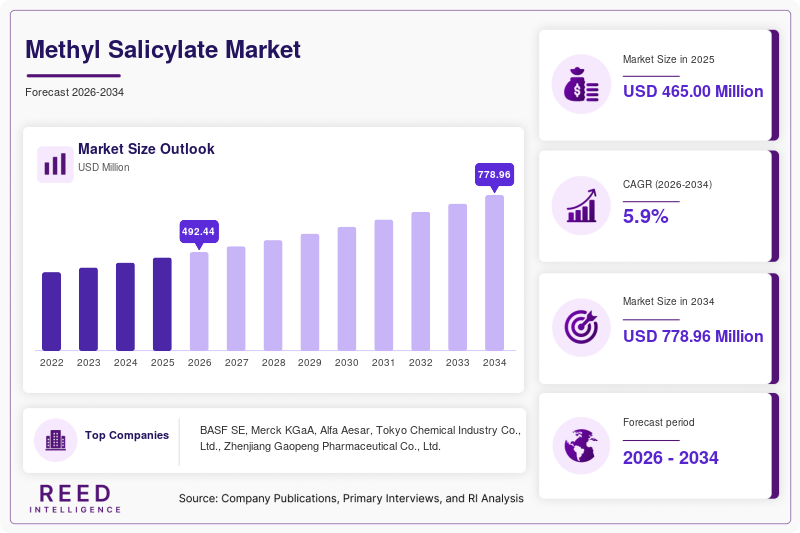
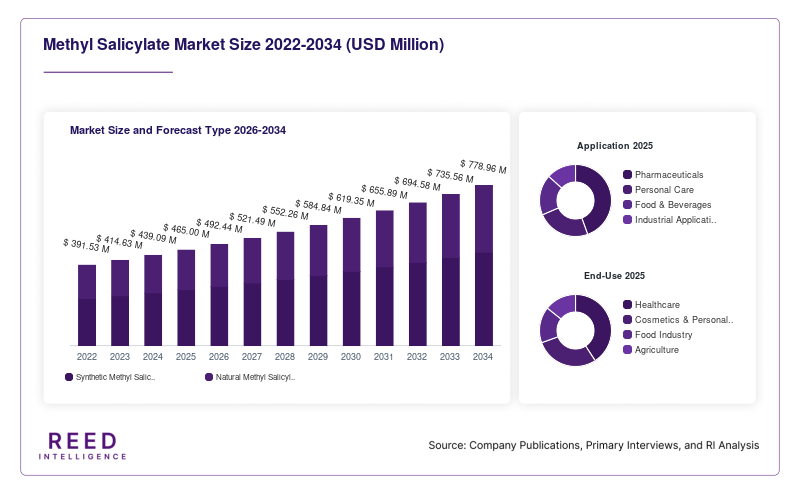
The Methyl Salicylate Market size was valued at approximately USD 465 million in 2026 and is projected to reach around USD 735 million by 2034, expanding at a CAGR of 5.9% during the forecast period of 2026–2034. The market demonstrates steady growth driven by its wide usage across pharmaceuticals, personal care, food flavoring, and industrial applications. Methyl salicylate, commonly known as wintergreen oil, is extensively used as a topical analgesic in pain relief formulations and as a fragrance component in cosmetics and toiletries.
A key global factor supporting market growth is the increasing demand for topical pain relief products due to the rising prevalence of musculoskeletal disorders, arthritis, and sports-related injuries. Aging populations and growing awareness of self-medication practices have encouraged the adoption of over-the-counter analgesics, which frequently incorporate methyl salicylate due to its effectiveness and cost efficiency.
The food and beverage sector also contributes to demand, as the compound is used as a flavoring agent in confectionery and beverages. Additionally, expanding industrial applications such as agrochemicals and fragrance manufacturing have strengthened the market’s demand base.
Key Highlights
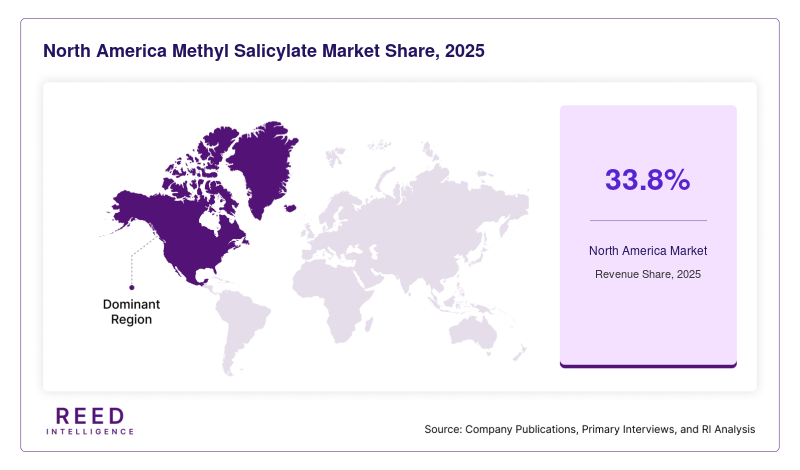
- North America dominated the market with a 33.8% share in 2025.
- Asia Pacific is expected to grow at the fastest CAGR of 7.1% during 2026–2034.
- By type, synthetic methyl salicylate accounted for the largest share of 61.4%, while natural methyl salicylate is projected to grow at a CAGR of 6.8%.
- By application, pharmaceuticals led with a 44.9% share, whereas personal care products are expected to expand at a CAGR of 6.5%.
- The United States remained the dominant country, with market values of USD 145 million in 2024 and USD 158 million in 2025.
Market Trends
Increasing preference for natural and plant-derived ingredients
One of the noticeable trends in the methyl salicylate market is the growing preference for natural and plant-derived variants. Consumers are becoming more aware of ingredient sourcing, particularly in personal care and food products. This shift has encouraged manufacturers to focus on extracting methyl salicylate from natural sources such as wintergreen leaves and birch bark. Although synthetic variants remain cost-effective, natural alternatives are gaining traction in premium product categories. This trend is especially strong in developed regions where regulatory frameworks support clean-label initiatives and transparency in product formulation. Companies are investing in sustainable sourcing and eco-friendly extraction processes to align with changing consumer expectations and regulatory standards.
Expansion of multifunctional applications across industries
Another trend shaping the market is the expansion of methyl salicylate applications beyond traditional uses. While pharmaceuticals remain the primary segment, the compound is increasingly used in agrochemicals, fragrances, and industrial formulations. In agriculture, methyl salicylate acts as a plant defense signaling compound, supporting crop protection strategies. The fragrance industry uses it for its distinctive aroma in perfumes and air fresheners. Additionally, manufacturers are exploring its role in advanced formulations such as liniments, transdermal patches, and therapeutic balms. This diversification of applications is helping stabilize demand and reduce dependency on a single industry, contributing to long-term market resilience.
Market Drivers
Rising demand for topical analgesics and pain management solutions
The increasing prevalence of chronic pain conditions is a key driver for the methyl salicylate market. Conditions such as arthritis, muscle strain, and joint disorders are becoming more common due to aging populations and sedentary lifestyles. Methyl salicylate is widely used in topical pain relief products due to its anti-inflammatory and analgesic properties. It provides a warming sensation that helps reduce discomfort and improve blood circulation in affected areas. The growing popularity of over-the-counter medications has further supported its adoption. Consumers prefer topical solutions as they offer localized relief with fewer systemic side effects compared to oral medications, making methyl salicylate a preferred ingredient in many formulations.
Growth in personal care and cosmetics industry
The expansion of the global personal care and cosmetics industry is another significant driver. Methyl salicylate is commonly used as a fragrance and flavoring agent in products such as lotions, shampoos, and oral care items. Increasing disposable income and changing lifestyle preferences have boosted demand for premium personal care products, particularly in emerging economies. Additionally, the rise of e-commerce platforms has improved product accessibility, further driving consumption. Manufacturers are incorporating methyl salicylate into innovative formulations to enhance sensory appeal and functionality. The compound’s versatility in both fragrance and therapeutic applications makes it valuable in a wide range of cosmetic products.
Market Restraint
Regulatory limitations and potential health concerns
A major restraint affecting the methyl salicylate market is the presence of strict regulatory guidelines and concerns regarding toxicity at higher concentrations. Regulatory bodies in various regions impose limits on the permissible levels of methyl salicylate in consumer products, especially in pharmaceuticals and cosmetics. Excessive exposure can lead to skin irritation or systemic toxicity, particularly in children and sensitive individuals. These safety concerns have prompted manufacturers to carefully balance formulation concentrations, which can limit product innovation and application scope. For example, certain countries restrict the use of methyl salicylate in pediatric products, reducing its market potential in that segment. Compliance with varying international regulations also increases production costs and complicates global market expansion.
Market Opportunities
Emerging demand in developing economies
Developing economies present a significant growth opportunity for the methyl salicylate market. Rapid urbanization, improving healthcare infrastructure, and rising disposable incomes are driving demand for pharmaceutical and personal care products. Countries in Asia Pacific and Latin America are witnessing increased awareness of pain management solutions and hygiene products, which directly supports methyl salicylate consumption. Local manufacturers are expanding production capacities to meet domestic demand, while international companies are entering these markets through partnerships and distribution agreements. The relatively lower penetration of advanced products in these regions provides ample scope for growth, particularly in rural and semi-urban areas.
Innovation in pharmaceutical formulations
Another opportunity lies in the development of advanced pharmaceutical formulations incorporating methyl salicylate. Research and development activities are focusing on improving delivery mechanisms such as transdermal patches, gels, and controlled-release systems. These innovations enhance product effectiveness and user convenience, making them more appealing to consumers. Pharmaceutical companies are also exploring combinations of methyl salicylate with other active ingredients to create multifunctional products. This approach can address multiple symptoms simultaneously, increasing product value. As healthcare trends shift toward personalized and targeted therapies, methyl salicylate-based formulations are expected to play a larger role in modern treatment approaches.
Segmental Analysis
By Type
Synthetic methyl salicylate dominated the market, accounting for approximately 61.4% of the share in 2024. Its dominance is primarily due to cost efficiency and consistent quality, which make it suitable for large-scale industrial applications. Synthetic variants are widely used in pharmaceuticals, personal care products, and food flavoring due to their stable composition and easy availability. Manufacturers prefer synthetic methyl salicylate for its scalability and predictable performance in formulations. Additionally, the well-established supply chain for chemical synthesis ensures steady production and distribution, further supporting its leading position in the market.
Natural methyl salicylate is the fastest-growing subsegment, expected to expand at a CAGR of 6.8% during the forecast period. The growth is driven by increasing consumer preference for natural and organic products, particularly in the personal care and food industries. Natural variants are derived from plant sources such as wintergreen and birch, making them appealing to environmentally conscious consumers. Although production costs are higher compared to synthetic alternatives, the premium pricing of natural products offsets this challenge. Companies are investing in sustainable extraction methods to enhance production efficiency and meet growing demand.
By Application
The pharmaceutical segment held the largest share of approximately 44.9% in 2024. Methyl salicylate is widely used in topical analgesics, ointments, and liniments due to its anti-inflammatory properties. The segment’s dominance is supported by the rising prevalence of chronic pain conditions and increasing demand for over-the-counter medications. Pharmaceutical companies continue to incorporate methyl salicylate into innovative formulations to improve product efficacy and consumer convenience. Its effectiveness in providing localized pain relief makes it a key ingredient in many therapeutic products.
The personal care segment is the fastest-growing application, with a projected CAGR of 6.5%. Growth is driven by the increasing demand for cosmetics and hygiene products that offer both functional and sensory benefits. Methyl salicylate is used as a fragrance and flavoring agent in products such as lotions, shampoos, and oral care items. The expansion of e-commerce platforms and rising disposable incomes have further boosted demand. Manufacturers are focusing on product innovation to cater to evolving consumer preferences, particularly in emerging markets.
By End-Use
The healthcare industry dominated the market, accounting for approximately 48.2% of the share in 2024. This segment includes hospitals, clinics, and pharmaceutical manufacturers that use methyl salicylate in various therapeutic products. The increasing burden of chronic diseases and the growing demand for pain management solutions have driven the adoption of methyl salicylate in healthcare applications. Its proven efficacy and cost-effectiveness make it a preferred choice for many formulations.
The cosmetics and personal care industry is the fastest-growing end-use segment, expected to grow at a CAGR of 6.7%. The growth is fueled by changing consumer preferences and the rising popularity of premium personal care products. Methyl salicylate is valued for its fragrance and functional properties, making it a versatile ingredient in various formulations. The increasing focus on product differentiation and brand positioning has encouraged manufacturers to incorporate methyl salicylate into innovative cosmetic products.
Regional Analysis
North America
North America held a significant share of approximately 33.8% in 2025 and is expected to grow at a CAGR of 5.2% during the forecast period. The region’s dominance is attributed to a well-established pharmaceutical industry and high consumer awareness regarding pain management products. The presence of leading manufacturers and advanced distribution networks further supports market growth. Additionally, the increasing adoption of topical analgesics among aging populations contributes to sustained demand.
The United States remains the dominant country in this region due to its strong healthcare infrastructure and high expenditure on personal care products. A key growth factor is the increasing preference for over-the-counter medications, driven by convenience and cost considerations. The country’s regulatory environment also supports innovation in pharmaceutical formulations, encouraging companies to develop advanced methyl salicylate-based products.
Europe
Europe accounted for around 27.5% of the market share in 2025 and is projected to grow at a CAGR of 5.4% through 2034. The region benefits from a strong cosmetics and personal care industry, where methyl salicylate is widely used as a fragrance ingredient. Strict regulatory standards ensure product safety, which enhances consumer trust and drives consistent demand across applications.
Germany is the leading country in the European market, supported by its robust chemical manufacturing sector. A unique growth factor is the increasing demand for natural and organic personal care products. This trend has encouraged manufacturers to focus on plant-derived methyl salicylate, aligning with consumer preferences for clean-label products.
Asia Pacific
Asia Pacific is the fastest-growing region, with a projected CAGR of 7.1% during the forecast period. The region held a market share of approximately 24.6% in 2025. Rapid industrialization, growing healthcare awareness, and expanding middle-class populations are key factors driving growth. The region also benefits from cost-effective manufacturing and abundant raw material availability.
China dominates the Asia Pacific market due to its large-scale chemical production capabilities. A major growth factor is the increasing demand for pharmaceutical and personal care products in urban areas. Government initiatives to improve healthcare access and promote domestic manufacturing further support market expansion.
Middle East & Africa
The Middle East & Africa region accounted for about 7.2% of the market share in 2025 and is expected to grow at a CAGR of 4.8%. The market is gradually expanding due to improving healthcare infrastructure and rising awareness of pain management solutions. However, limited industrial development in certain areas may restrain growth.
South Africa is the leading country in this region, driven by its relatively advanced healthcare system. A key growth factor is the increasing availability of imported pharmaceutical and personal care products. Expanding retail networks and urbanization are also contributing to higher product adoption rates.
Latin America
Latin America held a market share of approximately 6.9% in 2025 and is projected to grow at a CAGR of 5.6% during the forecast period. The region’s growth is supported by rising consumer spending on healthcare and personal care products. Increasing awareness of self-medication practices is also driving demand for topical analgesics.
Brazil is the dominant country in Latin America, benefiting from its large population and growing pharmaceutical industry. A unique growth factor is the expansion of local manufacturing capabilities, which reduces dependency on imports and enhances product availability across the region.
Competitive Landscape
The methyl salicylate market is moderately fragmented, with several global and regional players competing based on product quality, pricing, and distribution networks. Leading companies focus on expanding their product portfolios and investing in research and development to enhance formulation efficiency. Strategic partnerships, mergers, and acquisitions are common approaches to strengthen market presence.
One of the leading players in the market is a global chemical manufacturer known for its extensive product portfolio and strong distribution network. The company has recently invested in expanding its production capacity to meet growing demand from pharmaceutical and personal care industries. Other key players are focusing on sustainable sourcing and eco-friendly production methods to align with evolving regulatory requirements and consumer preferences. Continuous innovation and geographic expansion remain critical strategies for maintaining competitiveness in the market.
Key Players
- BASF SE
- Merck KGaA
- Alfa Aesar
- Tokyo Chemical Industry Co., Ltd.
- Zhenjiang Gaopeng Pharmaceutical Co., Ltd.
- Alta Laboratories Ltd.
- Siddharth Carbochem Products Ltd.
- Simco Chemicals
- Wuhan Biet Co., Ltd.
- Hebei Jingye Group
- Salicylates and Chemicals Pvt. Ltd.
- JQC (Huayin) Pharmaceutical Co., Ltd.
- Jiangsu Tianxin Chemical Co., Ltd.
- Shandong Xinhua Pharmaceutical Co., Ltd.
- Nantong Acetic Acid Chemical Co., Ltd.
Recent Developments
- A major chemical manufacturer expanded its production facility in Asia to increase methyl salicylate output and meet rising regional demand.
- A pharmaceutical company introduced a new topical gel formulation incorporating methyl salicylate for enhanced pain relief effectiveness.
- A personal care brand launched a line of natural skincare products featuring plant-derived methyl salicylate to cater to clean-label trends.
Methyl Salicylate Market Segments
Type
- Synthetic Methyl Salicylate
- Natural Methyl Salicylate
Application
- Pharmaceuticals
- Personal Care
- Food & Beverages
- Industrial Applications
End-Use
- Healthcare
- Cosmetics & Personal Care
- Food Industry
- Agriculture
By Region
- North America
- Europe
- APAC
- Middle East and Africa
- LATAM