Micro Machined Flow Sensor Market Size, Share Demand Report By Type (Thermal Flow Sensors, Differential Pressure Flow Sensors, Coriolis Flow Sensors, Ultrasonic Flow Sensors), By Application (Healthcare, Environmental Monitoring, Industrial Process Control, Consumer Electronics), By End-Use Industry (Industrial, Automotive, Healthcare, Energy & Utilities), By Region & Segment Forecasts, 2025–2034
USD 3950
Market Overview
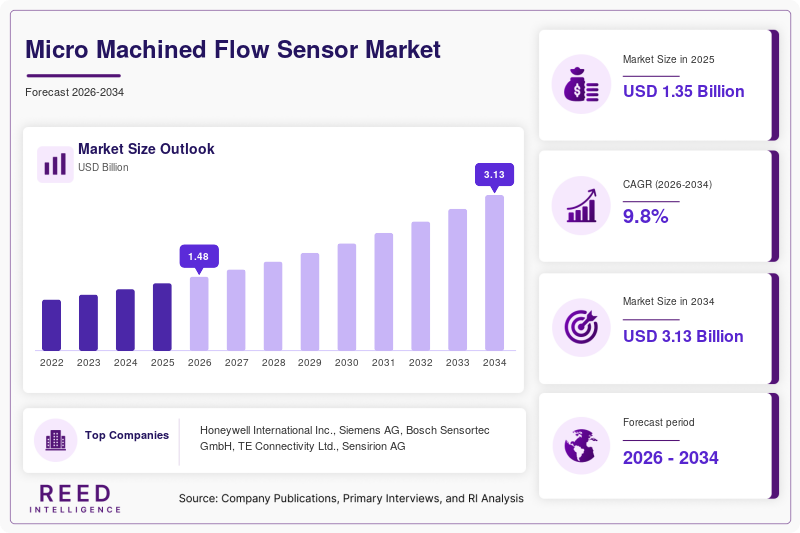
The Micro Machined Flow Sensor Market size was valued at approximately USD 1.35 billion in 2025 and is projected to reach USD 3.12 billion by 2034, expanding at a CAGR of 9.8% during the forecast period (2025–2034). The market growth is primarily driven by the increasing adoption of miniaturized sensing technologies across industrial automation, healthcare devices, and consumer electronics. These sensors, built using MEMS (Micro-Electro-Mechanical Systems) technology, offer high precision, low power consumption, and compact size, making them suitable for next-generation applications.
A major global factor supporting the expansion of the Micro Machined Flow Sensor Market is the rapid integration of smart monitoring systems across industries. As manufacturing and healthcare sectors increasingly shift toward automation and real-time data analytics, demand for accurate and responsive flow measurement solutions continues to rise. Micro machined flow sensors provide enhanced reliability and efficiency, supporting their widespread deployment.
Key Highlights
- North America dominated the market with a 34.5% share in 2025, while Asia Pacific is projected to grow at the fastest CAGR of 11.6%.
- Thermal flow sensors emerged as the leading type segment with a 41% share, whereas Coriolis micro sensors are expected to grow at a CAGR of 12.4%.
- Healthcare applications accounted for the largest share at 29%, while environmental monitoring is anticipated to expand at a CAGR of 12.1%.
- The United States remained the dominant country, valued at USD 420 million in 2025 and estimated to reach USD 455 million in 2026.
Market Trends
Integration with IoT and Smart Systems
The integration of micro machined flow sensors with IoT-enabled systems is reshaping the Micro Machined Flow Sensor Market. These sensors are increasingly embedded into connected devices to enable real-time monitoring, predictive maintenance, and process optimization. Industries such as water management and HVAC are adopting smart flow measurement systems to improve efficiency and reduce operational costs. The growing ecosystem of connected infrastructure continues to enhance the value proposition of these sensors.
Shift Toward Ultra-Low Power Consumption Designs
Manufacturers are focusing on developing ultra-low power flow sensors to meet the needs of battery-operated and portable devices. This trend is particularly relevant in wearable medical devices and remote environmental monitoring systems. Innovations in MEMS fabrication techniques and semiconductor materials are enabling sensors that maintain high accuracy while minimizing energy consumption, thereby extending device lifespan and improving performance.
Market Drivers
Rising Demand for Miniaturized Medical Devices
The increasing use of compact medical equipment such as ventilators, infusion pumps, and diagnostic devices is a key driver of the Micro Machined Flow Sensor Market. These sensors provide precise flow measurement in small form factors, which is essential for ensuring patient safety and device accuracy. The growth of home healthcare and portable medical systems further supports demand.
Expansion of Industrial Automation
The expansion of automation across manufacturing and processing industries is fueling the adoption of micro machined flow sensors. These sensors play a critical role in monitoring fluid dynamics, ensuring process efficiency, and maintaining quality control. As industries adopt Industry 4.0 practices, the need for reliable and real-time flow sensing solutions continues to grow.
Market Restraint
High Manufacturing and Calibration Costs
One of the key challenges in the Micro Machined Flow Sensor Market is the high cost associated with manufacturing and calibration. MEMS-based sensors require advanced fabrication processes and precision engineering, which increases production expenses. Additionally, calibration for specific applications can be complex and time-consuming, particularly in high-accuracy environments such as healthcare and aerospace. These cost-related barriers can limit adoption among small and medium-sized enterprises, especially in price-sensitive markets. While technological advancements are gradually reducing costs, the initial investment remains a concern for many end users.
Market Opportunities
Growth in Environmental Monitoring Applications
The rising emphasis on environmental sustainability is creating opportunities for the Micro Machined Flow Sensor Market. These sensors are increasingly used in air and water quality monitoring systems to measure flow rates accurately. Governments and organizations are investing in smart environmental monitoring infrastructure, driving demand for compact and reliable sensors.
Expansion in Electric and Autonomous Vehicles
The growing adoption of electric and autonomous vehicles presents a significant opportunity for micro machined flow sensors. These sensors are used in battery cooling systems, fuel management, and HVAC systems within vehicles. As automotive technologies evolve, the need for efficient thermal and fluid management solutions will drive the integration of advanced flow sensing technologies.
Segmental Analysis
By Type
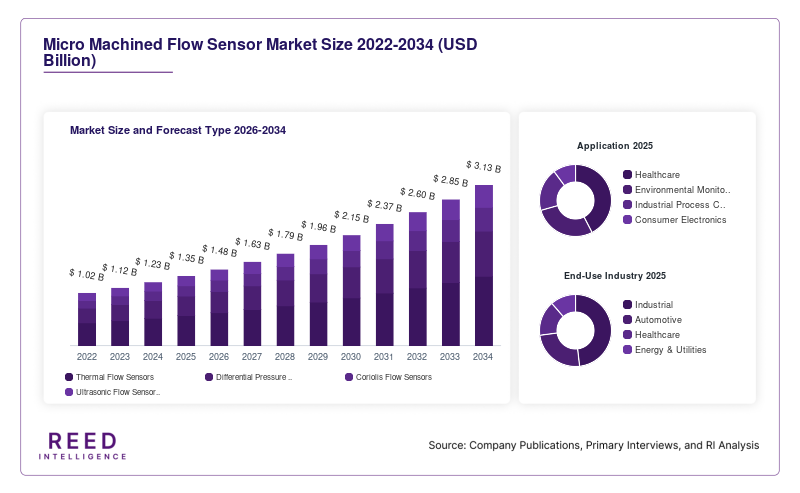
Thermal flow sensors dominated the Micro Machined Flow Sensor Market with a 41% share in 2025, owing to their high sensitivity and suitability for low flow rate measurements. These sensors are widely used in medical and environmental applications.
Coriolis micro flow sensors are expected to grow at the fastest CAGR of 12.4%, driven by their ability to provide highly accurate mass flow measurements. Their adoption will increase in high-precision industrial applications.
By Material
Silicon-based sensors held the largest share of 48% in 2025, as silicon is widely used in MEMS fabrication due to its excellent mechanical and thermal properties.
Polymer-based sensors are projected to grow at a CAGR of 11.2%, supported by their flexibility and cost-effectiveness. These sensors will gain traction in wearable and portable devices.
By Application
Healthcare applications accounted for 29% of the market share in 2025, driven by the increasing use of flow sensors in medical devices such as ventilators and infusion systems.
Environmental monitoring is anticipated to grow at a CAGR of 12.1%, fueled by rising concerns about air and water quality. Governments will increasingly adopt these sensors in monitoring systems.
By End-Use Industry
The industrial sector dominated with a 35% share in 2025, as flow sensors are essential for process control and automation.
The automotive sector is expected to grow at a CAGR of 11.5%, driven by advancements in electric vehicles and the need for efficient thermal management systems.
Regional Analysis
North America
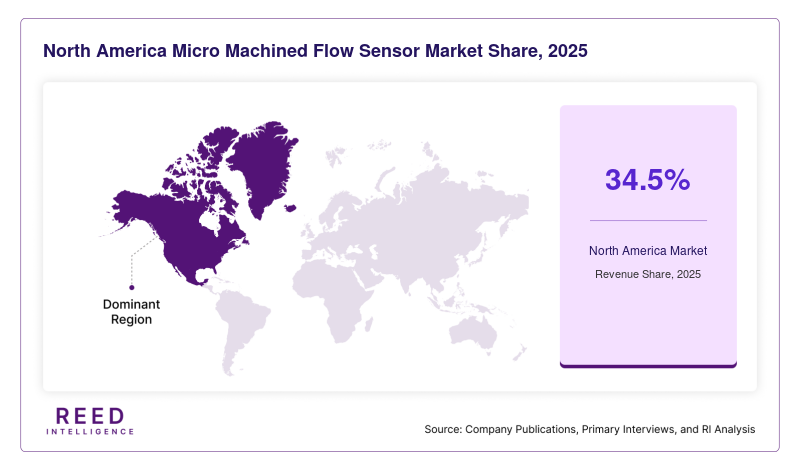
North America held a 34.5% share of the Micro Machined Flow Sensor Market in 2025 and is expected to grow at a CAGR of 8.9% during the forecast period. The region’s growth will be driven by strong adoption across healthcare, aerospace, and industrial sectors.
The United States dominated the regional market due to its advanced technological infrastructure and strong presence of sensor manufacturers. The country’s focus on innovation and early adoption of automation technologies contributed significantly to market expansion.
Europe
Europe accounted for approximately 27.2% of the market share in 2025 and is projected to grow at a CAGR of 9.1% through 2034. The region’s emphasis on energy efficiency and environmental regulations will support market growth.
Germany emerged as the dominant country, driven by its strong industrial base and focus on precision engineering. The country’s investments in smart manufacturing technologies have significantly increased demand for micro machined flow sensors.
Asia Pacific
Asia Pacific captured around 24.8% of the market in 2025 and is anticipated to register the fastest CAGR of 11.6% during the forecast period. Rapid industrialization and increasing adoption of advanced technologies will fuel growth.
China led the regional market due to its large-scale manufacturing sector and growing investments in automation. The expansion of electronics and automotive industries has significantly boosted demand for flow sensors.
Middle East & Africa
The Middle East & Africa held a 7.1% share in 2025 and is expected to grow at a CAGR of 9.5% through 2034. The region’s focus on oil & gas and water management projects will support market expansion.
Saudi Arabia dominated the market, driven by investments in infrastructure and energy projects. The country’s efforts to modernize industrial operations have increased the adoption of advanced sensing technologies.
Latin America
Latin America accounted for approximately 6.4% of the market share in 2025 and is projected to grow at a CAGR of 8.7% during the forecast period. Increasing industrial activities and modernization efforts will drive demand.
Brazil emerged as the leading country, supported by its growing manufacturing sector and investments in automation technologies. The adoption of efficient flow measurement solutions has increased across industries.
Competitive Landscape
The Micro Machined Flow Sensor Market is moderately fragmented, with key players focusing on product innovation and strategic partnerships. Leading companies are investing in advanced MEMS technologies to enhance sensor performance and reduce power consumption.
Honeywell International Inc. stands out as a market leader due to its extensive product portfolio and continuous innovation. The company recently introduced a new line of ultra-low power micro flow sensors designed for portable medical devices, strengthening its market position.
Other major players are focusing on expanding their global presence and enhancing their technological capabilities to remain competitive in the evolving market landscape.
Key Players
- Honeywell International Inc.
- Siemens AG
- Bosch Sensortec GmbH
- TE Connectivity Ltd.
- Sensirion AG
- Omron Corporation
- Analog Devices, Inc.
- NXP Semiconductors
- STMicroelectronics
- Infineon Technologies AG
- First Sensor AG
- Ametek Inc.
- All Sensors Corporation
- Fluid Components International LLC
- Bronkhorst High-Tech B.V.
Recent Developments
- In 2024, Honeywell launched a new series of compact flow sensors targeting portable healthcare devices.
- Sensirion AG expanded its manufacturing capacity to meet rising demand in Asia Pacific.
- Bosch Sensortec introduced advanced MEMS-based sensors for automotive applications.
- TE Connectivity developed high-precision flow sensors for industrial automation.
- STMicroelectronics invested in R&D to enhance low-power sensor technologies.
Micro Machined Flow Sensor Market Segments
Type
- Thermal Flow Sensors
- Differential Pressure Flow Sensors
- Coriolis Flow Sensors
- Ultrasonic Flow Sensors
Application
- Healthcare
- Environmental Monitoring
- Industrial Process Control
- Consumer Electronics
End-Use Industry
- Industrial
- Automotive
- Healthcare
- Energy & Utilities
By Region
- North America
- Europe
- APAC
- Middle East and Africa
- LATAM