Micro Winery Equipment Market Size, Share & Demand Report By Equipment Type (Fermentation Equipment, Bottling Equipment, Storage and Cooling Systems, Cleaning and Sanitization Equipment), By Winery Size (Micro Commercial Wineries, Boutique Premium Wineries, Experimental and Research Wineries), By Distribution Channel (Industrial Distributors, Online Industrial Procurement Platforms, Equipment Leasing Providers), By Region & Segment Forecasts, 2026–2034
USD 3950
Market Overview
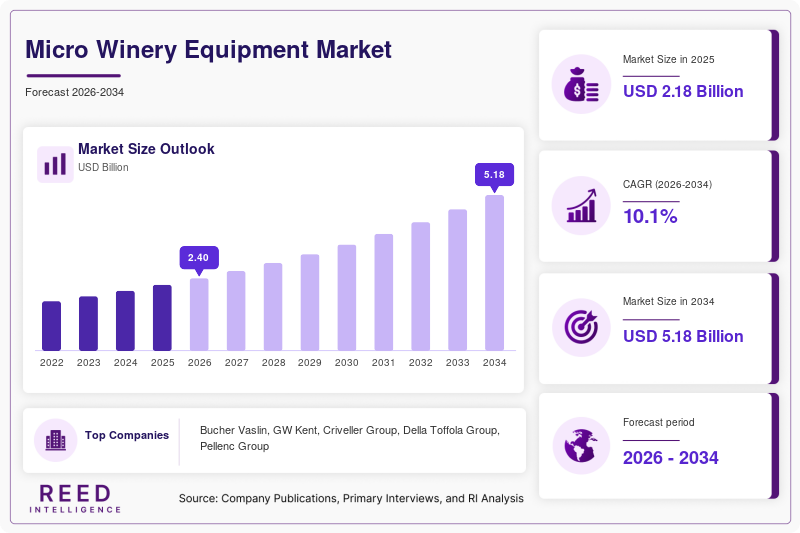
The global Micro Winery Equipment Market size was valued at USD 2.18 billion in 2026 and is projected to reach USD 4.71 billion by 2034, expanding at a CAGR of 10.1% during the forecast period from 2026 to 2034. The market is witnessing steady expansion due to the increasing number of small-scale wineries, rising consumer demand for premium wines, and growing investments in automated beverage processing systems. Micro winery equipment includes compact fermentation tanks, grape crushers, presses, filtration systems, bottling machines, and cooling technologies designed for limited-volume wine production facilities.
One of the major global factors supporting market growth is the rising popularity of artisanal and locally produced alcoholic beverages. Consumers are increasingly preferring handcrafted wines with regional flavor profiles, encouraging entrepreneurs and vineyard owners to establish boutique wineries. This trend has accelerated demand for scalable and energy-efficient winery equipment capable of improving production quality while reducing labor dependency. Manufacturers are also introducing digitally controlled fermentation systems and automated bottling technologies to enhance operational efficiency for smaller wine producers.
Key Highlights
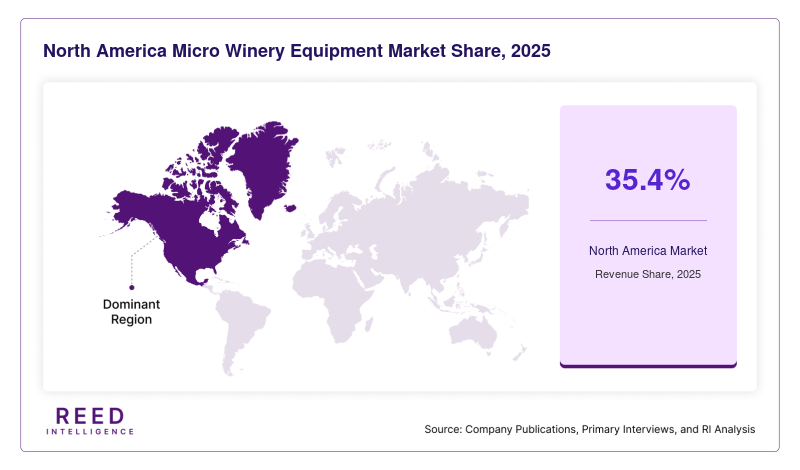
- North America dominated the market with a 35.4% share in 2025.
- Asia Pacific is expected to grow at the fastest CAGR of 11.6% during 2026–2034.
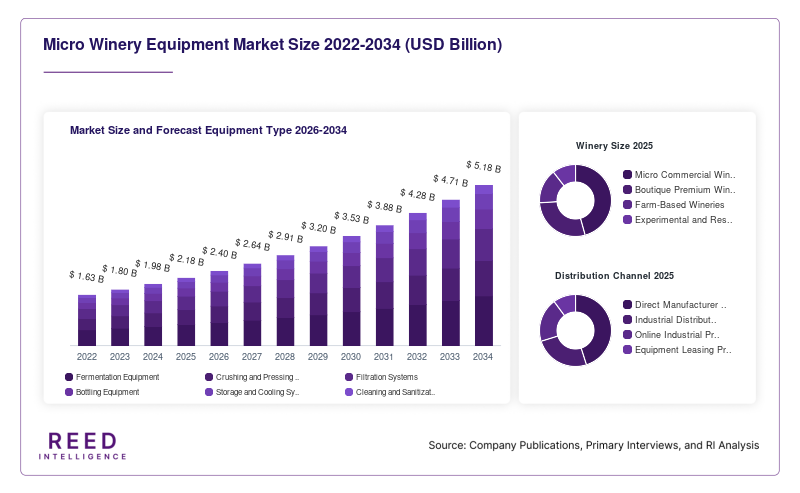
- By equipment type, fermentation equipment accounted for the largest share of 33.8%.
- while automated bottling systems are projected to grow at a CAGR of 12.3%.
- By winery size, micro commercial wineries led with a 48.7% share.
- whereas boutique premium wineries are expected to expand at a CAGR of 11.9%.
- By distribution channel, direct manufacturer sales held a 44.5% share.
- while online industrial procurement platforms are projected to grow at a CAGR of 13.1%.
- The United States remained the dominant country, with market values of USD 412 million in 2024 and USD 451 million in 2025.
Market Trends
Increasing Adoption of Smart Winery Technologies
The adoption of smart and automated technologies is becoming a significant trend across the Micro Winery Equipment Market. Small wineries are increasingly implementing sensor-enabled fermentation tanks, automated bottling systems, and digital monitoring platforms to improve wine quality and reduce production errors. Modern equipment solutions allow operators to monitor temperature, sugar concentration, and fermentation progress through cloud-connected systems, improving operational accuracy and reducing manual intervention. The growing affordability of compact automation systems is making advanced production technologies accessible to independent and family-owned wineries.
Manufacturers are introducing modular equipment systems that can be integrated into existing winery infrastructure without major facility modifications. Smart cleaning systems, automated grape sorting machinery, and digital filtration monitoring tools are helping wineries improve productivity and maintain hygiene standards. The trend is particularly strong in North America and Europe, where wineries are focused on improving efficiency while maintaining premium product quality. As consumer demand for consistent wine quality continues to increase, smart winery technologies are expected to become an essential component of small-scale wine production operations.
Rising Focus on Sustainable Wine Production Equipment
Sustainability is emerging as another major trend influencing purchasing decisions in the Micro Winery Equipment Market. Wineries are increasingly investing in energy-efficient cooling systems, low-water filtration technologies, and recyclable stainless steel processing equipment to reduce environmental impact. Consumers are associating sustainable wine production with premium quality and responsible sourcing practices, encouraging wineries to adopt environmentally friendly processing methods. This shift is driving demand for equipment designed to minimize waste generation and optimize energy usage.
Equipment manufacturers are responding by developing compact machinery with improved energy performance and lower operating costs. Solar-powered cooling systems, wastewater recycling technologies, and eco-friendly bottling solutions are gaining popularity among small wineries focused on long-term sustainability goals. European wineries are particularly active in adopting green production technologies due to stricter environmental regulations and sustainability certification requirements. Emerging wine-producing regions in Asia Pacific and Latin America are also integrating sustainable infrastructure during the early stages of winery establishment, supporting long-term demand for eco-efficient equipment systems.
Market Drivers
Expansion of Boutique and Craft Wineries
The increasing establishment of boutique and craft wineries is a major factor driving the growth of the Micro Winery Equipment Market. Consumers are showing growing interest in locally produced and premium-quality wines, encouraging entrepreneurs and agricultural businesses to enter the wine production industry. Small wineries require compact and scalable processing equipment capable of supporting flexible production volumes while maintaining product quality. This has increased demand for fermentation tanks, grape crushers, presses, and automated bottling solutions designed specifically for low-volume production facilities.
Governments in several countries are supporting rural entrepreneurship and agri-tourism initiatives, creating favorable conditions for small winery development. Financial incentives and equipment leasing programs are also improving accessibility to advanced winery machinery for independent producers. The growth of winery tourism and direct wine sales through tasting rooms has further strengthened demand for modernized production infrastructure. As premium wine consumption continues to expand globally, boutique wineries are expected to remain an important contributor to equipment market growth throughout the forecast period.
Growing Wine Consumption in Emerging Economies
Increasing wine consumption across developing economies is another important driver supporting the Micro Winery Equipment Market. Rising urbanization, changing consumer lifestyles, and higher disposable incomes are encouraging consumers in Asia Pacific, Latin America, and parts of Africa to adopt wine as a mainstream beverage choice. Younger consumers are increasingly influenced by international dining culture and premium beverage trends, creating strong demand for locally produced wines. This shift is motivating domestic producers to establish small and medium-sized wineries with modern processing capabilities.
Emerging wine markets such as China, India, Brazil, and South Africa are witnessing increasing investments in vineyard cultivation and wine production infrastructure. Compact winery equipment is particularly attractive in these regions because it offers lower capital investment requirements compared to large industrial facilities. Equipment manufacturers are also expanding regional distribution partnerships and after-sales service networks to improve product accessibility. As domestic wine industries mature and export opportunities expand, demand for technologically advanced micro winery equipment is expected to rise steadily over the coming years.
Market Restraint
High Capital Investment and Maintenance Expenses
High equipment acquisition and maintenance costs continue to restrain the growth potential of the Micro Winery Equipment Market. Although micro winery systems are smaller than industrial-scale production facilities, they still require significant investment in fermentation tanks, bottling lines, cooling technologies, and filtration systems. Small wineries and new market entrants often face financial challenges during the early stages of operation, particularly in regions with limited access to long-term industrial financing. The cost of importing advanced winery equipment from international manufacturers can further increase overall setup expenses for emerging businesses.
Maintenance requirements also create operational challenges for small winery operators with limited technical expertise. Equipment failures during harvest or fermentation periods can disrupt production schedules and negatively affect wine quality. Many wineries rely on imported machinery that requires specialized technicians and expensive replacement parts for servicing. For example, boutique wineries in developing wine-producing regions frequently experience delays in maintenance support due to limited local service networks. These financial and operational barriers can slow modernization efforts and reduce equipment adoption rates among smaller wineries operating with constrained budgets.
Market Opportunities
Growth of Wine Tourism and Hospitality Integration
The rapid expansion of wine tourism is creating strong opportunities within the Micro Winery Equipment Market. Vineyard destinations are increasingly attracting domestic and international tourists seeking premium tasting experiences, winery tours, and rural hospitality activities. Small wineries are investing in modernized production facilities that combine operational efficiency with visually attractive infrastructure capable of enhancing visitor experiences. This trend is driving demand for aesthetically designed fermentation systems, compact bottling machinery, and transparent production layouts that allow customers to observe wine-making processes directly.
Governments in several countries are promoting vineyard tourism as part of regional economic development programs, encouraging winery expansion in rural areas. Boutique wineries are also integrating event spaces, restaurants, and accommodation facilities into their operations, increasing investments in technologically advanced equipment that supports higher production consistency and presentation quality. Equipment suppliers are responding by offering customizable production systems tailored for tourism-oriented wineries. As experiential hospitality continues to influence consumer spending patterns, demand for modern micro winery infrastructure is expected to increase steadily.
Rising Demand for Organic and Specialty Wines
The increasing popularity of organic and specialty wine products is generating attractive growth opportunities for the Micro Winery Equipment Market. Consumers are becoming more selective regarding ingredient sourcing, environmental sustainability, and production transparency, leading to stronger demand for natural and clean-label wine products. Small wineries are well positioned to capitalize on this trend because they can produce limited batches with customized fermentation techniques and region-specific flavor profiles. This has increased demand for specialized processing equipment designed to maintain purity and product consistency.
Organic wine production often requires advanced temperature control, contamination prevention, and precise filtration management, encouraging wineries to invest in high-performance equipment systems. Manufacturers are introducing hygienic stainless steel fermentation tanks, low-impact filtration technologies, and digital quality monitoring systems tailored for specialty wine applications. In addition, the growing demand for low-alcohol wines, fruit-infused wines, and biodynamic products is encouraging wineries to adopt flexible processing equipment capable of handling diverse ingredients and production methods. This diversification within wine categories is expected to create long-term growth opportunities for equipment suppliers globally.
Segmental Analysis
By Equipment Type
Fermentation equipment accounted for the largest share of the Micro Winery Equipment Market in 2024, representing approximately 33.8% of total revenue. The segment includes fermentation tanks, temperature control systems, and monitoring devices that play a critical role in maintaining wine quality and flavor consistency. Stainless steel fermentation tanks remain highly preferred because of their durability, hygienic properties, and ability to support precise temperature management. Small wineries are increasingly investing in compact fermentation systems that can handle multiple wine varieties within limited production spaces. The rising popularity of organic and specialty wines has further increased demand for advanced fermentation technologies capable of reducing contamination risks and preserving natural flavor profiles.
By Winery Size
Micro commercial wineries held the dominant share of the Micro Winery Equipment Market in 2024, accounting for nearly 48.7% of overall revenue. These wineries typically serve regional retail markets, restaurants, and tourism-driven sales channels while operating with moderate production capacities. The segment benefits from growing consumer demand for regionally produced wines and customized flavor offerings. Equipment demand remains strong for scalable fermentation systems, manual presses, compact filtration units, and cost-effective bottling technologies. Many operators are also integrating digital monitoring systems to improve quality consistency and comply with food safety requirements.
By Distribution Channel
Direct manufacturer sales represented the largest share of the Micro Winery Equipment Market in 2024, contributing approximately 44.5% of total revenue. Winery operators often prefer purchasing equipment directly from manufacturers because it allows access to customized system configurations, technical support services, and maintenance agreements. Direct procurement also enables wineries to evaluate production compatibility and operational performance before installation. Equipment manufacturers benefit from long-term customer relationships that support repeat purchases and after-sales service contracts. Increasing adoption of automated and digitally connected winery systems has further strengthened the importance of direct manufacturer engagement.
Regional Analysis
North America
North America accounted for approximately 35.4% of the global Micro Winery Equipment Market in 2025 and is projected to expand at a CAGR of 9.4% during the forecast period. The region benefits from a well-established wine production industry, strong consumer demand for premium beverages, and increasing investments in craft winery operations. Small wineries across the United States and Canada are adopting advanced fermentation systems, automated bottling machinery, and energy-efficient cooling technologies to improve operational performance and product quality consistency.
The United States remained the dominant country within North America due to its large concentration of boutique wineries and vineyard tourism destinations. A unique factor supporting regional growth is the increasing popularity of direct-to-consumer wine sales through tasting rooms and subscription-based delivery services.
Europe
Europe represented nearly 29.1% of the global Micro Winery Equipment Market in 2025 and is expected to grow at a CAGR of 8.8% through 2034. The region benefits from a long-established wine culture, advanced agricultural infrastructure, and strong export demand for premium wine products. European wineries are increasingly investing in sustainable production technologies and automated processing equipment to improve operational efficiency and comply with environmental regulations. Demand for modular winery systems is also increasing among family-owned vineyards modernizing existing facilities.
Italy emerged as the dominant country within the European market because of its extensive network of small and medium-sized wineries. One distinctive growth factor driving equipment demand is the increasing adoption of sustainability certifications across regional wine producers.
Asia Pacific
Asia Pacific held approximately 20.3% of the global Micro Winery Equipment Market in 2025 and is forecast to register the fastest CAGR of 11.6% during 2026–2034. Rapid urbanization, rising disposable incomes, and changing lifestyle preferences are increasing wine consumption across several countries in the region. Local wine producers are expanding production capacities and investing in compact winery systems to meet growing domestic demand. Equipment suppliers are strengthening regional distribution channels and technical service capabilities to support expanding winery infrastructure projects.
China remained the leading country in Asia Pacific because of its growing domestic wine industry and large consumer population. A key growth factor supporting regional expansion is the increasing development of vineyard tourism destinations in rural agricultural provinces.
Middle East & Africa
The Middle East & Africa accounted for around 7.2% of the global Micro Winery Equipment Market in 2025 and is projected to expand at a CAGR of 8.5% through 2034. The regional market is gradually developing due to increasing investments in premium hospitality projects, vineyard tourism, and export-oriented wine production facilities. South Africa remains the largest contributor to regional demand, while selected Middle Eastern countries are exploring controlled-environment wine production technologies linked to luxury tourism developments.
Latin America
Latin America captured nearly 8.0% of the global Micro Winery Equipment Market in 2025 and is expected to grow at a CAGR of 9.1% during the forecast period. The region benefits from favorable climatic conditions for grape cultivation and increasing global recognition of Latin American wines. Countries such as Argentina, Chile, and Brazil are witnessing growing investments in boutique winery development and premium wine production infrastructure. Equipment demand is rising for scalable fermentation systems and compact processing technologies suitable for small-scale operations.
Competitive Landscape
The Micro Winery Equipment Market is moderately fragmented, with several regional and international manufacturers competing through automation capabilities, product quality, pricing strategies, and after-sales service networks. Companies are increasingly focusing on energy-efficient equipment, smart monitoring technologies, and modular production systems to strengthen market positioning. Partnerships with vineyard operators and tourism-oriented wineries are also becoming important competitive strategies across the industry.
Bucher Vaslin remains one of the leading participants in the market due to its extensive portfolio of grape processing, fermentation, and filtration equipment solutions tailored for boutique wineries and commercial wine producers. The company recently introduced advanced automated grape sorting technologies designed to improve production efficiency and reduce raw material losses during wine processing operations.
Key Players
- Bucher Vaslin
- GW Kent
- Criveller Group
- Della Toffola Group
- Pellenc Group
- Zambelli Enotech
- Premier Stainless Systems
- Winequip
- AEB Group
- Lejeune Stainless Steel
- Jiangsu Prettech Machinery & Technology
- Alpha Brewing Operations
- Schneider Industries
- Prospero Equipment Corporation
- Enoveneta
Recent Developments
- In February 2026, Pellenc Group introduced an advanced Smart Press system integrated with real-time weighing and juice yield monitoring, improving precision in small-batch wine production and reducing grape processing losses in boutique wineries.
- In April 2026, next-generation modular micro winery systems were launched featuring compact fermentation tanks and integrated digital control units, enabling small wineries to scale production without expanding physical infrastructure. These systems are increasingly adopted in urban winery setups.
- In 2026, several manufacturers expanded automation-focused equipment offerings in Asia Pacific through strategic distribution partnerships, strengthening access to small-scale wineries investing in modern fermentation and bottling technologies.
Micro Winery Equipment Market Segments
Equipment Type
- Fermentation Equipment
- Crushing and Pressing Equipment
- Filtration Systems
- Bottling Equipment
- Storage and Cooling Systems
- Cleaning and Sanitization Equipment
Winery Size
- Micro Commercial Wineries
- Boutique Premium Wineries
- Farm-Based Wineries
- Experimental and Research Wineries
Distribution Channel
- Direct Manufacturer Sales
- Industrial Distributors
- Online Industrial Procurement Platforms
- Equipment Leasing Providers
By Region
- North America
- Europe
- APAC
- Middle East and Africa
- LATAM