Microalgae Docosahexaenoic Acid Dha Market Size, Share & Demand Report By Form (Oil, Powder), By Application (Nutraceuticals, Infant Formula, Functional Food & Beverages, Pharmaceuticals), By Source Type (Heterotrophic Microalgae, Autotrophic Microalgae), By End-Use Industry (Food & Beverage, Pharmaceutical, Animal Nutrition), By Distribution Channel (Online, Offline) & Segment Forecasts, 2025–2034
USD 3950
Market Overview
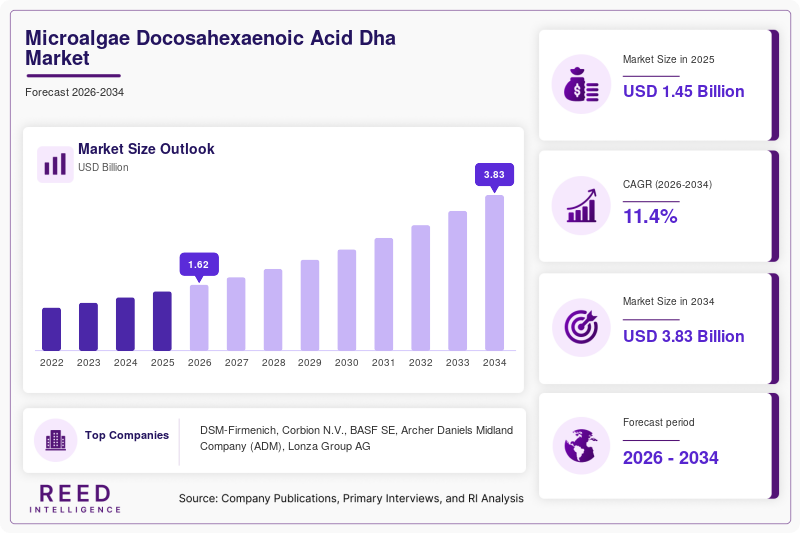
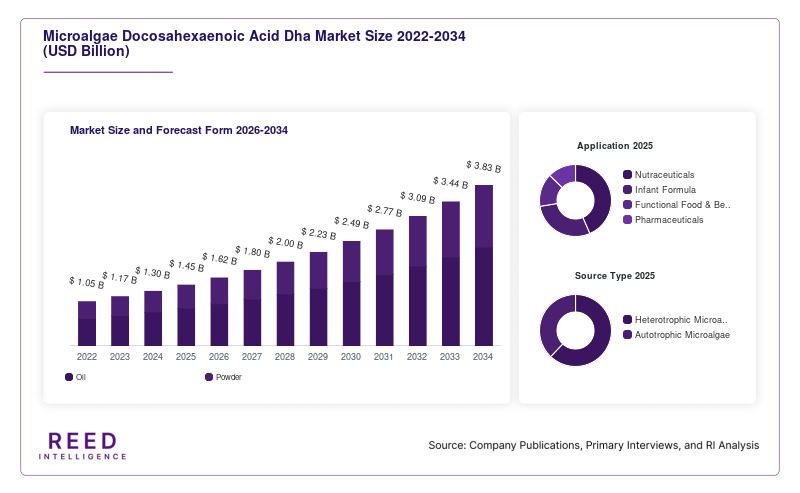
The Microalgae Docosahexaenoic Acid Dha Market size was valued at approximately USD 1.45 billion in 2025 and is projected to reach USD 3.85 billion by 2034, expanding at a CAGR of 11.4% from 2025 to 2034. The market is gaining steady traction due to increasing consumer awareness regarding plant-based omega-3 alternatives and the rising adoption of sustainable nutritional ingredients across food, pharmaceutical, and nutraceutical industries.
A key global factor supporting market growth is the shift toward sustainable and vegan sources of omega-3 fatty acids. Microalgae-derived DHA offers a renewable and environmentally friendly alternative to fish oil, reducing pressure on marine ecosystems while aligning with clean-label and plant-based product trends.
Key Highlights
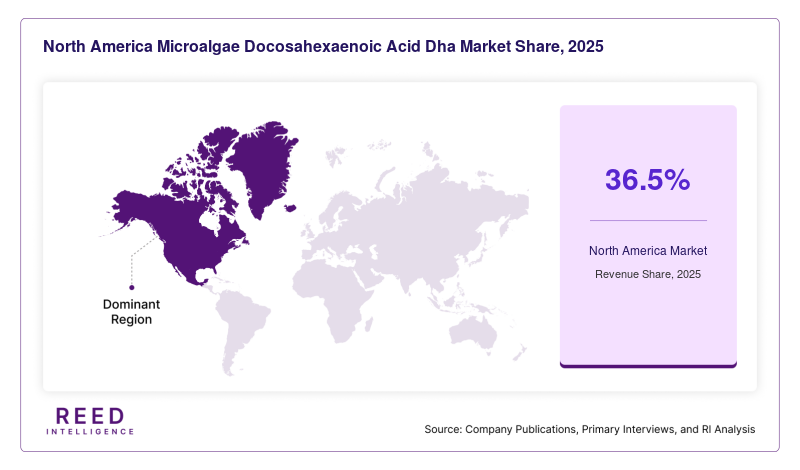
- Dominant region: North America held approximately 36.5% market share in 2025, while Asia Pacific is projected to register the fastest growth at a CAGR of 13.2%.
- Leading subsegments:
- By Form: Oil-based DHA accounted for 62% share, while Powder is expected to grow at 12.8% CAGR.
- By Application: Nutraceuticals led with 38% share, while Infant Formula is forecasted to grow at 13.5% CAGR.
- Dominant country: The United States market was valued at USD 420 million in 2025 and is expected to reach USD 455 million in 2026.
Market Trends
Rising Demand for Plant-Based Omega-3 Alternatives
The Microalgae Docosahexaenoic Acid Dha Market is witnessing a strong shift toward plant-based nutrition. Consumers are increasingly seeking alternatives to fish-derived omega-3 due to environmental concerns, dietary preferences, and allergen considerations. Microalgae DHA aligns well with vegan and vegetarian lifestyles, making it a preferred choice for supplement manufacturers and food producers. This trend is further reinforced by regulatory support for sustainable sourcing and growing demand for clean-label ingredients.
Integration into Functional Foods and Beverages
Another notable trend is the increasing use of microalgae DHA in functional foods and beverages. Manufacturers are incorporating DHA into dairy alternatives, fortified juices, and snack products to enhance nutritional value. The ability of microalgae DHA to maintain stability and bioavailability in diverse formulations has made it suitable for mass-market applications. This trend is expected to expand as consumers prioritize preventive healthcare and nutritional enrichment in daily diets.
Market Drivers
Increasing Awareness of Cognitive and Cardiovascular Health
Rising awareness regarding the health benefits of DHA, particularly for brain development and heart health, is a significant driver of the Microalgae Docosahexaenoic Acid Dha Market. Consumers are actively seeking supplements and fortified products that support cognitive performance, especially among aging populations and children. This has increased demand for high-quality DHA sources, with microalgae gaining preference due to purity and sustainability.
Expansion of Infant Nutrition Industry
The growing infant nutrition sector is another key driver. DHA is a critical component in infant formula for supporting neural and visual development. Regulatory mandates in several countries requiring DHA fortification in infant formulas have accelerated demand. Microalgae-derived DHA is particularly favored due to its safety profile and controlled production environment, ensuring consistent quality.
Market Restraint
High Production and Processing Costs
One of the primary challenges in the Microalgae Docosahexaenoic Acid Dha Market is the relatively high cost of production. Cultivation, harvesting, and extraction of microalgae require advanced technologies and controlled environments, leading to increased operational expenses. Compared to traditional fish oil-based DHA, microalgae-derived DHA often carries a price premium, which can limit its adoption in cost-sensitive markets. Additionally, scaling production while maintaining quality remains a technical challenge for manufacturers, further impacting pricing dynamics.
Market Opportunities
Growth in Vegan and Plant-Based Product Segment
The expanding vegan population presents a major opportunity for the Microalgae Docosahexaenoic Acid Dha Market. As consumers shift toward plant-based diets, the demand for non-animal omega-3 sources is expected to increase significantly. This trend opens avenues for product innovation in supplements, functional foods, and beverages, enabling manufacturers to capture new consumer segments.
Technological Advancements in Algae Cultivation
Advancements in photobioreactor systems and fermentation technologies are creating opportunities to improve production efficiency. These innovations are expected to reduce costs and enhance scalability, making microalgae DHA more competitive with traditional sources. Companies investing in research and development are likely to benefit from improved yields and expanded application areas.
Segmental Analysis
By Form
The oil segment dominated the Microalgae Docosahexaenoic Acid Dha Market, accounting for approximately 62% share in 2025. Its widespread use in dietary supplements and infant formula contributed to its leading position due to high bioavailability and ease of incorporation.
The powder segment is expected to grow at a CAGR of 12.8% during the forecast period. Its extended shelf life and suitability for dry formulations will drive adoption in functional foods and beverages.
By Application
Nutraceuticals represented the largest application segment, holding about 38% share in 2025. The segment benefited from increasing consumer preference for preventive healthcare products.
Infant formula is projected to grow at a CAGR of 13.5%, driven by regulatory requirements and rising demand for enhanced nutrition products.
By Source Type
Heterotrophic microalgae accounted for the dominant share of 55% in 2025, supported by efficient large-scale production capabilities.
Autotrophic microalgae are expected to grow at a CAGR of 12.2%, driven by advancements in photobioreactor technologies and sustainability advantages.
By End-Use Industry
The food & beverage industry held a dominant share of 34% in 2025, as manufacturers increasingly incorporated DHA into functional products.
The pharmaceutical segment is projected to grow at a CAGR of 11.9%, supported by increasing research into DHA-based therapeutic applications.
By Distribution Channel
Offline channels accounted for 68% share in 2025, driven by established retail networks and consumer trust in physical stores.
Online channels are expected to grow at a CAGR of 14.1%, fueled by the expansion of e-commerce platforms and direct-to-consumer strategies.
Regional Analysis
North America
North America accounted for approximately 36.5% of the Microalgae Docosahexaenoic Acid Dha Market share in 2025 and is expected to grow at a CAGR of 10.8% through 2034. The region’s established nutraceutical industry and strong consumer awareness supported its dominant position.
The United States led the regional market due to high demand for dietary supplements and fortified foods. The presence of advanced manufacturing infrastructure and a strong focus on plant-based nutrition contributed to sustained growth.
Europe
Europe held around 27.8% market share in 2025 and will likely expand at a CAGR of 10.5% during the forecast period. The region benefited from stringent regulations promoting sustainable and traceable ingredient sourcing.
Germany emerged as the dominant country, driven by increasing demand for organic and clean-label products. The country’s strong food processing industry facilitated the integration of microalgae DHA into various applications.
Asia Pacific
Asia Pacific captured approximately 22.4% share in 2025 and is projected to grow at the fastest CAGR of 13.2%. Rapid urbanization and rising disposable income supported market expansion.
China dominated the region due to its large population and growing infant nutrition sector. Increasing investments in biotechnology and algae cultivation also contributed to market growth.
Middle East & Africa
The Middle East & Africa accounted for about 6.2% of the market share in 2025 and is expected to grow at a CAGR of 9.6%. The region’s growth was supported by increasing awareness of nutritional supplements.
The United Arab Emirates led the market due to rising health-conscious consumer behavior and expanding retail distribution networks.
Latin America
Latin America held nearly 7.1% share in 2025 and is forecasted to grow at a CAGR of 10.1%. The region’s growth was driven by expanding food and beverage industries.
Brazil dominated the regional market, supported by increasing demand for fortified food products and dietary supplements.
Competitive Landscape
The Microalgae Docosahexaenoic Acid Dha Market is moderately consolidated, with key players focusing on product innovation, partnerships, and capacity expansion. Leading companies are investing in advanced cultivation technologies to enhance production efficiency and reduce costs.
DSM-Firmenich is a prominent market leader, known for its strong portfolio of algae-based nutritional ingredients. The company recently expanded its production capacity to meet rising global demand for sustainable omega-3 solutions.
Other major players are strengthening their market presence through strategic collaborations and product launches targeting functional foods and nutraceutical applications. Continuous investment in research and development remains a key competitive strategy in this evolving market.
Key Players
- DSM-Firmenich
- Corbion N.V.
- BASF SE
- ADM (Archer Daniels Midland Company)
- Lonza Group
- Cellana Inc.
- Algaetech International
- Qualitas Health
- Cyanotech Corporation
- Polaris S.A.
- AlgaeCytes Limited
- Algisys LLC
- Martek Biosciences (part of DSM)
- Heliae Development LLC
- Roquette Frères
Recent Developments
- DSM-Firmenich expanded its algae-based DHA production capacity to support global demand.
- Corbion introduced a new high-concentration DHA ingredient for infant nutrition.
- ADM invested in fermentation technology to improve microalgae yield efficiency.
- BASF launched a new plant-based omega-3 product line targeting functional foods.
- Qualitas Health expanded its product portfolio with clean-label DHA solutions.
Microalgae Docosahexaenoic Acid Dha Market Segments
Form
- Oil
- Powder
Application
- Nutraceuticals
- Infant Formula
- Functional Food & Beverages
- Pharmaceuticals
Source Type
- Heterotrophic Microalgae
- Autotrophic Microalgae
End-Use Industry
- Food & Beverage
- Pharmaceutical
- Animal Nutrition
Distribution Channel
- Offline Retail
- Online Retail
By Region
- North America
- Europe
- APAC
- Middle East and Africa
- LATAM