Microalgae in Feed Market Size, Share Demand Report By Type (Spirulina, Chlorella, Dunaliella, Others), By Application (Aquaculture, Poultry Feed, Livestock Feed, Others), By End-Use (Livestock, Aquaculture, Pet Food) & Segment Forecasts, 2026–2034
USD 3950
Market Overview
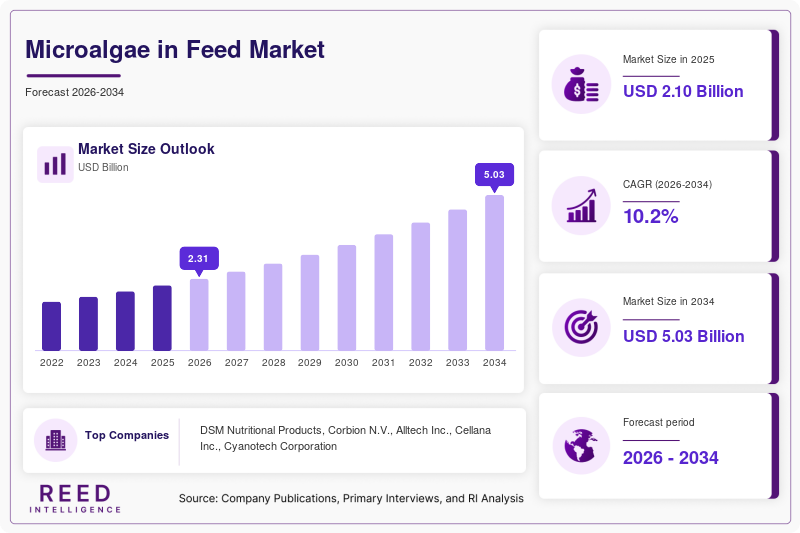
The global Microalgae in Feed Market was valued at approximately USD 2.1 billion in 2026 and is projected to reach USD 4.6 billion by 2034, expanding at a CAGR of 10.2% during the forecast period (2026–2034). The market is experiencing steady growth due to the rising demand for sustainable and nutrient-rich feed ingredients across livestock, aquaculture, and poultry industries. Microalgae offer a rich source of proteins, omega-3 fatty acids, vitamins, and antioxidants, making them an increasingly preferred alternative to traditional feed additives.
One key global factor supporting market growth is the increasing pressure on the feed industry to adopt environmentally sustainable practices. Conventional feed sources such as fishmeal and soybean meal face supply constraints and environmental concerns, prompting producers to explore alternatives like microalgae. The ability of microalgae to be cultivated with minimal land and water resources further strengthens its adoption, especially in regions facing agricultural limitations.
Key Highlights
- North America dominated the market with a 33.8% share in 2025.
- Asia Pacific is expected to grow at the fastest CAGR of 11.5% during 2026–2034.
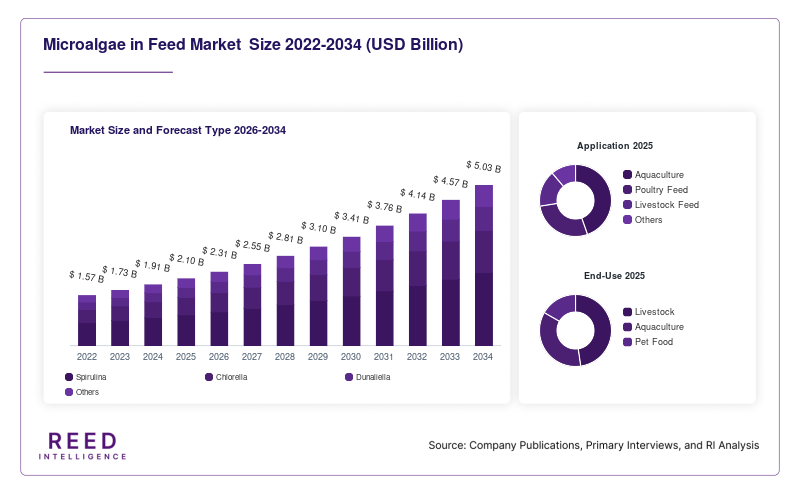
- By type, Spirulina accounted for the largest share of 39.6%.
- while Chlorella is projected to grow at a CAGR of 11.8%.
- By application, aquaculture led with a 42.3% share, whereas poultry feed is expected to expand at a CAGR of 10.9%.
- The United States remained the dominant country, with market values of USD 520 million in 2024 and USD 575 million in 2025.
Market Trends
Increasing Integration of Functional Feed Ingredients
The integration of functional ingredients into animal feed formulations is gaining traction, and microalgae are becoming a central component of this shift. Feed producers are increasingly focusing on improving animal health, immunity, and productivity through nutrition. Microalgae, being rich in bioactive compounds such as carotenoids, polysaccharides, and omega-3 fatty acids, are being incorporated into feed to enhance growth rates and disease resistance. This trend is particularly prominent in aquaculture, where microalgae-based feed contributes to improved fish coloration and nutritional value. Additionally, consumer demand for high-quality animal products is influencing feed manufacturers to adopt premium ingredients. This is driving continuous innovation in microalgae processing and formulation techniques.
Expansion of Commercial-Scale Microalgae Cultivation
The market is witnessing a shift toward large-scale commercial cultivation of microalgae to meet growing demand. Companies are investing in advanced cultivation systems such as closed-loop photobioreactors to ensure consistent quality and higher yields. These systems enable better control over environmental conditions, resulting in improved biomass productivity. Moreover, strategic collaborations between biotechnology firms and feed manufacturers are accelerating the scaling of production capacities. Governments in several regions are also supporting algae-based projects through funding and policy initiatives. This trend is expected to reduce production costs over time and enhance the accessibility of microalgae-based feed products across emerging markets.
Market Drivers
Rising Demand for Sustainable Feed Alternatives
The growing awareness of environmental sustainability is a major driver of the microalgae in feed market. Traditional feed ingredients, such as fishmeal, are associated with overfishing and ecological degradation. Similarly, soybean cultivation contributes to deforestation and greenhouse gas emissions. Microalgae provide a viable alternative as they can be cultivated using non-arable land and require fewer natural resources. Their ability to absorb carbon dioxide during growth further adds to their environmental benefits. As regulatory frameworks tighten around sustainability, feed manufacturers are increasingly shifting toward algae-based ingredients. This transition is particularly evident in developed regions where environmental compliance is a key business requirement.
Increasing Demand from Aquaculture Industry
The rapid expansion of the global aquaculture industry is significantly driving the demand for microalgae-based feed. Aquaculture relies heavily on high-quality feed to ensure optimal growth and health of aquatic species. Microalgae serve as a natural and efficient feed source for fish and shrimp due to their high nutritional content. They also improve feed conversion ratios and enhance the quality of end products. With the rising global consumption of seafood, aquaculture production is expected to increase, thereby boosting the demand for microalgae. Furthermore, the shift toward antibiotic-free feed solutions is encouraging the adoption of natural ingredients like microalgae.
Market Restraint
High Production Costs and Scalability Challenges
Despite its potential, the microalgae in feed market faces challenges related to high production costs and scalability. Cultivation of microalgae requires specialized infrastructure, including controlled environments, advanced lighting systems, and efficient harvesting techniques. These factors contribute to higher operational costs compared to conventional feed ingredients. Additionally, maintaining consistent quality and yield at a large scale remains a significant challenge for producers. Variations in environmental conditions can affect the growth rate and composition of microalgae, leading to inconsistencies in feed quality.
The high initial investment required for setting up cultivation facilities can also act as a barrier for new entrants. Small and medium-sized enterprises often find it difficult to compete with established players due to limited financial resources. For example, in emerging markets, the lack of technical expertise and infrastructure further restricts market growth. Although ongoing research and technological advancements are expected to address these challenges, cost competitiveness remains a key concern for widespread adoption.
Market Opportunities
Development of Customized Feed Solutions
The growing demand for species-specific and performance-enhancing feed solutions presents a significant opportunity for the microalgae in feed market. Feed manufacturers are increasingly focusing on developing customized formulations tailored to the nutritional requirements of different animal species. Microalgae offer flexibility in formulation due to their diverse nutrient profile, enabling producers to create targeted solutions for aquaculture, poultry, and livestock. This approach not only improves animal health and productivity but also enhances feed efficiency. The adoption of precision nutrition strategies is expected to drive innovation in microalgae-based feed products, creating new growth avenues for market players.
Expansion in Emerging Economies
Emerging economies in Asia Pacific, Latin America, and Africa offer substantial growth opportunities for the market. These regions are witnessing rapid growth in livestock and aquaculture production, driven by increasing population and rising protein consumption. Governments are also promoting sustainable agricultural practices, which aligns with the adoption of microalgae-based feed. Additionally, the availability of favorable climatic conditions in these regions supports cost-effective microalgae cultivation. Investments in infrastructure and technological advancements are further expected to enhance production capabilities. As awareness of the benefits of microalgae increases, market penetration in these regions is likely to expand significantly.
Segmental Analysis
By Type
Spirulina emerged as the dominant subsegment, accounting for a 39.6% share in 2024. Its high protein content and rich nutritional profile make it a preferred choice for feed manufacturers. Spirulina is widely used in aquaculture and poultry feed due to its ability to enhance growth performance and improve immunity. The availability of established cultivation techniques and relatively lower production costs further contribute to its dominance. Additionally, its application in improving pigmentation in fish and poultry products has increased its demand across various regions.
Chlorella is expected to be the fastest-growing subsegment, with a CAGR of 11.8% during the forecast period. The growth is driven by its high content of essential amino acids and vitamins. Chlorella is increasingly being used in specialized feed formulations aimed at improving animal health and productivity. Advances in cultivation technologies are making its production more cost-effective, further supporting its adoption.
By Application
Aquaculture held the largest share of 42.3% in 2024. The segment’s dominance is attributed to the extensive use of microalgae as a natural feed source for fish and shrimp. Microalgae provide essential nutrients that enhance growth rates and improve the quality of aquatic products. The increasing demand for seafood and the expansion of aquaculture activities are key factors driving this segment.
Poultry feed is expected to grow at the fastest CAGR of 10.9%. The rising demand for high-quality poultry products is encouraging the adoption of microalgae-based feed. Microalgae improve feed efficiency and enhance the nutritional value of poultry products. Additionally, the shift toward antibiotic-free feed solutions is further boosting demand in this segment.
By End-Use
The livestock segment accounted for the largest share in 2024, driven by the widespread use of microalgae in cattle and swine feed. Microalgae help improve digestion, enhance nutrient absorption, and support overall animal health. The growing demand for high-quality meat and dairy products is further driving the adoption of microalgae in livestock feed.
The pet food segment is expected to witness the fastest growth during the forecast period, with a CAGR exceeding 11%. Increasing consumer awareness regarding pet nutrition is driving the demand for premium feed products. Microalgae are being incorporated into pet food formulations due to their health benefits, including improved skin and coat health.
Regional Analysis
North America
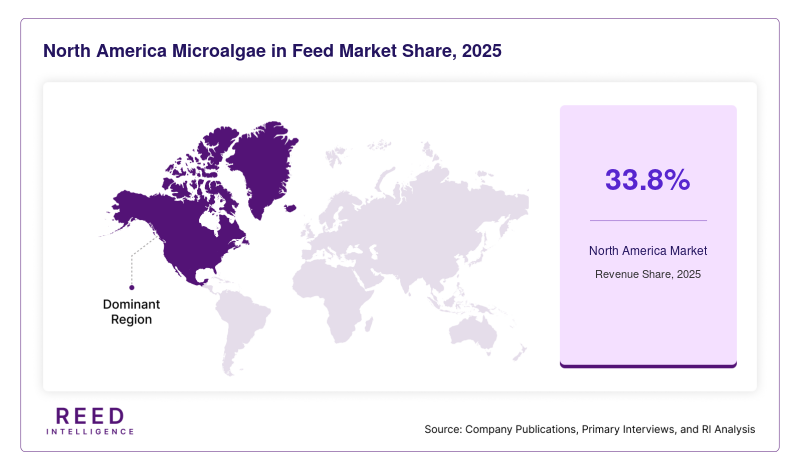
North America accounted for a significant share of 33.8% in 2025 and is expected to grow at a CAGR of 9.8% during the forecast period. The region benefits from advanced feed manufacturing infrastructure and strong adoption of innovative feed ingredients. Increasing consumer awareness regarding sustainable animal products is encouraging producers to incorporate microalgae into feed formulations. Regulatory support and investment in research and development further strengthen the market outlook.
The United States dominates the regional market due to its well-established aquaculture and livestock industries. A key growth factor is the presence of leading biotechnology firms focusing on algae-based innovations. Additionally, government funding for sustainable agriculture initiatives is promoting the adoption of microalgae in feed applications.
Europe
Europe held a market share of 27.4% in 2025 and is projected to expand at a CAGR of 9.5% through 2034. The region’s stringent environmental regulations are driving the demand for sustainable feed alternatives. Feed producers are increasingly adopting microalgae to meet regulatory requirements and reduce environmental impact. The growing trend of organic farming is also supporting market growth.
Germany leads the European market due to its strong focus on sustainable agriculture and advanced research capabilities. A unique growth factor is the increasing collaboration between research institutions and feed manufacturers to develop innovative algae-based products. This is enhancing the overall market ecosystem.
Asia Pacific
Asia Pacific is expected to witness the fastest growth, with a CAGR of 11.5% during the forecast period. The region’s large population and rising demand for animal protein are driving the expansion of the feed industry. Increasing investments in aquaculture and poultry farming are further boosting demand for high-quality feed ingredients such as microalgae.
China dominates the regional market due to its extensive aquaculture industry. A key growth factor is the availability of favorable climatic conditions for large-scale microalgae cultivation. Government initiatives supporting sustainable farming practices are also contributing to market growth.
Middle East & Africa
The Middle East & Africa region accounted for a smaller share of 6.8% in 2025 but is expected to grow at a CAGR of 8.9%. The region is gradually adopting microalgae-based feed due to increasing awareness of sustainable agriculture practices. Limited availability of traditional feed resources is encouraging the exploration of alternative solutions.
South Africa leads the regional market due to its growing livestock sector. A unique growth factor is the increasing focus on reducing dependency on imported feed ingredients. This is driving investments in local microalgae production facilities.
Latin America
Latin America held a market share of 9.6% in 2025 and is projected to grow at a CAGR of 10.1%. The region’s strong agricultural base and expanding livestock industry are key drivers of market growth. Increasing adoption of advanced feed technologies is also contributing to the demand for microalgae.
Brazil dominates the market due to its large-scale livestock production. A key growth factor is the rising demand for high-quality animal products for export markets. This is encouraging producers to adopt nutrient-rich feed ingredients such as microalgae.
Competitive Landscape
The microalgae in feed market is moderately fragmented, with several key players focusing on innovation and strategic partnerships to strengthen their market position. Companies are investing in research and development to improve cultivation efficiency and reduce production costs. Strategic collaborations between feed manufacturers and biotechnology firms are also becoming increasingly common.
One of the leading players in the market is DSM Nutritional Products, known for its strong portfolio of algae-based solutions. The company has recently expanded its production capacity to meet growing demand. Other major players are focusing on product diversification and geographic expansion to enhance their market presence. The competitive landscape is characterized by continuous innovation, with companies striving to develop cost-effective and high-quality microalgae-based feed products.
Key Players List
- DSM Nutritional Products
- Corbion N.V.
- Alltech Inc.
- Cellana Inc.
- Cyanotech Corporation
- AlgaEnergy S.A.
- Roquette Frères
- Archer Daniels Midland Company
- DIC Corporation
- BASF SE
- Algatech Ltd.
- Phycom B.V.
- E.I.D. Parry Limited
- TerraVia Holdings Inc.
- Solazyme Inc.
Recent Developments
- In 2025, a leading market player expanded its microalgae production facility to enhance output capacity and meet rising global demand.
- In 2024, a strategic partnership between a biotechnology firm and a feed manufacturer led to the development of advanced algae-based feed formulations.
- In 2026, a new cultivation technology was introduced, significantly reducing production costs and improving scalability.
Microalgae in Feed Market Segments
Type
- Spirulina
- Chlorella
- Dunaliella
- Others
Application
- Aquaculture
- Poultry Feed
- Livestock Feed
- Others
End-Use
- Livestock
- Aquaculture
- Pet Food
By Region
- North America
- Europe
- APAC
- Middle East and Africa
- LATAM