Microbial Bacterial Cellulose Market Size, Share Demand Report By Application (Food and Beverage Ingredients, Biomedical Materials, Cosmetics and Personal Care, Advanced Materials), By Product Form (Hydrogel Bacterial Cellulose, Nanofibrillated Bacterial Cellulose, Powdered Cellulose), By End-Use Industry (Food Industry, Healthcare and Medical Devices, Cosmetics Industry, Packaging and Materials), By Region & Segment Forecasts, 2025–2034
USD 3950
Market Overview
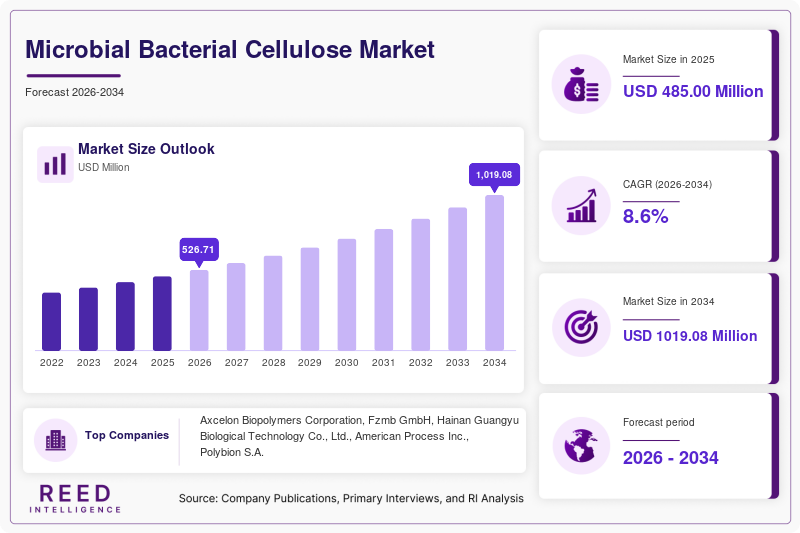
The Microbial Bacterial Cellulose Market size was valued at approximately USD 485 million in 2024 and is projected to reach around USD 1.02 billion by 2033, expanding at a compound annual growth rate (CAGR) of 8.6% from 2025 to 2034. Microbial bacterial cellulose (MBC) is a naturally derived polymer produced by certain bacteria through fermentation processes. Unlike plant-based cellulose, bacterial cellulose offers a highly pure nanofiber structure, strong mechanical properties, and high water retention capacity. These characteristics make it suitable for applications in biomedical materials, food products, cosmetics, and advanced functional materials.
Microbial bacterial cellulose has gained increasing attention across industries due to its biodegradability and compatibility with biological systems. It is widely used in wound dressings, tissue engineering scaffolds, cosmetic formulations, and specialty food ingredients. The material’s unique structural characteristics allow it to form flexible and durable membranes, which makes it useful for high-value applications requiring biocompatible materials.
Key Highlights
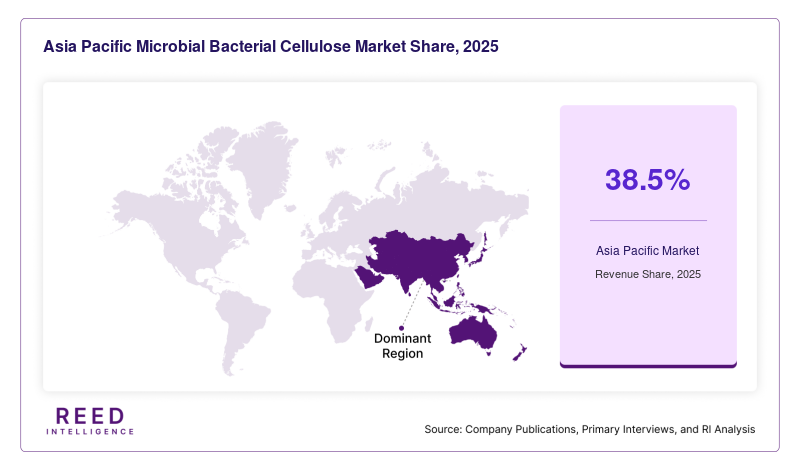
- Asia Pacific dominated the Microbial Bacterial Cellulose Market with a 38.5% share in 2025, while North America is projected to record the fastest CAGR of 9.3% through 2034.
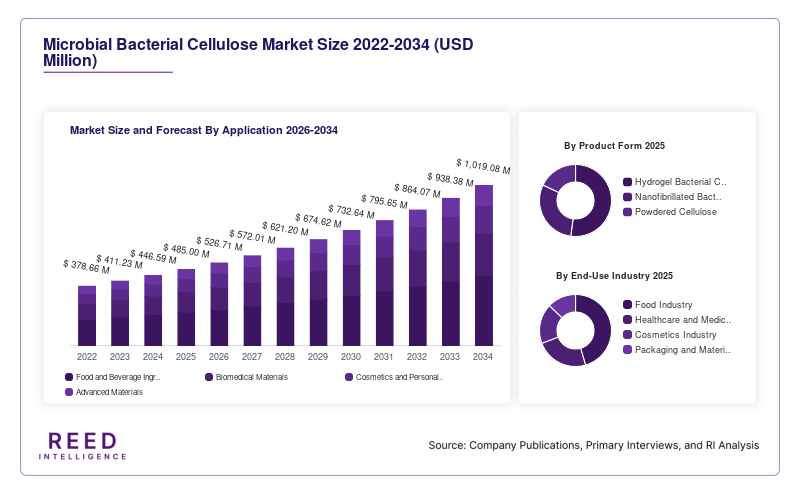
- By application, food and beverage ingredients accounted for 34.2% of the market in 2024, while biomedical materials are projected to grow at a CAGR of 10.1%.
- By product form, hydrogel bacterial cellulose held 46.7% of the market share in 2024, whereas nanofibrillated cellulose will expand at a CAGR of 9.4%.
- China represented the dominant country market, with an estimated USD 92 million in 2024, increasing to approximately USD 98 million in 2025.
Market Trends
Growing Use in Biomedical and Healthcare Applications
One significant trend shaping the Microbial Bacterial Cellulose Market is the expanding use of bacterial cellulose in biomedical applications. The material’s high biocompatibility, flexibility, and moisture retention capabilities make it suitable for wound dressings, artificial skin substitutes, and tissue engineering scaffolds. Medical researchers have explored microbial cellulose as a scaffold material for regenerative medicine due to its structural similarity to extracellular matrices.
Hospitals and healthcare providers increasingly adopt advanced wound care materials that support faster healing and reduce infection risk. Microbial bacterial cellulose membranes can maintain a moist environment around wounds while providing mechanical protection. These characteristics have led to increasing adoption of bacterial cellulose-based medical products.
Expansion of Fermentation-Based Manufacturing Technologies
Another trend influencing the Microbial Bacterial Cellulose Market is the advancement of fermentation technologies used to produce bacterial cellulose. Manufacturers are optimizing fermentation processes to increase production efficiency and reduce manufacturing costs. New fermentation methods use controlled microbial cultures that generate cellulose fibers with consistent structural properties.
These production improvements allow companies to scale bacterial cellulose manufacturing for industrial applications. As fermentation technology continues to evolve, manufacturers are able to supply larger volumes of microbial cellulose for applications in food processing, cosmetics, and advanced materials.
Market Drivers
Rising Demand for Bio-Based and Sustainable Materials
A major driver supporting the Microbial Bacterial Cellulose Market is the increasing demand for bio-based materials that can replace synthetic polymers. Governments, industries, and consumers are increasingly focused on reducing environmental impact and promoting sustainable production practices.
Microbial bacterial cellulose is produced through natural fermentation processes and does not require extensive chemical processing. The material is biodegradable and can be produced using renewable feedstocks such as sugars derived from agricultural sources. As companies seek environmentally responsible alternatives for packaging, biomedical materials, and consumer products, bacterial cellulose is gaining attention as a viable material option.
Expanding Applications in the Food Industry
Another important driver is the expanding use of bacterial cellulose in food and beverage products. In certain regions, microbial cellulose is used as a food ingredient due to its texture-modifying properties and ability to retain moisture.
Food manufacturers incorporate bacterial cellulose into specialty desserts, beverages, and plant-based food products. Its ability to provide a unique texture without altering flavor profiles has supported its use in innovative food formulations. As food producers explore new ingredients that enhance product quality, demand for microbial cellulose is expected to increase.
Market Restraint
High Production Costs and Process Complexity
One of the primary restraints affecting the Microbial Bacterial Cellulose Market is the relatively high cost associated with production. Bacterial cellulose manufacturing involves controlled fermentation processes that require specialized equipment, microbial culture management, and quality monitoring.
Compared with plant-derived cellulose, microbial cellulose production can be more expensive due to longer production cycles and higher operational requirements. These cost factors may limit large-scale adoption in certain industrial applications where lower-cost materials are available.
In addition, scaling fermentation-based production to meet industrial demand requires significant capital investment. Manufacturers must maintain precise environmental conditions during fermentation to ensure consistent product quality. These operational challenges may slow market expansion in cost-sensitive industries.
Market Opportunities
Development of Advanced Biomedical Materials
An emerging opportunity within the Microbial Bacterial Cellulose Market is the development of advanced biomedical materials. Researchers are exploring bacterial cellulose for use in artificial organs, implantable devices, and drug delivery systems.
The material’s nanofiber network structure provides strong mechanical properties while maintaining flexibility and biocompatibility. These features allow bacterial cellulose to support cell growth and tissue regeneration. Continued innovation in biomedical engineering could expand the role of microbial cellulose in medical devices and regenerative therapies.
Increasing Adoption in Sustainable Packaging
Another opportunity lies in the use of microbial bacterial cellulose in sustainable packaging solutions. Many companies are exploring biodegradable packaging materials as alternatives to plastic-based products.
Bacterial cellulose films can provide barrier properties suitable for certain packaging applications. These materials can be engineered to create flexible, compostable packaging films for food and consumer goods. As sustainability initiatives influence packaging innovation, microbial cellulose-based materials could gain greater adoption.
Segmental Analysis
By Application
Food and beverage ingredients accounted for the largest share of the Microbial Bacterial Cellulose Market in 2024, representing 34.2% of total market demand. Bacterial cellulose is used in certain specialty foods due to its unique texture and water retention properties. Food manufacturers use the material to improve mouthfeel and structural stability in beverages, desserts, and plant-based foods. The versatility of microbial cellulose as a food ingredient contributed to the dominance of this segment.
Biomedical materials will represent the fastest-growing application segment, expanding at a CAGR of 10.1% through 2034. The biocompatibility and mechanical strength of bacterial cellulose make it suitable for wound care products, tissue scaffolds, and medical implants. As research into regenerative medicine advances, the adoption of bacterial cellulose-based biomedical products is expected to increase.
By Product Form
Hydrogel bacterial cellulose represented the largest product form segment in 2024, accounting for 46.7% of the Microbial Bacterial Cellulose Market share. Hydrogel forms of bacterial cellulose are widely used in wound dressings, cosmetic masks, and specialty food products due to their ability to retain large amounts of water. The hydrogel structure allows the material to maintain flexibility while providing a protective barrier.
Nanofibrillated bacterial cellulose will represent the fastest-growing segment, with a projected CAGR of 9.4% during the forecast period. Nanofibrillated cellulose consists of nanoscale fibers that provide strong mechanical properties and large surface area. These materials are being explored for use in advanced composites, filtration systems, and biomedical devices. The development of nanotechnology applications is expected to increase demand for this product form.
By End-Use Industry
The food industry accounted for the largest share of the Microbial Bacterial Cellulose Market in 2024, representing 39.1% of total demand. Food manufacturers utilize bacterial cellulose as a texturizing agent and moisture stabilizer in specialty food formulations. Its ability to maintain structural integrity without altering flavor characteristics supports its use in various food products.
The healthcare and medical devices industry will represent the fastest-growing end-use segment, expanding at a CAGR of 9.8% during the forecast period. Healthcare providers and medical manufacturers are increasingly adopting advanced biomaterials that support wound healing and tissue regeneration. Bacterial cellulose membranes can provide structural support while maintaining moisture levels in wound care applications. As healthcare innovation continues, demand from the medical sector is expected to grow.
Regional Analysis
Asia Pacific
Asia Pacific accounted for 38.5% of the Microbial Bacterial Cellulose Market share in 2025 and represented the largest regional market. The region will grow at a CAGR of 8.7% from 2025 to 2034. The presence of established biotechnology research institutions and fermentation-based manufacturing industries contributed to the region’s market leadership. Additionally, several countries in Asia have incorporated microbial cellulose into traditional food products, supporting local demand.
China represented the dominant national market within Asia Pacific. The country maintains a strong biotechnology sector and a large food processing industry that utilizes microbial cellulose as a specialty ingredient. Chinese manufacturers have invested in fermentation technologies capable of producing bacterial cellulose at commercial scale. The availability of raw materials and growing biotechnology infrastructure have supported the development of the Microbial Bacterial Cellulose Market in China.
North America
North America held 24.3% of the Microbial Bacterial Cellulose Market share in 2025 and will expand at a CAGR of 9.3% during the forecast period. Growth in the region has been supported by the presence of biotechnology companies, advanced research institutions, and healthcare innovation hubs.
The United States represented the leading national market in North America. The country has an active biotechnology research environment that supports the development of novel biomaterials. Academic institutions and biotechnology firms conduct research into bacterial cellulose applications in wound care products and medical materials. These activities contribute to increasing demand for microbial cellulose in the U.S. market.
Europe
Europe accounted for 20.8% of the Microbial Bacterial Cellulose Market share in 2025 and will grow at a CAGR of 8.1% over the forecast period. The region’s focus on sustainability and bio-based materials has encouraged the development of microbial cellulose applications in packaging and consumer goods.
Germany represented the dominant national market in Europe. The country maintains a strong industrial biotechnology sector that supports the development of fermentation-based materials. German research institutions have explored bacterial cellulose for applications in specialty materials and medical technologies. These research initiatives contribute to the expansion of the Microbial Bacterial Cellulose Market in Europe.
Middle East & Africa
The Middle East & Africa accounted for 8.4% of the Microbial Bacterial Cellulose Market share in 2025 and will expand at a CAGR of 7.2% through 2034. The region has gradually increased investments in biotechnology research and sustainable material development.
The United Arab Emirates represented the leading national market within the region. The country has introduced initiatives aimed at promoting biotechnology innovation and sustainable materials research. These initiatives have encouraged universities and research institutions to explore microbial cellulose applications in advanced materials and environmental technologies.
Latin America
Latin America captured 8.0% of the Microbial Bacterial Cellulose Market share in 2025 and is expected to grow at a CAGR of 7.5% during the forecast period. The region has developed an expanding biotechnology sector supported by agricultural resources that can serve as feedstock for fermentation processes.
Brazil represented the dominant national market in Latin America. The country has a strong agricultural industry that provides abundant raw materials for microbial fermentation. Brazilian research institutions have explored bacterial cellulose production using agricultural waste streams, supporting the development of sustainable production methods.
Competitive Landscape
The Microbial Bacterial Cellulose Market includes biotechnology companies, specialty chemical manufacturers, and research-driven material science firms. These companies focus on developing fermentation technologies and innovative applications for bacterial cellulose.
Axcelon Biopolymers Corporation is recognized as a leading participant in the market due to its expertise in producing bacterial cellulose materials for biomedical and industrial applications. The company has invested in research initiatives aimed at improving fermentation efficiency and expanding the use of bacterial cellulose in advanced biomaterials.
Other companies in the market are focused on developing new applications in food ingredients, cosmetic formulations, and sustainable packaging materials. Research partnerships with universities and biotechnology institutions remain an important strategy for expanding product applications.
Key Players
- Axcelon Biopolymers Corporation
- Fzmb GmbH
- Hainan Guangyu Biological Technology Co., Ltd.
- American Process Inc.
- Polybion S.A.
- CelluForce Inc.
- Nanollose Limited
- Green Science Alliance Co., Ltd.
- Xylocor Therapeutics
- Bioweg UG
- JeNaCell GmbH
- Sappi Limited
- CP Kelco
- BASF SE
- Mitsubishi Chemical Group
Recent Developments
- Biotechnology companies introduced improved fermentation techniques for high-yield bacterial cellulose production.
- Several research institutions developed nanofibrillated cellulose materials for advanced composite applications.
- Biomedical companies expanded clinical research programs exploring bacterial cellulose wound care materials.
- Packaging technology developers began testing biodegradable films derived from microbial cellulose.
- Material science companies launched cosmetic formulations incorporating bacterial cellulose hydrogel masks.
Microbial Bacterial Cellulose Market Segments
By Application
- Food and Beverage Ingredients
- Biomedical Materials
- Cosmetics and Personal Care
- Advanced Materials
By Product Form
- Hydrogel Bacterial Cellulose
- Nanofibrillated Bacterial Cellulose
- Powdered Cellulose
By End-Use Industry
- Food Industry
- Healthcare and Medical Devices
- Cosmetics Industry
- Packaging and Materials
By Region
- North America
- Europe
- Asia Pacific
- Middle East & Africa
- Latin America
By Region
- North America
- Europe
- APAC
- Middle East and Africa
- LATAM