Microbiome Skincare Product Market Size, Share & Demand Report By Product Type (Creams and Moisturizers, Cleansers), By Ingredient Type (Probiotic Skincare Products, Prebiotic Skincare Products, Postbiotic Skincare Products), By Application (Anti-Aging Skincare, Acne Treatment, Hydration and Repair), By Distribution Channel (Online Retail, Supermarkets and Hypermarkets, Specialty Beauty Stores) By Region & Segment Forecasts, 2026–2034
USD 3950
Market Overview
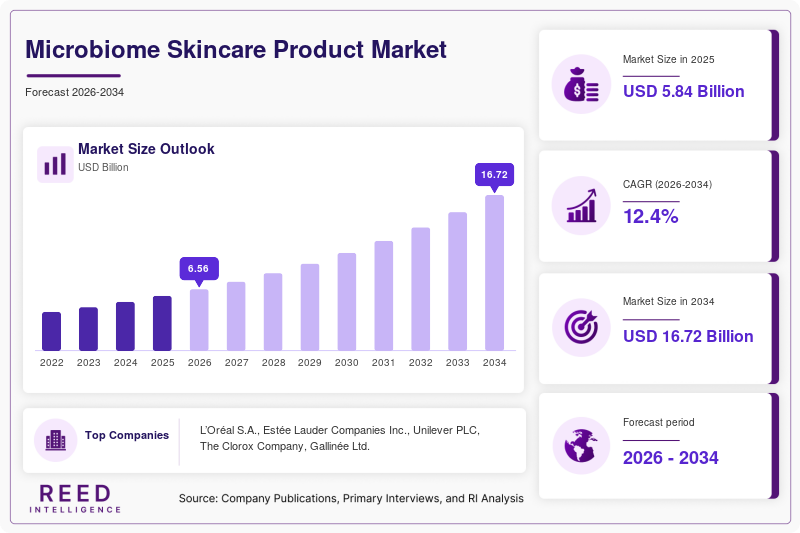
The Microbiome Skincare Product Market size was valued at USD 5.84 billion in 2026 and is projected to reach USD 14.92 billion by 2034, expanding at a CAGR of 12.4% during the forecast period from 2026 to 2034. The global Microbiome Skincare Product Market growth has been supported by increasing consumer awareness regarding skin microbiota health and rising demand for science-backed skincare formulations. Growing preference for clean-label beauty products and preventive skincare routines has further accelerated product adoption across developed and emerging economies.
Microbiome skincare products are designed to maintain and restore the natural balance of microorganisms present on the skin. These products include formulations enriched with probiotics, prebiotics, postbiotics, and microbiome-friendly ingredients that help strengthen the skin barrier and reduce irritation. The increasing prevalence of sensitive skin conditions, acne, eczema, and environmental skin stress has significantly contributed to the expansion of the Microbiome Skincare Product Market.
Key Highlights
- North America accounted for 36.8% of the global Microbiome Skincare Product Market share in 2025, while Asia Pacific is expected to register the fastest CAGR of 13.6% during 2026–2034.
- By product type, creams and moisturizers held the largest share of 38.7% in 2025, whereas microbiome serums are projected to expand at the fastest CAGR of 14.2%.
- By ingredient type, probiotic-based skincare products accounted for 44.3% of the market share in 2025, while postbiotic skincare products are expected to grow at a CAGR of 14.7%.
- By application, anti-aging skincare represented the largest share of 31.5% in 2025, while sensitive skin treatment products are anticipated to witness the fastest CAGR of 13.9%.
- By distribution channel, online retail accounted for 42.8% of the global market share in 2025, while direct-to-consumer subscription models are expected to grow at a CAGR of 15.1%.
- The United States remained the dominant country in the market and was valued at USD 1.62 billion in 2024, increasing to USD 1.83 billion in 2025 due to rising demand for dermatologist-backed skincare products and personalized beauty routines.
Market Trends
Increasing Popularity of Biotech-Driven Beauty Formulations
The Microbiome Skincare Product Market has been experiencing increasing adoption of biotechnology-driven skincare formulations. Cosmetic brands are integrating microbiome science with advanced dermatological research to develop products focused on long-term skin health. Companies are emphasizing clinically tested formulations containing probiotic and postbiotic ingredients to strengthen product credibility among health-conscious consumers.
Growing Consumer Preference for Minimalist Skincare
The increasing popularity of minimalist skincare routines has emerged as another major trend influencing the Microbiome Skincare Product Market. Consumers are reducing the use of harsh exfoliants and chemically aggressive products in favor of microbiome-friendly formulations designed to maintain natural skin balance. This trend has encouraged brands to launch gentle skincare products with fewer synthetic ingredients and enhanced barrier protection capabilities.
Market Drivers
Rising Demand for Personalized Skincare Solutions
The growing demand for personalized skincare products has significantly supported the expansion of the Microbiome Skincare Product Market. Consumers increasingly prefer customized skincare solutions tailored to individual skin conditions, microbiota composition, and environmental exposure. Beauty brands are introducing microbiome testing services and AI-based skincare recommendations to improve customer engagement and product effectiveness.
Increasing Prevalence of Skin Sensitivity and Barrier Damage
The rising prevalence of sensitive skin conditions and skin barrier disorders has accelerated demand for microbiome skincare products. Environmental pollution, excessive cosmetic use, stress, and changing lifestyles have contributed to increased skin irritation and inflammatory conditions. Consumers are actively seeking skincare products that help restore microbiome balance and strengthen natural skin defense mechanisms.
Market Restraint
High Product Development and Formulation Costs
One of the major restraints affecting the Microbiome Skincare Product Market is the high cost associated with microbiome-focused research and formulation development. Companies must invest heavily in clinical testing, biotechnology partnerships, and advanced ingredient sourcing to ensure product safety and efficacy. Premium pricing of microbiome skincare products may limit adoption among price-sensitive consumers in developing economies.
Market Opportunities
Expansion of Dermatology and Clinical Skincare Partnerships
The increasing collaboration between skincare brands and dermatology clinics presents a significant opportunity for the Microbiome Skincare Product Market. Dermatologist-endorsed microbiome products are gaining popularity among consumers seeking medically supported skincare solutions. Clinical skincare partnerships are expected to improve product credibility and strengthen market penetration.
Growth of Sustainable and Clean Beauty Products
The rising demand for sustainable and clean beauty products is creating favorable growth opportunities for market participants. Consumers increasingly prefer environmentally responsible skincare products with biodegradable packaging and naturally derived ingredients. Microbiome skincare brands focusing on eco-friendly production and transparent ingredient labeling are expected to attract a wider consumer base.
Segmental Analysis
By Product Type
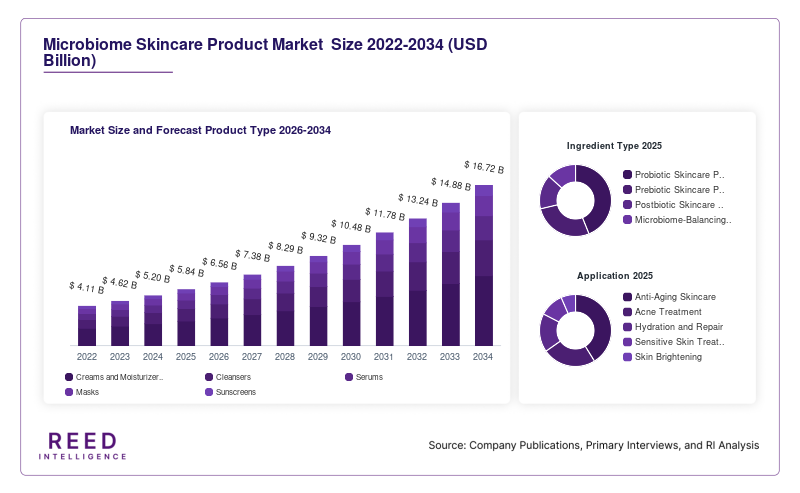
Based on product type, the Microbiome Skincare Product Market is segmented into creams and moisturizers, cleansers, serums, masks, and sunscreens.
Creams and moisturizers dominated the market with a 38.7% share in 2025 due to their widespread use in daily skincare routines and strong demand for hydration-focused formulations. Consumers preferred microbiome-based moisturizers for improving skin barrier function and maintaining long-term skin health.
Serums are expected to witness the fastest CAGR of 14.2% during the forecast period. The segment growth will be supported by increasing demand for concentrated active ingredient formulations targeting skin repair, hydration, and anti-aging benefits.
By Ingredient Type
Based on ingredient type, the market is segmented into probiotic skincare products, prebiotic skincare products, postbiotic skincare products, and microbiome-balancing botanical formulations.
Probiotic skincare products accounted for the largest market share of 44.3% in 2025 owing to strong consumer awareness regarding beneficial bacteria and skin microbiota restoration. These products gained popularity for their ability to support sensitive and acne-prone skin conditions.
Postbiotic skincare products are expected to grow at the fastest CAGR of 14.7% from 2026 to 2034. The growth will be driven by increasing scientific research regarding the stability and efficacy of postbiotic compounds in skincare applications.
By Application
Based on application, the Microbiome Skincare Product Market is categorized into anti-aging skincare, acne treatment, hydration and repair, sensitive skin treatment, and skin brightening.
Anti-aging skincare held the dominant market share of 31.5% in 2025 due to rising consumer focus on preventive skincare and long-term skin rejuvenation. Microbiome-friendly anti-aging products gained traction because they support collagen preservation and skin barrier protection.
Sensitive skin treatment products are projected to expand at the fastest CAGR of 13.9% during the forecast period. Increasing environmental stress and rising cases of skin irritation will continue supporting demand for soothing and microbiome-protective skincare solutions.
By Distribution Channel
Based on distribution channel, the market is divided into online retail, supermarkets and hypermarkets, specialty beauty stores, pharmacies, and direct-to-consumer channels.
Online retail dominated the market with a 42.8% share in 2025 because consumers increasingly relied on digital beauty platforms for skincare product purchases and personalized product recommendations. Social media marketing and influencer-driven promotions also strengthened online sales growth.
Direct-to-consumer subscription models are anticipated to witness the fastest CAGR of 15.1% through 2034. Increasing consumer preference for customized skincare regimens and recurring product delivery services will support rapid segment expansion.
Regional Analysis
North America
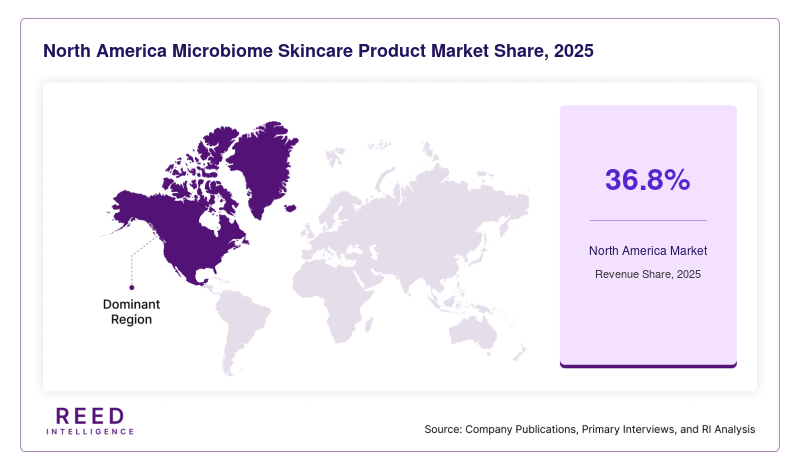
North America held 36.8% of the global Microbiome Skincare Product Market share in 2025 and is expected to expand at a CAGR of 11.6% during the forecast period. The region benefited from strong consumer awareness regarding skin wellness and increasing adoption of premium skincare products. The United States dominated the regional market due to high spending on dermatologist-recommended skincare and growing demand for clinically tested beauty products.
Europe
Europe accounted for 28.5% of the global Microbiome Skincare Product Market share in 2025 and is projected to grow at a CAGR of 11.2% from 2026 to 2034. The market growth in the region was supported by increasing preference for natural skincare formulations and stringent cosmetic safety standards. France emerged as the dominant country because of its established skincare industry and rising investment in microbiome-focused cosmetic innovation.
Asia Pacific
Asia Pacific represented 23.7% of the global Microbiome Skincare Product Market share in 2025 and is forecast to register the fastest CAGR of 13.6% during the forecast period. Rapid urbanization, rising disposable income, and increasing beauty consciousness supported regional market growth. South Korea dominated the regional market owing to strong innovation in skincare technology and growing consumer interest in advanced cosmetic formulations.
Middle East & Africa
The Middle East & Africa accounted for 5.8% of the global Microbiome Skincare Product Market share in 2025 and is anticipated to grow at a CAGR of 10.4% through 2034. Expanding beauty retail infrastructure and increasing demand for premium skincare products contributed to regional market development. The United Arab Emirates emerged as the dominant country due to growing luxury skincare consumption and expanding international beauty brand presence.
Latin America
Latin America held 5.2% of the global Microbiome Skincare Product Market share in 2025 and is projected to grow at a CAGR of 10.8% from 2026 to 2034. Increasing awareness regarding skin health and rising adoption of premium personal care products supported market expansion across the region. Brazil dominated the regional market because of strong consumer demand for advanced cosmetic and anti-aging skincare products.
Competitive Landscape
The Microbiome Skincare Product Market remains competitive with the presence of global skincare brands, biotechnology companies, and clean beauty startups focusing on microbiome-based innovation. Companies are investing in dermatological research, clinical validation, and sustainable ingredient sourcing to strengthen market positioning.
L’Oréal S.A. emerged as one of the leading players in the market due to its strong skincare research capabilities and expanding microbiome-focused beauty portfolio. The company recently expanded its microbiome skincare product range through advanced probiotic-based formulations designed for sensitive and aging skin applications.
Estée Lauder Companies continued strengthening its premium skincare offerings with biotechnology-driven formulations focused on skin barrier restoration. Unilever emphasized sustainable beauty innovation and microbiome-friendly skincare ingredients. Gallinée focused exclusively on probiotic skincare products targeting sensitive skin conditions, while The Clorox Company expanded Burt’s Bees microbiome-support skincare lines for natural beauty consumers.
Manufacturers are increasingly emphasizing scientific validation, dermatologist collaboration, and clean-label product development. Strategic partnerships with biotechnology research organizations are expected to improve product innovation capabilities and market competitiveness throughout the forecast period.
Key Players List
- L’Oréal S.A.
- Estée Lauder Companies Inc.
- Unilever PLC
- The Clorox Company
- Gallinée Ltd.
- Mother Dirt
- TULA Life Inc.
- Glowbiotics Inc.
- LaFlore Probiotic Skincare
- Esse Skincare
- Aurelia London
- Clinique Laboratories LLC
- Drunk Elephant
- BIOSSANCE
- EVELOM
Recent Developments
- In March 2026, L’Oréal S.A. launched a new microbiome skincare line focused on hydration and skin barrier repair using probiotic-derived ingredients.
- In August 2025, Estée Lauder Companies expanded its clinical skincare research partnerships to strengthen microbiome-focused product development.
- In November 2025, Unilever introduced sustainable microbiome skincare packaging solutions for its premium beauty portfolio.
- In January 2026, Gallinée Ltd. launched advanced postbiotic skincare serums designed for sensitive skin applications.
- In April 2026, TULA Life Inc. expanded its direct-to-consumer subscription platform for personalized microbiome skincare solutions.
Microbiome Skincare Product Market Segments
Product Type
- Creams and Moisturizers
- Cleansers
- Serums
- Masks
- Sunscreens
Ingredient Type
- Probiotic Skincare Products
- Prebiotic Skincare Products
- Postbiotic Skincare Products
- Microbiome-Balancing Botanical Formulations
Application
- Anti-Aging Skincare
- Acne Treatment
- Hydration and Repair
- Sensitive Skin Treatment
- Skin Brightening
Distribution Channel
- Online Retail
- Supermarkets and Hypermarkets
- Specialty Beauty Stores
- Pharmacies
- Direct-to-Consumer Channels
By Region
- North America
- Europe
- APAC
- Middle East and Africa
- LATAM