Microcontroller Start Stop System Market Size, Share & Demand Report By Microcontroller Type (8-bit Microcontrollers, 16-bit Microcontrollers, 32-bit Microcontrollers, Low-Power Microcontrollers), By Vehicle Type (Passenger Vehicles, Commercial Vehicles), By Component (Electronic Control Units (ECUs), Sensors, Actuators), By Fuel Type (Gasoline, Diesel, Hybrid), By Sales Channel (OEM, Aftermarket), By Region & Segment Forecasts, 2025–2034
USD 3950
Market Overview
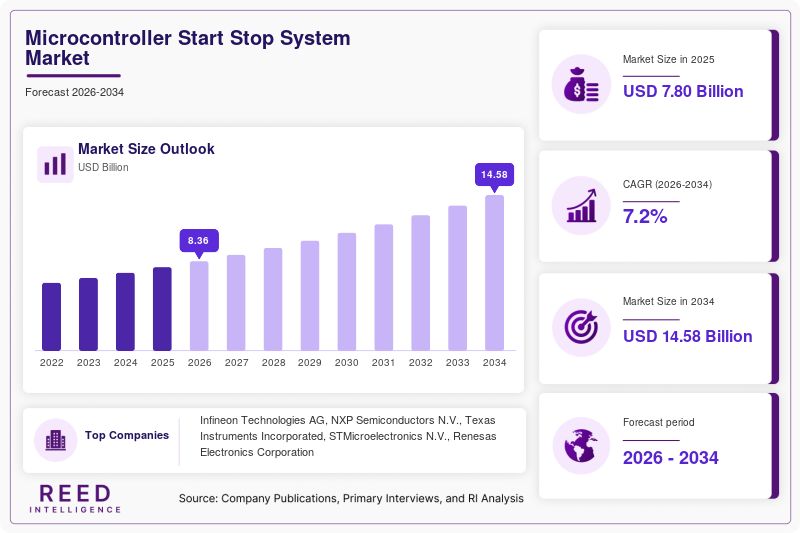
The Microcontroller Start Stop System Market size was valued at approximately USD 7.8 billion in 2025 and is projected to reach USD 14.6 billion by 2034, expanding at a CAGR of 7.2% during 2025–2034. The increasing integration of fuel-efficient technologies in automobiles, combined with regulatory pressure to reduce vehicle emissions, has significantly accelerated the adoption of microcontroller-based start-stop systems globally.
A major global factor supporting the growth of the Microcontroller Start Stop System Market is the rapid electrification of vehicles and the transition toward energy-efficient automotive technologies. Governments worldwide are implementing stringent fuel economy norms and carbon reduction targets, encouraging automakers to integrate start-stop systems that automatically shut down and restart engines to minimize fuel consumption and idle emissions.
Key Highlights
- North America dominated the market with a 34.5% share in 2025, while Asia Pacific is projected to grow at the fastest CAGR of 8.5%.
- Passenger vehicles led the application segment with a 61.2% share, whereas commercial vehicles are expected to grow at a CAGR of 7.9%.
- 32-bit microcontrollers accounted for the largest share at 48.7%, while advanced low-power microcontrollers are projected to grow at 8.8% CAGR.
- The United States market was valued at USD 2.1 billion in 2025 and is estimated to reach USD 2.3 billion in 2026.
Market Trends
Integration of Advanced Microcontrollers in Automotive Systems
The Microcontroller Start Stop System Market is witnessing a shift toward the adoption of advanced 32-bit and low-power microcontrollers that enable improved computational efficiency and energy optimization. Automakers are increasingly integrating these microcontrollers to enhance engine restart speed, reduce vibration, and provide smoother driving experiences. The trend is further supported by the rising demand for intelligent electronic control units (ECUs) and connected vehicle technologies.
Increasing Adoption in Hybrid and Electric Vehicles –
Another notable trend in the Microcontroller Start Stop System Market is the growing application of start-stop systems in hybrid vehicles. While electric vehicles do not require traditional start-stop mechanisms, hybrid vehicles benefit significantly from such systems to optimize fuel usage and battery efficiency. This trend is gaining traction as hybrid vehicle adoption rises globally, particularly in urban environments where frequent stops make start-stop systems highly effective.
Market Drivers
Rising Fuel Efficiency Requirements
The growing need for fuel efficiency across the automotive industry is a primary driver of the Microcontroller Start Stop System Market. Start-stop systems significantly reduce fuel consumption by turning off the engine during idle periods. As fuel prices fluctuate and consumers seek cost savings, the adoption of such systems continues to increase, especially in urban driving conditions.
Stringent Emission Regulations
Governments worldwide are implementing strict emission norms to combat environmental concerns. These regulations are compelling automakers to incorporate technologies that reduce carbon emissions. Microcontroller-based start-stop systems contribute to lower CO₂ emissions, making them a preferred solution for compliance with regulatory standards.
Market Restraint
High System Integration Costs
One of the key restraints in the Microcontroller Start Stop System Market is the relatively high cost associated with system integration and advanced microcontroller components. The inclusion of additional sensors, control units, and battery enhancements increases the overall vehicle cost. This can limit adoption in cost-sensitive markets and entry-level vehicle segments.
Furthermore, the complexity of integrating start-stop systems with existing vehicle architectures may require redesigning engine control systems, adding to development costs. Concerns regarding battery wear and system durability also influence consumer perception, potentially restricting market growth in certain regions.
Market Opportunities
Expansion in Emerging Automotive Markets
Emerging economies present significant growth opportunities for the Microcontroller Start Stop System Market. Increasing urbanization, rising disposable incomes, and expanding automotive production are driving the demand for fuel-efficient vehicles. As governments in these regions begin to enforce stricter emission norms, the adoption of start-stop systems is expected to rise.
Technological Advancements in Semiconductor Design
Advancements in semiconductor technologies are creating opportunities for the development of more efficient and cost-effective microcontrollers. Innovations such as low-power architectures and enhanced processing capabilities enable improved performance of start-stop systems. These advancements are expected to reduce system costs over time and expand adoption across a broader range of vehicles.
Segmental Analysis
By Microcontroller Type
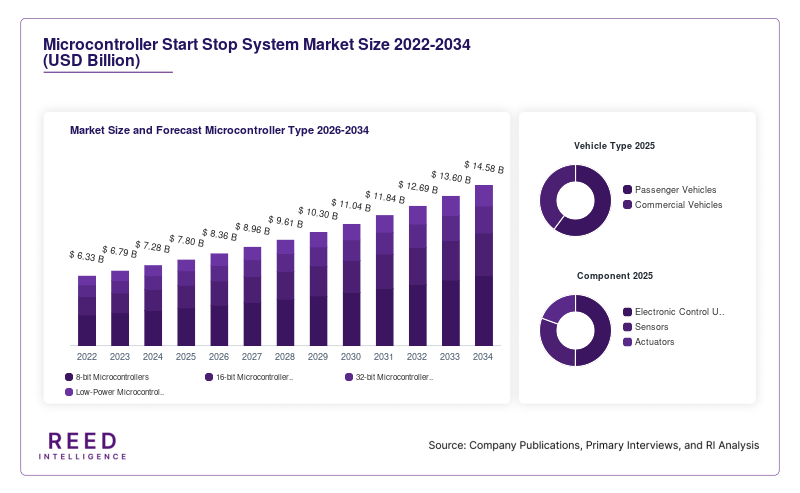
32-bit microcontrollers dominated the Microcontroller Start Stop System Market with a 48.7% share in 2025. Their superior processing capabilities and ability to handle complex control algorithms make them ideal for modern start-stop systems.
Low-power microcontrollers are expected to grow at the fastest CAGR of 8.8%. Their ability to reduce energy consumption while maintaining performance will drive their adoption in next-generation automotive systems.
By Vehicle Type
Passenger vehicles accounted for the largest share of 61.2% in 2025, driven by high production volumes and increasing consumer demand for fuel-efficient cars.
Commercial vehicles are projected to grow at a CAGR of 7.9%, supported by the need to reduce operational costs and improve fuel efficiency in logistics and transportation sectors.
By Component
Electronic control units (ECUs) held the dominant share of 42.5% in 2025, as they serve as the central processing unit for start-stop systems.
Sensors are expected to grow at the fastest CAGR of 8.1%, driven by advancements in real-time monitoring technologies and increasing system complexity.
By Fuel Type
Gasoline vehicles dominated the market with a 55.3% share in 2025, owing to their widespread adoption globally.
Hybrid vehicles are anticipated to grow at a CAGR of 8.6%, supported by increasing adoption of eco-friendly transportation solutions.
By Sales Channel
OEMs accounted for the largest share of 68.9% in 2025, as start-stop systems are primarily integrated during vehicle manufacturing.
Aftermarket sales are expected to grow at a CAGR of 6.7%, driven by retrofitting demand and vehicle upgrades.
Regional Analysis
North America
North America accounted for 34.5% of the Microcontroller Start Stop System Market share in 2025 and is expected to grow at a CAGR of 6.8% during the forecast period. The region’s growth is driven by the widespread adoption of advanced automotive technologies and increasing demand for fuel-efficient vehicles.
The United States dominated the regional market due to strong automotive manufacturing capabilities and high consumer awareness regarding fuel efficiency. The presence of established automotive OEMs and technological innovation in semiconductor solutions further supported market expansion.
Europe
Europe held a 28.3% share in 2025 and is projected to grow at a CAGR of 6.5%. The region has been a leader in implementing stringent emission regulations, which has significantly driven the adoption of start-stop systems.
Germany emerged as the dominant country due to its strong automotive industry and focus on engineering excellence. The integration of advanced vehicle technologies and emphasis on sustainability have contributed to steady market growth.
Asia Pacific
Asia Pacific captured 24.7% of the market share in 2025 and is expected to grow at the fastest CAGR of 8.5%. The region’s growth is supported by increasing vehicle production and rising demand for fuel-efficient automobiles.
China led the regional market due to its large automotive manufacturing base and government initiatives promoting energy-efficient technologies. Rapid urbanization and increasing vehicle ownership further drive demand.
Middle East & Africa
The Middle East & Africa accounted for 6.5% of the market share in 2025 and is projected to grow at a CAGR of 5.9%. Growth in this region is supported by gradual adoption of advanced automotive technologies.
The United Arab Emirates dominated the market due to increasing demand for premium vehicles and rising awareness of fuel efficiency. Infrastructure development and economic diversification also contribute to growth.
Latin America
Latin America held 6.0% of the market share in 2025 and is expected to grow at a CAGR of 6.2%. The market is driven by increasing automotive sales and growing awareness of fuel-saving technologies.
Brazil emerged as the dominant country due to its expanding automotive sector and government initiatives supporting energy efficiency. The rising demand for cost-effective vehicles with advanced features supports market growth.

Competitive Landscape
The Microcontroller Start Stop System Market is moderately competitive, with key players focusing on innovation, partnerships, and product development. Leading companies are investing in advanced semiconductor technologies to enhance system performance and efficiency.
A major market leader is Infineon Technologies AG, which has introduced advanced automotive microcontrollers designed for energy-efficient applications. The company continues to expand its product portfolio to meet evolving industry demands.
Other players are focusing on strategic collaborations with automotive OEMs to strengthen their market presence. Continuous R&D investments and technological advancements are key strategies adopted by market participants.
Key Players
- Infineon Technologies AG
- NXP Semiconductors N.V.
- Texas Instruments Incorporated
- STMicroelectronics N.V.
- Renesas Electronics Corporation
- Microchip Technology Inc.
- ON Semiconductor Corporation
- Bosch Mobility Solutions
- Continental AG
- Denso Corporation
- Mitsubishi Electric Corporation
- Toshiba Electronic Devices & Storage Corporation
- Analog Devices Inc.
- Cypress Semiconductor Corporation
- Qualcomm Incorporated
Recent Developments
- 2024: Infineon Technologies launched a new low-power automotive microcontroller series for start-stop applications.
- 2024: NXP Semiconductors partnered with automotive OEMs to enhance ECU performance.
- 2023: STMicroelectronics introduced advanced sensor-integrated microcontrollers.
- 2023: Renesas Electronics expanded its automotive solutions portfolio.
- 2023: Texas Instruments developed next-generation energy-efficient control systems.
Microcontroller Start Stop System Market Segments
Microcontroller Type
- 8-bit Microcontrollers
- 16-bit Microcontrollers
- 32-bit Microcontrollers
- Low-Power Microcontrollers
Vehicle Type
- Passenger Vehicles
- Commercial Vehicles
Component
- Electronic Control Units (ECUs)
- Sensors
- Actuators
Fuel Type
- Gasoline
- Diesel
- Hybrid
Sales Channel
- OEM
- Aftermarket
By Region
- North America
- Europe
- APAC
- Middle East and Africa
- LATAM