Microencapsulated Omega 3 Powder Market Size, Share & Demand Report By Source (Fish Oil, Algae Oil, Krill Oil), By Technology (Spray Drying, Freeze Drying, Coacervation, Liposomal Encapsulation), By Application (Food & Beverages, Dietary Supplements, Pharmaceuticals, Animal Nutrition), By End-Use (Adult Nutrition, Infant Nutrition, Geriatric Nutrition), By Distribution Channel (Online, Offline), By Region & Segment Forecasts, 2026–2034
USD 3950
Market Overview
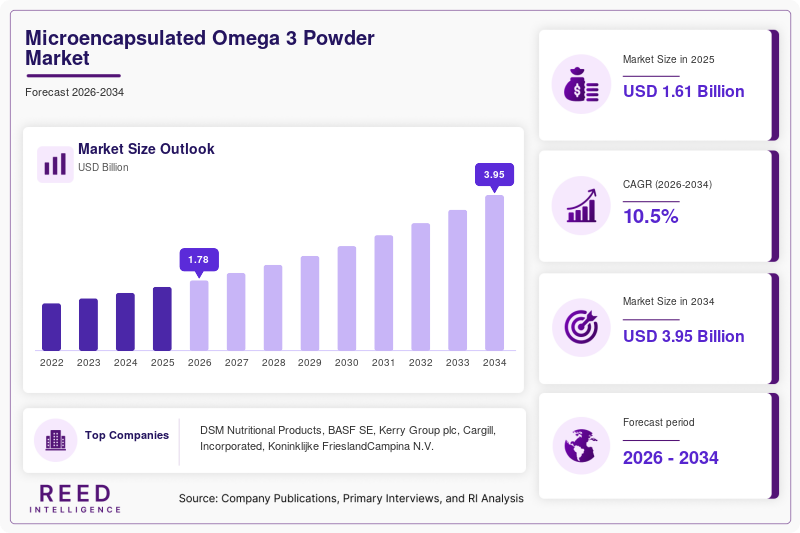
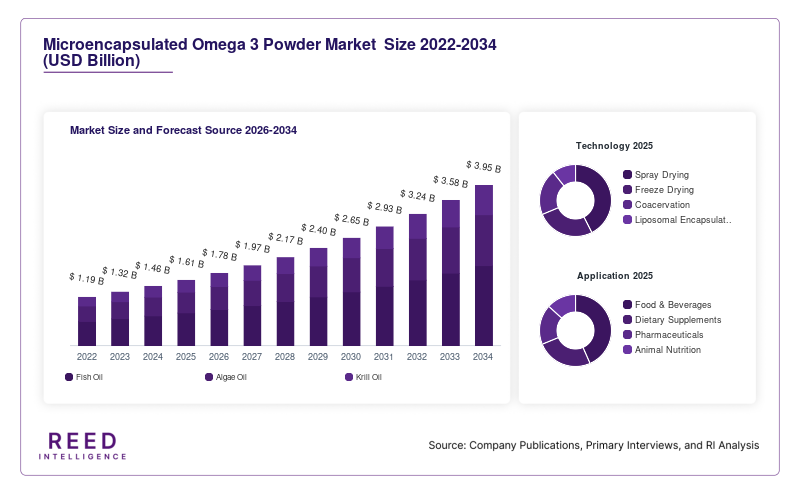
The Microencapsulated Omega 3 Powder Market size was estimated at USD 1.78 billion in 2026 and is projected to reach USD 3.96 billion by 2034, expanding at a CAGR of 10.5% during 2026–2034. The market growth is being supported by the rising global inclination toward functional nutrition, where consumers increasingly seek convenient and stable forms of omega-3 fatty acids for daily intake.
A key global factor contributing to the growth of the Microencapsulated Omega 3 Powder Market is the expansion of fortified food and beverage industries. Manufacturers are integrating omega-3 powders into dairy, bakery, and beverage products to improve nutritional value without compromising taste, odor, or shelf stability. This has significantly increased product adoption across developed and emerging economies.
Key Highlights:
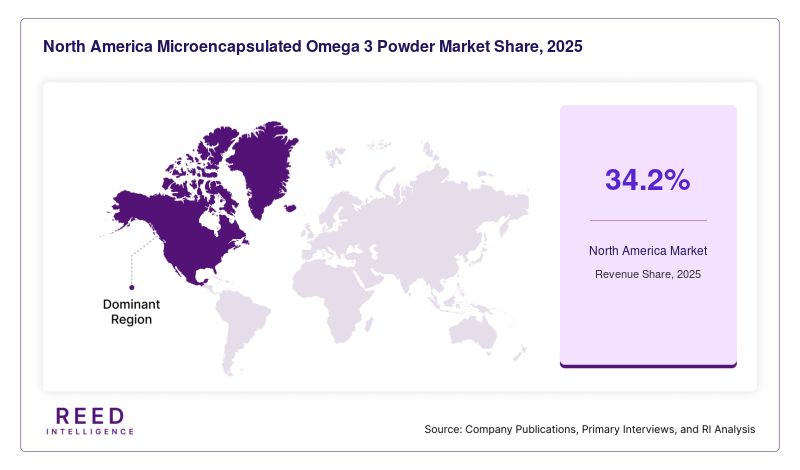
- North America dominated the market with a 34.2% share in 2025, while Asia Pacific is projected to grow at the fastest CAGR of 12.1% during the forecast period.
- The fish oil-based microencapsulation segment led with a 48.6% share in 2025, whereas algae-based powders are expected to grow at a CAGR of 11.8%.
- The food & beverages application segment accounted for 52.3% share in 2025, while dietary supplements are forecast to grow at a CAGR of 11.2%.
- The U.S. Microencapsulated Omega 3 Powder Market was valued at USD 412 million in 2024 and USD 438 million in 2025, reflecting steady expansion.
Market Trends
Clean Label and Plant-Based Alternatives
The Microencapsulated Omega 3 Powder Market is witnessing a shift toward plant-based omega-3 sources, especially algae-derived powders. Consumers prefer clean-label ingredients with minimal processing and sustainable sourcing, which is encouraging manufacturers to invest in algae-based microencapsulation technologies.
Advancements in Encapsulation Technologies
Technological innovations such as spray drying, coacervation, and liposomal encapsulation are improving product stability and bioavailability. These methods reduce oxidation and mask fishy odor, making omega-3 powders more suitable for a wide range of food applications.
Market Drivers
Increasing Demand for Functional Food Ingredients
The growing consumption of fortified and functional foods has significantly contributed to the Microencapsulated Omega 3 Powder Market. Consumers are actively seeking products that support heart health, cognitive function, and overall wellness, which has led to increased demand for omega-3 enriched products.
Expanding Nutraceutical Industry
The rapid growth of the global nutraceutical sector is driving the demand for stable and easy-to-consume omega-3 formats. Microencapsulated powders offer improved shelf life and compatibility with capsules, tablets, and powdered supplements, supporting widespread adoption.
Market Restraint
High Production Costs
The Microencapsulated Omega 3 Powder Market faces challenges due to the high cost associated with advanced encapsulation technologies and raw materials. This can limit adoption among small and medium-scale manufacturers.
Market Opportunities
Growth in Infant Nutrition Products
The increasing demand for fortified infant formulas presents a strong opportunity for the Microencapsulated Omega 3 Powder Market. Omega-3 fatty acids are essential for brain development, encouraging manufacturers to integrate microencapsulated powders into baby food formulations.
Expansion in Emerging Markets
Rising disposable income and growing health awareness in developing countries offer new growth avenues. Manufacturers are focusing on expanding their distribution networks in Asia Pacific and Latin America to tap into these opportunities.
Segmental Analysis
By Source
Fish oil-based microencapsulated omega-3 powders dominated the Microencapsulated Omega 3 Powder Market with a 48.6% share in 2025, owing to their high EPA and DHA content and widespread availability.
Algae-based powders are projected to grow at a CAGR of 11.8%, driven by increasing demand for vegan and sustainable alternatives.
By Technology
Spray drying emerged as the dominant technology with a 55.2% share in 2025, due to its cost-effectiveness and scalability.
Liposomal encapsulation is anticipated to grow at a CAGR of 12.4%, supported by enhanced bioavailability and controlled release properties.
By Application
Food & beverages accounted for the largest share of 52.3% in 2025, driven by increased fortification in dairy and bakery products.
Dietary supplements are expected to grow at a CAGR of 11.2%, fueled by rising health-conscious consumer behavior.
By End-Use
The adult nutrition segment held a 46.5% share in 2025, supported by growing demand for preventive healthcare products.
Infant nutrition is projected to grow at a CAGR of 12.0%, owing to increasing focus on early-stage nutritional development.
By Distribution Channel
Offline retail dominated with a 61.4% share in 2025, driven by strong presence of supermarkets and specialty stores.
Online channels are expected to grow at a CAGR of 13.1%, supported by the expansion of e-commerce platforms.
Regional Analysis
North America
North America accounted for 34.2% of the Microencapsulated Omega 3 Powder Market share in 2025 and is expected to grow at a CAGR of 9.8% during the forecast period. The U.S. remained the dominant country due to high consumer awareness and established functional food industries.
Europe
Europe held 27.6% share in 2025 and will grow at a CAGR of 9.5% through 2034. Germany led the regional market, supported by strong demand for fortified dairy and bakery products.
Asia Pacific
Asia Pacific represented 22.4% share in 2025 and is projected to expand at the fastest CAGR of 12.1%. China dominated the region, driven by increasing demand for infant nutrition and dietary supplements.
Middle East & Africa
The Middle East & Africa held 8.1% share in 2025 and is expected to grow at a CAGR of 8.9%. The UAE emerged as a key country due to rising demand for premium health products.
Latin America
Latin America accounted for 7.7% share in 2025 and is forecast to grow at a CAGR of 9.2%. Brazil dominated the region, supported by growing awareness of nutritional supplements.
Competitive Landscape
The Microencapsulated Omega 3 Powder Market is moderately consolidated, with key players focusing on product innovation and strategic partnerships. Leading companies are investing in advanced encapsulation technologies to enhance product stability and expand application areas.
One of the prominent market leaders, DSM Nutritional Products, has strengthened its position by introducing algae-based omega-3 powders targeting plant-based product manufacturers. Companies such as BASF SE, Kerry Group, and Cargill, Incorporated are actively expanding their portfolios through acquisitions and collaborations. Meanwhile, niche players are focusing on specialized applications such as infant nutrition and clinical supplements. Competitive strategies include capacity expansion, regional diversification, and sustainability initiatives to meet evolving consumer demands.
Key Players List
- DSM Nutritional Products
- BASF SE
- Kerry Group plc
- Cargill, Incorporated
- Koninklijke FrieslandCampina N.V.
- Arla Foods Ingredients Group P/S
- Croda International Plc
- Balchem Corporation
- FrieslandCampina Ingredients
- Omega Protein Corporation
- Ingredion Incorporated
- Glanbia plc
- Stepan Company
- LycoRed Ltd.
- Biosearch Life
Recent Developments
- In 2025, DSM Nutritional Products launched a new plant-based microencapsulated omega-3 powder aimed at vegan food manufacturers.
- In 2024, BASF SE expanded its omega-3 production capacity to meet increasing global demand.
- In 2025, Kerry Group introduced advanced encapsulation solutions for beverage applications.
- In 2024, Cargill partnered with a biotechnology firm to enhance algae-based omega-3 production.
- In 2025, Croda International Plc developed high-stability omega-3 powders for infant nutrition products.
Microencapsulated Omega 3 Powder Market Segments
Source
- Fish Oil
- Algae Oil
- Krill Oil
Technology
- Spray Drying
- Freeze Drying
- Coacervation
- Liposomal Encapsulation
Application
- Food & Beverages
- Dietary Supplements
- Pharmaceuticals
- Animal Nutrition
End-Use
- Adult Nutrition
- Infant Nutrition
- Geriatric Nutrition
Distribution Channel
- Online Retail
- Supermarkets & Hypermarkets
- Specialty Stores
- Pharmacies & Drug Stores
By Region
- North America
- Europe
- APAC
- Middle East and Africa
- LATAM