Microfibrillated Cellulose Fiber Market Size, Share Demand Report By Type (Wood-Based, Non-Wood-Based), By Application (Packaging, Biomedical, Composites, Paper & Pulp, Others), By End-Use Industry (Construction, Automotive, Personal Care & Cosmetics, Healthcare, Others), By Region & Segment Forecasts, 2026–2034
USD 3950
Market Overview
The global Microfibrillated Cellulose Fiber Market size valued at USD 1.25 billion in 2026 and projected to reach USD 2.85 billion by 2034, registering a CAGR of 10.8% (2026–2034). Growth is primarily driven by the increasing adoption of bio-based and renewable materials across packaging, pharmaceuticals, and advanced composites industries. A key global factor supporting market expansion is the rising regulatory push toward sustainable and biodegradable alternatives to petroleum-based polymers, encouraging manufacturers to adopt cellulose-derived fibers in industrial applications.
Technological advancements in nanocellulose processing, coupled with increasing R&D investments in sustainable material science, have significantly improved production efficiency and scalability of microfibrillated cellulose fibers. These fibers are increasingly used for enhancing mechanical strength, barrier properties, and lightweight performance in end-use applications such as food packaging, medical coatings, and paper reinforcement.
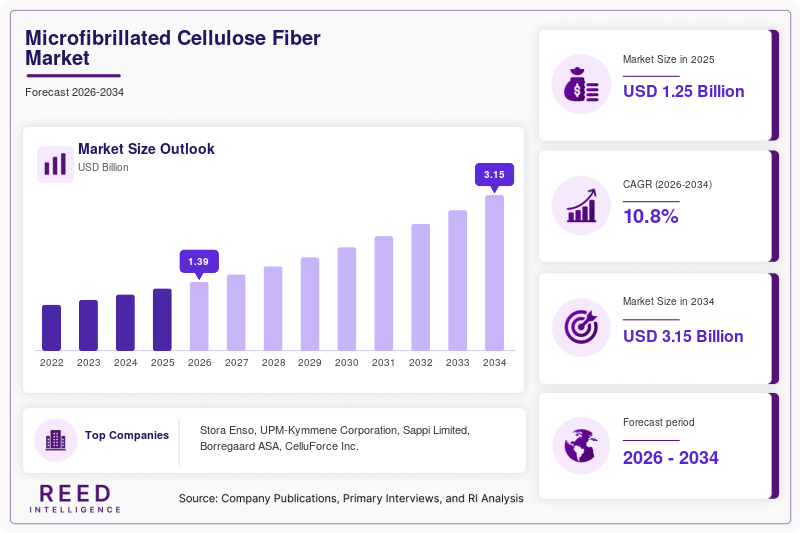
Key Highlights
- North America dominated the market with a 34.6% share in 2025.
- Asia Pacific is expected to grow at the fastest CAGR of 11.4% during 2026–2034.
- By application, packaging materials accounted for the largest share of 39.8%.
- while biomedical applications are projected to grow at a CAGR of 12.1%.
- By form, dry microfibrillated cellulose held a dominant 57.2% share, whereas gel-based cellulose is expected to expand at the fastest CAGR of 11.6%.
- The United States remained the dominant country, with market values of USD 620 million in 2024 and USD 680 million in 2025.
Market Trends
Rising Adoption in Sustainable Packaging Solutions
The increasing emphasis on sustainable packaging has significantly influenced the Microfibrillated Cellulose Fiber Market. Companies in the food and beverage and e-commerce sectors are transitioning toward biodegradable and recyclable materials to reduce environmental impact. Microfibrillated cellulose fibers provide excellent barrier properties, mechanical strength, and flexibility, making them suitable for replacing plastic-based packaging. Regulatory frameworks supporting eco-friendly packaging have further encouraged adoption. Additionally, consumer awareness regarding environmental sustainability continues to grow, prompting brands to incorporate renewable materials into their packaging strategies. This trend is expected to strengthen as companies invest in research to enhance the performance of cellulose-based materials in packaging applications.
Technological Advancements in Nanocellulose Processing
Continuous advancements in nanocellulose processing technologies are shaping the market landscape. Improved mechanical and chemical processing methods have enabled the production of high-quality microfibrillated cellulose fibers with enhanced properties such as tensile strength and transparency. These innovations have expanded their use in advanced applications, including electronics, coatings, and biomedical products. Automation and scale-up of production facilities have also reduced manufacturing costs, making these materials more commercially viable. Furthermore, collaborations between research institutions and industry players are accelerating innovation, leading to the development of customized fiber solutions tailored to specific industrial requirements.
Market Drivers
Increasing Demand for Bio-Based and Renewable Materials
The global shift toward sustainable materials is a major driver of the Microfibrillated Cellulose Fiber Market. Industries are actively seeking alternatives to fossil-based materials due to environmental concerns and regulatory pressures. Microfibrillated cellulose fibers, being renewable and biodegradable, align with sustainability goals across sectors such as packaging, automotive, and construction. Governments are implementing policies that promote the use of eco-friendly materials, which has further boosted market demand. Additionally, companies are incorporating sustainability into their brand identity, increasing the adoption of cellulose-based products. This growing demand for green materials is expected to drive consistent market expansion over the forecast period.
Expanding Applications Across Multiple Industries
The versatility of microfibrillated cellulose fibers has led to their adoption across diverse industries. In the construction sector, they are used to enhance the strength and durability of cement composites. In personal care and cosmetics, they act as stabilizers and thickening agents. The automotive industry utilizes these fibers to develop lightweight and high-strength components, improving fuel efficiency. Moreover, the biomedical sector is exploring their use in drug delivery systems and tissue engineering. This wide range of applications has significantly contributed to market growth, as manufacturers continue to discover new uses for these fibers.
Market Restraint
High Production Costs and Scalability Challenges
Despite its advantages, the Microfibrillated Cellulose Fiber Market faces challenges related to high production costs and scalability. The manufacturing process involves complex mechanical and chemical treatments, which require significant energy and specialized equipment. These factors increase overall production expenses, limiting the affordability of the final product compared to conventional materials. Small and medium enterprises often find it difficult to invest in advanced processing technologies, which restricts market entry. Additionally, achieving consistent quality at large-scale production remains a challenge for manufacturers. This constraint affects supply chain efficiency and slows down widespread adoption, particularly in cost-sensitive industries such as packaging and construction.
Market Opportunities
Growth Potential in Biomedical and Healthcare Applications
The biomedical sector presents significant growth opportunities for the Microfibrillated Cellulose Fiber Market. These fibers possess unique properties such as biocompatibility, high surface area, and mechanical strength, making them suitable for advanced medical applications. They are increasingly being used in wound dressings, drug delivery systems, and tissue engineering. Research and development activities in this field are expanding, with scientists exploring new ways to utilize cellulose fibers in regenerative medicine. The growing demand for innovative healthcare solutions, combined with advancements in material science, is expected to create new revenue streams for market players.
Emerging Demand in Developing Economies
Developing economies offer substantial growth opportunities due to increasing industrialization and environmental awareness. Countries in Asia Pacific and Latin America are witnessing rising demand for sustainable materials across industries such as packaging, construction, and automotive. Government initiatives promoting eco-friendly products and investments in infrastructure development are supporting market expansion. Additionally, the availability of raw materials in these regions provides a cost advantage for manufacturers. As local industries adopt advanced materials to enhance product performance, the demand for microfibrillated cellulose fibers is expected to grow significantly.
Segmental Analysis
By Type
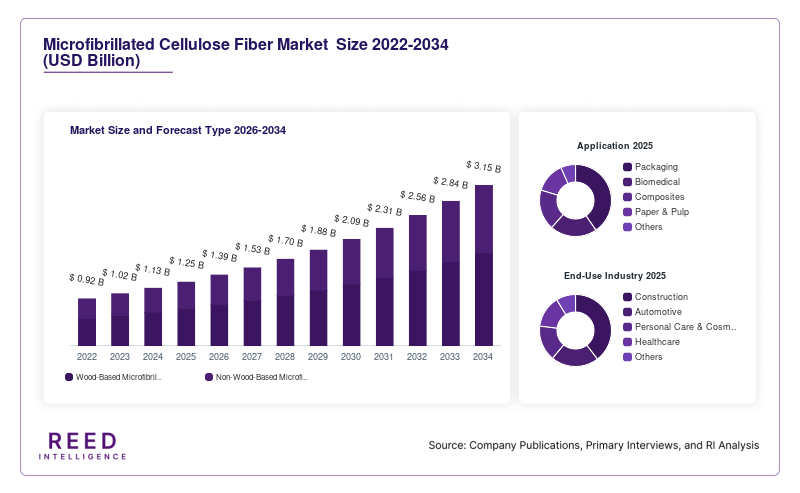
The dry microfibrillated cellulose segment dominated the market with a 57.2% share in 2024, driven by its widespread use in packaging, paper reinforcement, and composite materials. Its ease of handling, storage stability, and compatibility with industrial processes make it the preferred form among manufacturers. Increasing demand from high-volume industries has further strengthened its dominance in global supply chains.
The gel-based cellulose segment is expected to grow at a CAGR of 11.6%, supported by rising applications in biomedical and pharmaceutical industries. Its high water retention capacity and superior rheological properties make it suitable for wound care products, drug delivery systems, and cosmetic formulations. Continuous research into nanostructured gels is expanding its functional capabilities.
By Application
Packaging applications held the largest share of 39.8% in 2024, driven by increasing demand for sustainable and biodegradable packaging solutions. Microfibrillated cellulose enhances barrier performance and mechanical strength, making it suitable for food and beverage packaging. The shift toward eco-friendly materials in retail and e-commerce sectors continues to reinforce segment dominance.
Biomedical applications are projected to grow at a CAGR of 12.1%, fueled by increasing use in tissue engineering, wound healing, and drug delivery systems. Rising healthcare innovation and demand for biocompatible materials are driving adoption in advanced medical research and clinical applications.
By End-Use Industry
The paper and packaging industry accounted for a 41.5% share in 2024, supported by strong demand for reinforcement and barrier-enhancing materials. Microfibrillated cellulose improves durability and reduces material weight, making it ideal for modern packaging solutions.
The healthcare and pharmaceuticals segment is expected to grow at a CAGR of 11.9%, driven by rising applications in regenerative medicine and drug formulation technologies. Increasing investment in biomedical research is accelerating adoption.
Regional Analysis
North America
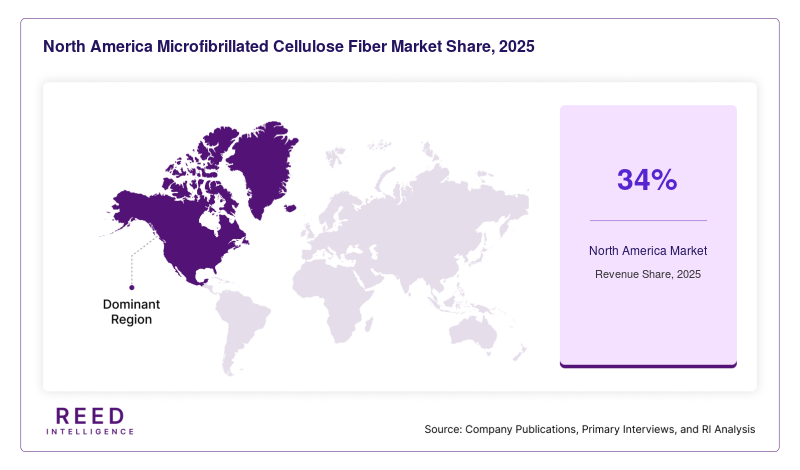
North America remains the dominant region in the Microfibrillated Cellulose Fiber Market, accounting for approximately 34%–42% share in 2025, supported by advanced industrial infrastructure and strong demand for sustainable materials. The region is projected to grow at a CAGR of around 10.2%–10.8% during 2026–2034, driven by increasing investments in bio-based technologies and packaging innovations. The presence of established pulp and paper industries and regulatory support for biodegradable alternatives further strengthens regional growth.
The United States dominates the regional market, with rising adoption across packaging, biomedical, and specialty material applications. A key growth factor is the implementation of sustainability initiatives such as recyclable packaging mandates and the shift toward circular economy practices. Additionally, strong R&D capabilities and partnerships between academic institutions and private companies are accelerating commercialization of microfibrillated cellulose fibers.
Europe
Europe holds a significant share of approximately 27%–30% in 2025, supported by stringent environmental regulations and increasing adoption of renewable materials. The region is expected to expand at a CAGR of around 10.5%–11.0% during the forecast period. The European Union’s focus on reducing plastic waste and promoting bio-based alternatives is a major driver for market growth across multiple industries, including packaging and automotive composites.
Germany leads the European market due to its strong manufacturing base and innovation in material science. A unique growth factor is the region’s emphasis on circular economy frameworks, where industries are required to adopt sustainable raw materials. This has significantly boosted demand for microfibrillated cellulose fibers in packaging and industrial applications.
Asia Pacific
Asia Pacific accounted for approximately 25%–28% market share in 2025 and is projected to be the fastest-growing region with a CAGR of 11.4%–12.0% during 2026–2034. Rapid industrialization, growing packaging demand, and increasing awareness of sustainable materials are key contributors to regional growth. Countries in this region are investing heavily in manufacturing capabilities and export-oriented production of cellulose-based materials.
China dominates the Asia Pacific market due to its large-scale industrial base and cost-efficient production capabilities. A major growth factor is government support for bio-based material innovation and environmental sustainability initiatives. Additionally, expanding automotive and construction sectors are driving demand for lightweight and high-strength materials such as microfibrillated cellulose fibers.
Middle East & Africa
The Middle East & Africa region represents a smaller share of around 6%–7% in 2025, with a projected CAGR of 9.5%–10.0% during the forecast period. Growth is primarily driven by increasing diversification efforts in industrial sectors and rising awareness of sustainable materials. Governments in the region are gradually adopting environmental policies to reduce dependence on petrochemical-based products.
Saudi Arabia leads the regional market due to its ongoing industrial transformation initiatives. A unique growth factor is the integration of sustainable materials into large-scale infrastructure and industrial projects. These initiatives are encouraging the adoption of microfibrillated cellulose fibers in construction and packaging applications.
Latin America
Latin America accounted for approximately 5%–6% share in 2025 and is expected to grow at a CAGR of 9.8%–10.2% through 2034. The region’s growth is supported by abundant forestry resources and increasing demand for sustainable packaging materials. Emerging economies are focusing on reducing plastic waste and promoting eco-friendly alternatives, which is driving adoption of cellulose-based fibers.
Brazil dominates the Latin American market due to its strong pulp and paper industry. A key growth factor is the availability of raw materials, particularly wood pulp, which provides a cost advantage for cellulose fiber production. Additionally, increasing export opportunities for sustainable materials are contributing to regional market expansion.
Competitive Landscape
The Microfibrillated Cellulose Fiber Market is moderately consolidated, with key players focusing on capacity expansion, R&D investment, and strategic partnerships. Leading companies include Stora Enso, which maintains a strong position due to its advanced nanocellulose production technologies. Other major players such as UPM-Kymmene Corporation, Borregaard, Nippon Paper Industries, and Sappi Limited are actively expanding their bio-based product portfolios. A recent development includes Stora Enso’s expansion of its pilot production facility to enhance nanocellulose scalability for industrial applications.
Key Players List
- Stora Enso
- UPM-Kymmene Corporation
- Borregaard ASA
- Nippon Paper Industries Co., Ltd.
- Sappi Limited
- Fibria Celulose S.A.
- CelluForce Inc.
- Melodea Ltd.
- American Process Inc.
- Daicel Corporation
- GranBio Technologies
- Innventia AB
- Borregaard HBI
- Georgia-Pacific LLC
- Rayonier Advanced Materials
Recent Developments
- In 2025, Stora Enso announced an expansion of its nanocellulose production capacity to support growing demand in packaging and biomedical applications.
- UPM-Kymmene Corporation invested in advanced cellulose processing technologies to improve production efficiency and reduce environmental impact.
- Borregaard introduced a new bio-based cellulose material designed for high-performance industrial applications, strengthening its sustainable product portfolio.
Microfibrillated Cellulose Fiber Market Segments
Type
- Wood-Based Microfibrillated Cellulose
- Non-Wood-Based Microfibrillated Cellulose
Application
- Packaging
- Biomedical
- Composites
- Paper & Pulp
- Others
End-Use Industry
- Construction
- Automotive
- Personal Care & Cosmetics
- Healthcare
- Others
By Region
- North America
- Europe
- APAC
- Middle East and Africa
- LATAM