Microneedle Flu Vaccine Market Size, Share & Demand Report By Type (Solid Microneedles, Hollow Microneedles, Dissolving Microneedles, Coated Microneedles), By Material (Silicon, Metal, Polymer, Ceramic), By End-Use (Hospitals, Clinics, Homecare Settings, Research Institutes), By Distribution Channel (Hospital Pharmacies, Retail Pharmacies, Online Pharmacies) & Segment Forecasts, 2025–2034
USD 3950
Market Overview
The global Microneedle Flu Vaccine Market size was valued at USD 1.18 billion in 2025 and is projected to reach USD 4.92 billion by 2034, expanding at a CAGR of 17.3% during the forecast period (2025–2034). The market is gaining traction due to the increasing need for painless, self-administrable vaccination methods that improve immunization coverage and patient compliance.
A key global factor supporting market growth is the rising emphasis on pandemic preparedness and immunization infrastructure modernization. Governments and healthcare organizations are investing in advanced vaccine delivery technologies that reduce dependency on trained healthcare professionals and cold-chain logistics. Microneedle-based vaccines address both challenges by enabling simplified administration and improved stability, making them particularly suitable for large-scale vaccination programs.
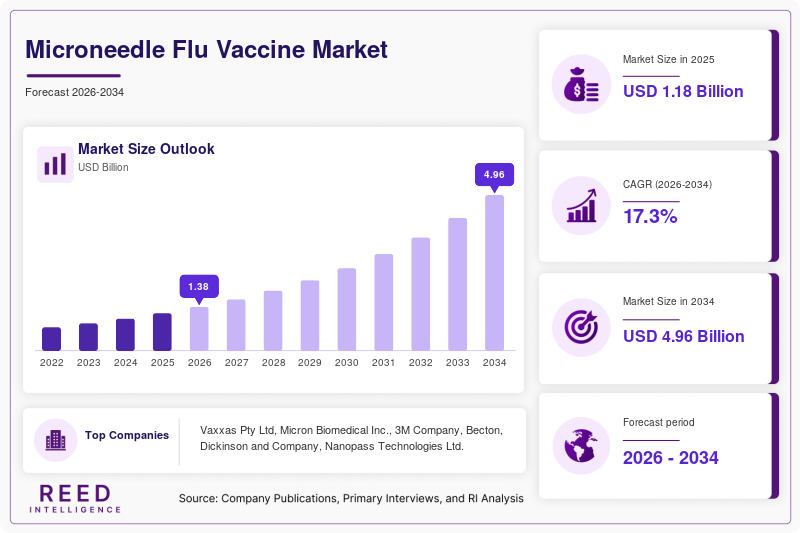
Key Highlights
- North America dominated the market with a share of 38.6% in 2025, while Asia Pacific is expected to grow fastest at a CAGR of 19.1%.
- By type, solid microneedles led with 41.2% share, whereas dissolving microneedles are projected to grow at 18.5% CAGR.
- By end-use, hospitals dominated with 46.8% share, while homecare settings are expected to grow fastest at 20.2% CAGR.
- The United States market was valued at USD 420 million in 2025 and is expected to reach USD 480 million in 2026.
Market Trends
Expansion of Self-Administration Vaccination Models
The shift toward self-administration is a defining trend in the Microneedle Flu Vaccine Market. Microneedle patches are designed for ease of use, allowing patients to administer vaccines without medical supervision. This trend is particularly relevant in rural and underserved areas where healthcare access is limited. Additionally, the convenience of self-application is increasing acceptance among working populations, contributing to improved vaccination rates.
Integration of Smart Drug Delivery Technologies
The integration of smart technologies, such as sensor-enabled patches and controlled-release systems, is shaping the market landscape. These innovations enable real-time monitoring of vaccine delivery and dosage accuracy. Companies are developing microneedle systems that provide feedback on application success, ensuring optimal immunization outcomes. This trend is expected to enhance clinical reliability and drive adoption among healthcare providers and regulatory bodies.
Market Drivers
Rising Demand for Pain-Free Vaccination Solutions
The growing preference for minimally invasive healthcare solutions is driving the adoption of microneedle flu vaccines. Traditional injections often cause discomfort and needle-related anxiety, which can deter individuals from receiving annual flu shots. Microneedle technology eliminates these barriers by offering a virtually painless alternative, increasing vaccination uptake across all age groups.
Increasing Government Immunization Initiatives
Governments worldwide are expanding immunization programs to reduce the burden of seasonal influenza. Microneedle vaccines align with these initiatives by simplifying distribution and administration processes. Their ease of storage and transportation, compared to conventional vaccines, supports large-scale deployment in national vaccination campaigns.
Market Restraint
Regulatory and Manufacturing Complexities
Despite its advantages, the Microneedle Flu Vaccine Market faces challenges related to regulatory approvals and manufacturing scalability. Microneedle-based systems combine medical devices and pharmaceutical components, leading to complex regulatory pathways. Approval processes often require extensive clinical validation to demonstrate safety, efficacy, and consistency.
Additionally, manufacturing microneedle patches involves precision engineering and specialized materials, increasing production costs. Scaling up manufacturing while maintaining quality standards remains a significant hurdle for market participants. These factors can delay product commercialization and limit market penetration, particularly for smaller companies with limited resources.
Market Opportunities
Expansion in Emerging Markets
Emerging economies present significant growth opportunities for the Microneedle Flu Vaccine Market. Increasing healthcare investments, rising awareness of preventive care, and improving vaccination infrastructure are driving demand. Microneedle vaccines are particularly suitable for these regions due to their ease of use and reduced reliance on cold-chain logistics.
Development of Combination Vaccines
The development of combination vaccines using microneedle technology is an emerging opportunity. Researchers are exploring the delivery of multiple antigens through a single patch, enabling protection against multiple strains or diseases simultaneously. This approach can improve patient compliance and reduce healthcare costs, making it attractive for both providers and patients.
Segmental Analysis
By Type
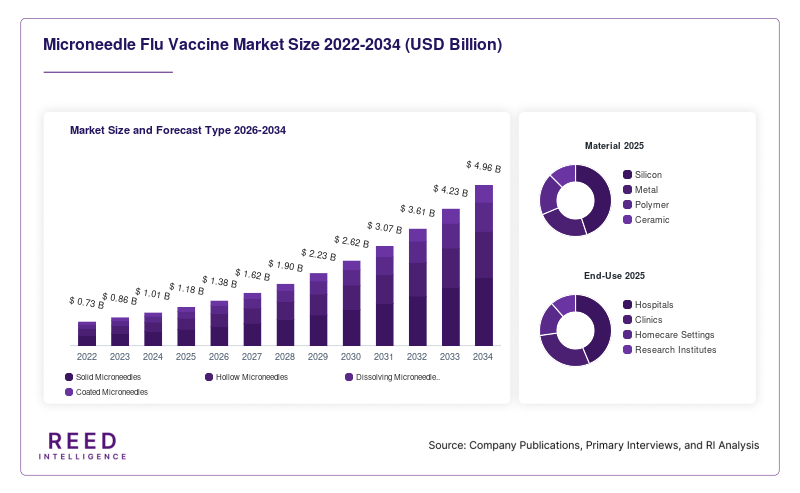
Solid microneedles dominated the Microneedle Flu Vaccine Market with a 41.2% share in 2025, owing to their established use and reliability in vaccine delivery. These microneedles are widely adopted due to their structural strength and ease of manufacturing.
Dissolving microneedles are expected to grow at the fastest CAGR of 18.5% during the forecast period. Their ability to dissolve in the skin eliminates biohazard waste and enhances patient safety. This unique feature will drive their adoption in large-scale immunization programs.
By Material
Silicon-based microneedles accounted for the largest share of 36.7% in 2025, due to their precision and compatibility with microfabrication technologies.
Polymer-based microneedles are projected to grow at a CAGR of 18.9%, driven by their biocompatibility and cost-effectiveness. These materials allow for flexible designs and are suitable for dissolving microneedle applications.
By End-Use
Hospitals dominated the market with a 46.8% share in 2025, as they remain primary centers for vaccination programs and clinical trials.
Homecare settings are expected to grow at a CAGR of 20.2%, supported by the increasing availability of user-friendly microneedle patches. The convenience of self-administration will drive this segment’s growth.
By Distribution Channel
Hospital pharmacies held the largest share at 42.5% in 2025, due to centralized vaccine distribution systems.
Online pharmacies are projected to grow at a CAGR of 19.7%, driven by the expansion of e-commerce platforms and digital healthcare services. Increased consumer preference for online purchasing will support this growth.
Regional Analysis
North America
North America accounted for 38.6% of the global Microneedle Flu Vaccine Market share in 2025 and is projected to grow at a CAGR of 16.8% during the forecast period. The region’s growth is driven by advanced healthcare infrastructure and early adoption of innovative vaccine delivery systems. Strong research and development capabilities and high healthcare expenditure contribute to market expansion.
The United States dominated the regional market due to robust funding for vaccine innovation and widespread awareness of influenza prevention. The presence of leading biotechnology firms and ongoing clinical trials for microneedle vaccines are key growth factors. Additionally, favorable reimbursement policies support market penetration.
Europe
Europe held a 27.4% share in 2025 and is expected to grow at a CAGR of 16.2%. The region benefits from strong government support for vaccination programs and increasing investments in advanced healthcare technologies.
Germany emerged as the dominant country, driven by its well-established pharmaceutical industry and focus on preventive healthcare. Public health initiatives promoting seasonal flu vaccination and technological advancements in drug delivery systems are contributing to market growth.
Asia Pacific
Asia Pacific accounted for 21.3% of the market share in 2025 and is anticipated to grow at the fastest CAGR of 19.1%. Rapid urbanization, increasing healthcare awareness, and rising disposable incomes are key growth drivers.
China dominated the region due to its large population base and expanding healthcare infrastructure. Government initiatives to improve vaccination coverage and investments in biotechnology research are accelerating market growth.
Middle East & Africa
The Middle East & Africa held 7.2% of the market share in 2025 and is projected to grow at a CAGR of 15.4%. The region is witnessing gradual improvements in healthcare infrastructure and increasing awareness of preventive healthcare.
Saudi Arabia led the regional market, supported by government-led healthcare reforms and investments in advanced medical technologies. Efforts to modernize healthcare systems are driving adoption of innovative vaccination methods.
Latin America
Latin America accounted for 5.5% of the market share in 2025 and is expected to grow at a CAGR of 15.9%. Increasing healthcare expenditure and rising awareness of influenza vaccination are supporting market growth.
Brazil dominated the region due to its large population and government-supported immunization programs. The country’s focus on expanding vaccination coverage and improving healthcare access is driving demand for microneedle flu vaccines.

Competitive Landscape
The Microneedle Flu Vaccine Market is moderately competitive, with several global and regional players focusing on product innovation and strategic partnerships. Companies are investing in research and development to enhance microneedle technology and expand their product portfolios.
A leading player in the market is Vaxxas Pty Ltd, known for its advanced microneedle patch technology. The company recently announced progress in clinical trials for its influenza vaccine patch, demonstrating strong immunogenic response and user acceptance.
Other key players are focusing on collaborations with pharmaceutical companies and research institutions to accelerate commercialization. Strategic initiatives such as mergers, acquisitions, and product launches are shaping the competitive landscape.
Key Players List
- Vaxxas Pty Ltd
- Micron Biomedical Inc.
- 3M Company
- Becton, Dickinson and Company
- Nanopass Technologies Ltd.
- Zosano Pharma Corporation
- Corium International Inc.
- Valeritas Holdings Inc.
- Debiotech S.A.
- Raphas Co., Ltd.
- Nitto Denko Corporation
- Kindeva Drug Delivery
- Hisamitsu Pharmaceutical Co., Inc.
- PharmaJet Inc.
- Vaxess Technologies Inc.
Recent Developments
- 2024: Vaxxas Pty Ltd advanced its influenza microneedle patch into late-stage clinical trials.
- 2024: Micron Biomedical expanded its manufacturing facility to scale production capabilities.
- 2023: Raphas Co., Ltd. launched a new dissolving microneedle platform for vaccine delivery.
- 2023: 3M Company invested in microneedle-based drug delivery research.
- 2023: Nanopass Technologies partnered with pharmaceutical firms to develop next-generation vaccine patches.
Microneedle Flu Vaccine Market Segments
Type
- Solid Microneedles
- Hollow Microneedles
- Dissolving Microneedles
- Coated Microneedles
Material
- Silicon
- Metal
- Polymer
- Ceramic
End-Use
- Hospitals
- Clinics
- Homecare Settings
- Research Institutes
Distribution Channel
- Hospital Pharmacies
- Retail Pharmacies
- Online Pharmacies
By Region
- North America
- Europe
- APAC
- Middle East and Africa
- LATAM