Micronized PTFE Market Size, Share & Demand Report By Type (Modified Micronized PTFE, Unmodified Micronized PTFE), By Application (Coatings, Lubricants, Inks, Plastics), By End-Use Industry (Automotive, Electronics, Construction, Industrial Manufacturing) & Segment Forecasts, 2025–2034
USD 3950
Market Overview
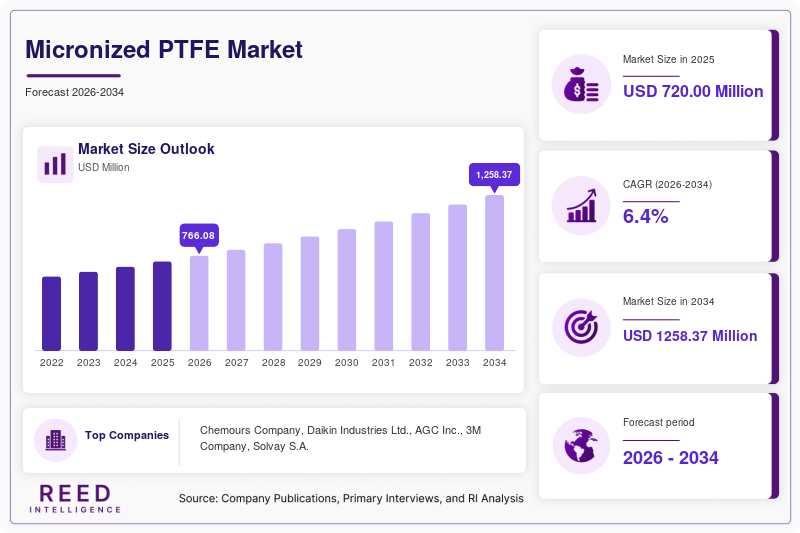
The Micronized PTFE Market size is experiencing steady expansion, supported by rising demand across coatings, lubricants, plastics, and printing inks. In 2025, the global micronized PTFE market size is estimated to reach USD 720 million, followed by an increase to approximately USD 760 million in 2026. The market is projected to achieve a valuation of USD 1250 million by 2034, registering a CAGR of 6.4% during the forecast period (2025–2034).
Micronized polytetrafluoroethylene (PTFE) powders are widely utilized as performance-enhancing additives due to their low friction coefficient, chemical resistance, and thermal stability. These properties make them suitable for improving wear resistance, scratch resistance, and lubrication in industrial formulations. The increasing use of high-performance coatings in automotive, construction, and industrial machinery sectors is a major contributor to market growth.
Key Highlights
- Market size reached USD 720 million in 2025 and is projected to reach USD 1.25 billion by 2034
- CAGR of 6.4% during 2025–2034
- Strong demand from coatings and lubricant industries
- Increasing adoption in eco-friendly formulations
- Growth driven by automotive and industrial sectors
Market Trends
Increasing Use in Water-Based Coatings
The transition toward environmentally compliant formulations is shaping the micronized PTFE market. Manufacturers are increasingly incorporating micronized PTFE in water-based coatings to reduce environmental impact without compromising performance. These coatings offer improved abrasion resistance, slip properties, and durability, making them suitable for industrial and architectural applications. Regulatory pressure to reduce VOC emissions is pushing companies to adopt sustainable materials, which has accelerated the use of micronized PTFE in green coatings. Additionally, innovation in dispersion technologies has improved compatibility with aqueous systems, further supporting this trend.
Rising Demand for High-Performance Lubricants
Micronized PTFE is gaining traction in advanced lubricant formulations due to its ability to reduce friction and wear under extreme conditions. Industries such as automotive, aerospace, and heavy machinery are increasingly adopting these lubricants to enhance equipment efficiency and lifespan. The growing focus on energy efficiency and reduced maintenance costs is encouraging the use of PTFE-based additives. Moreover, the expansion of electric vehicles and precision machinery is creating demand for specialized lubrication solutions, positioning micronized PTFE as a critical component in next-generation lubricant technologies.
Market Drivers
Expansion of the Automotive Industry
The automotive sector plays a significant role in driving the micronized PTFE market. The demand for lightweight, durable, and high-performance materials has increased as manufacturers aim to improve fuel efficiency and reduce emissions. Micronized PTFE is used in coatings, seals, and lubricants to enhance performance and durability. With the rise of electric vehicles, there is a growing need for advanced materials that can withstand higher temperatures and provide efficient lubrication. This trend is expected to sustain demand for micronized PTFE in automotive applications over the forecast period.
Growth in Industrial Coatings Applications
Industrial coatings represent a major application area for micronized PTFE, as they require enhanced durability and resistance to harsh environments. The material improves scratch resistance, corrosion protection, and surface smoothness. Industries such as construction, marine, and manufacturing are increasingly adopting PTFE-based coatings to extend the lifespan of equipment and infrastructure. The ongoing industrialization in emerging economies is further boosting demand for protective coatings, thereby driving the growth of the micronized PTFE market.
Market Restraint
High Production Costs and Processing Challenges
The micronized PTFE market faces challenges related to high production costs and complex processing requirements. Manufacturing micronized PTFE involves specialized techniques such as irradiation and thermal degradation, which increase operational expenses. Additionally, maintaining uniform particle size distribution and ensuring compatibility with various formulations can be technically demanding. These factors limit the adoption of micronized PTFE among small and medium-scale manufacturers. For example, companies producing low-cost coatings may opt for alternative additives to reduce production expenses, which can hinder market growth. Furthermore, fluctuations in raw material prices and regulatory compliance costs add to the overall financial burden, affecting profit margins and slowing market expansion.
Market Opportunities
Growth in Emerging Economies
Emerging economies present significant growth opportunities for the micronized PTFE market. Rapid industrialization, urbanization, and infrastructure development are increasing demand for high-performance materials. Countries in Asia Pacific and Latin America are investing in construction and manufacturing sectors, creating a strong need for advanced coatings and lubricants. The rising middle class and increasing consumer spending are also driving demand for durable and high-quality products. This trend is expected to create new revenue streams for manufacturers and expand market reach in developing regions.
Advancements in Polymer Technology
Technological advancements in polymer science are opening new avenues for the micronized PTFE market. Innovations in dispersion techniques and surface modification are improving the compatibility of PTFE with various materials. This enables its use in advanced applications such as 3D printing, electronics, and medical devices. Additionally, research into hybrid materials and nanocomposites is expanding the functional capabilities of micronized PTFE. These developments are expected to enhance product performance and create new application areas, driving long-term market growth.
Segmental Analysis
By Type
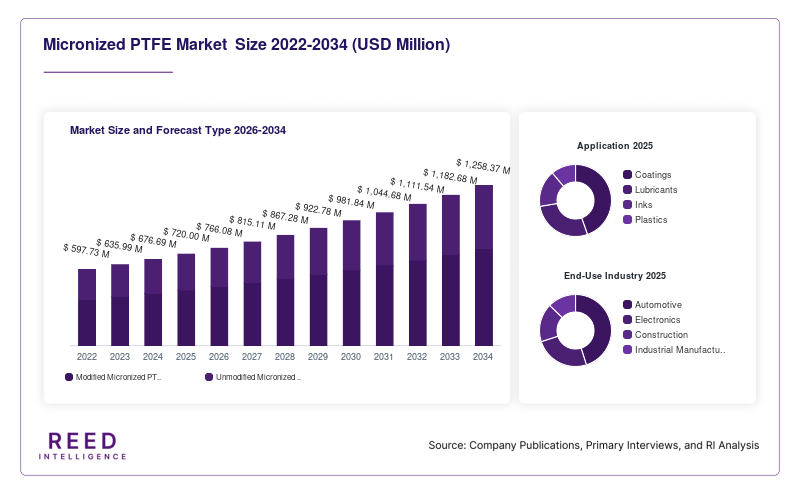
The modified micronized PTFE segment dominated the market in 2024, accounting for approximately 58% of the total share. Modified PTFE offers improved compatibility with other materials, making it suitable for a wide range of applications. Its enhanced dispersion properties and performance characteristics make it a preferred choice in coatings and lubricants. The increasing demand for high-performance materials in industrial applications is driving the growth of this segment. Additionally, advancements in modification techniques are improving product quality and expanding application areas.
The unmodified micronized PTFE segment is expected to be the fastest-growing, with a CAGR of 6.8% during the forecast period. This growth is attributed to its cost-effectiveness and suitability for basic applications. Industries seeking affordable solutions are increasingly adopting unmodified PTFE for standard coatings and lubrication needs. The rising demand from small and medium enterprises is further supporting segment growth.
By Application
The coatings segment held the largest share of 46% in 2024, driven by the increasing demand for protective and decorative coatings. Micronized PTFE enhances scratch resistance, durability, and surface smoothness, making it ideal for industrial and architectural coatings. The growing construction and automotive industries are major contributors to this segment’s growth.
The lubricants segment is expected to witness the fastest growth, with a CAGR of 7.1%. The increasing need for high-performance lubrication solutions in automotive and industrial machinery is driving this segment. Micronized PTFE reduces friction and wear, improving equipment efficiency and lifespan. The expansion of electric vehicles is also contributing to the growth of this segment.
By End-Use Industry
The automotive industry dominated the market in 2024, accounting for 34% of the total share. The use of micronized PTFE in coatings, seals, and lubricants enhances vehicle performance and durability. The increasing production of vehicles and the shift toward electric mobility are driving demand in this segment.
The electronics industry is projected to be the fastest-growing segment, with a CAGR of 7.3%. The demand for advanced materials in electronic components is increasing, driven by miniaturization and technological advancements. Micronized PTFE is used in insulation and protective coatings, supporting the growth of this segment.
Regional Analysis
North America
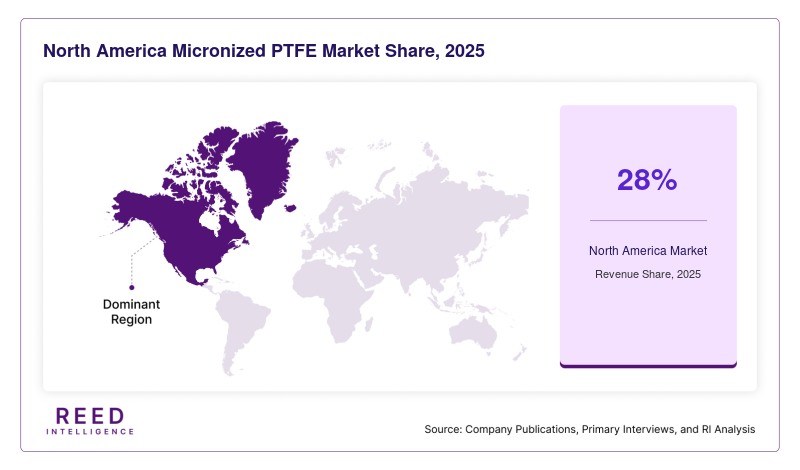
North America accounted for approximately 28% of the global micronized PTFE market share in 2025 and is expected to grow at a CAGR of 5.8% during the forecast period. The region benefits from a well-established industrial base and high adoption of advanced materials in automotive and aerospace sectors. Increasing demand for high-performance coatings and lubricants is supporting market growth. Additionally, stringent environmental regulations are encouraging the use of eco-friendly formulations.
The United States dominates the regional market due to its strong manufacturing sector and focus on innovation. A key growth factor is the increasing adoption of electric vehicles, which require advanced lubrication and thermal management solutions. This trend is driving demand for micronized PTFE in automotive applications.
Europe
Europe held a market share of around 24% in 2025 and is projected to grow at a CAGR of 5.6%. The region’s focus on sustainability and environmental regulations is driving the adoption of water-based coatings and eco-friendly materials. The presence of established automotive and industrial sectors further supports market growth.
Germany leads the European market, driven by its strong automotive and engineering industries. A unique growth factor is the emphasis on sustainable manufacturing practices, which is increasing the use of micronized PTFE in low-VOC coatings and environmentally compliant products.
Asia Pacific
Asia Pacific accounted for the largest share of 32% in 2025 and is expected to grow at the highest CAGR of 7.4%. Rapid industrialization, urbanization, and expanding manufacturing activities are driving demand for micronized PTFE. The region is also witnessing increased investment in infrastructure and construction projects.
China dominates the Asia Pacific market due to its large manufacturing base and growing demand for high-performance materials. A key growth factor is the expansion of the construction industry, which is increasing the use of PTFE-based coatings for durability and protection.
Middle East & Africa
The Middle East & Africa region held a market share of 8% in 2025 and is expected to grow at a CAGR of 6.1%. The region is experiencing growth in construction and oil & gas industries, which are major consumers of protective coatings and lubricants.
Saudi Arabia leads the regional market, supported by large-scale infrastructure projects and industrial development. A unique growth factor is the increasing investment in oil & gas exploration, which requires high-performance materials capable of withstanding extreme conditions.
Latin America
Latin America accounted for approximately 8% of the market share in 2025 and is projected to grow at a CAGR of 6.0%. The region is witnessing growth in manufacturing and construction sectors, which is driving demand for advanced materials.
Brazil dominates the Latin American market due to its expanding industrial base. A key growth factor is the increasing demand for durable coatings in infrastructure projects, which is boosting the use of micronized PTFE.
Competitive Landscape
The micronized PTFE market is moderately consolidated, with several global and regional players competing based on product quality, innovation, and pricing. Leading companies are focusing on expanding their product portfolios and investing in research and development to enhance performance characteristics. Strategic collaborations and mergers are also common to strengthen market presence.
A leading player in the market is Chemours, which has a strong global presence and extensive product offerings. The company focuses on innovation and sustainability to maintain its competitive position. Recent developments include the introduction of advanced PTFE formulations designed for eco-friendly applications. Other key players are also investing in capacity expansion and technological advancements to meet growing demand.
Key Players List
- Chemours Company
- Daikin Industries Ltd.
- AGC Inc.
- 3M Company
- Solvay S.A.
- Gujarat Fluorochemicals Limited
- Shamrock Technologies
- Micro Powders Inc.
- Fluoro-Plastics Inc.
- Kitamura Limited
- Mitsui Chemicals Inc.
- Dongyue Group
- Hubei Everflon Polymer
- Zhejiang Juhua Co. Ltd.
- Jiangsu Meilan Chemical
Recent Developments
- In 2024, a major manufacturer introduced a new line of micronized PTFE powders designed for water-based coatings, improving environmental compliance.
- In 2025, a leading company expanded its production capacity in Asia Pacific to meet rising regional demand.
- In 2025, a strategic partnership was formed between two industry players to develop advanced PTFE-based lubricant solutions for electric vehicles.
Micronized PTFE Market Segments
Type
- Modified Micronized PTFE
- Unmodified Micronized PTFE
Application
- Coatings
- Lubricants
- Inks
- Plastics
End-Use Industry
- Automotive
- Electronics
- Construction
- Industrial Manufacturing
By Region
- North America
- Europe
- APAC
- Middle East and Africa
- LATAM