Micronized Wax Market Size, Share & Demand Report By Type (Polyethylene Wax, Polypropylene Wax, Fischer-Tropsch Wax, Others), By Application (Coatings, Printing Inks, Plastics, Adhesives, Others), By End-Use Industry (Packaging, Automotive, Construction, Textile, Others), By Region & Segment Forecasts, 2026–2034
USD 3950
Market Overview
The global Micronized Wax Market was valued at approximately USD 1.48 billion in 2026 and is projected to reach USD 2.76 billion by 2034, expanding at a CAGR of 8.1% during 2026–2034. The market growth is primarily driven by increasing demand for high-performance additives in coatings, inks, and plastics. Micronized waxes, known for their fine particle size and enhanced dispersion properties, are widely used to improve abrasion resistance, surface smoothness, and matting effects across industrial applications.
A key global factor supporting market expansion is the rising adoption of advanced coatings technologies across automotive, packaging, and construction industries. As manufacturers prioritize product durability and aesthetic appeal, micronized waxes have gained traction as essential formulation components. Additionally, the shift toward water-based and eco-friendly coatings has encouraged the use of synthetic and bio-based micronized wax variants, further accelerating market growth.
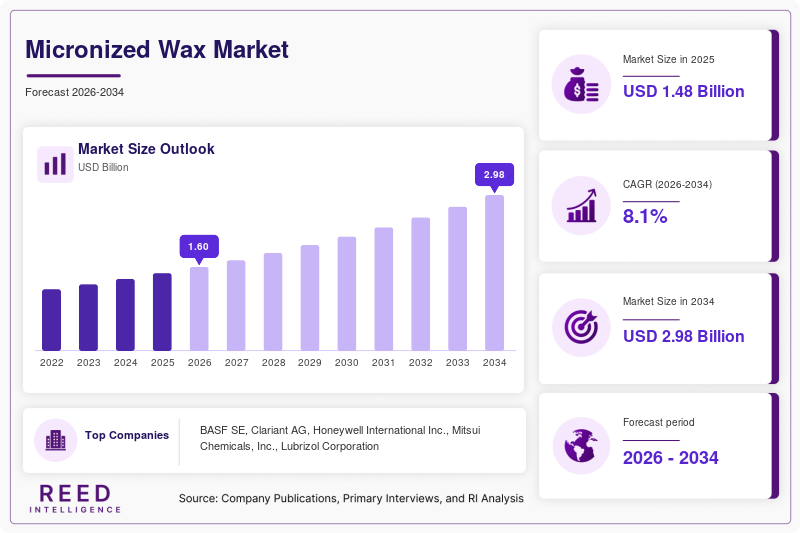
Key Highlights
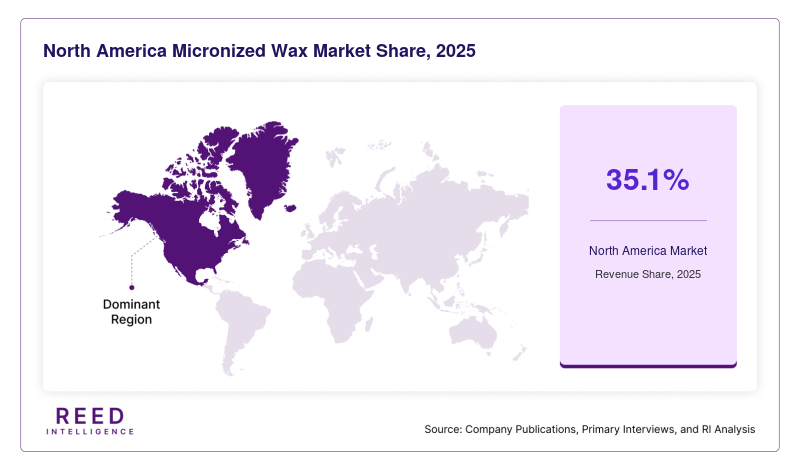
- North America dominated the market with a 35.1% share in 2025.
- Asia Pacific is expected to grow at the fastest CAGR of 9.4% during 2026–2034.
- By type, polyethylene wax accounted for the largest share of 42.3%.
- while polypropylene wax is projected to grow at a CAGR of 9.1%.
- By application, coatings led with a 39.6% share, whereas printing inks are expected to expand at a CAGR of 8.8%.
- The United States remained the dominant country, with market values of USD 520 million in 2024 and USD 565 million in 2025.
Market Trends
Increasing Shift Toward Eco-Friendly and Bio-Based Waxes
One of the prominent trends in the Micronized Wax Market is the growing inclination toward eco-friendly and bio-based wax products. Regulatory frameworks focused on reducing environmental impact have encouraged manufacturers to develop sustainable alternatives derived from natural sources such as plant-based waxes. These materials are gaining adoption in coatings and packaging applications where environmental compliance is critical. Additionally, end-users are seeking products with lower volatile organic compound (VOC) emissions, pushing innovation in formulation chemistry. This trend is particularly visible in Europe and North America, where sustainability standards are stringent. As a result, companies are investing in research and development to produce biodegradable and renewable micronized waxes without compromising performance attributes such as hardness and dispersion efficiency.
Rising Demand from High-Performance Coatings Applications
Another key trend is the increasing use of micronized wax in high-performance coatings across automotive, industrial, and construction sectors. These waxes enhance scratch resistance, slip properties, and surface protection, making them essential additives in premium coating formulations. The automotive industry, in particular, is driving demand as manufacturers focus on improving vehicle aesthetics and durability. Additionally, architectural coatings are evolving to meet higher performance standards, including weather resistance and long-term stability. The integration of micronized wax into advanced coating systems supports these requirements, leading to increased consumption. Continuous product innovation, including ultra-fine particle sizes and improved compatibility with resin systems, is further strengthening this trend globally.
Market Drivers
Expansion of the Global Coatings and Paints Industry
The rapid expansion of the global coatings and paints industry is a significant driver for the Micronized Wax Market. Increasing construction activities, infrastructure development, and automotive production have fueled demand for protective and decorative coatings. Micronized wax plays a critical role in improving surface properties such as gloss control, scratch resistance, and anti-blocking characteristics. As end-users demand higher performance coatings, manufacturers are incorporating advanced additives, including micronized waxes, into formulations. The growing popularity of water-based coatings has further boosted demand, as micronized wax provides compatibility and enhanced performance in these systems. Emerging economies, particularly in Asia Pacific, are witnessing increased investments in infrastructure, which is accelerating the adoption of coatings and, consequently, micronized wax products.
Growing Use in Printing Inks and Packaging Applications
Another major driver is the rising utilization of micronized wax in printing inks and packaging solutions. The packaging industry has experienced steady growth due to increasing consumer demand for packaged goods, especially in food and e-commerce sectors. Micronized wax improves rub resistance, slip properties, and print quality, making it a preferred additive in ink formulations. Additionally, advancements in digital printing technologies have increased the need for specialized inks that can deliver high-quality output on various substrates. This has driven the demand for micronized wax with tailored particle sizes and performance characteristics. As the global packaging industry continues to evolve, the demand for high-performance inks and coatings is expected to support sustained market growth.
Market Restraint
Volatility in Raw Material Prices and Supply Chain Constraints
One of the key restraints affecting the Micronized Wax Market is the volatility in raw material prices and associated supply chain challenges. Micronized waxes are primarily derived from petroleum-based sources such as polyethylene and polypropylene, making them highly sensitive to fluctuations in crude oil prices. Any instability in global oil markets directly impacts production costs, which can reduce profit margins for manufacturers. Additionally, supply chain disruptions, including transportation delays and geopolitical uncertainties, have created challenges in maintaining consistent raw material availability.
These factors often lead to price fluctuations in the final product, affecting purchasing decisions among end-users, particularly small and medium-sized enterprises. For example, during periods of supply shortages, manufacturers may face difficulties in fulfilling large-scale orders, resulting in delayed project timelines in industries such as construction and automotive. Furthermore, the dependency on petrochemical derivatives limits the adoption of micronized wax in regions with strict environmental regulations. Although bio-based alternatives are emerging, their higher production costs and limited scalability continue to restrict widespread adoption. Overall, these challenges create uncertainty in the market and may hinder long-term growth prospects.
Market Opportunities
Rising Demand in Emerging Economies
Emerging economies present significant growth opportunities for the Micronized Wax Market due to rapid industrialization and urbanization. Countries in Asia Pacific, Latin America, and parts of Africa are witnessing increased investments in construction, automotive manufacturing, and packaging industries. These sectors require high-performance coatings and inks, which in turn drive the demand for micronized wax. Additionally, improving economic conditions and rising disposable incomes are boosting consumption of packaged goods, further supporting market expansion. Governments in these regions are also investing in infrastructure development, creating a favorable environment for the coatings and plastics industries. As local manufacturers expand production capacities, the demand for micronized wax is expected to increase substantially.
Technological Advancements in Micronization Processes
Technological advancements in micronization processes offer another promising opportunity for market growth. Innovations in grinding and classification techniques have enabled the production of ultra-fine wax particles with improved uniformity and performance characteristics. These advancements enhance the functionality of micronized wax in applications such as coatings, inks, and plastics. Additionally, the development of hybrid wax formulations that combine different material properties is gaining traction. Such products offer improved durability, better dispersion, and enhanced compatibility with various systems. As manufacturers continue to invest in advanced technologies, the availability of high-performance micronized wax products is expected to expand, opening new application areas and driving market growth.
Segmental Analysis
By Type
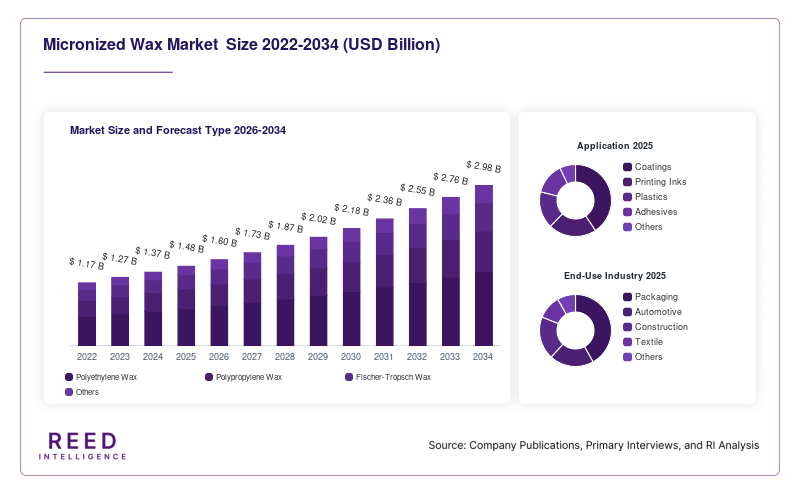
Polyethylene wax emerged as the dominant subsegment in the Micronized Wax Market, accounting for approximately 42.3% of the total share in 2024. Its widespread use is attributed to its excellent hardness, chemical resistance, and compatibility with various formulations. Polyethylene wax is extensively used in coatings, inks, and plastics to improve surface properties such as abrasion resistance and gloss control. Additionally, its cost-effectiveness and availability make it a preferred choice among manufacturers. The increasing demand for high-performance coatings in automotive and construction industries has further strengthened the position of polyethylene wax in the market.
Polypropylene wax is expected to be the fastest-growing subsegment, with a projected CAGR of 9.1% during the forecast period. This growth is driven by its superior thermal stability and enhanced slip properties compared to polyethylene wax. Polypropylene wax is gaining popularity in applications requiring high-temperature resistance and improved durability. Additionally, advancements in production technologies have enabled the development of high-quality polypropylene wax with better performance characteristics. The increasing adoption of advanced coatings and inks is expected to drive the demand for this subsegment in the coming years.
By Application
Coatings dominated the application segment, holding a share of approximately 39.6% in 2024. The use of micronized wax in coatings enhances surface protection, scratch resistance, and aesthetic properties. The growing demand for high-performance coatings in automotive, construction, and industrial applications has driven the adoption of micronized wax. Additionally, the shift toward water-based coatings has increased the need for additives that improve performance and durability. Manufacturers are focusing on developing specialized wax formulations to meet the evolving requirements of the coatings industry.
Printing inks are projected to be the fastest-growing application segment, with a CAGR of 8.8% during the forecast period. The increasing demand for high-quality printing in packaging and labeling applications is driving the growth of this segment. Micronized wax improves ink performance by enhancing rub resistance, slip properties, and print quality. The rapid growth of e-commerce and the packaging industry has further boosted the demand for advanced printing inks. As digital printing technologies continue to evolve, the demand for micronized wax in ink formulations is expected to increase significantly.
By End-Use Industry
The packaging industry emerged as the dominant end-use segment, accounting for approximately 36.8% of the market share in 2024. The growth of this segment is driven by increasing consumer demand for packaged goods, particularly in food and beverages. Micronized wax is widely used in packaging applications to improve coating and printing ink performance. Additionally, the rise of e-commerce has led to increased demand for durable and high-quality packaging materials, further supporting market growth.
The automotive industry is expected to be the fastest-growing end-use segment, with a projected CAGR of 8.9% during the forecast period. The demand for advanced coatings and materials in automotive manufacturing is driving the adoption of micronized wax. These waxes enhance surface properties, improve durability, and provide protection against environmental factors. The increasing production of vehicles and the growing focus on aesthetics and performance are expected to drive the demand for micronized wax in the automotive sector.
Regional Analysis
North America
North America held a dominant position in the Micronized Wax Market, accounting for approximately 35.1% of the global share in 2025. The region is expected to grow at a steady CAGR of 7.5% during the forecast period. The presence of well-established coatings and printing ink industries, along with strong demand from automotive and packaging sectors, has contributed to market leadership. Additionally, technological advancements and early adoption of high-performance additives have supported market growth. The region also benefits from a robust research and development ecosystem, enabling continuous product innovation.
The United States remains the dominant country in North America, driven by its extensive industrial base and high demand for advanced coatings. A key growth factor is the increasing adoption of sustainable and water-based coatings, which require specialized additives such as micronized wax. The country’s strong focus on environmental regulations has encouraged manufacturers to develop eco-friendly solutions, further driving demand for innovative wax products.
Europe
Europe accounted for a significant share of the Micronized Wax Market in 2025, contributing around 27.4% of global revenue. The region is projected to grow at a CAGR of 7.8% during the forecast period. The presence of stringent environmental regulations has accelerated the shift toward sustainable coatings and inks, boosting the demand for bio-based and synthetic micronized waxes. Additionally, the region’s strong automotive and construction industries continue to support market growth.
Germany is the leading country in the European market, supported by its advanced manufacturing sector and strong emphasis on quality standards. A unique growth factor is the increasing investment in green technologies and sustainable materials. German manufacturers are focusing on reducing carbon footprints, which has led to increased adoption of environmentally friendly micronized wax products in industrial applications.
Asia Pacific
Asia Pacific is the fastest-growing region in the Micronized Wax Market, with a projected CAGR of 9.4% during 2026–2034. The region held a share of approximately 24.8% in 2025 and is expected to witness significant expansion. Rapid industrialization, urbanization, and infrastructure development are key factors driving market growth. The increasing demand for coatings, plastics, and packaging materials in countries such as China and India is boosting the consumption of micronized wax.
China dominates the Asia Pacific market due to its large manufacturing base and high production capacity. A key growth factor is the rapid expansion of the construction and automotive industries, which require advanced coatings and materials. Government initiatives supporting industrial growth and infrastructure development have further accelerated the demand for micronized wax in the region.
Middle East & Africa
The Middle East & Africa region accounted for a smaller share of the Micronized Wax Market, approximately 6.5% in 2025, but is expected to grow at a CAGR of 8.3%. The market is driven by increasing investments in construction and infrastructure projects, particularly in the Gulf Cooperation Council (GCC) countries. The growing demand for protective coatings in harsh environmental conditions is supporting the use of micronized wax.
Saudi Arabia is the dominant country in this region, primarily due to its large-scale construction and industrial projects. A unique growth factor is the region’s extreme climatic conditions, which require durable coatings with enhanced resistance properties. This has increased the demand for micronized wax as an additive to improve coating performance and longevity.
Latin America
Latin America held a market share of approximately 6.2% in 2025 and is expected to grow at a CAGR of 7.9% during the forecast period. The region’s growth is supported by increasing industrial activities and expanding packaging and automotive sectors. Economic development and rising consumer demand for packaged goods are contributing to the growth of the micronized wax market.
Brazil is the leading country in Latin America, driven by its strong industrial base and growing manufacturing sector. A key growth factor is the expansion of the packaging industry, fueled by increasing demand for consumer goods. This has led to higher consumption of printing inks and coatings, thereby boosting the demand for micronized wax in the region.
Competitive Landscape
The Micronized Wax Market is characterized by the presence of several global and regional players competing on product quality, innovation, and pricing strategies. Key companies are focusing on expanding their product portfolios and investing in research and development to enhance performance characteristics. Strategic collaborations, mergers, and acquisitions are common in the market as companies aim to strengthen their market position.
A leading player in the market is BASF SE, which has established a strong presence through its extensive product portfolio and global distribution network. The company has recently introduced advanced micronized wax formulations designed for high-performance coatings, reflecting its focus on innovation. Other major players are also investing in sustainable product development to meet growing environmental regulations.
The competitive landscape is expected to remain dynamic, with increasing emphasis on technological advancements and product differentiation. Companies that can offer high-quality, cost-effective, and environmentally friendly solutions are likely to gain a competitive edge in the market.
Key Players List
- BASF SE
- Clariant AG
- Honeywell International Inc.
- Mitsui Chemicals, Inc.
- Lubrizol Corporation
- Michelman, Inc.
- BYK Additives & Instruments
- Arkema Group
- Sasol Limited
- Croda International Plc
- Evonik Industries AG
- The Dow Chemical Company
- Shamrock Technologies
- Paramelt B.V.
- Trecora Resources
Recent Developments
- In 2025, BASF SE launched a new range of micronized wax products designed for water-based coatings with enhanced dispersion properties.
- In 2024, Clariant AG expanded its production capacity for specialty waxes to meet increasing demand from the packaging industry.
- In 2025, Lubrizol Corporation introduced advanced micronized wax additives aimed at improving scratch resistance in automotive coatings.
Micronized Wax Market Segments
Type
- Polyethylene Wax
- Polypropylene Wax
- Fischer-Tropsch Wax
- Others
Application
- Coatings
- Printing Inks
- Plastics
- Adhesives
- Others
End-Use Industry
- Packaging
- Automotive
- Construction
- Textile
- Others
By Region
- North America
- Europe
- APAC
- Middle East and Africa
- LATAM