Microscope Digital Camera Market Size, Share & Demand Report By Product Type (CMOS Cameras, CCD Cameras, sCMOS Cameras), By Application (Life Sciences Research, Industrial Inspection, Material Science, Education), By End-Use (Research Laboratories, Hospitals & Diagnostic Centers, Academic Institutions, Industrial Facilities), By Region & Segment Forecasts, 2026–2034
USD 3950
Market Overview
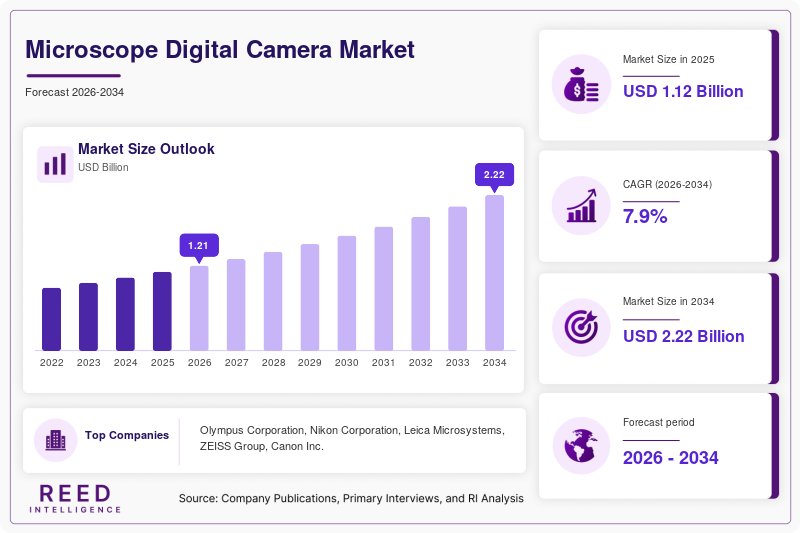
The global Microscope Digital Camera Market size was valued at approximately USD 1.12 billion in 2026 and is projected to reach around USD 2.05 billion by 2034, expanding at a compound annual growth rate (CAGR) of 7.9% during 2026–2034. The steady rise in life sciences research, coupled with increasing investments in nanotechnology and materials science, has supported consistent demand for high-resolution imaging solutions. Microscope digital cameras play a critical role in enabling precise visualization, documentation, and analysis across academic research, clinical diagnostics, and industrial quality inspection.
A key global factor contributing to market growth is the rapid expansion of biomedical research infrastructure. Governments and private organizations are allocating larger budgets toward disease research, drug discovery, and advanced diagnostics. This has increased the adoption of digital imaging systems integrated with microscopes, particularly in pathology labs and research institutions. The growing preference for automated imaging workflows and real-time data sharing is further enhancing product adoption across both developed and emerging markets.
Key Highlights
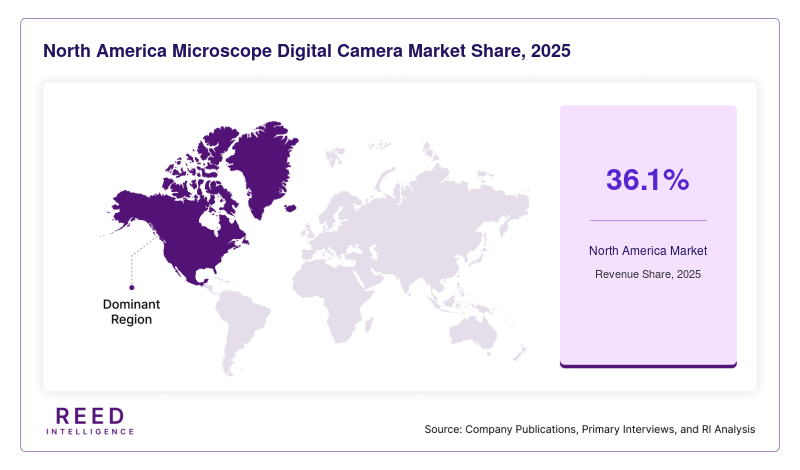
- North America dominated the market with a 36.1% share in 2025.
- Asia Pacific is expected to grow at the fastest CAGR of 9.8% during 2026–2034.
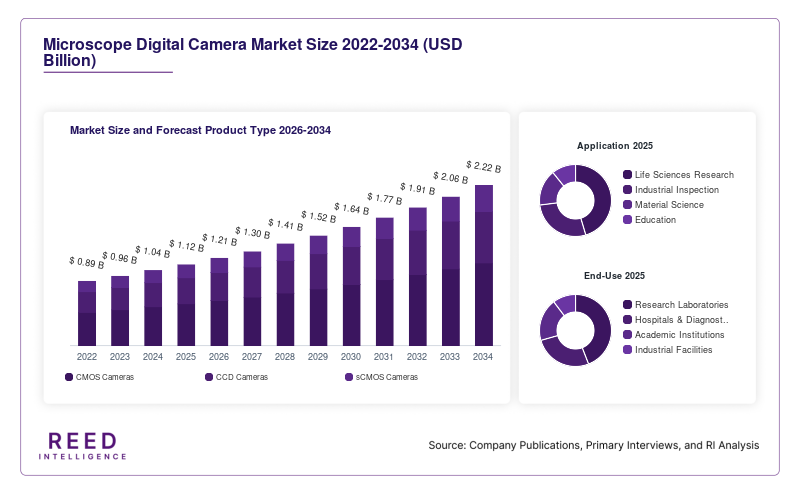
- By product type, CMOS cameras accounted for the largest share of 42.7%, while sCMOS cameras are projected to grow at a CAGR of 10.6%.
- By application, life sciences research led with a 44.3% share, whereas industrial inspection is expected to expand at a CAGR of 9.3%.
- The United States remained the dominant country, with market values of USD 390 million in 2024 and USD 425 million in 2025.
Market Trends
Integration of AI-powered imaging and analytics
The integration of artificial intelligence into microscope digital cameras is emerging as a defining trend shaping the market. AI-enabled systems enhance image acquisition, processing, and analysis by automating tasks such as object detection, cell counting, and anomaly identification. These capabilities are particularly valuable in clinical diagnostics and research workflows where accuracy and speed are essential. Laboratories are increasingly adopting AI-based imaging platforms to reduce human error and improve reproducibility of results.
Moreover, AI integration enables real-time decision-making, allowing researchers to analyze samples instantly without relying on time-consuming manual interpretation. This trend is further supported by advancements in machine learning algorithms and cloud-based platforms that allow seamless data storage and sharing. As digital pathology and precision medicine gain traction, AI-driven microscope cameras are expected to become a standard feature in modern laboratories, strengthening their demand across multiple applications.
Rising adoption of high-resolution and 4K imaging systems
The growing demand for high-resolution imaging solutions is another significant trend influencing the microscope digital camera market. Researchers and industrial users are increasingly prioritizing clarity and detail in microscopic imaging, leading to the adoption of 4K and ultra-high-definition camera systems. These advanced cameras provide superior image quality, enabling precise analysis of microstructures, biological tissues, and material surfaces.
High-resolution imaging is particularly important in applications such as semiconductor inspection, nanotechnology research, and advanced medical diagnostics. The ability to capture detailed images enhances accuracy in detecting defects, abnormalities, and structural variations. Additionally, improvements in sensor technology, including enhanced sensitivity and dynamic range, are supporting this trend. As industries continue to demand better visualization capabilities, the shift toward high-resolution microscope cameras is expected to accelerate, driving overall market growth.
Market Drivers
Expansion of life sciences and clinical research activities
The rapid expansion of life sciences research and clinical diagnostics is a major driver of the microscope digital camera market. Increasing prevalence of chronic diseases and the need for advanced diagnostic techniques have led to higher investments in laboratory infrastructure. Microscope digital cameras are essential tools in research and diagnostics, enabling detailed visualization and accurate documentation of biological samples.
Pharmaceutical companies, academic institutions, and research organizations are continuously upgrading their imaging systems to improve efficiency and data accuracy. The growing focus on personalized medicine and molecular diagnostics is further boosting demand for advanced imaging solutions. Additionally, the rise in government funding for biomedical research in emerging economies is creating new growth opportunities. As research activities continue to expand globally, the demand for high-performance microscope cameras is expected to increase significantly.
Growth in industrial inspection and quality control applications
The increasing adoption of microscope digital cameras in industrial inspection and quality control processes is another key driver of market growth. Industries such as electronics, automotive, and manufacturing rely heavily on microscopic imaging to ensure product quality and detect defects at early stages. Digital cameras integrated with microscopes provide high-resolution images that help identify structural inconsistencies and material flaws.
The shift toward automation and precision manufacturing has further accelerated the use of advanced imaging technologies. Companies are investing in digital inspection systems to improve efficiency and reduce production errors. Additionally, the rise of semiconductor manufacturing and microelectronics production is driving demand for high-performance microscope cameras. As industrial processes become more complex and quality standards more stringent, the adoption of digital imaging solutions is expected to grow steadily.
Market Restraint
High cost of advanced imaging systems and integration challenges
The high cost associated with advanced microscope digital cameras remains a significant restraint for market growth. High-resolution cameras, particularly those equipped with advanced sensors and AI capabilities, require substantial investment. This cost factor limits adoption among small laboratories, educational institutions, and organizations with constrained budgets. Additionally, integrating these cameras with existing microscope systems and software platforms can be technically challenging and expensive.
The complexity of installation and maintenance further adds to the overall cost of ownership. Many users require specialized training to operate advanced imaging systems effectively, which increases operational expenses. For instance, small-scale research labs may delay upgrading their imaging equipment due to budget constraints, opting instead for conventional solutions. These factors collectively hinder widespread adoption, particularly in developing regions, and pose a challenge to market expansion despite strong demand.
Market Opportunities
Emerging demand in digital pathology and telemedicine
The growing adoption of digital pathology and telemedicine presents significant opportunities for the microscope digital camera market. Digital pathology involves the digitization of microscopic slides for analysis, storage, and remote consultation. Microscope digital cameras play a critical role in capturing high-quality images required for accurate diagnosis and collaboration among healthcare professionals.
Telemedicine is gaining momentum, especially in remote and underserved regions where access to specialized healthcare is limited. Digital imaging systems enable pathologists and clinicians to share data in real time, facilitating faster diagnosis and treatment decisions. As healthcare systems continue to digitize, the demand for advanced microscope cameras is expected to increase. This trend is particularly strong in emerging economies, where investments in healthcare infrastructure are rising steadily.
Increasing applications in education and training institutions
The expanding use of microscope digital cameras in educational institutions is creating new growth opportunities for the market. Universities, colleges, and training centers are adopting digital imaging systems to enhance teaching and learning experiences. These cameras allow students to visualize microscopic structures on screens, making it easier to understand complex concepts.
Additionally, digital imaging enables remote learning and virtual labs, which have gained importance in recent years. Educational institutions are increasingly investing in modern laboratory equipment to improve the quality of education and attract students. The integration of digital cameras with interactive software further enhances the learning process. As the demand for advanced education tools continues to grow, the adoption of microscope digital cameras in academic settings is expected to increase significantly.
Segmental Analysis
By Product Type
CMOS cameras dominated the market with a share of approximately 42.7% in 2024. These cameras are widely preferred due to their cost-effectiveness, high speed, and low power consumption. CMOS technology offers advantages such as faster image processing and better integration with digital systems, making it suitable for a wide range of applications. Laboratories and industrial users favor CMOS cameras for routine imaging tasks due to their reliability and efficiency.
sCMOS cameras are expected to be the fastest-growing subsegment, with a projected CAGR of 10.6%. These cameras offer enhanced sensitivity, low noise, and high dynamic range, making them ideal for advanced research applications. The growing demand for high-performance imaging in life sciences and nanotechnology is driving the adoption of sCMOS cameras. Their ability to capture detailed images under low-light conditions further supports their increasing use.
By Application
Life sciences research accounted for the largest share of 44.3% in 2024. The increasing focus on biomedical research and drug discovery has driven demand for advanced imaging systems. Microscope digital cameras are essential tools in research laboratories, enabling detailed analysis of biological samples. The growing prevalence of chronic diseases and the need for accurate diagnostics further contribute to this segment’s dominance.
Industrial inspection is expected to be the fastest-growing subsegment, with a CAGR of 9.3%. The rising demand for quality control in manufacturing and electronics industries is driving the adoption of digital imaging systems. Microscope cameras enable precise inspection of components, helping identify defects and ensure product quality. The trend toward automation and precision manufacturing further supports growth in this segment.
By End-Use
Research laboratories dominated the market with a share of approximately 39.6% in 2024. These laboratories rely heavily on advanced imaging systems for various applications, including cell analysis, material science, and nanotechnology research. The availability of funding and the need for high-quality data drive the adoption of microscope digital cameras in research settings.
Hospitals and diagnostic centers are expected to be the fastest-growing subsegment, with a CAGR of 8.8%. The increasing adoption of digital pathology and advanced diagnostic techniques is driving demand for high-resolution imaging systems. Microscope digital cameras enable accurate diagnosis and efficient data management, making them essential tools in modern healthcare facilities.
Regional Analysis
North America
North America held a dominant share of approximately 36.1% in 2025 and is expected to grow at a CAGR of 7.2% during the forecast period. The region’s strong presence of research institutions, advanced healthcare infrastructure, and significant investments in life sciences contribute to its leading position. The adoption of advanced imaging technologies is high, supported by ongoing technological innovations and the presence of major market players.
The United States remains the dominant country in this region, driven by extensive biomedical research and strong funding support. A unique growth factor is the widespread adoption of digital pathology solutions, which rely heavily on high-quality imaging systems. This has significantly increased the demand for microscope digital cameras across hospitals and research laboratories.
Europe
Europe accounted for around 27.4% of the market share in 2025 and is projected to grow at a CAGR of 7.5%. The region benefits from well-established research infrastructure and strong government support for scientific innovation. Countries such as Germany, the UK, and France are investing heavily in advanced imaging technologies, supporting market expansion.
Germany leads the regional market due to its strong industrial base and focus on precision engineering. A unique growth factor is the increasing adoption of microscope cameras in industrial inspection, particularly in automotive and manufacturing sectors. This trend is contributing to steady demand for high-performance imaging systems.
Asia Pacific
Asia Pacific held a market share of 22.8% in 2025 and is expected to register the fastest CAGR of 9.8% during the forecast period. Rapid industrialization, expanding healthcare infrastructure, and increasing research activities are key factors driving growth in this region. Countries such as China, India, and Japan are witnessing rising demand for advanced imaging solutions.
China dominates the regional market, supported by large-scale investments in biotechnology and semiconductor manufacturing. A unique growth factor is the rapid expansion of research institutions and laboratories, which is driving the adoption of microscope digital cameras. This trend is expected to continue as the region strengthens its position in global research and manufacturing.
Middle East & Africa
The Middle East & Africa region accounted for approximately 7.2% of the market share in 2025 and is projected to grow at a CAGR of 6.9%. The market is driven by improving healthcare infrastructure and increasing investments in research and education. Governments in the region are focusing on enhancing laboratory capabilities, supporting market growth.
Saudi Arabia leads the regional market due to its investments in healthcare modernization. A unique growth factor is the development of advanced medical facilities, which require high-quality imaging systems for diagnostics and research. This is contributing to steady demand for microscope digital cameras.
Latin America
Latin America held a market share of around 6.5% in 2025 and is expected to grow at a CAGR of 7.1%. The region is experiencing gradual growth due to increasing adoption of advanced technologies in healthcare and research sectors. Brazil and Mexico are key contributors to market expansion.
Brazil dominates the regional market, supported by growing investments in healthcare and education. A unique growth factor is the increasing focus on academic research and laboratory modernization, which is driving the adoption of digital imaging systems across universities and research institutions.
Competitive Landscape
The microscope digital camera market is characterized by the presence of several established players focusing on product innovation and strategic collaborations. Companies are investing in research and development to introduce advanced imaging solutions with improved performance and functionality. The competitive environment is moderately consolidated, with key players maintaining strong market positions through technological advancements and global distribution networks.
A leading company in the market is Olympus Corporation, known for its advanced imaging solutions and strong presence in life sciences and industrial applications. The company has recently introduced upgraded digital camera systems with enhanced resolution and AI-based features, strengthening its product portfolio. Other major players are also focusing on expanding their offerings and entering emerging markets to capture growth opportunities.
Key Players
- Olympus Corporation
- Nikon Corporation
- Leica Microsystems
- ZEISS Group
- Canon Inc.
- Basler AG
- Andor Technology
- Teledyne Technologies
- Hamamatsu Photonics
- Jenoptik AG
- Lumenera Corporation
- Meiji Techno
- Motic Instruments
- Euromex Microscopen
- Pixelink
Recent Developments
- Several companies have introduced advanced microscope digital cameras with AI-enabled imaging capabilities, improving analysis efficiency and accuracy.
- A major player launched a new high-resolution 4K camera designed for industrial inspection applications, enhancing product quality assessment.
- Strategic collaborations between imaging technology providers and research institutions have increased, focusing on developing innovative solutions for biomedical research.
Microscope Digital Camera Market Segments
Product Type
- CMOS Cameras
- CCD Cameras
- sCMOS Cameras
Application
- Life Sciences Research
- Industrial Inspection
- Material Science
- Education
End-Use
- Research Laboratories
- Hospitals & Diagnostic Centers
- Academic Institutions
- Industrial Facilities
By Region
- North America
- Europe
- APAC
- Middle East and Africa
- LATAM