Microseismic Monitoring Technology Market Size, Share & Demand Report By Component (Hardware, Software, Services), By Application (Hydraulic Fracturing, Mining, Reservoir Monitoring, Geothermal Energy, Others), By End-Use Industry (Oil & Gas, Mining, Construction & Infrastructure, Energy & Utilities, Others), By Deployment (On-Premise, Cloud-Based), By Monitoring Type (Surface Monitoring, Downhole Monitoring), By Region & Segment Forecasts, 2025–2034
USD 3950
Market Overview
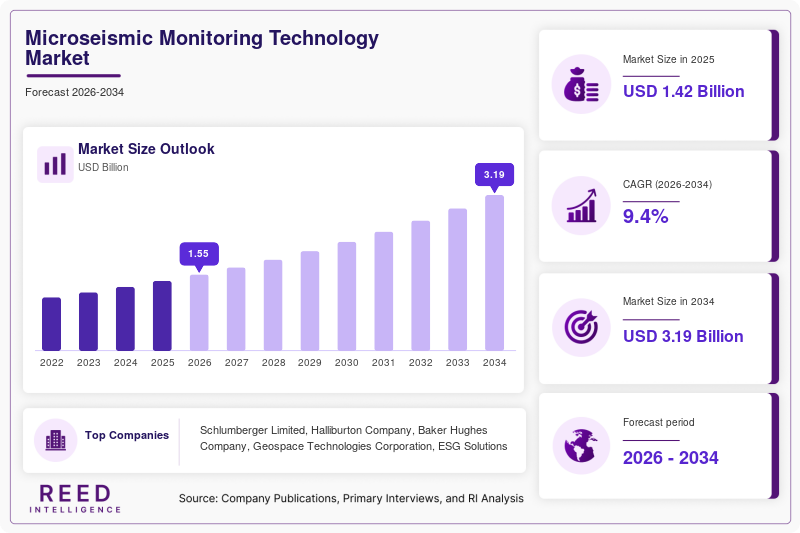
The global Microseismic Monitoring Technology Market size was valued at USD 1.42 billion in 2025 and is projected to reach USD 3.18 billion by 2034, expanding at a CAGR of 9.4% during the forecast period (2025–2034). The market growth is primarily supported by the increasing demand for real-time subsurface monitoring across industries such as oil & gas, mining, and geotechnical engineering. Microseismic monitoring systems play a crucial role in detecting and analyzing seismic events at a micro level, enabling improved operational safety, resource optimization, and risk mitigation.
A key global factor driving the Microseismic Monitoring Technology Market is the rising focus on infrastructure safety and environmental monitoring. Governments and private organizations are investing in advanced monitoring solutions to prevent structural failures and enhance project efficiency. This has led to increased adoption of high-resolution sensors, cloud-based analytics, and integrated monitoring platforms.
Key Highlights
- North America dominated the market with a 38.6% share in 2025, while Asia Pacific is projected to register the fastest CAGR of 11.2% during the forecast period.
- By component, hardware led with a 46.3% share in 2025, whereas software solutions are expected to grow at the fastest CAGR of 10.8%.
- By application, hydraulic fracturing held the largest share of 41.7%, while mining applications are projected to grow at a CAGR of 10.5%.
- The United States remained the dominant country, with market values of USD 520 million in 2025 and USD 565 million in 2026.
Market Trends
Integration of AI and Advanced Data Analytics
The Microseismic Monitoring Technology Market is witnessing increased integration of artificial intelligence and advanced data analytics tools. These technologies enable faster interpretation of seismic data, improve event detection accuracy, and reduce manual intervention. Companies are deploying machine learning algorithms to analyze complex subsurface patterns, enhancing predictive capabilities and operational decision-making. This trend is particularly evident in oil & gas exploration and underground mining operations.
Adoption of Wireless and Real-Time Monitoring Systems
Another significant trend shaping the Microseismic Monitoring Technology Market is the shift toward wireless and real-time monitoring solutions. Traditional wired systems are being replaced by flexible wireless sensor networks that offer easier deployment and scalability. Real-time monitoring enables immediate detection of seismic anomalies, helping operators respond promptly to potential risks. This transition is improving safety standards and operational efficiency across various industries.
Market Drivers
Increasing Demand for Resource Optimization
Industries such as oil & gas and mining are under pressure to maximize resource extraction while minimizing costs. Microseismic monitoring technology provides precise insights into subsurface conditions, enabling efficient resource utilization. This has driven widespread adoption of monitoring systems to enhance productivity and reduce operational uncertainties.
Growing Emphasis on Safety and Risk Management
The rising need to ensure worker safety and prevent structural failures is a major driver for the Microseismic Monitoring Technology Market. Monitoring systems help detect early signs of ground instability, allowing timely interventions. Regulatory frameworks across regions are also encouraging the use of advanced monitoring technologies, further supporting market growth.
Market Restraint
High Installation and Maintenance Costs
One of the primary challenges limiting the growth of the Microseismic Monitoring Technology Market is the high cost associated with system installation and maintenance. Advanced sensors, data acquisition systems, and analytics platforms require significant upfront investment. Additionally, ongoing maintenance and calibration costs can be substantial, especially for large-scale projects.
Small and medium-sized enterprises often face financial constraints, restricting their ability to adopt these technologies. The complexity of integrating monitoring systems with existing infrastructure further adds to the overall cost burden. As a result, market penetration in cost-sensitive regions remains limited.
Market Opportunities
Expansion in Renewable Energy Projects
The growing focus on renewable energy, particularly geothermal energy, presents new opportunities for the Microseismic Monitoring Technology Market. Monitoring systems are essential for assessing subsurface conditions and ensuring the safety of geothermal operations. Increasing investments in clean energy projects are expected to drive demand for advanced monitoring technologies.
Development of Cloud-Based Monitoring Platforms
The emergence of cloud-based platforms is creating opportunities for market expansion. These platforms enable remote data access, real-time analysis, and seamless integration with other systems. Cloud solutions reduce infrastructure costs and enhance scalability, making microseismic monitoring more accessible to a broader range of industries.
Segmental Analysis
By Component
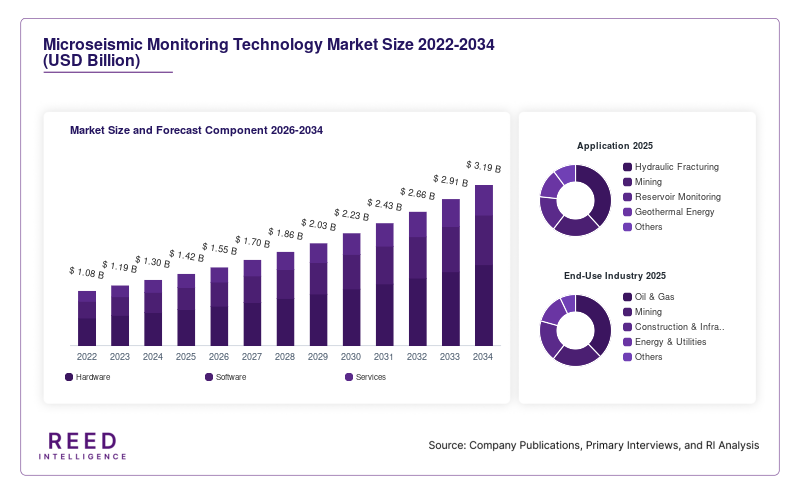
Hardware dominated the Microseismic Monitoring Technology Market with a 46.3% share in 2025. This segment includes sensors, data acquisition systems, and communication devices that form the backbone of monitoring systems. The demand for high-precision sensors has driven the dominance of this segment.
Software is expected to be the fastest-growing subsegment, registering a CAGR of 10.8% during the forecast period. The growth is driven by the increasing need for advanced data analytics and visualization tools that enable better interpretation of seismic data.
By Deployment Type
On-premise deployment accounted for the largest share of 58.7% in 2025. Organizations preferred on-premise solutions for better control over data and system performance. This approach has been widely adopted in large-scale industrial projects.
Cloud-based deployment is projected to grow at the fastest CAGR of 11.5%. The flexibility, scalability, and cost efficiency of cloud solutions are key factors driving this growth.
By Application
Hydraulic fracturing held the largest share of 41.7% in 2025. The use of microseismic monitoring in fracking operations helps optimize resource extraction and improve efficiency.
Mining applications are expected to grow at a CAGR of 10.5%, driven by the increasing need for safety monitoring in underground operations.
By End-Use Industry
The oil & gas industry dominated the market with a 44.9% share in 2025. The extensive use of monitoring systems in exploration and production activities has supported this dominance.
The construction and infrastructure sector is anticipated to grow at the fastest CAGR of 10.2%. The rising focus on structural safety and risk management is driving the adoption of monitoring technologies.
By Monitoring Type
Surface monitoring accounted for the largest share of 52.4% in 2025. This method is widely used due to its ease of deployment and cost-effectiveness.
Downhole monitoring is expected to grow at a CAGR of 10.7%, as it provides more accurate and detailed subsurface data.
Regional Analysis
North America
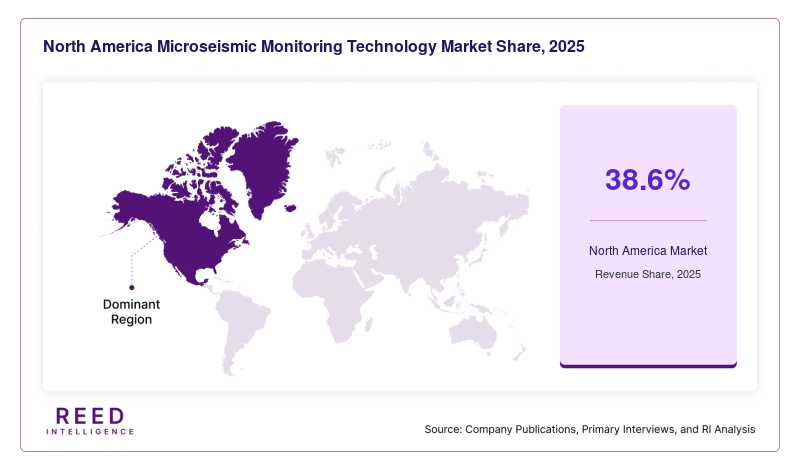
North America accounted for 38.6% of the Microseismic Monitoring Technology Market share in 2025 and is expected to grow at a CAGR of 8.7% during the forecast period. The region has a well-established oil & gas industry and advanced technological infrastructure, which has supported the adoption of microseismic monitoring systems.
The United States dominated the regional market due to extensive shale gas exploration activities. The presence of mature energy projects and continuous technological advancements has contributed to the widespread use of monitoring solutions.
Europe
Europe held a 24.1% share of the Microseismic Monitoring Technology Market in 2025 and is projected to grow at a CAGR of 8.9% through 2034. The region has emphasized environmental sustainability and infrastructure safety, driving the adoption of monitoring technologies.
Germany emerged as the leading country, supported by strong investments in underground construction and tunneling projects. The country’s focus on engineering precision has encouraged the use of advanced monitoring systems.
Asia Pacific
Asia Pacific captured 21.8% of the Microseismic Monitoring Technology Market share in 2025 and is anticipated to grow at the fastest CAGR of 11.2%. Rapid industrialization and increasing infrastructure development have fueled market expansion in the region.
China led the regional market due to large-scale mining activities and significant investments in energy projects. The need for efficient monitoring solutions in high-risk environments has accelerated adoption.
Middle East & Africa
The Middle East & Africa accounted for 9.3% of the Microseismic Monitoring Technology Market in 2025 and is expected to grow at a CAGR of 9.1%. The region’s oil-rich economies have driven the demand for advanced monitoring technologies.
Saudi Arabia dominated the market due to ongoing oil exploration and production projects. The focus on improving operational efficiency and safety has supported the adoption of microseismic systems.
Latin America
Latin America held a 6.2% share of the Microseismic Monitoring Technology Market in 2025 and is projected to grow at a CAGR of 9.0%. The region has witnessed increased investments in mining and energy sectors.
Brazil emerged as the leading country, supported by expanding mining operations. The need for monitoring solutions to enhance safety and efficiency has driven market growth.
Competitive Landscape
The Microseismic Monitoring Technology Market is moderately consolidated, with several key players focusing on technological advancements and strategic collaborations. Companies are investing in research and development to enhance sensor accuracy and data analytics capabilities.
A leading player in the market is Schlumberger Limited, which has maintained a strong position through continuous innovation and global presence. The company recently introduced advanced microseismic monitoring solutions integrated with AI-driven analytics, improving real-time data interpretation.
Other prominent players are expanding their product portfolios and strengthening their market presence through partnerships and acquisitions. The competitive environment is characterized by a focus on delivering comprehensive monitoring solutions that meet the evolving needs of various industries.
Key Players List
- Schlumberger Limited
- Halliburton Company
- Baker Hughes Company
- Geospace Technologies Corporation
- ESG Solutions
- MicroSeismic Inc.
- Applied Seismology Consultants
- Nanometrics Inc.
- Kinemetrics Inc.
- RST Instruments Ltd.
- Omnisens SA
- Fairfield Geotechnologies
- Dawson Geophysical Company
- SISGEO S.r.l.
- Terra15 Technologies
Recent Developments
- In 2024, Schlumberger launched an AI-integrated microseismic monitoring platform to enhance real-time analytics.
- In 2023, Halliburton expanded its monitoring solutions portfolio for unconventional oil & gas operations.
- In 2024, ESG Solutions introduced a cloud-based seismic data platform to improve remote accessibility.
- In 2023, Nanometrics Inc. developed next-generation sensors for high-precision monitoring.
- In 2024, Baker Hughes partnered with technology firms to enhance digital monitoring capabilities.
Microseismic Monitoring Technology Market Segments
Component
- Hardware
- Software
- Services
Application
- Hydraulic Fracturing
- Mining
- Reservoir Monitoring
- Geothermal Energy
- Others
End-Use Industry
- Oil & Gas
- Mining
- Construction & Infrastructure
- Energy & Utilities
- Others
Deployment
- On-Premise
- Cloud-Based
Monitoring Type
- Surface Monitoring
- Downhole Monitoring
By Region
- North America
- Europe
- APAC
- Middle East and Africa
- LATAM