Microsilica Powder Market Size, Share & Demand Report By Type (Densified Microsilica Powder, Undensified Microsilica Powder), By Application (Concrete Additives, Refractory Materials, Oil Well Grouting, Shotcrete, Others), By End-Use (Construction and Infrastructure, Industrial Processing, Oil and Gas, Marine Construction, Mining and Tunneling, Others), By Region & Segment Forecasts, 2026–2034
USD 3950
Market Overview
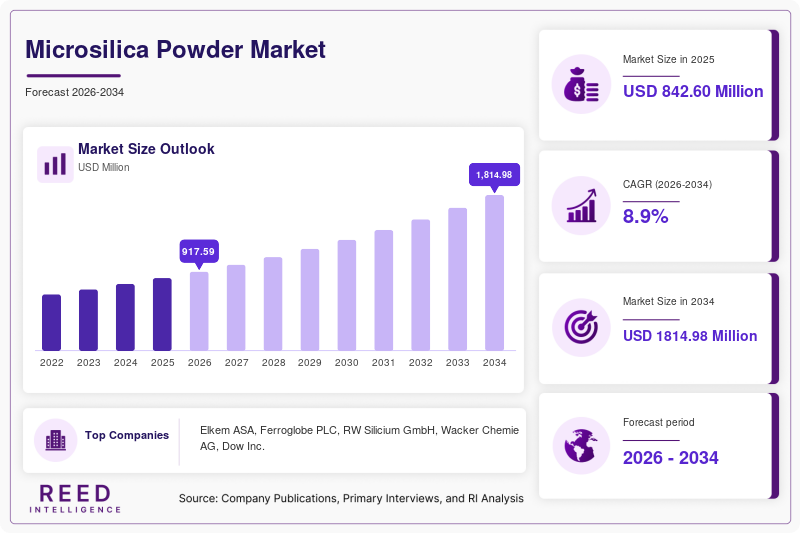
The global Microsilica Powder Market size was valued at USD 842.6 million in 2026 and is projected to reach USD 1670 million by 2034, expanding at a CAGR of 8.9% during the forecast period from 2026 to 2034. Microsilica powder, also known as silica fume, is widely used in construction materials, refractory products, oil well grouting, and specialty concrete applications due to its high pozzolanic activity and fine particle structure. The material improves durability, compressive strength, and chemical resistance in concrete, making it increasingly valuable in large-scale infrastructure projects and industrial construction.
Rising investments in transportation infrastructure, urban development, and energy-efficient commercial buildings continue to support market expansion across developed and emerging economies. Governments in Asia Pacific, North America, and the Middle East are increasing funding for bridges, tunnels, highways, ports, and industrial complexes, which has accelerated demand for high-performance concrete solutions. Microsilica powder has become a preferred additive in these applications because it enhances resistance against corrosion, moisture penetration, and sulfate attack. The growing focus on extending infrastructure life cycles and reducing maintenance costs has also contributed to wider adoption.
Key Highlights
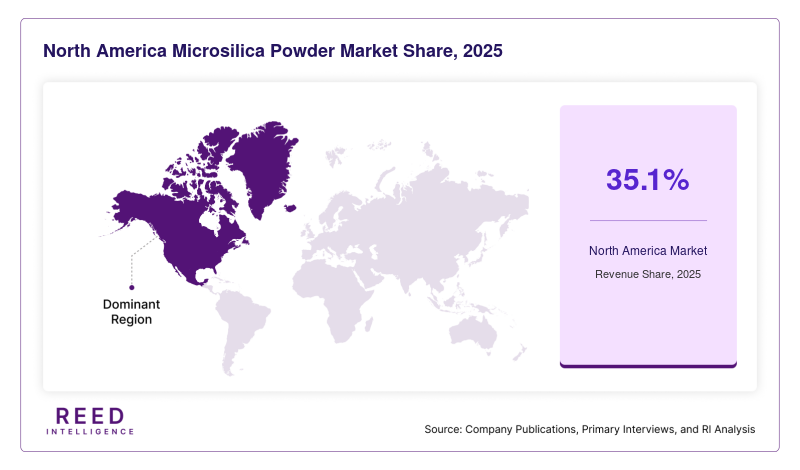
- North America dominated the market with a 35.1% share in 2025.
- Asia Pacific is expected to grow at the fastest CAGR of 10.8% during 2026–2034.
- By type, densified microsilica powder accounted for the largest share of 57.4%.
- while undensified microsilica powder is projected to grow at a CAGR of 10.2%.
- By application, concrete additives led with a 46.8% share, whereas refractory materials are expected to expand at a CAGR of 9.7%.
- By end-use, construction and infrastructure held the highest share of 52.6%, while oil and gas applications are forecast to grow at a CAGR of 9.9%.
- The United States remained the dominant country, with market values of USD 168 million in 2024 and USD 182 million in 2025.
Market Trends
Expansion of Sustainable High-Performance Concrete Applications
The increasing adoption of sustainable construction practices has become a major trend shaping the Microsilica Powder Market. Construction companies and infrastructure developers are using high-performance concrete mixtures that improve structural durability while lowering long-term environmental impact. Microsilica powder helps reduce water permeability, improve strength, and minimize concrete cracking, which makes it suitable for green infrastructure projects and commercial buildings. Governments across several countries are introducing stricter environmental regulations for construction materials, encouraging contractors to adopt supplementary cementitious materials. The demand for resilient infrastructure in flood-prone and coastal regions has also increased the use of microsilica-enhanced concrete in bridges, dams, tunnels, and marine structures. As urban populations continue to grow, the trend toward sustainable and long-lasting construction materials is expected to strengthen demand for advanced microsilica formulations.
Rising Adoption in Refractory and Industrial Processing Applications
Another important trend influencing the Microsilica Powder Market is the growing use of microsilica powder in refractory products and industrial processing industries. Steel manufacturing plants, foundries, and cement kilns increasingly require refractory linings that can withstand high temperatures and aggressive chemical environments. Microsilica powder improves thermal resistance, mechanical strength, and abrasion performance in refractory materials, making it a preferred additive for industrial furnaces and ladles. Industrial manufacturers are also adopting refined microsilica products with controlled particle distribution to improve operational efficiency and reduce maintenance downtime. Growing steel production in Asia Pacific and the Middle East has supported demand for advanced refractory materials. In addition, manufacturers are developing customized microsilica blends for specialized industrial applications, creating new opportunities for product innovation and premium-grade material development.
Market Drivers
Increasing Global Infrastructure Development Activities
Rapid infrastructure development across emerging and developed economies is one of the major drivers supporting the growth of the Microsilica Powder Market. Governments are investing heavily in transportation systems, urban housing projects, industrial corridors, and renewable energy infrastructure. Microsilica powder is increasingly used in these projects because it improves the mechanical properties and service life of concrete structures. Large bridge projects, underground tunnels, airports, and marine construction activities require concrete materials with high resistance to corrosion and chemical attack. The growing focus on reducing maintenance costs and improving long-term structural reliability has accelerated the use of microsilica-enhanced concrete. Public-private partnerships in infrastructure development have also increased construction activity in Asia Pacific and the Middle East. As demand for durable construction materials rises, microsilica powder manufacturers are expanding production capacity to meet growing industry requirements.
Growing Demand for Durable and Corrosion-Resistant Materials
The rising requirement for durable and corrosion-resistant construction materials has further strengthened the growth outlook for the Microsilica Powder Market. Industrial facilities, offshore platforms, wastewater treatment plants, and coastal infrastructure projects often face harsh environmental conditions that reduce the lifespan of conventional concrete structures. Microsilica powder improves concrete density and minimizes chloride penetration, helping structures maintain performance in demanding operating environments. Construction firms are increasingly prioritizing advanced admixtures that extend service life and reduce repair expenses. Demand from industrial flooring and high-rise building projects has also increased due to the need for enhanced compressive strength and surface durability. In addition, the expansion of energy and utility projects in regions with extreme weather conditions has encouraged wider adoption of microsilica-based concrete systems. These factors continue to support long-term market growth across multiple end-use industries.
Market Restraints
Volatility in Raw Material Supply and Processing Costs
Fluctuations in raw material availability and processing costs remain a major restraint affecting the Microsilica Powder Market. Microsilica powder is primarily collected as a byproduct during silicon metal and ferrosilicon alloy production, which means market supply is closely linked to the performance of the metallurgical industry. Variations in energy prices, furnace operating costs, and silicon production volumes can directly influence microsilica availability and pricing. Manufacturers often face challenges in maintaining consistent product quality due to differences in collection and processing methods across production facilities. Transportation and storage also add operational complexity because microsilica powder has extremely fine particles that require specialized handling systems.
The impact of cost volatility is particularly significant for small and medium-sized construction companies operating with limited project budgets. Sudden increases in raw material prices can affect procurement planning and reduce adoption in price-sensitive regions. In some developing economies, inconsistent supply chains and limited local processing infrastructure further restrict product penetration. For example, infrastructure contractors in rapidly growing urban markets may delay advanced concrete adoption when cement additives become more expensive than traditional materials. These cost pressures can slow investment in large-scale projects and create uncertainty for suppliers attempting to expand production capacity. Although demand remains positive, supply chain fluctuations continue to present operational and pricing challenges across the industry.
Market Opportunities
Growth in Smart Cities and Urban Redevelopment Projects
The expansion of smart city initiatives and urban redevelopment programs presents significant opportunities for the Microsilica Powder Market. Governments in Asia Pacific, Europe, and the Middle East are investing in intelligent transportation systems, modern public infrastructure, and sustainable residential developments to support rising urban populations. These projects require durable construction materials capable of delivering long operational life with minimal maintenance. Microsilica powder supports these objectives by improving concrete strength, reducing permeability, and enhancing structural resilience. Urban redevelopment activities involving commercial towers, metro rail systems, and underground utility networks are also increasing the demand for advanced concrete additives.
Construction companies are focusing on materials that improve energy efficiency and environmental performance in modern infrastructure. Microsilica powder contributes to sustainability goals by reducing cement consumption and lowering carbon emissions associated with concrete production. In addition, smart city projects often involve complex engineering structures exposed to heavy traffic loads and challenging environmental conditions. This creates long-term demand for high-performance construction materials. Manufacturers that develop specialized microsilica formulations for smart infrastructure applications are expected to benefit from rising public and private sector investments over the forecast period.
Expansion of Oil and Gas Well Cementing Applications
Increasing exploration and drilling activities in the energy sector are creating new opportunities for the Microsilica Powder Market. Oil and gas companies use microsilica powder in well cementing operations because it improves cement stability, reduces permeability, and enhances resistance to high-pressure conditions. Deepwater drilling projects and unconventional oil extraction activities require specialized cement systems capable of performing under extreme temperatures and corrosive environments. Microsilica powder helps maintain structural integrity in these demanding applications, making it an important additive in energy infrastructure projects.
Growing investments in offshore exploration across the Middle East, Latin America, and North America are expected to increase demand for advanced well cementing materials. Energy companies are also focusing on reducing operational risks and improving long-term well durability, which supports the use of premium-grade microsilica products. In addition, rising natural gas infrastructure development and pipeline expansion projects are creating demand for durable grouting and sealing materials. Suppliers that establish partnerships with oilfield service providers and develop customized formulations for high-temperature drilling environments are likely to gain competitive advantages in this evolving market segment.
Segmental Analysis
By Type
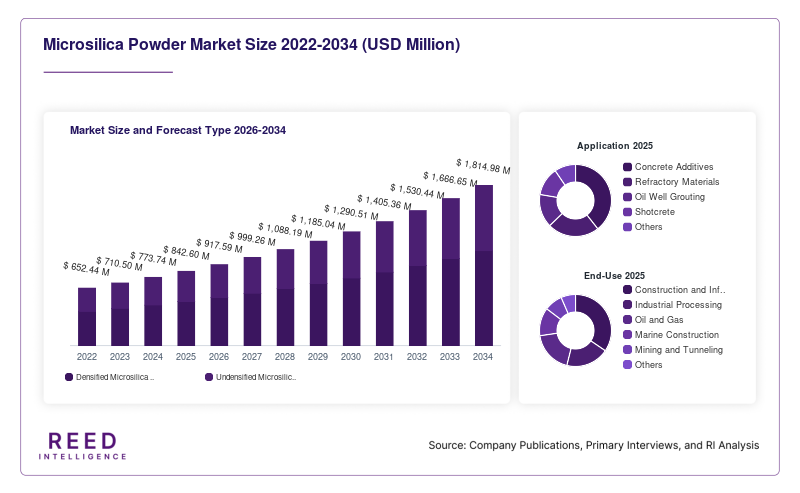
Densified microsilica powder accounted for the largest share of the Microsilica Powder Market in 2024, representing 57.4% of global revenue. The dominance of this segment is primarily linked to its easier handling, lower transportation costs, and improved storage efficiency compared to undensified forms. Densified products are widely used in large-scale construction and infrastructure projects because they offer better bulk density and reduced dust generation during application. Concrete manufacturers and contractors prefer densified microsilica powder for ready-mix concrete operations, precast construction, and industrial flooring projects. The segment has also benefited from rising adoption in marine structures and bridge construction where high-strength concrete is required. Manufacturers continue to improve densification processes to maintain particle consistency and enhance blending performance in cementitious materials. Strong demand from commercial construction and transportation infrastructure sectors has further supported the leading position of this segment in the global market.
Undensified microsilica powder is projected to register the fastest CAGR of 10.2% during the forecast period due to its superior dispersion properties and higher reactivity in specialized applications. The segment is increasingly used in high-performance concrete systems, shotcrete applications, and premium refractory products where precise particle distribution is critical. Industrial users prefer undensified variants because they provide better bonding characteristics and improved mechanical performance in demanding operating conditions. Growth is also supported by increasing investments in underground construction, mining tunnels, and advanced industrial furnaces. In addition, research institutions and material science companies are developing optimized undensified formulations for sustainable construction and advanced ceramic applications. The growing focus on premium-grade construction materials and the expansion of specialized infrastructure projects are expected to strengthen the growth outlook for this segment over the coming years.
By Application
Concrete additives represented the largest application segment in the Microsilica Powder Market in 2024, accounting for 46.8% of overall revenue. The segment continues to dominate due to the widespread use of microsilica powder in high-strength and durable concrete formulations. Construction companies rely on microsilica-enhanced concrete to improve compressive strength, reduce permeability, and enhance resistance against harsh environmental conditions. Demand has remained particularly strong in bridge construction, tunnels, commercial towers, industrial flooring, and marine infrastructure projects. Rapid urbanization and rising public infrastructure spending across Asia Pacific and North America have also supported the growth of this segment. In addition, ready-mix concrete manufacturers are increasingly incorporating microsilica powder into premium concrete solutions designed for high-load and long-life applications. The ability of microsilica powder to reduce maintenance costs and extend structural service life continues to support its strong market position.
Refractory materials are anticipated to expand at the fastest CAGR of 9.7% during the forecast period due to increasing demand from steel manufacturing, foundries, and industrial processing sectors. Microsilica powder improves thermal stability, abrasion resistance, and structural strength in refractory linings used in high-temperature industrial equipment. Rapid industrialization in emerging economies has increased the need for advanced refractory products capable of operating under aggressive chemical and thermal conditions. Steel production growth in China, India, and the Middle East is also contributing to higher demand for microsilica-based refractory systems. Manufacturers are developing customized refractory formulations with enhanced performance characteristics to meet industry-specific operating requirements. In addition, growing investments in industrial modernization and energy-efficient manufacturing facilities are expected to create new opportunities for refractory-grade microsilica powder suppliers.
By End-Use
Construction and infrastructure remained the dominant end-use segment in the Microsilica Powder Market in 2024, capturing 52.6% of global revenue. The segment benefits from extensive use of microsilica powder in residential, commercial, industrial, and transportation infrastructure projects. High-performance concrete containing microsilica powder is increasingly used in bridges, highways, tunnels, ports, and high-rise buildings because it improves strength, durability, and resistance to moisture penetration. Governments worldwide are increasing investments in urban development and public infrastructure modernization, creating sustained demand for advanced construction materials. The segment has also benefited from growing adoption of sustainable construction practices aimed at improving structural life cycles and reducing environmental impact. In addition, rising renovation and repair activities in aging infrastructure systems have increased the use of microsilica-enhanced repair mortars and grouting materials across developed economies.
Oil and gas applications are projected to witness the fastest CAGR of 9.9% over the forecast period due to rising energy exploration and drilling activities worldwide. Microsilica powder is widely used in oil well cementing operations because it enhances cement integrity and improves resistance to high-pressure and corrosive environments. Deepwater exploration projects and unconventional shale drilling operations require advanced cement systems capable of maintaining stability under extreme operating conditions. The segment is also supported by increasing investments in offshore platforms, pipeline infrastructure, and natural gas processing facilities. Energy companies are prioritizing materials that reduce operational risks and extend the lifespan of drilling infrastructure. In addition, expansion of energy projects in the Middle East, North America, and Latin America continues to create strong demand for high-performance microsilica formulations designed specifically for oilfield and energy-related applications.
Regional Analysis
North America
North America accounted for 35.1% of the global Microsilica Powder Market in 2025 and continues to maintain a strong position due to advanced infrastructure development and high adoption of performance-enhancing concrete additives. The region is expected to expand at a CAGR of 8.1% during the forecast period. Growth is supported by rising investments in bridge rehabilitation, highway modernization, and commercial building renovation projects. Construction companies across the United States and Canada increasingly use microsilica powder to improve structural durability and reduce maintenance expenses in harsh environmental conditions.
Europe
Europe represented 24.3% of the global Microsilica Powder Market in 2025 and is projected to grow at a CAGR of 7.6% through 2034. Demand in the region is supported by strict environmental regulations, rising renovation activities, and increased adoption of energy-efficient construction materials. Countries across Western Europe are focusing on modernizing aging infrastructure systems while reducing the environmental footprint of construction operations. Microsilica powder is widely used in high-strength concrete applications because it improves durability and supports long-term sustainability objectives in public infrastructure projects.
Asia Pacific
Asia Pacific held 28.7% of the global Microsilica Powder Market in 2025 and is anticipated to register the fastest CAGR of 10.8% during the forecast period. Rapid urbanization, industrial expansion, and large-scale infrastructure spending are driving demand across the region. Governments in China, India, Southeast Asia, and Japan are investing in highways, smart cities, airports, ports, and energy infrastructure projects. Microsilica powder is increasingly preferred in these projects because it improves compressive strength and enhances resistance to environmental degradation in high-density urban developments.
Middle East & Africa
The Middle East & Africa region accounted for 7.2% of the global Microsilica Powder Market in 2025 and is forecast to grow at a CAGR of 8.7% between 2026 and 2034. Demand is increasing due to major infrastructure projects, industrial development, and expansion of energy facilities across Gulf countries and selected African economies. Construction companies in the region require durable concrete materials capable of performing under extreme temperature conditions and corrosive environments. Microsilica powder is increasingly used in marine structures, desalination plants, industrial flooring, and oilfield applications.
Latin America
Latin America captured 4.7% of the global Microsilica Powder Market in 2025 and is expected to grow at a CAGR of 7.9% over the forecast period. The market is supported by increasing investments in transportation infrastructure, mining projects, and commercial construction activities across several economies. Construction firms are gradually adopting advanced concrete additives to improve structural performance and extend the lifespan of public infrastructure. Rising awareness regarding durable construction materials has also contributed to higher demand for microsilica powder in urban development projects.
Competitive Landscape
The Microsilica Powder Market is moderately consolidated, with several international and regional manufacturers competing on product quality, pricing, distribution capabilities, and technical support services. Leading companies are investing in advanced processing technologies to improve product consistency and enhance application performance across construction and industrial sectors. Strategic partnerships with construction firms, ready-mix concrete producers, and refractory manufacturers remain a common growth strategy among major participants.
Elkem ASA maintained a leading position in the global market due to its extensive production network, strong research capabilities, and diversified product portfolio. The company continues to focus on sustainable production methods and customized microsilica solutions for infrastructure and industrial applications. Other major players are also expanding regional manufacturing facilities to strengthen supply chain efficiency and improve market penetration in emerging economies.
Key Players
- Elkem ASA
- Ferroglobe PLC
- RW Silicium GmbH
- Wacker Chemie AG
- Dow Inc.
- Finnfjord AS
- OFZ a.s.
- Washington Mills
- Globe Specialty Metals
- Harsco Corporation
- Sika AG
- SK Exports
- Zhejiang Huaqi Information Technology Co., Ltd.
- Henan Xunyu Chemical Co., Ltd.
- Simcoa Operations Pty Ltd
Recent Developments
- In February 2026, Elkem ASA expanded its microsilica processing capacity in North America to support rising demand from transportation infrastructure and marine construction projects.
- In September 2025, Sika AG introduced a new microsilica-enhanced concrete admixture designed for high-strength commercial and industrial flooring applications.
- In April 2026, Ferroglobe PLC announced a strategic partnership with a regional refractory manufacturer in Asia Pacific to develop customized microsilica formulations for steel processing facilities.
- In November 2025, Wacker Chemie AG invested in advanced particle refinement technology to improve product consistency and enhance performance in specialty concrete applications.
Microsilica Powder Market Segments
Type
- Densified Microsilica Powder
- Undensified Microsilica Powder
Application
- Concrete Additives
- Refractory Materials
- Oil Well Grouting
- Shotcrete
- Others
End-Use
- Construction and Infrastructure
- Industrial Processing
- Oil and Gas
- Marine Construction
- Mining and Tunneling
- Others
By Region
- North America
- Europe
- APAC
- Middle East and Africa
- LATAM