Microwave Radio Market Size, Share & Trends Analysis Report By Component (Microwave Radio Units, Antennas, Modems & Indoor Units, Accessories & Other Components), By Frequency Band (Traditional Microwave Bands, E-Band, W-Band & D-Band), By Application (Mobile Backhaul, Enterprise & Private Networks, Broadband Access, Critical Communications), By End User (Telecom Operators, Enterprises, Government & Defense) Forecasts, 2026–2034
USD 3950
Microwave Radio Market Size
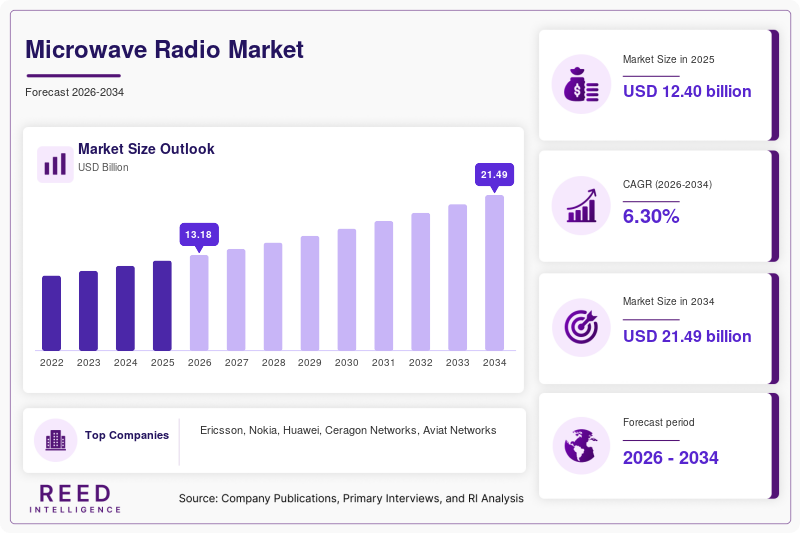
The global microwave radio market size was valued at USD 12.40 billion in 2025 and is projected to grow from USD 13.18 billion in 2026 to USD 21.49 billion by 2034, registering a CAGR of 6.30% during the forecast period from 2026 to 2034.
The microwave radio market is being reshaped by the increasing need for high-capacity wireless backhaul where fiber deployment is slow, expensive, technically difficult, or unavailable. Microwave links remain important in 5G networks, particularly across rural areas, difficult terrain, islands, temporary deployments and locations where operators need rapid capacity expansion. Ericsson's 2025 Microwave Outlook found that microwave backhaul was used in 75% of live 5G networks globally, while the installed base of microwave transceivers had reached approximately 10.5 million. Ericsson also projects a near-even 49% microwave and 51% fiber split in mobile backhaul by 2030.
The technology is moving beyond conventional microwave frequencies. E-band deployments have increased rapidly, with Ericsson reporting that E-band represented about 8% of the installed base in 2025 and had surpassed the 38 GHz band. W- and D-band technologies are also being developed for higher-capacity short-range links.
Microwave Radio Market Drivers
5G densification is increasing backhaul capacity requirements
5G networks require significantly more transport capacity because higher radio bandwidth, multiple carriers and increasing data consumption increase traffic between cell sites and the core network. Ericsson's 2025 Microwave Outlook reports that microwave backhaul is already present in 75% of live 5G networks and that the installed transceiver base has reached approximately 10.5 million. Huawei's 2025 Microwave Industry White Paper similarly identifies the transition from 5G to 5G-Advanced as a major source of rising backhaul requirements, with single-site traffic requirements increasing substantially as additional spectrum is deployed. This directly increases demand for higher-capacity radios, wider channels, carrier aggregation, adaptive modulation and E-band equipment. Operators can upgrade existing microwave paths rather than replacing the entire transport architecture, creating both new-equipment and modernization demand.
Microwave provides a faster alternative where fiber deployment is difficult
Microwave radio can be deployed without trenching or laying physical cable, making it useful where terrain, permitting, construction time or economics make fiber difficult. Ericsson notes that microwave can provide faster and more cost-efficient deployment than fiber in locations where fiber is not already available. Nokia similarly positions Wavence microwave transport for rural areas, offshore locations and difficult terrain where fiber is impractical or expensive. The commercial mechanism is particularly important in emerging 5G markets and remote areas: operators can establish backhaul connectivity rapidly while avoiding some civil-engineering costs. Microwave also provides network redundancy where fiber is already present, creating demand from operators seeking resilient transport rather than a simple fiber replacement.
E-band and higher-frequency technologies are increasing microwave capacity
The transition toward E-band, W-band and eventually D-band is expanding the capacity available from microwave links. Ericsson reports that E-band deployments have overtaken the 38 GHz band and that W- and D-band technologies are emerging as future spectrum options. Ericsson's 2026 technology discussion shows that combining two E-band radios can provide up to 20 Gbps, while Nokia's Wavence portfolio offers 20 Gbps E-band wireless backhaul for 5G sites. Huawei and du demonstrated a 25 Gbps E-band link for a 5G-Advanced site in the UAE in 2025. These developments expand the addressable market by allowing microwave to serve increasingly demanding urban and high-capacity sites.
Microwave Radio Market Restraints
Spectrum availability and licensing can constrain network expansion
Microwave performance depends heavily on access to suitable spectrum, channel bandwidth and licensing conditions. As 5G, 6G, Wi-Fi and other wireless services require additional spectrum, traditional microwave bands can face competing allocation pressures. Ericsson identifies spectrum availability and spectrum costs as important considerations for expanding microwave capacity, particularly as operators move toward higher-capacity links. Huawei's 2025 industry analysis similarly argues that microwave spectrum policies need to evolve alongside technological advances. E-band can provide very wide channels, but shorter propagation distances limit its suitability for some long-haul applications. Operators therefore often need multi-band architectures combining E-band with traditional microwave frequencies, which increases network planning and equipment complexity.
Fiber remains the preferred option for some high-capacity routes
Microwave and fiber are complementary technologies rather than direct substitutes across every network segment. Fiber generally provides higher capacity and is preferred where infrastructure is already available and deployment economics are favorable. Ericsson's 2025 outlook expects fiber to retain a slightly larger share of global mobile backhaul by 2030, at 51% compared with 49% for microwave. This limits microwave's opportunity in highly fiberized markets and dense metropolitan routes where operators already have extensive optical infrastructure. Microwave suppliers therefore increasingly compete by emphasizing rapid deployment, redundancy, difficult-terrain coverage, lower civil-work requirements and flexible capacity upgrades rather than positioning microwave as a universal replacement for fiber.
Microwave Radio Market Opportunities
AI-Based Network Management
AI and automation are creating a new value layer for microwave networks. Ericsson's Microwave Outlook describes AI-based preventive maintenance using high-granularity network data to identify potential failures and improve transport reliability. Nokia is also incorporating AI capabilities into Wavence management to improve troubleshooting and network efficiency. This creates an opportunity for suppliers to generate recurring software and service revenue alongside radio hardware. Operators can use predictive analytics to identify degrading links, optimize capacity and reduce unnecessary field visits. The commercial impact is particularly relevant for large distributed networks where thousands of links may operate across geographically dispersed sites.
Enterprise, Private Network and Critical-Communication Applications
Microwave technology is expanding beyond conventional mobile backhaul into enterprise networks, private networks, public-sector communications and critical infrastructure. Huawei's 2025 Microwave Industry White Paper identifies enterprise private networks, FTTH backhaul, fiber backup and private lines as emerging application areas. Nokia similarly markets Wavence for enterprises and mission-critical connectivity in addition to telecom operators. This broadens the addressable customer base. Mining, utilities, railways, offshore facilities, ports, defense organizations and public-safety networks can use microwave where wired infrastructure is difficult to install or where independent connectivity is required. Demand can therefore develop even in regions where conventional mobile-network investment is relatively mature.
Segmental Analysis
By Component
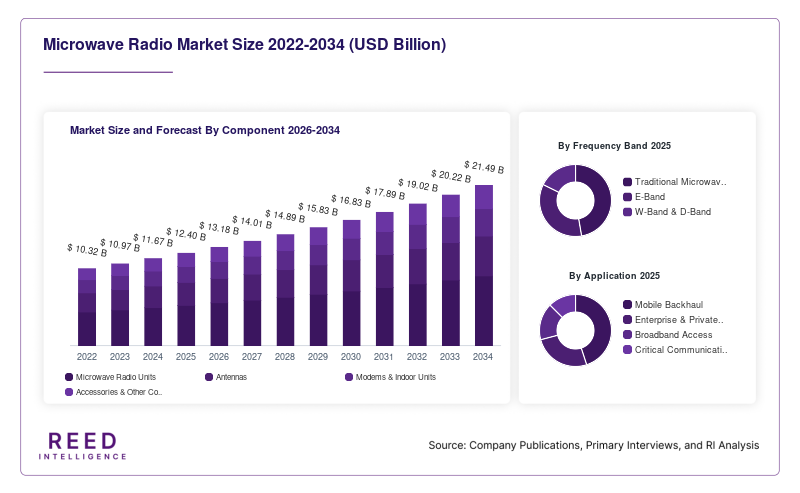
Microwave Radio Units represent approximately 52% of the global market in 2025, making them the dominant component. Radio units directly determine transmission capacity, modulation performance, frequency compatibility and network scalability. Ericsson's MINI-LINK portfolio covers traditional microwave frequencies from 5–80 GHz and supports both short-haul and long-haul deployment configurations.
Microwave Radio Units also remain central to modernization because operators can increase capacity through software upgrades, adaptive modulation, carrier aggregation and additional radio configurations. Ericsson identifies software-based capacity expansion and carrier aggregation as mechanisms for increasing microwave capacity without complete network replacement.
Antennas represent approximately 22%, while Modems & Indoor Units account for approximately 16%. Accessories and other components represent the remaining 10%.
By Frequency Band
Traditional Microwave Bands account for approximately 61% of the global market in 2025, maintaining the largest installed base because frequencies such as 6–42 GHz remain important for longer-distance links, suburban networks and rural connectivity. Ericsson's portfolio continues to support traditional frequencies alongside E-band.
E-Band is the fastest-growing frequency category, with a projected CAGR of approximately 10.2%. Ericsson reports that E-band already accounts for approximately 8% of the installed global transceiver base and has surpassed 38 GHz in deployment share. Its wide channels make it particularly suitable for high-capacity 5G and 5G-Advanced sites, although shorter propagation distances mean that E-band is often combined with traditional bands.
By Application
Mobile Backhaul represents approximately 64% of the global market in 2025, making it the dominant application. Microwave remains an important transport layer between mobile access sites and aggregation or core networks, particularly in areas without immediate fiber access. Ericsson's 2025 research found microwave backhaul in 75% of live 5G networks globally.
Enterprise & Private Networks is the fastest-growing application, with a projected CAGR of approximately 8.1%. Huawei identifies enterprise private networks and private lines as emerging microwave applications, while Nokia highlights enterprise and mission-critical connectivity in its Wavence portfolio. The demand mechanism is diversification beyond telecom operators toward industrial sites, utilities, transportation and public-sector infrastructure.
By End User
Telecom Operators hold approximately 68% of the global market in 2025, reflecting the extensive use of microwave in mobile backhaul. The customer base includes national mobile operators, broadband providers and communications service providers deploying 4G, 5G and 5G-Advanced networks.
Government & Defense is the fastest-growing end-user category, with a projected CAGR of approximately 8.0%. Microwave's rapid deployment characteristics, point-to-point architecture and suitability for remote or difficult environments support applications where independent, resilient communications infrastructure is required. Nokia specifically identifies mission-critical networks among Wavence applications.
Regional Analysis
North America Microwave Radio Market
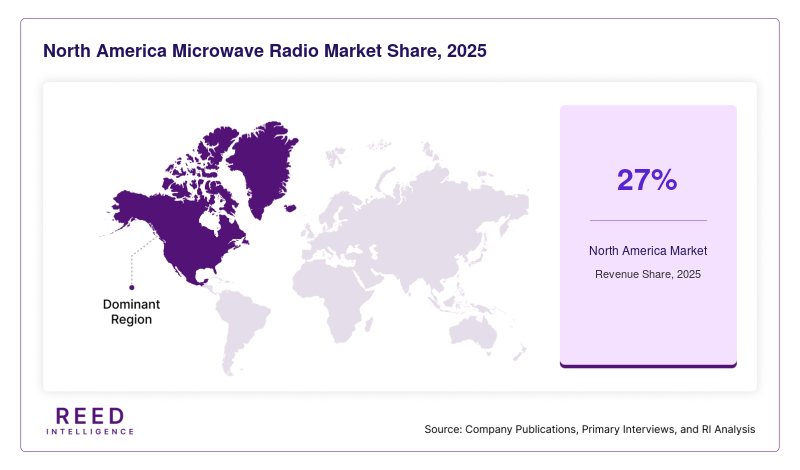
North America represents approximately 27% of the global microwave radio market in 2025, supported by mature telecom infrastructure, rural broadband requirements, enterprise connectivity and growing interest in high-capacity wireless transport. The region has historically exhibited greater fiber penetration than many emerging markets, but Ericsson's 2025 Microwave Outlook identified renewed interest in modern high-capacity microwave in the United States.
The commercial mechanism is shifting from basic mobile backhaul toward capacity augmentation, redundancy and difficult-to-fiber locations. Microwave can be deployed where fiber is unavailable or where construction requirements make optical infrastructure less attractive. Nokia's current Wavence portfolio specifically positions microwave for rural broadband, critical services and enterprise connectivity.
North America is projected to grow at approximately 5.7% CAGR through 2034. Demand will be supported by 5G capacity upgrades, rural broadband and mission-critical connectivity, although extensive existing fiber infrastructure limits microwave's share in major metropolitan routes.
Europe Microwave Radio Market
Europe accounts for approximately 20% of the global market in 2025, supported by extensive 5G deployments, rural connectivity requirements, enterprise networks and a large installed base of microwave infrastructure.
European operators are increasingly using higher-capacity microwave technologies to complement fiber. Ericsson's 2025 outlook identifies microwave as an important component of 5G transport and reports that W- and D-band technologies are being developed as additional spectrum options. A March 2025 field trial between Drei Austria and Ericsson demonstrated W-band microwave technology for high-capacity urban 5G connectivity, particularly where E-band can encounter congestion.
Europe is projected to register a CAGR of approximately 5.9%. Demand will be driven by 5G densification, rural broadband and network modernization, while high fiber penetration and mature telecom infrastructure moderate microwave equipment expansion.
APAC Microwave Radio Market
APAC represents approximately 34% of the global market in 2025, making it the largest regional market, with a projected CAGR of approximately 7.1%. China, India, Japan, South Korea and Southeast Asia are major contributors because of large mobile subscriber bases, extensive 5G deployment and the use of microwave in areas where fiber deployment is difficult.
India is particularly important to E-band adoption. Ericsson reported that the increase in E-band deployments in 2025 was largely driven by new rollouts in India. Ericsson has also highlighted India as one of the markets with high microwave usage in mobile backhaul.
China remains a major technology and deployment market. Huawei and China Unicom demonstrated a long-haul microwave solution capable of delivering 10 Gbps across a 36 km link, illustrating the industry's focus on reducing hardware while increasing capacity.
APAC's growth mechanism combines 5G densification, rural coverage, high mobile data usage and rapid adoption of higher-capacity microwave technologies. Spectrum availability, operator consolidation and different national licensing regimes remain relevant constraints.
Middle East and Africa Microwave Radio Market
Middle East and Africa represent approximately 12% of the global market in 2025 and are the fastest-growing region, with a projected CAGR of approximately 8.0%. Microwave has particular relevance in the region because of remote locations, difficult terrain, islands, sparse fiber infrastructure and rapid 5G deployment.
A February 2025 agreement between Ooredoo Qatar and Ericsson included multiband microwave technology combining E-band with traditional frequencies to provide backhaul capacity of up to 25 Gbps and extend 5G connectivity into locations where fiber is unavailable. In March 2026, Ericsson and Safaricom signed a multi-year microwave agreement in Kenya covering all-outdoor E-band and multi-band MINI-LINK products, with AI-based analytics and automation also planned.
Nokia's current Wavence portfolio similarly emphasizes offshore, rural and difficult-terrain applications. The region's relatively lower fiber availability in some markets creates a direct structural role for microwave, although spectrum licensing, investment cycles and economic conditions can influence deployment timing.
LATAM Microwave Radio Market
LATAM accounts for approximately 7% of the global market in 2025, with Brazil, Mexico, Argentina, Colombia and other markets using microwave for mobile backhaul, rural broadband and enterprise connectivity.
The region benefits from the technology's ability to bypass difficult civil works. This is particularly relevant in mountainous, forested and sparsely populated areas where fiber deployment can require substantial construction investment. Nokia's Wavence portfolio identifies rural and inaccessible terrain as important microwave use cases.
LATAM is projected to grow at approximately 7.3% CAGR. Increasing 5G coverage, mobile data traffic and rural connectivity initiatives will support equipment demand. Microwave can also provide network redundancy where fiber routes are vulnerable to physical damage.
The main constraints are currency volatility, infrastructure investment cycles, spectrum availability and uneven telecom capital expenditure between countries. These factors can create differences in deployment timing across national markets.
Competitive Landscape
The microwave radio market has a concentrated technology-supplier base, with competition centered on capacity, spectrum efficiency, energy consumption, link distance, network management, reliability and total cost of ownership. The leading suppliers increasingly combine radio hardware with software, AI-based management, antennas, IP/MPLS transport and professional services.
Ericsson maintains the MINI-LINK portfolio across traditional microwave and E-band frequencies, with support for short-haul and long-haul deployments. Its 2025 Microwave Outlook emphasizes the transition toward E-band, W-band and D-band technologies, as well as AI-based network management. Its March 2026 Safaricom agreement demonstrates commercial expansion of all-outdoor E-band and multiband solutions in Africa.
Key Market Players
- Ericsson
- Nokia
- Huawei
- Ceragon Networks
- Aviat Networks
- NEC Corporation
- SIAE MICROELETTRONICA
- Comba Telecom
- ZTE Corporation
- DragonWave
- Intracom Telecom
- Radwin
- Cambium Networks
- SAF Tehnika
- Siklu
Recent Market Developments
- August 2026 – Huawei: Huawei reported commercial deployment of its full-duplex E-band technology, with the company stating that the solution can provide up to 50 Gbps capacity and improve spectrum reuse. The development targets high-capacity 5G and 5G-Advanced backhaul.
- April 2026 – Ericsson: Ericsson highlighted the continued evolution of microwave as a strategic 5G transport technology and reported that microwave backhaul can support up to 20 Gbps through combined E-band configurations. The company also emphasized deployment advantages where fiber is unavailable or expensive.
Microwave Radio Market Segments
By Component
- Microwave Radio Units
- Antennas
- Modems & Indoor Units
- Accessories & Other Components
By Frequency Band
- Traditional Microwave Bands
- E-Band
- W-Band & D-Band
By Application
- Mobile Backhaul
- Enterprise & Private Networks
- Broadband Access
- Critical Communications
By End User
- Telecom Operators
- Enterprises
- Government & Defense
- Other End Users
By Region
- North America
- Europe
- APAC
- Middle East and Africa
- LATAM