Microwave Transmission Equipment Market Size, Share & Trends Analysis Report by Equipment Type, Frequency Band, Technology, Application, and Region, Forecasts, 2026–2034
USD 3950
Microwave Transmission Equipment Market Size
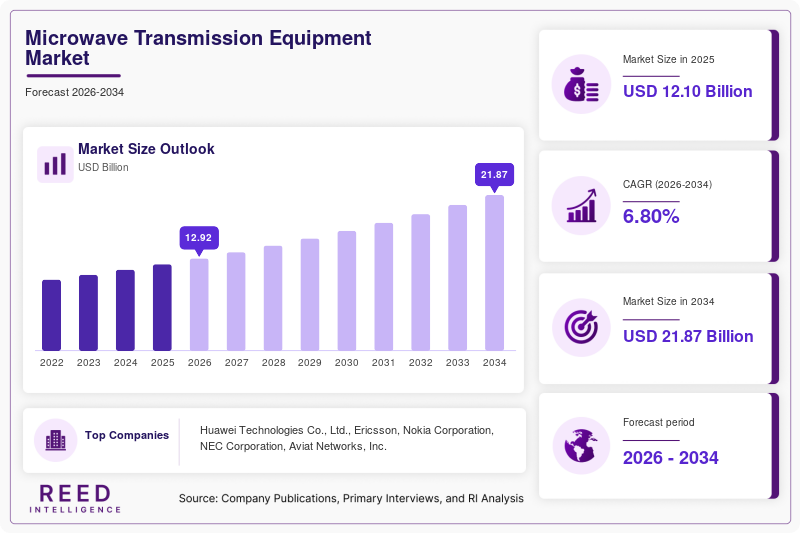
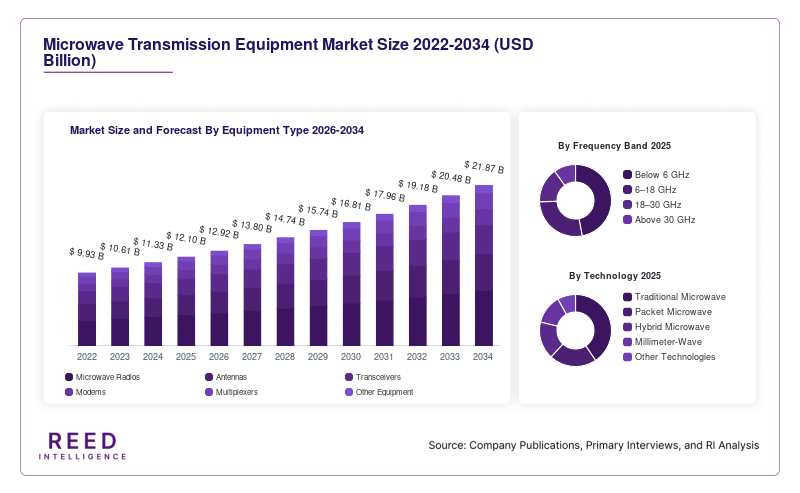
The global microwave transmission equipment market was valued at USD 12.10 billion in 2025 and is projected to grow from USD 12.92 billion in 2026 to USD 21.87 billion by 2034, registering a CAGR of 6.80% during the forecast period from 2026 to 2034.
The microwave transmission equipment market comprises equipment used to transmit voice, data, video, and other digital signals through microwave radio links. The market includes microwave radios, antennas, transceivers, modems, multiplexers, and associated transmission systems deployed across telecommunications, enterprise networks, broadcasting, public safety, transportation, utilities, defense, and other applications.
Microwave transmission provides an alternative or complementary connectivity solution where fiber deployment is difficult, expensive, or time-consuming. Point-to-point and point-to-multipoint microwave links are widely used for backhaul, access networks, temporary connectivity, and network expansion. Increasing data consumption, 5G network deployment, rural connectivity requirements, and the need for resilient communications infrastructure are supporting market demand.
Microwave Transmission Equipment Market Drivers
The deployment of 5G networks is increasing requirements for high-capacity backhaul and transport infrastructure. Microwave transmission equipment can provide rapid deployment and flexible connectivity where fiber installation is impractical, particularly for cell-site backhaul and network expansion.
Rising mobile data consumption, video traffic, cloud applications, and connected devices are increasing capacity requirements across telecommunications networks. Microwave equipment manufacturers are responding with higher-throughput radios and improved spectral efficiency.
Microwave links can be deployed without extensive physical cabling and civil construction. This can make them attractive for remote areas, difficult terrain, temporary connections, and locations where fiber installation requires significant time or investment.
Organizations and network operators require reliable communication infrastructure capable of maintaining connectivity during disruptions. Microwave links can provide backup connectivity and geographically diverse transmission paths alongside fiber-based networks.
Microwave Transmission Equipment Market Restraints
Microwave transmission depends on suitable radio-frequency spectrum. Availability and licensing requirements differ across countries and frequency bands, potentially increasing deployment complexity and limiting the availability of certain spectrum resources.
Traditional microwave links generally require suitable line-of-sight conditions between transmission points. Terrain, buildings, vegetation, and other physical obstructions can affect network planning and may require towers, repeaters, or alternative connectivity technologies.
Fiber offers very high capacity and is preferred for many high-density network applications. Continued fiber deployment can limit microwave equipment demand in locations where fiber infrastructure is readily available and economically viable.
Rain, atmospheric conditions, and other environmental factors can affect microwave signal quality, particularly at higher frequencies. Network operators may need redundancy, link engineering, and adaptive technologies to maintain required availability.
Microwave Transmission Equipment Market Opportunities
Continued 5G expansion provides opportunities for high-capacity microwave and millimeter-wave transmission equipment. Operators can use microwave links to connect cell sites and network aggregation points where fiber deployment is constrained.
Microwave technology can support broadband deployment in remote and underserved areas where fiber construction may be economically challenging. Government connectivity programs and telecom infrastructure investment can create additional demand.
Defense, emergency response, public safety, and critical infrastructure operators require secure and resilient communications. Portable and rapidly deployable microwave systems can support applications where reliable communications are essential.
Energy, transportation, mining, manufacturing, and utility operators can use microwave links for private communications networks, monitoring, automation, and remote-site connectivity. Expansion of connected industrial infrastructure creates opportunities for specialized transmission equipment.
Microwave Transmission Equipment Market Segmental Analysis
By Equipment Type
Microwave radios represent a core component of microwave transmission networks and are responsible for transmitting and receiving signals across wireless links. Antennas provide the directional interface required for transmission, while transceivers combine transmission and reception capabilities. Modems and multiplexers support signal processing and the integration of different traffic streams.
Demand across equipment categories is influenced by network capacity requirements, installation environment, link distance, frequency band, and modernization cycles. However, a comparable market-share dataset for each equipment category was not provided, so the dominant equipment type and fastest-growing equipment segment cannot be quantified reliably.
By Frequency Band
Lower-frequency microwave bands can provide greater propagation range and improved performance in certain environmental conditions, making them relevant for longer-distance links and selected backhaul applications. Higher-frequency bands can support greater capacity but may require more careful link planning and can be more sensitive to propagation conditions.
The selection of frequency depends on capacity requirements, distance, spectrum availability, regulatory conditions, and environmental characteristics. The dominant frequency band and fastest-growing band require comparable market-share and CAGR data, which are not available in the supplied market inputs.
By Technology
Traditional microwave systems continue to support established transmission networks, while packet microwave technology is increasingly aligned with IP-based network architectures. Hybrid systems can combine different transmission approaches to provide flexibility, while millimeter-wave technologies can support high-capacity short-range links.
The adoption of packet-based and higher-frequency technologies is influenced by 5G deployment, network modernization, spectrum availability, and data-traffic growth. A verified quantitative comparison of segment shares and growth rates is required to identify the dominant and fastest-growing technology segments.
By Application
Mobile backhaul represents an important application for microwave transmission equipment because wireless links can connect cell sites and aggregation points where fiber deployment is constrained. Enterprise networking applications include connectivity between facilities and remote sites, while broadcasting uses microwave links for content contribution and distribution.
Public safety, transportation, utilities, defense, and industrial users require microwave connectivity for resilient communications and remote infrastructure. The dominant application and fastest-growing application cannot be confirmed quantitatively without a consistent application-level market dataset.
Microwave Transmission Equipment Market Regional Analysis
Asia Pacific Microwave Transmission Equipment Market
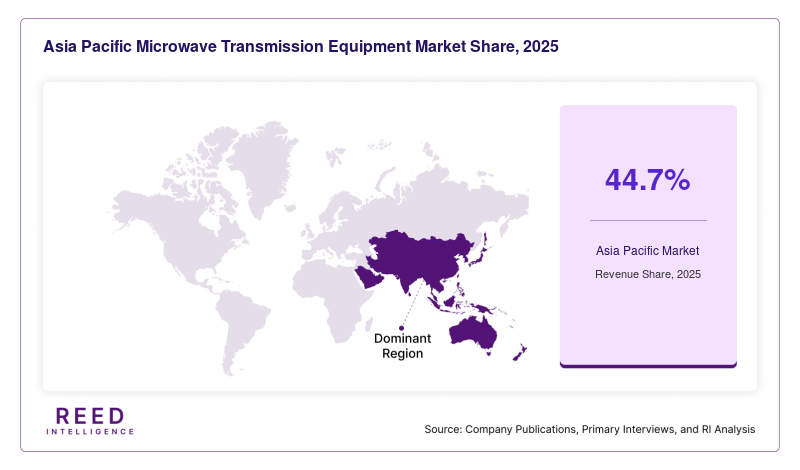
Asia Pacific is the dominant region in the global microwave transmission equipment market, accounting for approximately 44.65% of the global market in 2025, with a market value of about USD 6.24 billion. The region’s leadership is supported by large-scale telecommunications infrastructure investment, 5G network expansion, growing mobile data traffic, and extensive microwave backhaul deployment across China, India, and other Asia Pacific markets. The region is also identified as the largest market by other industry sources, although reported shares vary by market definition and methodology.
North America Microwave Transmission Equipment Market
North America is a mature market supported by 5G deployment, network densification, enterprise connectivity, rural broadband, public-safety communications, and continued modernization of wireless infrastructure. The region accounted for approximately 17.36% of the global market in 2025, equivalent to about USD 2.43 billion, in the same regional dataset that identifies Asia Pacific as the leader. The United States remains the principal market within the region, supported by investments in 5G infrastructure, private networks, and high-capacity wireless backhaul.
Europe Microwave Transmission Equipment Market
Europe accounted for approximately 20.35% of the global Microwave Transmission Equipment Market in 2025, representing about USD 2.85 billion in the same source dataset. Demand is supported by telecommunications modernization, 5G deployment, enterprise connectivity, transportation, utilities, and the need for reliable wireless backhaul. European deployments increasingly emphasize spectrum efficiency, high-capacity links, and advanced technologies such as adaptive modulation and higher-frequency transmission.
Latin America Microwave Transmission Equipment Market
Latin America represented approximately 6.17% of the global market in 2025, corresponding to around USD 862.47 million in the referenced regional dataset. Market demand is driven by mobile-network expansion, rural connectivity requirements, and the need to connect geographically dispersed sites where fiber deployment can be difficult or costly. Telecom operator investment cycles, spectrum availability, and infrastructure development remain important factors influencing regional growth.
Middle East & Africa Microwave Transmission Equipment Market
The Middle East & Africa accounted for approximately 11.47% of the global microwave transmission equipment market in 2025, with a market value of approximately USD 1.60 billion. Microwave technology is particularly relevant in areas where limited fiber availability, long distances, challenging terrain, and the need for resilient communications create demand for wireless transmission. The region is also identified as a high-growth area in the referenced market analysis because microwave links can provide practical backhaul solutions in difficult deployment environments.
Microwave Transmission Equipment Market Competitive Landscape
The microwave transmission equipment market includes telecommunications equipment manufacturers, wireless infrastructure providers, and specialized microwave radio companies. Competition is based on transmission capacity, spectrum efficiency, link availability, reliability, energy efficiency, software capabilities, network management, and total deployment cost.
Companies are focusing on higher-capacity radios, compact equipment, advanced modulation, IP and Ethernet integration, software-defined networking, and solutions designed for 5G transport. Vendors also compete through global distribution networks, technical support, system integration capabilities, and the ability to provide equipment suitable for diverse frequency bands and network environments.
Key Market Players
- Huawei Technologies Co., Ltd.
- Ericsson
- Nokia Corporation
- NEC Corporation
- Aviat Networks, Inc.
- Ceragon Networks Ltd.
- SIAE MICROELETTRONICA S.p.A.
- Mitsubishi Electric Corporation
- ZTE Corporation
- Cambium Networks Corporation
Microwave Transmission Equipment Market Recent Developments
- May 2026 -Ericsson: Ericsson announced that Cellnex became the lead customer for its MINI-LINK 6356 high-power E-band radio, designed to provide higher-capacity microwave backhaul with improved range and energy efficiency. The initial deployment began in Poland for Cellnex’s RAN modernization, with further deployments planned across its operating markets.
- May 2026 -Ceragon Networks: Ceragon announced approximately USD 86 million in year-to-date orders from Indian operators, with significant demand for its IP-50EXA platform and next-generation millimeter-wave technology supporting large-scale Fixed Wireless Access deployments.
Microwave Transmission Equipment Market Segments
By Equipment Type
- Microwave Radios
- Antennas
- Transceivers
- Modems
- Multiplexers
- Other Equipment
By Frequency Band
- Below 6 GHz
- 6–18 GHz
- 18–30 GHz
- Above 30 GHz
By Technology
- Traditional Microwave
- Packet Microwave
- Hybrid Microwave
- Millimeter-Wave
- Other Technologies
By Application
- Mobile Backhaul
- Enterprise Networking
- Broadcasting
- Public Safety
- Transportation
- Utilities
- Defense
- Other Applications
By Region
- North America
- Europe
- APAC
- Middle East and Africa
- LATAM