Mid and High Level Precision GPS Market Size, Share & Trends Analysis Report By Type (Differential Grade, Survey Grade), Frequency (Single Frequency, Dual Frequency), Industry (Mining, Agriculture, Construction, Oil & Gas, Others) and Region (North America, Europe, Asia Pacific, Latin America, Middle East & Africa) Forecasts, 2026–2034
USD 3950
Mid and High Level Precision GPS Market Size
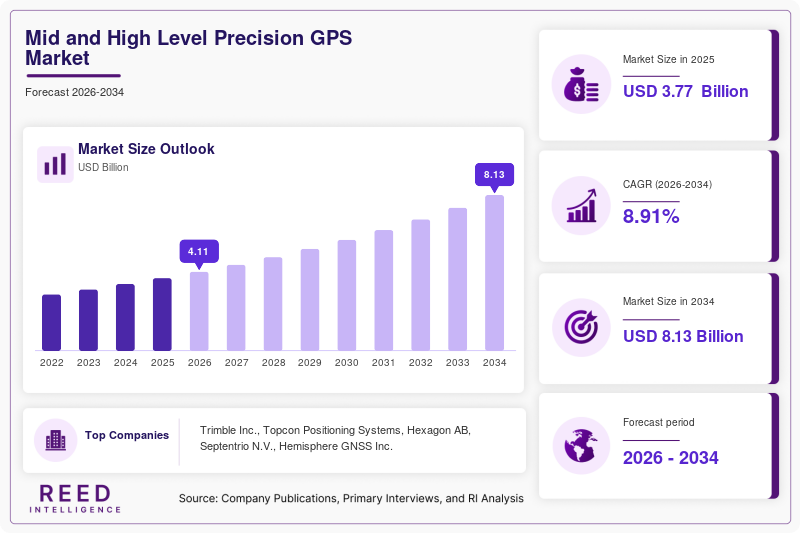
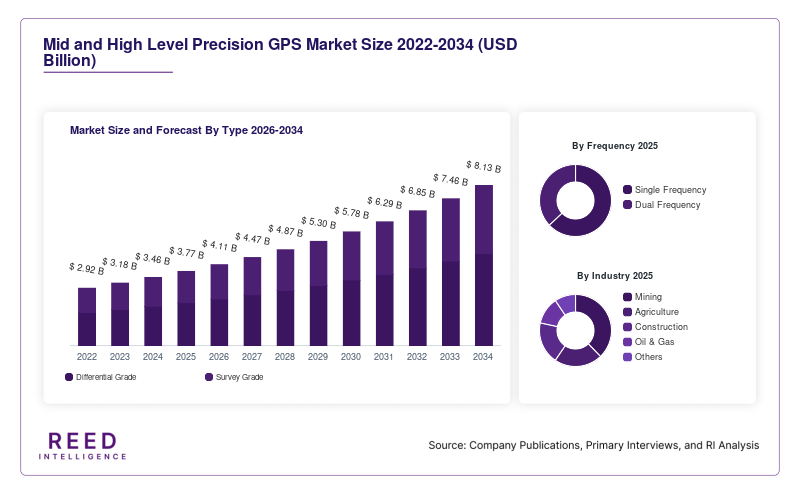
The global mid and high level precision GPS market was valued at USD 3.77 billion in 2025 and is projected to grow from USD 4.11 billion in 2026 to USD 8.13 billion by 2034, registering a CAGR of 8.91% during the forecast period from 2026 to 2034.
The mid and high level precision GPS market includes positioning systems and receivers designed to provide substantially higher accuracy than conventional GPS solutions, ranging from sub-meter positioning to centimeter-level accuracy. These systems are increasingly used in applications where precise location, navigation, surveying, machine control, and asset positioning are essential.
Precision GPS technologies such as Differential GPS, Real-Time Kinematic (RTK), and advanced multi-frequency GNSS positioning are being adopted across agriculture, construction, mining, oil and gas, surveying, transportation, autonomous systems, and infrastructure development. Increasing automation and digitalization are strengthening demand for accurate positioning data across industrial workflows.
Mid and High Level Precision GPS Market Drivers
Growth of Precision Agriculture: Precision farming increasingly depends on highly accurate positioning for automated tractors, variable-rate application, field mapping, machine guidance, and autonomous agricultural equipment.
Expansion of Construction and Infrastructure Projects: Construction companies are adopting precision GPS for surveying, machine control, site positioning, earthmoving, infrastructure development, and digital construction workflows.
Increasing Automation and Autonomous Systems: Autonomous vehicles, robotics, drones, and industrial machinery require accurate positioning and orientation data, supporting demand for high-performance GNSS receivers.
Demand for Accurate Surveying and Mapping: Land surveying, cadastral mapping, infrastructure inspection, and geospatial applications continue to require centimeter-level positioning and reliable correction services.
Mid and High Level Precision GPS Market Restraints
High Equipment Costs: Advanced dual-frequency and multi-frequency precision GPS equipment can involve significant acquisition and maintenance costs, limiting adoption among smaller businesses.
Signal Obstruction and Interference: Buildings, vegetation, terrain, electromagnetic interference, and other environmental conditions can degrade GNSS performance and reduce positioning reliability.
Dependence on Correction Infrastructure: High-accuracy positioning frequently requires RTK networks, correction services, reference stations, or other augmentation systems, creating additional infrastructure and subscription requirements.
Cybersecurity and GNSS Vulnerabilities: Jamming and spoofing can disrupt positioning services, increasing the need for advanced protection technologies and potentially raising system costs.
Mid and High Level Precision GPS Market Opportunities
Expansion of Autonomous Agriculture: Increasing adoption of autonomous agricultural machinery creates opportunities for precision GPS suppliers providing integrated positioning, correction, and machine-control solutions.
Growth of Robotics and Autonomous Vehicles: High-accuracy positioning can support autonomous ground vehicles, drones, warehouse robots, marine systems, and industrial mobile equipment.
Integration With AI and Sensor Fusion: Combining GNSS with cameras, IMUs, LiDAR, and AI-based positioning can improve reliability in GNSS-challenged environments.
Emerging Markets: Infrastructure modernization and agricultural mechanization in Asia Pacific and other developing regions are creating opportunities for affordable precision positioning systems.
Mid and High Level Precision GPS Market Segmental Analysis
By Type
Differential Grade systems are widely used where improved positioning accuracy is required compared with standalone GPS. These solutions support applications requiring reliable correction-based positioning while maintaining comparatively accessible system costs.
Survey Grade systems provide higher levels of positioning precision and are extensively used in surveying, mapping, construction, infrastructure development, and professional geospatial applications. Their advanced correction capabilities and centimeter-level accuracy make them particularly important for demanding professional workflows.
By Frequency
Single Frequency precision GPS systems remain relevant for applications where moderate positioning accuracy and cost efficiency are priorities. Dual Frequency systems are increasingly important because they can reduce ionospheric errors and support higher positioning accuracy. Their adoption is expanding across surveying, agriculture, construction, and machine-control applications.
By Industry
Agriculture is an important application area because precision GPS enables automated guidance, field mapping, variable-rate application, and autonomous machinery. Mining applications use precision positioning for machine control, fleet management, surveying, and operational monitoring. Construction increasingly relies on precision GPS for land surveying, equipment positioning, machine control, grading, and infrastructure projects. Oil & Gas applications include surveying, asset positioning, pipeline development, offshore operations, and geospatial data collection. Others include transportation, marine, defense, logistics, robotics, autonomous vehicles, and infrastructure inspection.
Mid and High Level Precision GPS Market Regional Analysis
North America Mid and High Level Precision GPS Market
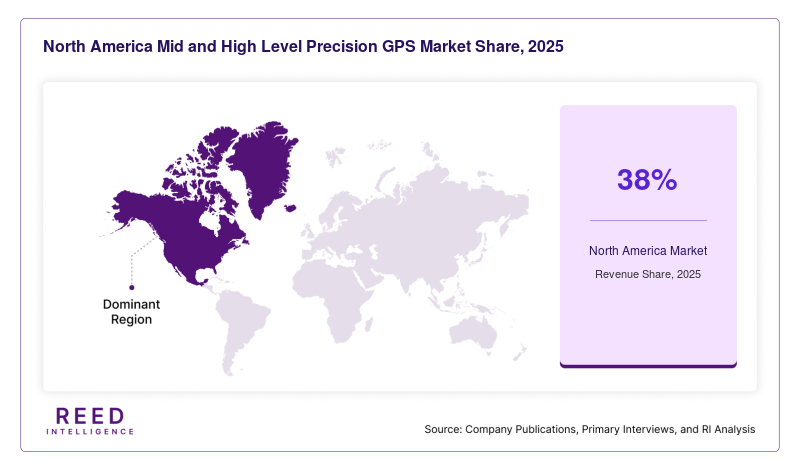
North America is the dominant region in the mid and high level precision GPS market. A comparable precision GPS receiver market source estimates that North America accounts for approximately 38% of market share, supported by strong adoption across agriculture, construction, transportation, defense, mining, and autonomous systems. The region benefits from advanced technological infrastructure, high investment in precision agriculture, established surveying capabilities, and strong demand for autonomous and machine-control technologies. However, the 38% figure comes from a related precision GPS receiver market definition rather than the exact USD 3.77 billion market series supplied for this report; therefore, it should be treated as a referenced regional benchmark rather than directly reconciled with the report's global market-size figures.
Europe Mid and High Level Precision GPS Market
Europe represents an important market supported by advanced surveying practices, infrastructure modernization, precision agriculture, autonomous mobility, and the development of Galileo-enabled positioning applications. Demand is also supported by increasing use of multi-frequency GNSS receivers and digital construction technologies.
Asia Pacific Mid and High Level Precision GPS Market
Asia Pacific is experiencing strong adoption of precision GPS because of rapid infrastructure development, agricultural modernization, expanding manufacturing activity, and increasing use of autonomous technologies. China, Japan, India, South Korea, and Australia represent important markets for precision positioning solutions. Some market research sources identify Asia Pacific as the largest or fastest-growing regional market, although the reported percentages vary materially according to market definition and methodology. Exact comparable market share for the specific USD 3.77 billion 2025 market series is unavailable from the verified sources reviewed.
Latin America Mid and High Level Precision GPS Market
Latin America is developing as an emerging market for precision GPS, particularly through the expansion of precision agriculture, mining, surveying, infrastructure projects, and natural-resource activities. Increased mechanization and demand for accurate field data are creating additional opportunities for positioning equipment and correction services.
Middle East & Africa Mid and High Level Precision GPS Market
The Middle East & Africa market is supported by infrastructure development, construction, mining, oil and gas activities, surveying, and emerging autonomous applications. Demand for accurate positioning is expected to increase as large-scale infrastructure and industrial projects become more digitally integrated.
Mid and High Level Precision GPS Market Competitive Landscape
The mid and high level precision GPS market is competitive, with established positioning technology companies focusing on receiver accuracy, multi-frequency support, correction services, inertial integration, signal resilience, software capabilities, and application-specific solutions.
Competition is increasingly shifting toward integrated positioning platforms rather than standalone receivers. Companies are developing compact GNSS modules, advanced RTK engines, GNSS/INS systems, visual positioning technologies, and anti-jamming and anti-spoofing capabilities.
Key Market Players
- Trimble Inc.
- Topcon Positioning Systems
- Hexagon AB
- Septentrio N.V.
- Hemisphere GNSS Inc.
- AG Leader Technology Inc.
- AGCO Corporation
- AgJunction Inc.
- Raytheon Technologies Corporation
- Stonex Group Inc.
- Thales Group
Mid and High Level Precision GPS Market Recent Developments
- September 2026 -Trimble: Trimble introduced its BD1090, BD1092, BD1092i and BX1092i GNSS receiver modules powered by Maxwell 8 technology. The new receivers provide multi-frequency and multi-constellation tracking, enhanced anti-jamming and anti-spoofing capabilities, increased processing power, improved IMU performance, and support for emerging LEO positioning signals.
- September 2026- Trimble: Trimble acquired Terasat Japan to expand its real-time, centimeter-level VRS correction services in Japan. The acquisition strengthens high-precision GNSS positioning services for surveying, construction, automotive, agriculture, IoT and autonomous-driving applications.
Mid and High Level Precision GPS Market Segments
By Type
- Differential Grade
- Survey Grade
By Frequency
- Single Frequency
- Dual Frequency
By Industry
- Mining
- Agriculture
- Construction
- Oil & Gas
- Others
By Region
- North America
- Europe
- APAC
- Middle East and Africa
- LATAM