Mid Infrared Sensors Market Size, Share & Trends Analysis Report By Sensor Type, Technology, Application, End-Use Industry and Region (North America, Europe, Asia Pacific, Latin America, Middle East & Africa) Forecasts, 2026–2034
USD 3950
Mid Infrared Sensors Market Size
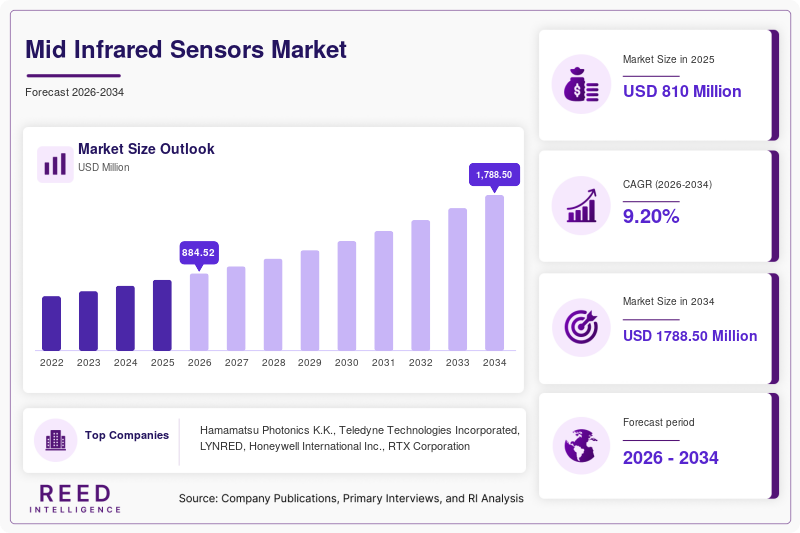
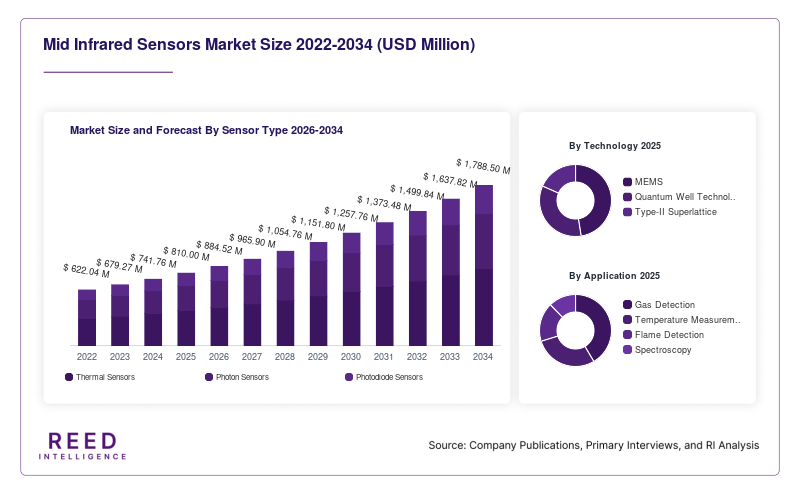
The global mid infrared sensors market was valued at USD 810 million in 2025 and is projected to grow from USD 884.52 million in 2026 to USD 1788.50 million by 2034, registering a CAGR of 9.20% during the forecast period from 2026 to 2034.
The mid infrared sensors market covers sensing technologies designed to detect and measure radiation within the mid-infrared spectrum, generally covering wavelengths between approximately 3 and 8 micrometers. These sensors can detect molecular signatures, thermal characteristics, gases, and other physical properties, making them important for industrial monitoring, environmental sensing, spectroscopy, defense, healthcare, and scientific applications.
Mid-infrared sensing technologies include photon detectors, thermal detectors, photodiodes, photoconductive detectors, quantum cascade detectors, thermopiles, and other specialized semiconductor-based sensing technologies. Their ability to provide selective detection of chemical and molecular signatures makes them particularly valuable for gas detection, emissions monitoring, process control, and analytical instrumentation.
Mid Infrared Sensors Market Drivers
Increasing Industrial Gas Detection Requirements: Growing emphasis on workplace safety, emissions monitoring, and process control is increasing demand for infrared-based gas sensing technologies.
Growth of Environmental Monitoring: Regulatory requirements for monitoring greenhouse gases, industrial emissions, and air quality are encouraging the deployment of highly selective infrared sensing technologies.
Expansion of Industrial Automation: Automated manufacturing and process-control systems increasingly require accurate sensors for temperature, gas concentration, chemical composition, and equipment monitoring.
Increasing Defense and Security Applications: Advanced infrared sensors are being adopted for surveillance, target detection, thermal imaging, and threat monitoring.
Mid Infrared Sensors Market Restraints
High Technology and Manufacturing Costs: Specialized detector materials, optical components, packaging, and signal-processing electronics can increase the cost of mid-infrared sensing systems.
Cooling Requirements for Certain Detectors: Some high-performance photon detectors require cooling to achieve the desired sensitivity, increasing system size, power consumption, and operating complexity.
Technical Integration Challenges: Integrating mid-infrared detectors with optics, signal processing, calibration systems, and other sensors can increase development complexity.
Limited Awareness in Emerging Applications: Adoption remains constrained in some developing markets because end users may lack awareness of the advantages and available applications of mid-infrared sensing.
Mid Infrared Sensors Market Opportunities
Room-Temperature Detector Development: Advances in quantum cascade detectors, Type-II superlattice detectors, and other technologies can reduce cooling requirements and enable broader commercial deployment.
Growth of Industrial Gas Monitoring: Oil and gas, chemicals, mining, manufacturing, and energy companies offer substantial opportunities for mid-infrared gas detection and safety systems.
Integration With AI and Advanced Analytics: Combining infrared sensing with AI-based signal processing can improve gas identification, anomaly detection, predictive maintenance, and automated monitoring.
Expansion of Portable and Embedded Sensors: Miniaturized mid-infrared modules can support portable spectroscopy, drones, autonomous systems, medical devices, and industrial inspection equipment.
Mid Infrared Sensors Market Segmental Analysis
By Sensor Type
Thermal Sensors are important for applications where cost efficiency, simple integration, and broad thermal detection capabilities are priorities. Their use across industrial monitoring, safety systems, and thermal applications supports continued demand.
Photon Sensors provide high sensitivity and wavelength-selective detection and are particularly important for demanding spectroscopy, gas analysis, scientific research, and defense applications.
Quantum Cascade Detectors represent a technologically advanced category within mid-infrared sensing. Their potential for room-temperature operation, low noise, and high-speed detection makes them attractive for demanding photonic applications. Hamamatsu identifies quantum cascade detectors as a room-temperature mid-infrared detector technology capable of high-speed operation.
By Technology
MEMS technology supports miniaturization and integration of infrared sensing components into compact systems.
Quantum Well Technology provides wavelength-selective detection and is suitable for specialized infrared sensing applications.
Type-II Superlattice technology is gaining importance because it can support high sensitivity, high resolution, and multi-band detection. Fujitsu's 2026 development of an over-one-megapixel dual-band T2SL sensor demonstrates continued advancement in this technology.
Quantum Cascade Technology enables high-performance mid-infrared detection and is increasingly relevant for spectroscopy, communications, gas sensing, and other high-speed applications.
By Application
Gas Detection is a major application because many gases exhibit strong absorption signatures in the mid-infrared region. This enables selective detection of hydrocarbons and other gases.
Spectroscopy uses mid-infrared sensing to identify molecular compositions and chemical characteristics, supporting pharmaceutical, chemical, environmental, and research applications.
Environmental Monitoring is benefiting from increasing demand for emissions measurement, air-quality monitoring, and greenhouse-gas detection.
Industrial Process Monitoring uses infrared sensing for real-time measurement of gases, temperature, chemical concentrations, and production conditions.
By End-Use Industry
Industrial and Chemical industries are major users of mid-infrared sensors because of requirements for process monitoring, safety, emissions detection, and quality control.
Oil & Gas applications include hydrocarbon detection, leak monitoring, refinery safety, and emissions monitoring.
Aerospace & Defense applications include thermal imaging, surveillance, target detection, missile warning, and high-speed threat tracking.
Healthcare and Research applications use mid-infrared spectroscopy and sensing for chemical analysis, diagnostics, laboratory measurement, and scientific research.
Mid Infrared Sensors Market Regional Analysis
North America Mid Infrared Sensors Market
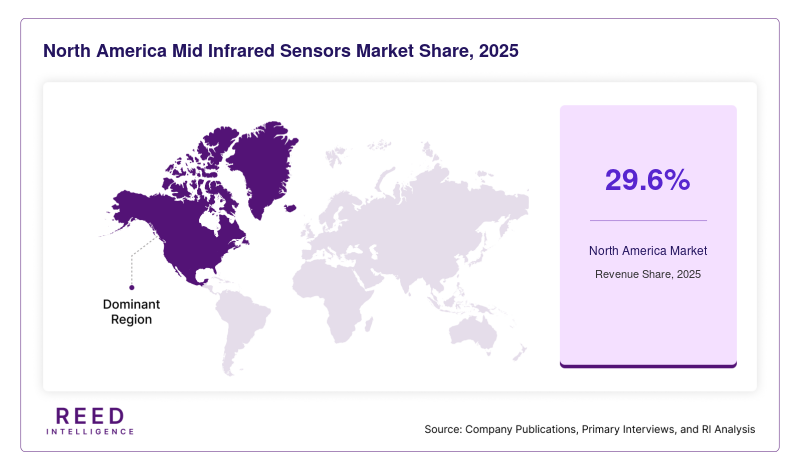
North America is the dominant region, accounting for 29.6% of the global mid infrared sensors market in 2025. The region's market was valued at approximately USD 0.24 billion in 2025, supported by established aerospace and defense industries, advanced research institutions, industrial safety requirements, and demand for thermal imaging and environmental monitoring technologies.
Europe Mid Infrared Sensors Market
Europe represents a significant market supported by stringent environmental regulations, industrial emissions monitoring, advanced photonics research, aerospace and defense programs, and demand for high-performance spectroscopy systems. Countries including Germany, France, and the United Kingdom have established optical, semiconductor, and aerospace industries supporting adoption.
Asia Pacific Mid Infrared Sensors Market
Asia Pacific is the fastest-growing regional market, supported by rapid industrialization, expanding manufacturing activity, semiconductor development, and increasing environmental monitoring requirements. China, Japan, South Korea, and India are important markets for infrared sensing technologies. A market-specific source reports Asia Pacific at 27.4% share in 2025 and forecasts an 11.8% CAGR through 2034, making it the fastest-growing region in that dataset.
Latin America Mid Infrared Sensors Market
Latin America is an emerging market for mid-infrared sensors, with opportunities arising from oil and gas, mining, chemical processing, environmental monitoring, and industrial automation. Increasing industrial safety requirements and emissions monitoring are expected to support adoption.
Middle East & Africa Mid Infrared Sensors Market
The Middle East & Africa market is supported by oil and gas operations, petrochemical facilities, mining, industrial safety, environmental monitoring, and infrastructure development. Mid-infrared gas detection is particularly relevant to hydrocarbon-intensive economies because infrared technologies can provide selective detection of combustible gases.
Mid Infrared Sensors Market Competitive Landscape
The mid infrared sensors market is characterized by competition among established infrared detector manufacturers, photonics companies, thermal imaging providers, semiconductor manufacturers, and specialized sensing technology companies.
Companies are focusing on improving detector sensitivity, wavelength selectivity, resolution, response speed, operating temperature, power consumption, and system integration. Competition is also increasing around compact detector modules and application-specific sensing platforms.
Recent product development indicates a shift toward room-temperature operation, multi-band detection, compact packaging, higher pixel counts, anti-interference capabilities, and embedded sensing solutions.
Key Market Players
- Hamamatsu Photonics K.K.
- Teledyne Technologies Incorporated
- LYNRED
- Honeywell International Inc.
- RTX Corporation
- Fujitsu Limited
- Raytheon Technologies
- Leonardo S.p.A.
- Thales Group
- InfraTec GmbH
Mid Infrared Sensors Market Recent Developments
- June 15, 2026 LYNRED: LYNRED introduced DRACO MW SL, an SXGA MWIR detector using Type-II Superlattice (T2SL) technology. The detector provides 1280 × 1024 resolution, 7.5 μm pixel pitch and 3.7–4.8 μm MWIR coverage, targeting land and counter-UAV applications.
- April 13, 2026 Raytheon (RTX): Raytheon demonstrated an event-based mid-wave infrared camera capable of tracking high-speed objects in real time while reducing processing and power requirements. The technology is being developed for defense applications including battlefield awareness, missile guidance and surveillance.
Mid Infrared Sensors Market Segments
By Sensor Type
- Thermal Sensors
- Photon Sensors
- Photodiode Sensors
By Technology
- MEMS
- Quantum Well Technology
- Type-II Superlattice
By Application
- Gas Detection
- Temperature Measurement
- Flame Detection
- Spectroscopy
By End-Use Industry
- Industrial
- Oil & Gas
- Chemical
- Healthcare
By Region
- North America
- Europe
- APAC
- Middle East and Africa
- LATAM