Mid Range KVM Over IP Market Size, Share & Trends Analysis Report By Type, Application and Region (North America, Europe, Asia Pacific, Latin America, Middle East & Africa) Forecasts, 2026–2034
USD 3950
Mid Range KVM Over IP Market Size
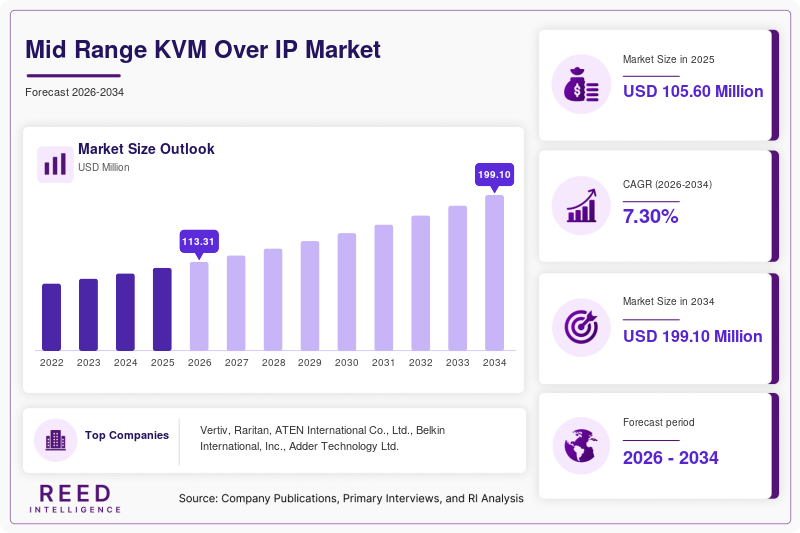
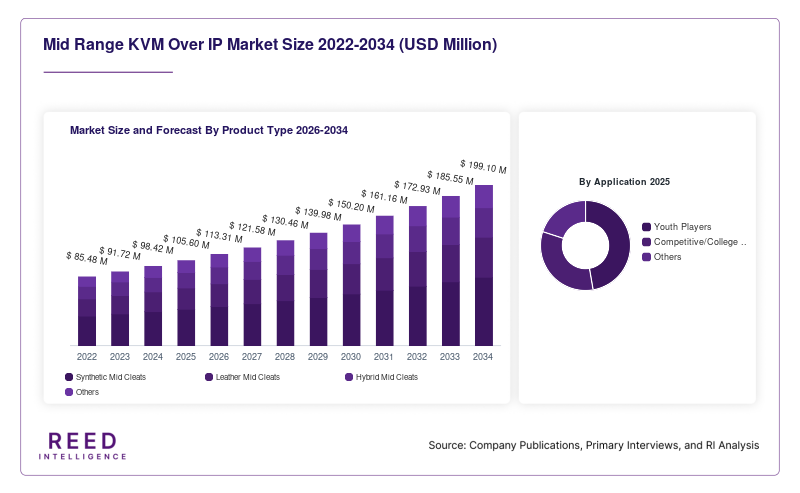
The global mid range KVM over IP market was valued at USD 105.60 million in 2025 and is projected to grow from USD 113.31 million in 2026 to USD 199.10 million by 2034, registering a CAGR of 7.30% during the forecast period from 2026 to 2034. The market is supported by increasing deployment of data centers, edge computing infrastructure, remote server management, and secure out-of-band access requirements. Independent market research also identifies data-center expansion, remote infrastructure management, and operational-efficiency requirements as important growth factors.
Mid Range KVM Over IP systems provide network-based keyboard, video, and mouse access to servers, workstations, and other IT equipment. They allow administrators to remotely access systems at the BIOS or hardware level, making them particularly valuable when operating-system-level remote-management software is unavailable or when a server requires troubleshooting, rebooting, configuration, or recovery.
Mid Range KVM Over IP Market Drivers
Expansion of Data Centers: Growing data-center capacity and distributed computing infrastructure are increasing demand for centralized hardware management and remote troubleshooting.
Growth of Edge Computing: Edge locations often operate with limited on-site IT resources, making remote KVM access valuable for maintenance, configuration, and recovery.
Need for Reduced Downtime: BIOS-level and out-of-band access enables administrators to respond to hardware and operating-system failures without requiring physical presence.
Increasing Cybersecurity Requirements: Strong authentication, access controls, encryption, and auditability are increasing the importance of secure KVM infrastructure.
Mid Range KVM Over IP Market Restraints
Competition From Software-Based Remote Access: RDP, VNC, virtualization platforms, and other software-based management solutions can provide lower-cost remote access for many routine IT tasks.
Initial Hardware Investment: Mid-range KVM deployments require switches, interface modules, cabling, network infrastructure, and installation, increasing upfront expenditure.
Network Dependency: IP-based KVM performance depends on network availability, bandwidth, latency, and appropriate configuration.
Configuration Complexity: Secure deployment can require networking and IT-management expertise, particularly when integrating authentication, permissions, and enterprise infrastructure.
Mid Range KVM Over IP Market Opportunities
Growing Edge and Branch Infrastructure: Increasingly distributed IT environments create opportunities for compact KVM solutions capable of centralized management.
Healthcare and Education Adoption: Hospitals, universities, and other institutions increasingly require reliable remote access to distributed IT systems and specialized equipment.
Cloud and Virtualization Integration: Combining physical KVM access with virtual machines, service processors, APIs, and infrastructure-management software creates opportunities for integrated management platforms.
High-Resolution KVM Applications: Demand for 4K and low-latency video creates opportunities in broadcasting, control rooms, engineering, healthcare, and specialized industrial environments.
Mid Range KVM Over IP Market Segmental Analysis
By Type
Multi-Port KVM Over IP represents the dominant type because mid-range users generally require centralized access to multiple servers and network devices. Multi-port configurations reduce the need for individual management connections and support centralized administration of distributed IT infrastructure.
KVM Over IP Extenders represent an important growth opportunity as organizations increasingly need to locate computing equipment away from user workstations while maintaining secure remote access. Vertiv's current KVM extender portfolio supports applications including data centers, banking, healthcare, education, government, and broadcasting.
By Application
Data Center Management is the dominant application because data centers require continuous access to servers, networking equipment, and other critical infrastructure. KVM over IP provides remote access, troubleshooting, provisioning, and recovery capabilities while reducing the need for physical intervention.
Remote Server Management is expected to remain one of the fastest-growing application areas as organizations operate increasingly distributed IT environments. Remote BIOS-level access is particularly valuable for systems that cannot be managed through conventional operating-system-based tools.
Broadcasting and Control Rooms provide an additional high-value application because users require high-resolution, low-latency access to workstations and production systems. Current KVM-over-IP extenders support 4K video and video-wall configurations for these environments.
Mid Range KVM Over IP Market Regional Analysis
North America Mid Range KVM Over IP Market
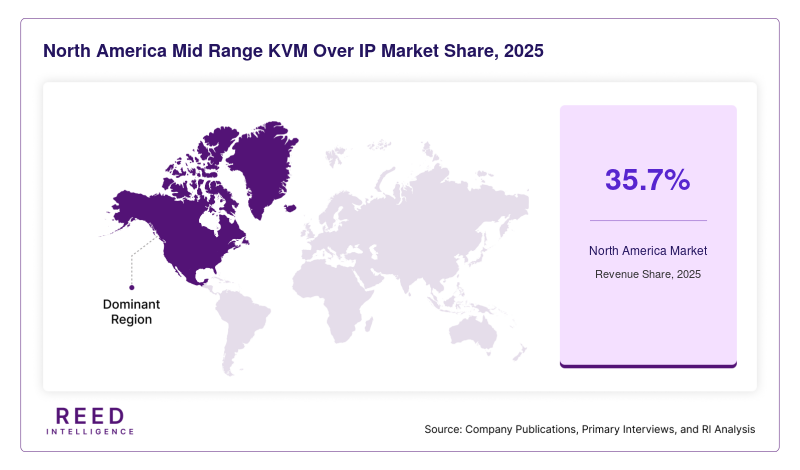
North America is the dominant regional market, accounting for approximately 35.70% of the global mid range KVM over IP market in 2026 according to the available market-specific analysis. The United States represents the primary contributor because of its large data-center base, advanced enterprise IT infrastructure, and strong adoption of remote-management technologies.
The region benefits from strong demand for business continuity, disaster recovery, secure remote administration, and distributed infrastructure management. Government and enterprise customers also place strong emphasis on authentication, encryption, and controlled access to critical IT systems.
Europe Mid Range KVM Over IP Market
Europe represents a significant market supported by mature data-center infrastructure, enterprise digitization, cybersecurity requirements, and increasing adoption of centralized IT-management technologies.
Demand is particularly relevant in financial services, government, healthcare, manufacturing, and telecommunications, where secure and auditable remote access is important.
Asia Pacific Mid Range KVM Over IP Market
Asia Pacific is expected to experience strong growth as China, Japan, South Korea, India, Singapore, and other markets continue investing in data centers, cloud infrastructure, telecommunications networks, and edge computing.
The region's expanding digital infrastructure provides opportunities for mid-range KVM systems that offer centralized management without the cost and complexity of the largest enterprise deployments.
Latin America Mid Range KVM Over IP Market
Latin America represents an emerging opportunity as enterprises modernize data centers and increase investment in cloud services, telecommunications, financial infrastructure, and digital business operations.
Brazil and Mexico represent important potential markets because of their comparatively developed enterprise and data-center ecosystems. Growth will also depend on network reliability, infrastructure investment, and availability of specialized IT-management solutions.
Middle East & Africa Mid range KVM over IP market
The Middle East & Africa market is supported by digital-transformation programs, data-center investment, smart-city initiatives, and expansion of enterprise IT infrastructure.
The available market-specific research identifies the Middle East as the fastest-growing regional area, with a reported CAGR of approximately 7.9%, supported by digital-transformation and smart-infrastructure investments.
Mid Range KVM Over IP Market Competitive Landscape
The mid range KVM over IP market is characterized by competition among established IT infrastructure companies, KVM specialists, data-center equipment manufacturers, and networking-equipment providers. Companies compete through port density, remote-access performance, video resolution, security, authentication, centralized management, scalability, interoperability, and total cost of ownership.
Leading vendors are increasingly combining KVM functionality with serial-console access, virtual-machine management, service-processor management, firmware updates, APIs, and centralized infrastructure-management platforms.
Key Market Players
- Vertiv
- Raritan
- ATEN International Co., Ltd.
- Belkin International, Inc.
- Adder Technology Ltd.
- Black Box
- Rose Electronics
- Schneider Electric
- Dell Technologies
- Lenovo
- Rextron Technology, Inc.
Mid range KVM over IP market Recent Developments
- July 16, 2026 Legrand / Raritan: Legrand unveiled the Dominion KX III G2, a next-generation KVM-over-IP matrix designed for secure remote management, troubleshooting, and recovery of critical IT systems. The platform is positioned for data centers, server rooms, and other distributed IT environments.
- May 27, 2026 Adder Technology: Adder announced a major upgrade to its ARDx remote-access KVM technology, adding multi-head connectivity, user-defined automatic framerate management, an SDK for third-party integrations, improved network-management capabilities, auto-discovery, and a redesigned interface.
Mid Range KVM Over IP Market Segments
By Product Type
- Synthetic Mid Cleats
- Leather Mid Cleats
- Hybrid Mid Cleats
- Others
By Application
- Youth Players
- Competitive/College Athletes
- Others
By Region
- North America
- Europe
- APAC
- Middle East and Africa
- LATAM