Midget Fuseblocks and Holder Market Size, Share & Trends Analysis Report By Product Type, Application and Region (North America, Europe, Asia Pacific, Latin America, Middle East & Africa) Forecasts, 2026–2034
USD 3950
Midget Fuseblocks and Holder Market Size
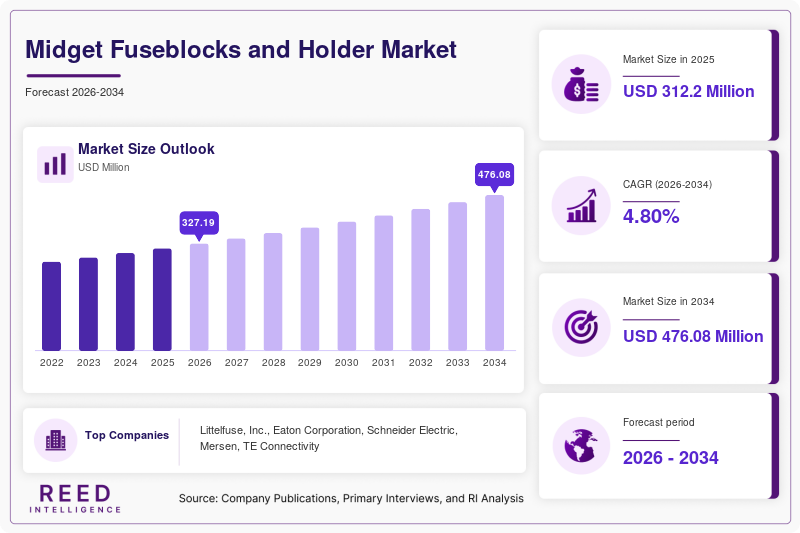
The global midget fuseblocks and holder market was valued at USD 312.2 million in 2025 and is projected to grow from USD 327.19 million in 2026 to USD 476.08 million by 2034, registering a CAGR of 4.80% during the forecast period from 2026 to 2034. The market includes compact fuseblocks and fuse holders used for circuit protection across industrial equipment, automotive systems, renewable energy installations, and other electrical applications.
Midget fuseblocks and holders are compact electrical protection components designed to accommodate and secure fuses while protecting electrical circuits against overcurrent conditions. Their compact dimensions make them suitable for applications where electrical enclosures and control panels have limited installation space.
Midget Fuseblocks and Holder Market Drivers
Industrial Automation and Electrification: Expansion of automated manufacturing equipment increases demand for compact circuit-protection components.
Renewable Energy Expansion: Solar and other renewable-energy systems require circuit protection across generation, conversion, storage, and distribution equipment.
Automotive Electrification: Increasing electrical content in conventional, hybrid, and electric vehicles expands demand for compact protection components.
Electrical Safety Requirements: Increasing emphasis on electrical safety and regulatory compliance supports continued adoption of certified fuse holders and fuseblocks.
Midget Fuseblocks and Holder Market Restraints
Competition From Solid-State Protection: Semiconductor-based and solid-state circuit-protection technologies can replace conventional fuses in selected high-value applications.
Price Competition: Standard fuseblocks and holders are relatively mature components, creating pricing pressure among manufacturers.
Replacement by Integrated Protection Systems: Increasing integration of protection functions into advanced power-electronic assemblies can limit demand for conventional standalone components in some applications.
Raw-Material Costs: Copper, brass, plastics, and other materials used in fuseblock and holder construction can affect manufacturing costs.
Midget Fuseblocks and Holder Market Opportunities
Renewable Energy and Energy Storage: Expansion of solar PV, battery storage, and distributed power infrastructure creates additional demand for specialized circuit-protection products.
Electric Vehicles: Higher electrical-system complexity and increasing battery-system deployment provide opportunities for manufacturers offering compact and application-specific protection solutions.
Industrial Automation: Factory automation and smart manufacturing create opportunities for higher-density fuseblocks with monitoring and diagnostic features.
Emerging Markets: Industrialization and infrastructure investment in Asia Pacific and other developing markets provide opportunities for manufacturers to expand distribution and production.
Midget Fuseblocks and Holder Market Segmental Analysis
By Product Type
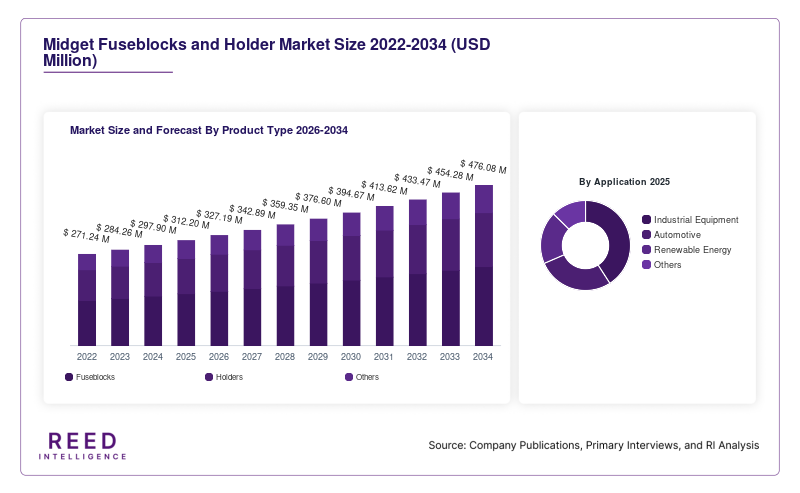
Fuseblocks are the dominant product segment, accounting for 58.3% of market value in 2025. Their leading position is supported by the need to protect multiple electrical circuits in compact control panels and equipment. Fuseblocks also simplify installation and circuit organization compared with multiple individual holders.
Holders represented 41.7% of market value in 2025 and are widely used where individual fuse replacement, flexible circuit configuration, automotive applications, and retrofit requirements are important. The segment is expected to maintain steady demand throughout the forecast period.
Fuseblocks remain the dominant segment, while the available market source identifies the Renewable Energy application as the fastest-growing application at approximately 4.7% CAGR.
By Application
Industrial Equipment is the dominant application segment, accounting for 34.8% of market value in 2025. Demand is supported by industrial automation, electrical control systems, manufacturing equipment, and increasing circuit density in modern industrial machinery.
Automotive is another major application, supported by increasing electrical content in vehicles and the continued requirement for compact circuit protection.
Renewable Energy is the fastest-growing application segment according to the available market-specific source, with a reported 4.7% CAGR. Solar PV and other renewable-energy installations require circuit protection across electrical generation and power-conversion equipment.
Midget Fuseblocks and Holder Market Regional Analysis
Asia Pacific Midget Fuseblocks and Holder Market
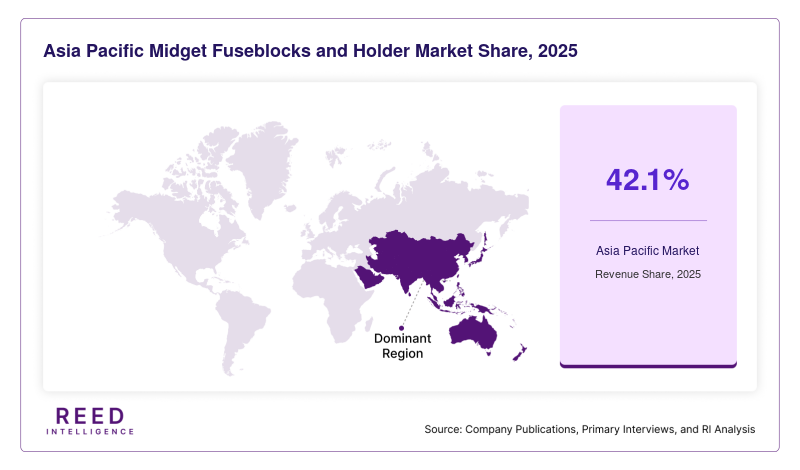
Asia Pacific is the dominant regional market, accounting for 42.1% of global revenue in 2025 according to the market-specific Dataintelo study. The region benefits from rapid industrialization, manufacturing expansion, renewable-energy investment, and large electrical and electronics production bases across China, India, Japan, South Korea, and Southeast Asia.
The region is also positioned for continued growth because of expanding industrial automation, renewable-energy capacity, electric-vehicle production, and infrastructure investment. These applications require increasing quantities of compact electrical protection components.
Europe Midget Fuseblocks and Holder Market
Europe accounted for 21.4% of global market revenue in 2025 according to the available market-specific analysis. The region benefits from established industrial manufacturing, automotive production, renewable-energy deployment, and stringent electrical-safety requirements.
Germany, France, Italy, the United Kingdom, and other industrial economies provide demand across automation, machinery, energy, and automotive applications. Increasing electrification and renewable-energy investment should support continued consumption.
North America Midget Fuseblocks and Holder Market
North America accounted for 17.3% of global market revenue in 2025 according to the same market-specific source. The region benefits from established industrial infrastructure, automation investment, renewable-energy projects, automotive manufacturing, and demand for certified electrical components.
The United States represents the largest contributor within the region. Demand is supported by industrial modernization and expansion of electrical infrastructure.
Latin America Midget Fuseblocks and Holder Market
Latin America accounted for 11.8% of global market revenue in 2025 according to the available market-specific analysis. Industrial development, automotive manufacturing, electrical infrastructure projects, and renewable-energy deployment provide opportunities for market expansion.
Brazil and Mexico are important markets because of their industrial bases and growing energy infrastructure. Increased local manufacturing and renewable-energy investment should create additional demand for circuit-protection components.
Middle East & Africa Midget Fuseblocks and Holder Market
The Middle East & Africa accounted for 7.4% of global market revenue in 2025 according to the available market-specific source. Demand is supported by industrial infrastructure, energy projects, electrical distribution investment, and gradual expansion of renewable-energy installations.
The region remains a smaller market compared with Asia Pacific, Europe, and North America, but infrastructure development and diversification of energy systems create long-term opportunities.
Midget Fuseblocks and Holder Market Competitive Landscape
The midget fuseblocks and holder market is moderately competitive and includes global electrical-component manufacturers, circuit-protection specialists, and regional suppliers. Competition is based on product reliability, electrical ratings, compact design, certification, installation flexibility, pricing, distribution reach, and application-specific customization.
Major manufacturers are increasingly developing integrated products that combine fuse protection with power distribution and simplified installation. Eaton's Bussmann power-distribution fuseblocks, for example, integrate fuseblock and power-distribution functions and are designed to reduce panel space and installation requirements.
Key Market Players
- Littelfuse, Inc.
- Eaton Corporation
- Schneider Electric
- Mersen
- TE Connectivity
- Phoenix Contact
- Siemens AG
- ABB Ltd.
- Legrand
- Schurter Holding AG
- Bel Fuse Inc.
Midget Fuseblocks and Holder Market Recent Developments
- March 1, 2026 Rockwell Automation: Rockwell Automation discontinued its 30 A UL Midget Fuse Holder with LED (140F-D3F-C30L) and directed customers to the 140F-D3C-C30L direct replacement, indicating ongoing product-line modernization within midget fuse-holder systems.
- July 26, 2026 Eaton: Eaton listed the Bussmann CHPV1IU photovoltaic fuse holder, a 30 A, 1,000 V DC single-pole modular fuse holder designed for PV Series fuses. The product expansion supports higher-voltage protection requirements associated with photovoltaic installations.
Midget Fuseblocks and Holder Market Segments
By Product Type
- Fuseblocks
- Holders
- Others
By Application
- Industrial Equipment
- Automotive
- Renewable Energy
- Others
By Region
- North America
- Europe
- APAC
- Middle East and Africa
- LATAM