Midline Catheter Market Size, Share & Demand Report By Product Type (Single-Lumen Midline Catheters, Double-Lumen Midline Catheters), By Application (Intravenous Therapy, Antibiotic Administration, Blood Sampling, Fluid and Nutrition Delivery), By End-Use (Hospitals, Ambulatory Surgical Centers, Home Healthcare, Specialty Clinics) By Region & Segment Forecasts, 2026–2034
USD 3950
Market Overview
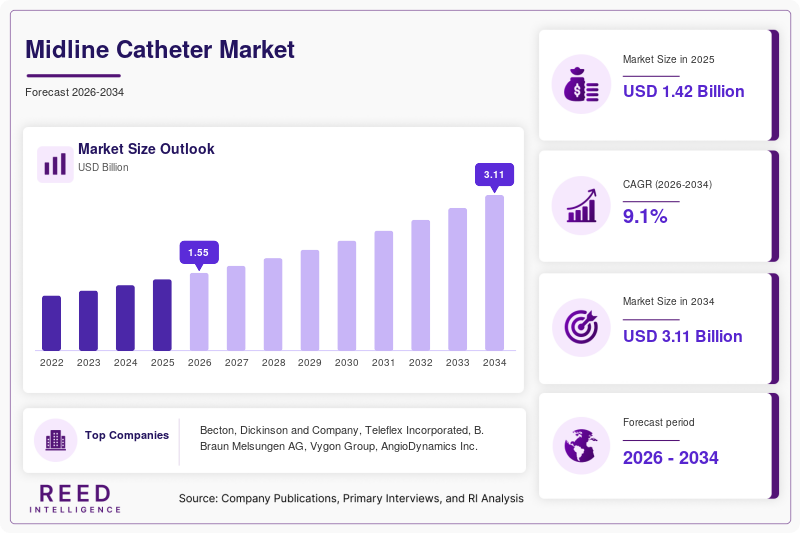
The global Midline Catheter Market was valued at approximately USD 1.42 billion in 2026 and is projected to reach USD 2.86 billion by 2034, expanding at a compound annual growth rate (CAGR) of 9.1% during the forecast period. Midline catheters, which are peripheral intravenous devices inserted into veins of the upper arm, have gained clinical preference as an intermediate solution between short peripheral IV catheters and central venous catheters. Their ability to reduce complications such as infections and repeated needle insertions has strengthened their adoption across hospitals and ambulatory care settings.
One key global factor driving market expansion is the increasing prevalence of chronic diseases requiring long-term intravenous therapies. Conditions such as cancer, cardiovascular disorders, and infectious diseases often require sustained drug administration, which boosts demand for reliable vascular access devices like midline catheters. Additionally, healthcare providers are shifting toward cost-effective and minimally invasive solutions, further supporting market growth.
Key Highlights
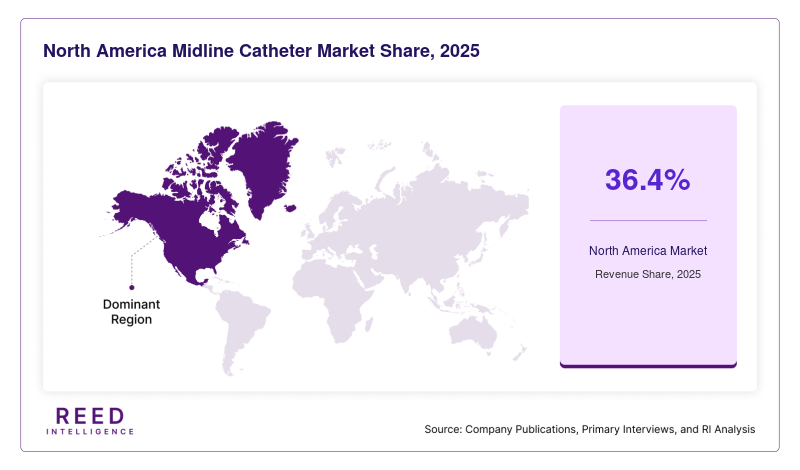
- North America dominated the market with a 36.4% share in 2025.
- Asia Pacific is expected to grow at the fastest CAGR of 10.8% during 2026–2034.
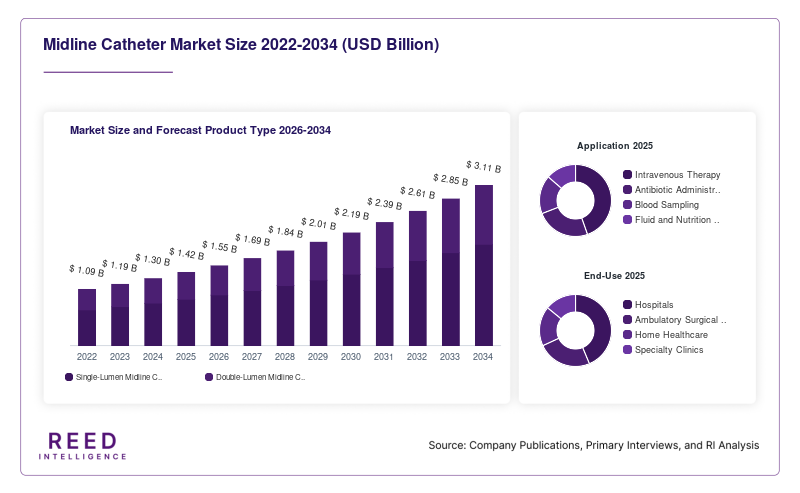
- By product type, single-lumen midline catheters accounted for the largest share of 42.7%, while double-lumen catheters are projected to grow at a CAGR of 10.5%.
- By application, intravenous therapy led with a 48.9% share, whereas antibiotic administration is expected to expand at a CAGR of 10.2%.
- The United States remained the dominant country, with market values of USD 520 million in 2024 and USD 575 million in 2025.
Market Trends
Increasing Adoption of Antimicrobial-Coated Catheters
Healthcare facilities are increasingly adopting antimicrobial-coated midline catheters to reduce the risk of catheter-associated bloodstream infections (CABSI). These infections remain a concern in clinical environments, particularly in intensive care units and long-term treatment scenarios. Manufacturers are investing in advanced coating technologies using silver ions, chlorhexidine, and antibiotic-based materials to enhance patient safety. The trend is gaining momentum as hospitals prioritize infection prevention and compliance with stringent regulatory standards. Furthermore, antimicrobial catheters help reduce hospital stay duration and overall treatment costs, making them a preferred choice among healthcare providers. This shift is expected to reshape product innovation strategies and increase premium product penetration across developed and developing markets.
Shift Toward Outpatient and Home-Based Care
The growing trend of outpatient care and home-based treatment is significantly influencing the midline catheter market. Patients increasingly prefer receiving therapies outside hospital settings due to cost considerations and convenience. Midline catheters are well-suited for such scenarios as they provide stable vascular access for extended durations without requiring central line insertion. Healthcare providers are aligning their services to support this transition by offering training and monitoring tools for patients and caregivers. This trend is particularly strong in regions with aging populations and rising healthcare costs. As a result, manufacturers are focusing on designing user-friendly, easy-to-insert catheters that support decentralized care delivery models.
Market Drivers
Rising Prevalence of Chronic Diseases
The increasing burden of chronic diseases such as diabetes, cancer, and cardiovascular disorders is a major driver of the midline catheter market. These conditions often require repeated or prolonged intravenous therapy, making midline catheters a suitable alternative to traditional IV access devices. Their extended dwell time reduces the need for frequent catheter replacements, improving patient comfort and clinical efficiency. Additionally, healthcare systems are emphasizing long-term disease management, which further increases demand for reliable vascular access solutions. The growing aging population worldwide also contributes to this trend, as elderly patients are more likely to require continuous medical care.
Cost Efficiency Compared to Central Venous Catheters
Midline catheters offer a cost-effective alternative to central venous catheters (CVCs), particularly in cases where long-term but non-critical access is required. They are easier to insert, require fewer specialized skills, and are associated with lower complication rates. Hospitals and healthcare providers are increasingly adopting cost-containment strategies, especially in resource-limited settings. Midline catheters align well with these objectives by reducing procedural costs and minimizing infection risks. Their ability to balance performance and affordability has led to widespread adoption across healthcare facilities, driving consistent market growth.
Market Restraint
Risk of Complications and Limited Awareness in Emerging Markets
Despite their advantages, midline catheters are associated with certain risks, including thrombosis, phlebitis, and catheter occlusion. These complications can limit their adoption, particularly in settings where healthcare professionals lack adequate training. In emerging markets, limited awareness and insufficient clinical guidelines further hinder market penetration. Healthcare providers may prefer traditional methods due to familiarity, even when midline catheters offer better outcomes. Additionally, concerns regarding improper insertion techniques and maintenance protocols can lead to adverse events, affecting patient safety and increasing healthcare costs. For example, in smaller hospitals or rural healthcare facilities, lack of skilled personnel may result in higher complication rates, discouraging widespread adoption. Addressing these challenges requires comprehensive training programs, improved clinical protocols, and awareness initiatives to ensure safe and effective use of midline catheters.
Market Opportunities
Expansion in Emerging Healthcare Markets
Emerging economies present significant growth opportunities for the midline catheter market due to expanding healthcare infrastructure and rising healthcare expenditure. Countries in Asia Pacific, Latin America, and Africa are investing in modern medical technologies to improve patient care. As healthcare systems evolve, the demand for advanced vascular access devices is expected to increase. Midline catheters, with their cost-effectiveness and clinical benefits, are well-positioned to capture this demand. Market players can leverage partnerships with local distributors and healthcare providers to expand their presence and improve product accessibility.
Technological Advancements in Catheter Design
Continuous innovation in catheter design offers promising growth opportunities for market participants. Developments such as ultrasound-guided insertion, improved biocompatible materials, and integrated safety features are enhancing product performance and usability. These advancements not only improve patient outcomes but also reduce the risk of complications. Manufacturers are focusing on creating customizable and patient-specific solutions to meet diverse clinical needs. The integration of digital health technologies, such as monitoring systems for catheter performance, further enhances value propositions. These innovations are expected to drive adoption across various healthcare settings and create new revenue streams for industry players.
Segmental Analysis
By Product Type
Single-lumen midline catheters dominated the market, accounting for approximately 42.7% of the total share in 2024. These catheters are widely used due to their simplicity, lower cost, and reduced risk of complications compared to multi-lumen alternatives. Healthcare providers prefer single-lumen devices for standard intravenous therapies, as they are easier to insert and maintain. Their widespread adoption across hospitals and outpatient settings contributes significantly to their market dominance. Additionally, advancements in material technology have improved the durability and performance of single-lumen catheters, further strengthening their position in the market.
Double-lumen midline catheters are expected to be the fastest-growing subsegment, with a projected CAGR of 10.5% during the forecast period. These catheters allow simultaneous administration of multiple medications, making them suitable for complex treatment regimens. Their growing use in critical care settings and among patients requiring multiple therapies is driving demand. The increasing prevalence of chronic diseases and the need for efficient treatment solutions further support the growth of this subsegment. Manufacturers are focusing on enhancing the safety and functionality of double-lumen catheters to meet evolving clinical needs.
By Application
Intravenous therapy accounted for the largest market share of 48.9% in 2024, driven by the widespread use of midline catheters for fluid and medication administration. These catheters provide a reliable and long-term solution for patients requiring continuous treatment, reducing the need for frequent needle insertions. The increasing number of hospital admissions and outpatient procedures further supports the dominance of this segment. Additionally, healthcare providers are adopting midline catheters to improve patient comfort and reduce complications associated with traditional IV methods.
Antibiotic administration is expected to grow at the fastest CAGR of 10.2% during the forecast period. The rising incidence of infectious diseases and the need for prolonged antibiotic therapy are key factors driving this growth. Midline catheters offer a convenient and effective solution for administering antibiotics over extended periods. Their ability to reduce infection risks and improve treatment outcomes makes them a preferred choice among healthcare providers. The increasing focus on antimicrobial stewardship programs also supports the growth of this subsegment.
By End-Use
Hospitals dominated the end-use segment, accounting for approximately 55.3% of the market share in 2024. The high volume of inpatient procedures and the availability of skilled healthcare professionals contribute to the dominance of this segment. Hospitals are the primary settings for complex treatments requiring reliable vascular access, making midline catheters an essential component of patient care. Additionally, the adoption of advanced medical technologies and infection control protocols further supports the growth of this segment.
Home healthcare is projected to be the fastest-growing subsegment, with a CAGR of 10.7% during the forecast period. The increasing preference for home-based care and the rising cost of hospital treatments are driving demand for midline catheters in this segment. Patients benefit from the convenience and comfort of receiving treatment at home, while healthcare providers can reduce operational costs. Technological advancements in portable medical devices and remote monitoring systems further support the growth of home healthcare. This trend is expected to create new opportunities for market expansion.
Regional Analysis
North America
North America accounted for a significant share of the midline catheter market, capturing approximately 36.4% of the global revenue in 2025. The region is expected to maintain steady growth with a projected CAGR of 8.7% during the forecast period. The presence of advanced healthcare infrastructure, high adoption of innovative medical devices, and strong reimbursement frameworks contribute to the region’s dominance. Additionally, increasing awareness regarding infection prevention and patient safety drives the adoption of midline catheters.
The United States dominates the regional market due to its well-established healthcare system and high prevalence of chronic diseases. A unique growth factor in this region is the widespread adoption of outpatient care models, which increases demand for long-term vascular access solutions. The emphasis on reducing hospital readmissions further supports market expansion.
Europe
Europe held a considerable market share of around 27.1% in 2025 and is projected to grow at a CAGR of 8.3% through 2034. The region benefits from strong regulatory frameworks and a focus on patient safety, which encourages the use of advanced medical devices. Increasing healthcare expenditure and aging populations also contribute to market growth.
Germany leads the European market, driven by its robust healthcare infrastructure and emphasis on technological innovation. A key growth factor is the integration of infection control protocols across healthcare facilities, which promotes the use of antimicrobial midline catheters. This approach enhances patient outcomes and reduces healthcare-associated infections.
Asia Pacific
Asia Pacific is expected to be the fastest-growing region, with a CAGR of 10.8% during the forecast period. The region accounted for approximately 21.3% of the market share in 2025. Rapid urbanization, improving healthcare infrastructure, and increasing healthcare spending are key factors driving growth.
China dominates the Asia Pacific market due to its large patient population and expanding healthcare system. A unique growth factor is the government’s focus on healthcare reforms and investment in medical technologies. These initiatives are improving access to advanced treatment options, including midline catheters.
Middle East & Africa
The Middle East & Africa region held a smaller share of around 8.2% in 2025 but is expected to grow at a CAGR of 9.5% over the forecast period. Growth is supported by increasing healthcare investments and rising awareness of advanced medical treatments.
Saudi Arabia is a key market within the region, driven by ongoing healthcare modernization efforts. A unique growth factor is the expansion of private healthcare facilities, which are adopting advanced medical devices to enhance service quality. This trend is expected to boost demand for midline catheters.
Latin America
Latin America accounted for approximately 7.0% of the market share in 2025 and is projected to grow at a CAGR of 9.0% through 2034. The region is experiencing gradual improvements in healthcare infrastructure and access to medical technologies.
Brazil leads the regional market due to its large healthcare system and growing demand for advanced treatments. A unique growth factor is the increasing focus on cost-effective healthcare solutions, which aligns with the benefits offered by midline catheters. This trend is expected to drive steady market growth.
Competitive Landscape
The midline catheter market is moderately competitive, with several global and regional players focusing on product innovation and strategic collaborations. Leading companies are investing in research and development to enhance catheter safety, durability, and ease of use. The market is characterized by the presence of established medical device manufacturers with strong distribution networks.
Becton, Dickinson and Company is a leading player in the market, known for its extensive portfolio of vascular access devices. The company has recently introduced advanced midline catheter solutions with improved safety features and antimicrobial coatings. Other key players are also focusing on expanding their product offerings and strengthening their market presence through partnerships and acquisitions. The competitive environment encourages continuous innovation, which benefits healthcare providers and patients alike.
Key Players
- Becton, Dickinson and Company
- Teleflex Incorporated
- B. Braun Melsungen AG
- Vygon Group
- AngioDynamics Inc.
- Smiths Medical
- ICU Medical Inc.
- Medtronic plc
- Cook Medical
- Terumo Corporation
- Nipro Corporation
- Poly Medicure Limited
- Argon Medical Devices
- Romsons Scientific & Surgical Pvt. Ltd.
- Fresenius Medical Care
Recent Developments
- In 2025, a leading manufacturer launched a new antimicrobial-coated midline catheter designed to reduce infection rates in long-term therapies.
- In 2024, a major healthcare company expanded its production capacity to meet rising global demand for vascular access devices.
- In 2025, a strategic partnership between two medical device firms aimed to enhance distribution networks in emerging markets.
Midline Catheter Market Segments
Product Type
- Single-Lumen Midline Catheters
- Double-Lumen Midline Catheters
Application
- Intravenous Therapy
- Antibiotic Administration
- Blood Sampling
- Fluid and Nutrition Delivery
End-Use
- Hospitals
- Ambulatory Surgical Centers
- Home Healthcare
- Specialty Clinics
By Region
- North America
- Europe
- APAC
- Middle East and Africa
- LATAM