MIG Torch Market Size, Share & Trends Analysis Report By Product Type, Application and Region (North America, Europe, Asia Pacific, Latin America, Middle East & Africa) Forecasts, 2026–2034
USD 3950
MIG Torch Market Size
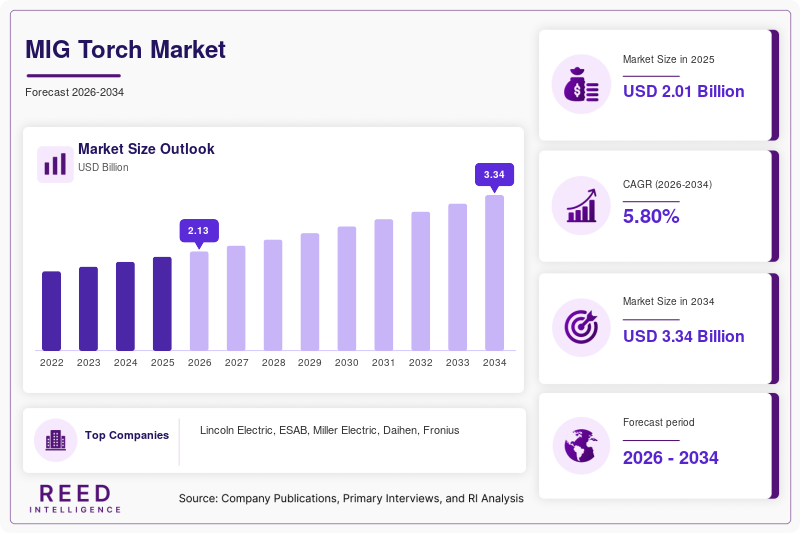
The global MIG torch market was valued at USD 2.01 billion in 2025 and is projected to grow from USD 2.13 billion in 2026 to USD 3.34 billion by 2034, registering a CAGR of 5.80% during the forecast period from 2026 to 2034. Market expansion is supported by increasing automotive manufacturing, industrial automation, demand for higher welding productivity, advanced cooling technologies, and growing adoption of robotic and semi-automated welding systems.
MIG torches are essential components of gas metal arc welding (GMAW) systems, delivering welding current, shielding gas and consumable wire to the welding zone. They are widely used across automotive manufacturing, heavy equipment production, shipbuilding, fabrication and other industrial applications.
MIG Torch Market Drivers
Expansion of Automotive Manufacturing:
Increasing vehicle production and expansion of automotive manufacturing facilities are creating demand for reliable MIG welding equipment and torches.
Growth of Industrial Automation:
Manufacturers are increasingly adopting robotic and semi-automated welding to improve consistency, throughput and production efficiency. This is increasing demand for robotic-compatible MIG torch systems.
Demand for Higher Welding Productivity:
Industrial users are seeking torches capable of operating at higher duty cycles while minimizing downtime and consumable replacement requirements.
Advancement in Cooling Technology:
Improved air- and water-cooled designs enable torches to handle demanding welding conditions and higher thermal loads.
MIG Torch Market Restraints
High Cost of Advanced Torch Systems:
Water-cooled, robotic and specialized MIG torch configurations generally require higher upfront investment than conventional torch systems.
Consumable Replacement Requirements:
Contact tips, liners, nozzles and other consumables require periodic replacement, creating ongoing operating costs.
Competition from Alternative Welding Processes:
TIG, laser and other advanced welding technologies can substitute MIG welding in applications requiring specific levels of precision, heat control or automation.
Maintenance Requirements:
Torch performance can deteriorate when liners, contact tips, cables or cooling systems are not properly maintained.
MIG Torch Market Opportunities
Robotic and Cobot Welding:
The expansion of robotic and collaborative welding creates opportunities for specialized MIG torch manufacturers. Parweld's 2026 robotic and cobot portfolio demonstrates the industry's movement toward dedicated automated torch solutions.
Advanced Aluminum Welding:
Growing demand for aluminum fabrication is creating opportunities for specialized push-pull and water-cooled MIG torch systems.
Smart Welding Systems:
Integration of welding equipment with monitoring, connectivity and digital manufacturing systems can create opportunities for intelligent torch and welding-cell solutions.
Emerging Manufacturing Economies:
Industrialization and manufacturing capacity expansion in Asia Pacific and other emerging economies are expected to generate additional demand for MIG welding equipment.
MIG Torch Market Segmental Analysis
By Product Type
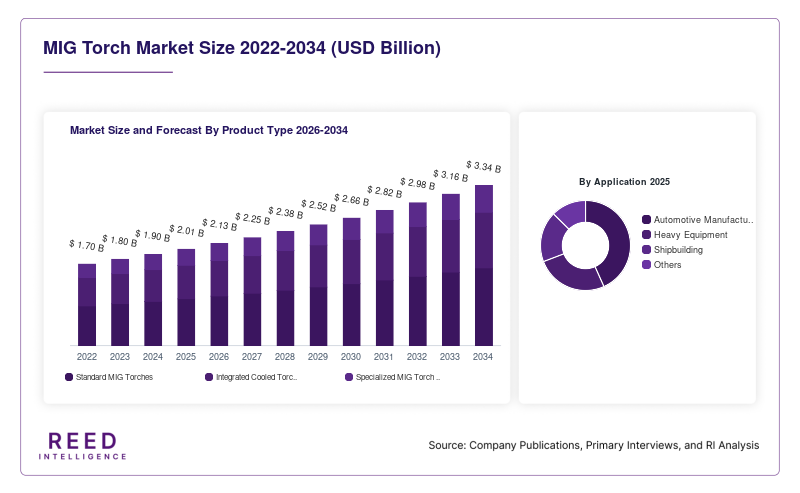
Standard MIG Torches held the dominant position, accounting for 52.8% of the market in 2025. Their broad applicability across general fabrication and industrial welding supports their leading position. The category is primarily valued for cost effectiveness and compatibility with a wide range of conventional welding applications.
Integrated Cooled Torches represented 35.2% of the market in 2025 and are expected to experience faster growth than standard torches as manufacturers increasingly require improved thermal management in high-duty-cycle welding operations. The segment recorded a reported 7.1% CAGR in the market-specific analysis.
Specialized MIG Torch Variants represented the smaller product category but were identified as the fastest-growing product segment, with a reported 8.5% CAGR. Their growth is supported by demand for specialized welding, automated systems and applications requiring enhanced performance.
By Application
Automotive Manufacturing is a major application for MIG torches because vehicle production involves extensive welding of steel, aluminum and other materials. The increasing use of automated welding cells further supports demand for compatible MIG torch technologies.
Heavy Equipment represents an important industrial application where MIG torches are used for structural fabrication, machinery manufacturing and high-duty-cycle welding operations.
Shipbuilding requires reliable MIG/MAG welding equipment for large-scale fabrication and structural joining. Demand is supported by continued shipbuilding activity and modernization of production facilities.
Others includes general fabrication, construction-related manufacturing, maintenance and other industrial welding activities.
MIG Torch Market Regional Analysis
Asia Pacific MIG Torch Market
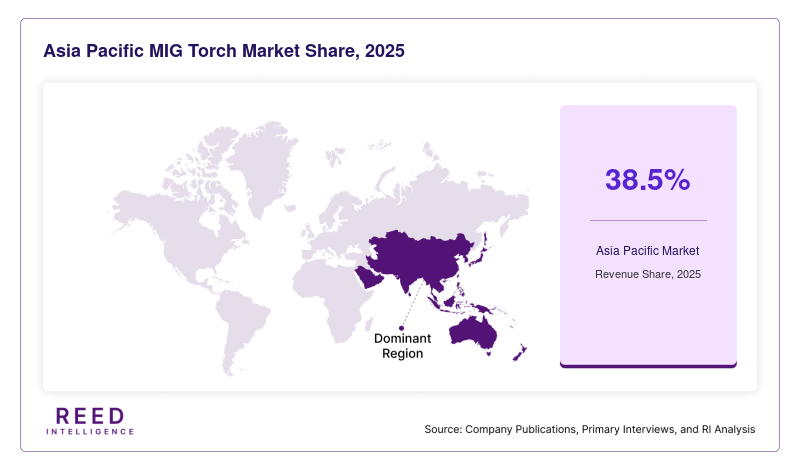
Asia Pacific was the dominant regional market, accounting for 38.5% of global MIG torch revenue in 2025. The region's leading position is supported by large-scale automotive production, industrial machinery manufacturing, shipbuilding and rapid industrial automation across China, Japan, India, South Korea and Southeast Asia.
The region also benefits from manufacturing investments, expansion of industrial facilities and growing adoption of automated welding systems. Japan and South Korea remain important welding-technology markets, while China and India provide substantial manufacturing demand.
Europe MIG Torch Market
Europe accounted for 26.1% of the global market in 2025 according to the market-specific analysis. The region's sophisticated manufacturing base and stringent welding-quality requirements support demand for premium MIG torch technologies.
Germany, Italy and Sweden are important industrial and welding-technology markets. Demand is supported by automotive manufacturing, machinery production, shipbuilding and increasing automation.
North America MIG Torch Market
North America accounted for 22.2% of the global MIG torch market in 2025. The regional market benefits from advanced automotive manufacturing, heavy equipment production, fabrication and increasing interest in automation and productivity-enhancing welding technologies.
The United States remains a major market because of its established industrial base and continued investment in advanced welding technologies. Manufacturers are increasingly emphasizing ergonomics, automation, digital monitoring and higher-productivity welding systems.
Latin America MIG Torch Market
Latin America represents a smaller share of global MIG torch demand but provides opportunities through automotive manufacturing, industrial fabrication, heavy equipment production and infrastructure-related activities.
Brazil and Mexico are important manufacturing markets, with automotive and industrial production providing a significant demand base. Growth in manufacturing automation is expected to support adoption of modern MIG torch systems.
Middle East & Africa MIG Torch Market
The Middle East & Africa market is supported by industrial development, construction, energy-related fabrication, infrastructure projects and machinery manufacturing.
Demand for MIG torches is expected to increase as industrial facilities modernize welding operations and manufacturers adopt more productive welding equipment. However, the exact market share and fastest-growing regional CAGR were not separately verified in the available market-specific source and therefore are not stated as confirmed figures.
MIG Torch Market Competitive Landscape
The MIG torch market is characterized by competition among established welding-equipment manufacturers and specialized welding-technology companies. Competition focuses on torch durability, cooling performance, ergonomics, consumable life, robotic compatibility, productivity and specialized welding capabilities.
Lincoln Electric, ESAB and Miller Electric are identified as leading companies in the market-specific competitive assessment. Other companies covered include Daihen, Fronius, Kemppi, Riland, Jasic, Hypertherm and Welding International.
Key Market Players
MIG Torch Market Recent Developments
- September, 2026 Miller Electric: Miller announced its upcoming Bernard Wingman and Tough Gun semi-automatic MIG guns and new Tregaskiss Atlas ThruArm MIG torch accessories for robotic welding applications at FABTECH 2026. The developments focus on improving welding productivity, operator performance, and robotic-system configuration.
- July, 2026 Parweld: Parweld introduced new taper consumable options for its PRO-FUME MIG/MAG fume-extraction torches, available in both air- and water-cooled versions. The development strengthens fume-extraction capability while maintaining MIG/MAG torch performance for industrial welding applications.
MIG Torch Market Segments
By Product Type
- Standard MIG Torches
- Integrated Cooled Torches
- Specialized MIG Torch Variants
By Application
- Automotive Manufacturing
- Heavy Equipment
- Shipbuilding
- Others
By Region
- North America
- Europe
- APAC
- Middle East and Africa
- LATAM