Mignon Battery Market Size, Share & Trends Analysis Report By Battery Type, Application and Region (North America, Europe, Asia Pacific, Latin America, Middle East & Africa) Forecasts, 2026–2034
USD 3950
Mignon Battery Market Size
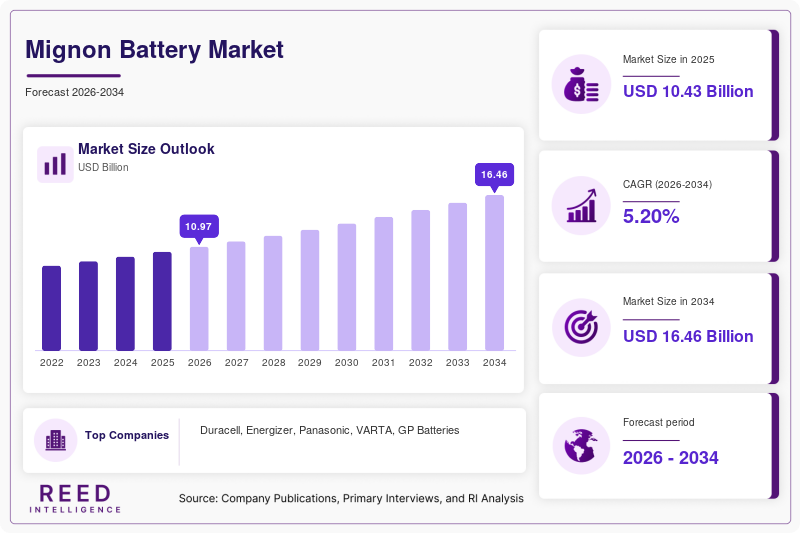
The global mignon battery market was valued at USD 10.43 billion in 2025 and is projected to grow from USD 10.97 billion in 2026 to USD 16.46 billion by 2034, registering a CAGR of 5.20% during the forecast period from 2026 to 2034. The market is supported by continued demand for portable power across consumer electronics, industrial equipment, emergency lighting, wireless peripherals, smart-home devices and other battery-powered applications.
Mignon batteries, commonly known as AA batteries, are standardized cylindrical cells used extensively in consumer and industrial equipment. The market includes alkaline batteries, carbon-zinc batteries, rechargeable NiMH batteries, lithium batteries and other specialty formulations.
Mignon batteries remain important because of their standardized form factor, broad device compatibility, easy availability and established replacement cycles. Consumer electronics remain a major source of demand, while industrial equipment, emergency lighting, sensors and portable equipment provide additional applications.
Mignon Battery Market Drivers
Rising Consumer Electronics Adoption:
The growing number of battery-powered consumer electronics and household devices creates recurring demand for AA batteries.
Expansion of Smart-Home Applications:
Battery-powered sensors, locks, remote controls and connected household products are creating additional applications for standardized Mignon batteries.
Growth of Industrial Equipment:
Portable industrial instruments, measurement equipment, sensors and backup systems use AA-format batteries where portability and reliability are important.
Demand for Emergency Backup Power:
Emergency lighting and other backup systems provide a continuing demand base for reliable primary batteries.
Mignon Battery Market Restraints
Increasing Competition From Rechargeable Batteries:
Repeated-use applications can shift from disposable alkaline and carbon-zinc batteries toward rechargeable NiMH and other rechargeable technologies.
Environmental Concerns:
Growing attention to battery disposal, recycling and material use is increasing pressure on manufacturers and consumers to adopt more sustainable battery solutions.
Competition From Integrated Rechargeable Systems:
Devices increasingly incorporate built-in rechargeable batteries, reducing the need for replaceable AA cells in certain consumer applications.
Raw Material and Manufacturing Costs:
Changes in the cost of zinc, manganese, lithium and other battery materials can influence manufacturing economics and retail prices.
Mignon Battery Market Opportunities
Growth in Smart-Home Devices:
The increasing number of wireless sensors and connected household devices provides an expanding application base for standardized AA cells.
High-Performance Lithium Batteries:
Premium lithium AA products can capture demand from high-drain electronics, professional equipment, outdoor applications and devices requiring long storage life.
Industrial and Medical Equipment:
Portable diagnostic, monitoring and measurement equipment provides opportunities for higher-reliability Mignon battery products.
Emerging Markets:
Increasing consumer-electronics penetration and household income in emerging economies can support higher battery consumption.
Mignon Battery Market Segmental Analysis
By Battery Type
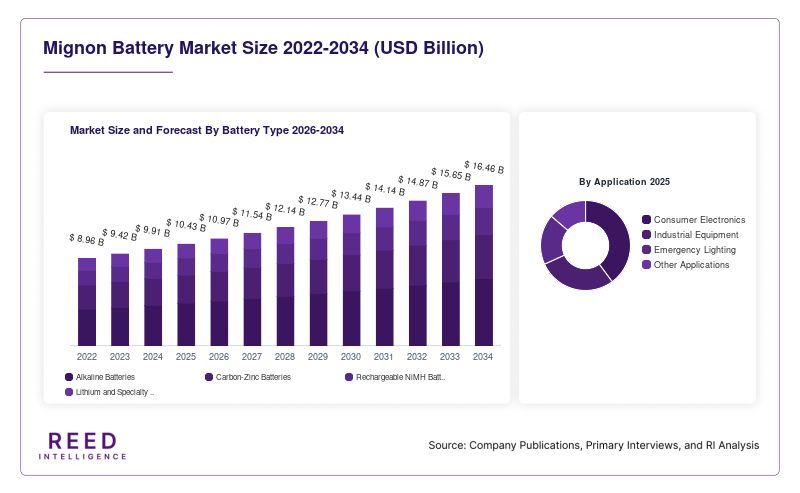
Alkaline Batteries represent the dominant battery category, accounting for 56.8% of the mignon battery market. Their leading position is supported by low cost, broad availability, established distribution networks and suitability for everyday consumer devices.
Carbon-Zinc Batteries continue to serve price-sensitive applications where power requirements are relatively modest. Their use is concentrated in basic electronic devices and applications where low acquisition cost is a major purchasing consideration.
Rechargeable NiMH Batteries provide an important reusable alternative for high-frequency applications. Their value proposition is particularly strong in devices with repeated battery replacement requirements.
Lithium and Specialty Batteries represent an increasingly important premium segment. Lithium AA batteries offer high energy density, low weight, long shelf life and strong performance under high-load conditions. The fastest growth within the broader technology mix is expected to come from higher-performance and rechargeable solutions as users increasingly prioritize longevity and operating efficiency.
By Application
Consumer Electronics represents the leading application segment because AA batteries are widely used in remote controls, wireless peripherals, toys, clocks, flashlights, personal electronics and smart-home equipment.
Industrial Equipment represents a significant demand category, particularly for portable instruments, sensors, measurement equipment and other devices where standardized replaceable power sources are useful.
Emergency Lighting provides a stable application base because emergency and backup systems require reliable power availability.
Other Applications include medical devices, outdoor equipment, security products, household accessories and various portable electronic products.
Mignon Battery Market Regional Analysis
Asia Pacific Mignon Battery Market
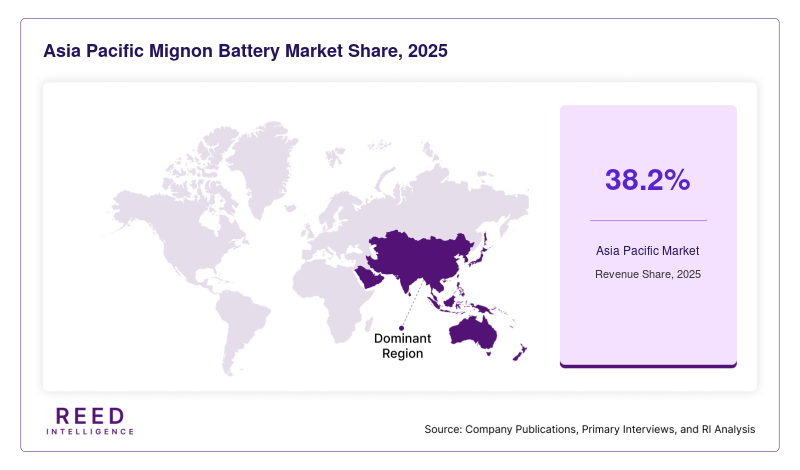
Asia Pacific was the dominant regional market, accounting for 38.2% of global Mignon battery revenue in 2025. The region's leadership is supported by China's extensive battery manufacturing ecosystem, strong consumer-electronics production, industrial development and growing household adoption of battery-powered devices.
China, Japan, South Korea and India represent important markets across the region. India's expanding consumer-electronics penetration and growing demand for battery-powered toys and household products provide additional growth opportunities. A broader AA battery analysis estimates India's market to grow at approximately 6.8% CAGR through 2034.
North America Mignon Battery Market
North America represents one of the world's most established mignon battery market, supported by high household penetration of battery-powered electronics, mature retail infrastructure and strong brand recognition.
The region has also shown increasing interest in premium alkaline and lithium AA products, particularly for high-drain electronics, flashlights, outdoor equipment and emergency preparedness.
Europe Mignon Battery Market
Europe represents a mature battery market supported by extensive consumer-electronics adoption and established retail networks. Germany, the United Kingdom, France and Italy are among the important national markets.
The region is also experiencing increasing emphasis on rechargeable batteries, recycling and sustainable battery management. European battery regulations are encouraging manufacturers and market participants to strengthen collection, recycling and environmental practices.
Latin America Mignon Battery Market
Latin America represents an emerging opportunity for Mignon battery manufacturers. Brazil and Mexico are important markets because of their expanding consumer-electronics, toy, household-equipment and retail sectors.
Growing household purchasing power and increasing penetration of battery-powered products are expected to support replacement-battery demand over the forecast period.
Middle East & Africa Mignon Battery Market
The Middle East & Africa market is supported by expanding consumer electronics, household products, emergency equipment and industrial applications.
Gulf markets such as the UAE and Saudi Arabia have relatively mature retail channels, while several African markets offer longer-term volume-growth opportunities as electrification, retail penetration and consumer-electronics ownership expand.
The exact Mignon-market share and CAGR for this region were not separately verified in the market-specific source and are therefore not stated as confirmed figures.
Mignon Battery Market Competitive Landscape
The Mignon Battery Market is highly competitive, with established multinational battery manufacturers competing on energy density, reliability, shelf life, price, brand recognition, distribution and chemistry.
Duracell and Energizer are identified as the leading participants in the market-specific analysis, with a combined 42.5% global share. Other important companies include Panasonic, VARTA, GP Batteries, Huatai, Sunwoda and Eveready.
Competition is increasingly focused on premium lithium products, improved alkaline formulations, rechargeable NiMH technologies, longer shelf life and sustainability initiatives.
Key Market Players
Mignon Battery Market Recent Developments
- June, 2026 – ANSMANN: ANSMANN reported that its Mignon AA 1.5V Extreme Lithium battery secured second place in the BILD-Kaufberater laboratory test, receiving a 1.1 (“very good”) rating. The battery performed particularly strongly under 200 mA and 800 mA load conditions, highlighting continued development toward high-performance lithium AA batteries.
- June, 2026 – ANSMANN: ANSMANN's Comfort Check battery tester received the “Excellent Product Quality 2026” award after previously receiving recognition from FAZ and the PLUS X AWARD. The development reflects the company's continued focus on battery-testing technology and consumer battery-management solutions.
Mignon Battery Market Segments
By Battery Type
- Alkaline Batteries
- Carbon-Zinc Batteries
- Rechargeable NiMH Batteries
- Lithium and Specialty Batteries
By Application
- Consumer Electronics
- Industrial Equipment
- Emergency Lighting
- Other Applications
By Region
- North America
- Europe
- APAC
- Middle East and Africa
- LATAM