Military Ammunition Market Size, Share & Trends Analysis Report By Product Type (Small Caliber Ammunition, Medium Caliber Ammunition, Large Caliber Ammunition, Artillery Ammunition, Mortar Ammunition), By Application (Defense, Homeland Security, Law Enforcement), By Component (Bullets, Shells, Cartridges, Others), By Distribution Channel (Direct Sales, Distributors) Forecasts, 2026–2034
USD 3950
Military Ammunition Market Size
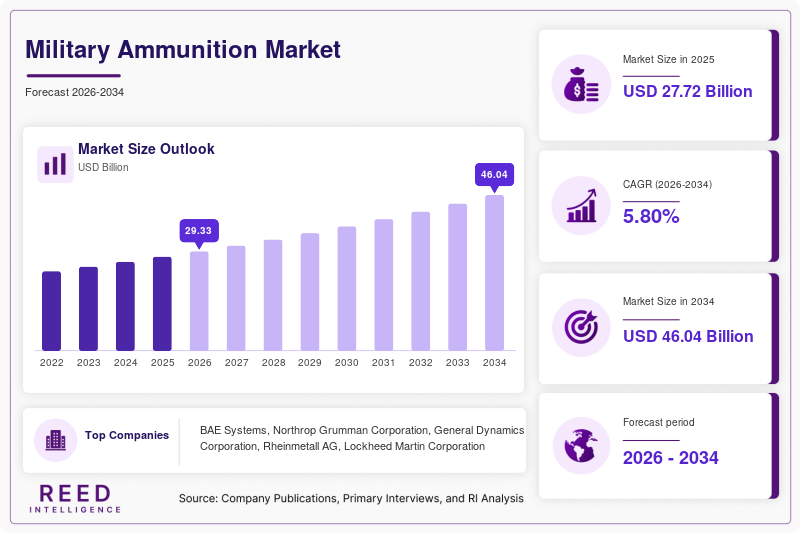
The global Military Ammunition Market was valued at USD 27.72 billion in 2025 and is projected to grow from USD 29.33 billion in 2026 to USD 46.04 billion by 2034, registering a CAGR of 5.80% during the forecast period from 2026 to 2034. The market growth is supported by military modernization programs, ammunition stockpile replenishment, geopolitical tensions, domestic production initiatives, and increasing adoption of technologically advanced ammunition systems.
The Military Ammunition Market comprises ammunition products designed for armed forces, homeland security organizations, and specialized law enforcement operations. The market includes small caliber ammunition, medium caliber ammunition, large caliber ammunition, artillery ammunition, and mortar ammunition. These products support infantry weapons, armored platforms, naval systems, air-defense platforms, artillery systems, and other military applications.
Military Ammunition Market Drivers
Escalating Geopolitical Tensions
Geopolitical tensions and continuing regional conflicts are major drivers of ammunition procurement. Governments are strengthening ammunition inventories because prolonged conflicts can rapidly consume existing stockpiles and expose limitations in domestic production capacity.
Military Modernization Programs
Military modernization programs are creating demand for ammunition compatible with new armored vehicles, artillery platforms, naval systems, air-defense platforms, and advanced infantry weapons. Modern platforms require ammunition with improved ballistic consistency, range, penetration, accuracy, and programmable effects.
Strategic Stockpiling
Governments are moving toward larger strategic reserves rather than relying solely on historical peacetime consumption levels. Stockpile replenishment creates recurring procurement opportunities for ammunition manufacturers.
Expansion of Domestic Production
National security concerns are encouraging governments to establish or expand domestic ammunition production. This creates demand for new factories, automated production lines, advanced manufacturing equipment, and technology-transfer partnerships.
Military Ammunition Market Restraints
High Manufacturing Costs
Military ammunition manufacturing requires specialized machinery, controlled production environments, precision metallurgy, energetics handling, testing infrastructure, and strict quality-control systems. These requirements increase capital and operating costs.
Stringent Regulations
Ammunition manufacturing and distribution are subject to strict national security, export-control, environmental, safety, and procurement regulations. These requirements can increase compliance costs and lengthen project-development timelines.
Raw Material Supply Constraints
Specialty alloys, energetic materials, electronic components, and other specialized inputs can face supply-chain limitations. Disruptions can affect production schedules and ammunition availability.
Skilled Labor Shortages
Expansion of ammunition manufacturing capacity requires skilled workers in precision manufacturing, metallurgy, electronics, chemical processing, and quality assurance. Shortages in these areas can limit capacity expansion.
Military Ammunition Market Opportunities
Precision-Guided Ammunition
The increasing use of advanced targeting systems creates opportunities for manufacturers developing precision-guided and extended-range ammunition. These products can command higher value than conventional ammunition.
Localization and Technology Partnerships
Countries seeking ammunition self-sufficiency are creating opportunities for joint ventures, technology licensing, domestic production partnerships, and localized manufacturing.
Advanced Materials
Lightweight composites, advanced penetrators, improved projectile structures, and other material innovations can improve ballistic performance while reducing ammunition weight.
Non-Lethal Ammunition
Modernization of law enforcement and homeland security operations creates opportunities for specialized non-lethal ammunition products, particularly for controlled-response and urban security applications.
Military Ammunition Market Segmental Analysis
By Product Type
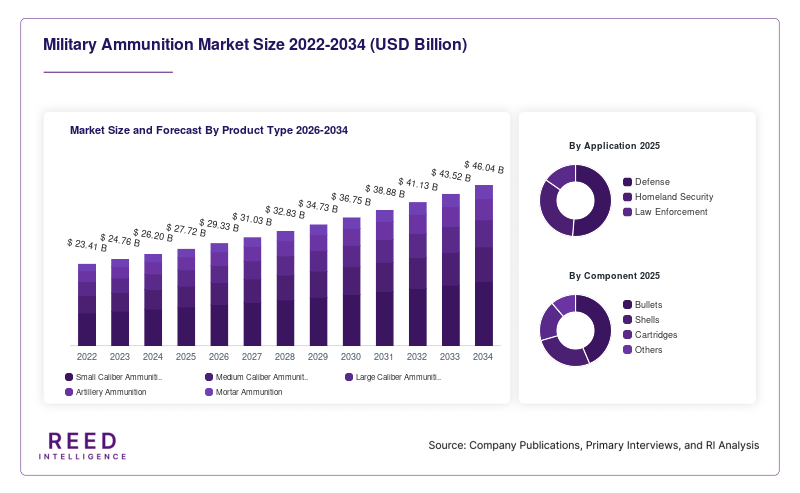
Small Caliber Ammunition is the dominant product segment, accounting for 38.5% market share. Its leadership is supported by extensive use in infantry training, operational readiness, machine guns, rifles, and other small-arms platforms. Continuous training requirements and military readiness programs create recurring consumption.
Medium Caliber Ammunition represents 26.3% of the market and is used across vehicle-mounted weapons, naval systems, air-defense platforms, and other 20mm–40mm applications. Its growth is supported by modernization of armored and air-defense systems.
Large Caliber Ammunition accounts for 16.8%, supported by naval modernization, air-defense platforms, and advanced ground systems.
Artillery Ammunition represents 11.2% and is supported by increasing adoption of 155mm and other advanced artillery systems.
Mortar Ammunition accounts for 7.2% and continues to serve light infantry and airborne forces.
The fastest-growing product segment is Large Caliber Ammunition, with a reported 6.8% CAGR, followed by Artillery Ammunition at 6.5%.
By Application
Defense is the dominant application, accounting for 64.2% market share. Demand comes from armed forces requiring ammunition for training, readiness, combat operations, infantry systems, armored platforms, artillery, air defense, and naval systems.
Homeland Security represents 22.5% of the market, supported by border security, maritime protection, port security, infrastructure protection, and specialized security operations.
Law Enforcement accounts for 13.3%, supported by police training, tactical operations, special-response teams, and specialized ammunition requirements.
The fastest-growing application is Defense, with a reported 5.9% CAGR, slightly above Homeland Security at 5.7%.
By Component
Bullets dominate the component segment with 32.4% market share, reflecting the high-volume use of small and medium caliber projectiles.
Shells account for 28.7%, supported by artillery, naval gun, and air-defense applications. Advanced shells incorporating precision fuzes and improved propellant systems represent higher-value products.
Cartridges represent 21.8%, benefiting from standardized military ammunition requirements and large-scale automated production.
Others account for 16.1%, including fuzing systems, explosive components, specialty materials, and packaging.
The fastest-growing component segment is Others, with a reported 6.8% CAGR, driven by advanced fuzing and specialized ammunition technologies.
By Distribution Channel
Direct Sales dominate distribution with 67.3% market share. Government-to-manufacturer procurement, multi-year contracts, strategic supply agreements, and national defense procurement programs support this channel.
Distributors account for 32.7%, serving smaller military organizations, homeland security agencies, law enforcement organizations, and customers requiring access to multiple manufacturers.
Direct Sales is also the faster-growing channel, with a reported 5.9% CAGR, compared with 5.6% for distributors.
Military Ammunition Market Regional Analysis
Asia Pacific Military Ammunition Market
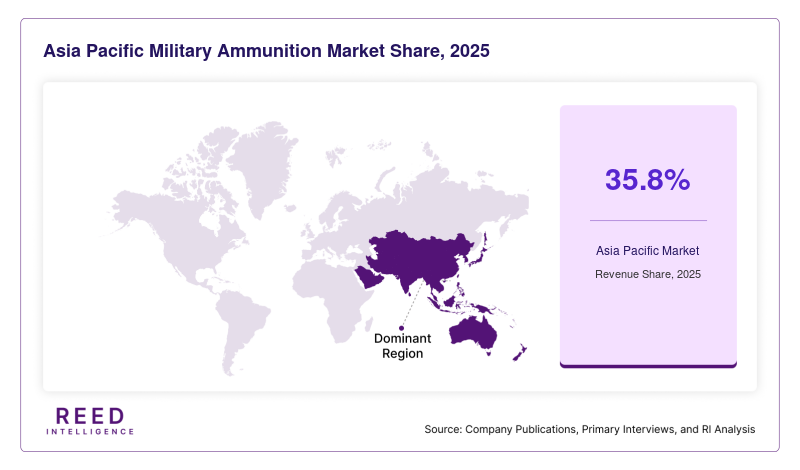
Asia Pacific is the dominant regional market, accounting for 35.8% of global Military Ammunition Market share. The region benefits from military modernization programs, increasing defense budgets, border-security requirements, maritime-security initiatives, and expansion of indigenous ammunition manufacturing. India, Japan, South Korea, Vietnam, and other regional markets are supporting demand for small, medium, large caliber, and artillery ammunition.
The region is also benefiting from domestic production initiatives and international defense partnerships. Investments in ammunition manufacturing capacity, advanced targeting systems, unmanned platforms, and modern artillery systems are supporting long-term procurement demand.
North America Military Ammunition Market
North America holds the second-largest regional share at 28.4%. The United States is the principal market, supported by high defense expenditure, NATO commitments, ammunition replenishment, military training requirements, and investments in domestic manufacturing capacity.
The region is also witnessing modernization of small caliber ammunition and expansion of production facilities. Continued investment in domestic supply chains and strategic stockpiles is expected to maintain strong regional demand.
Europe Military Ammunition Market
Europe accounts for 19.7% of the global market. Demand is being supported by NATO modernization, replenishment of ammunition inventories, increased defense expenditure, and the need to strengthen domestic defense-industrial capacity.
Germany, Poland, Romania, and other European countries are increasing procurement of medium and large caliber ammunition and artillery systems. The European defense industry is also expanding production capacity to reduce supply-chain vulnerabilities and support long-term regional security requirements.
Latin America Military Ammunition Market
Latin America represents approximately 10.6% of the global market. Demand is supported by law-enforcement modernization, border security, counterterrorism requirements, and military capability development.
Brazil represents an important regional market because of its defense-industrial base and law-enforcement requirements. Argentina and other regional countries also contribute to demand through modernization of military capabilities and security infrastructure.
Middle East & Africa Military Ammunition Market
The Middle East & Africa region accounts for approximately 5.5% of global market share. Demand is supported by regional security requirements, counterterrorism operations, border management, military modernization, and defense spending by Gulf Cooperation Council countries.
The region also provides opportunities for manufacturers through localized production partnerships, direct government procurement, and supply agreements supporting military and homeland-security requirements.
Military Ammunition Market Competitive Landscape
The Military Ammunition Market is highly competitive and concentrated among large defense contractors with established manufacturing capabilities, government relationships, extensive product portfolios, and significant R&D resources.
BAE Systems is identified as the leading company in the market, supported by its broad ammunition portfolio and international presence. Northrop Grumman and General Dynamics are other major participants with significant ammunition manufacturing and advanced defense-system capabilities.
Rheinmetall is strengthening its position through substantial investments in ammunition production capacity, particularly for artillery and medium-caliber ammunition. Other major participants compete through precision ammunition, advanced fuzing, specialized ammunition, regional manufacturing, and strategic government partnerships.
Key Market Players
- BAE Systems
- Northrop Grumman Corporation
- General Dynamics Corporation
- Rheinmetall AG
- Lockheed Martin Corporation
- Thales Group
- Raytheon Technologies Corporation
- Leonardo S.p.A.
- Elbit Systems Ltd.
- Nammo AS
- Olin Corporation
- Orbital ATK Inc.
Military Ammunition Market Recent Developments
September , 2026, Winchester Ammunition announced that it had been selected by the U.S. Army as a Second Source provider for small-caliber rifle ammunition. The contract covers 5.56mm, 7.62mm, and .50 caliber ammunition, strengthening the Army's multi-supplier ammunition procurement strategy.
September , 2026, Rheinmetall announced an international order for a low five-figure quantity of 155mm artillery projectiles, with the contract valued in the low three-digit millions of euros. Production has already started and delivery is scheduled for 2027. Rheinmetall also stated that it is expanding capacity with a target of approximately 1.5 million 155mm artillery shells annually by 2030.
Military Ammunition Market Segments
By Product Type
- Small Caliber Ammunition
- Medium Caliber Ammunition
- Large Caliber Ammunition
- Artillery Ammunition
- Mortar Ammunition
By Application
- Defense
- Homeland Security
- Law Enforcement
By Component
- Bullets
- Shells
- Cartridges
- Others
By Distribution Channel
- Direct Sales
- Distributors
By Region
- North America
- Europe
- APAC
- Middle East and Africa
- LATAM