Military Armored Vehicles and Counter IED Vehicles Market Size, Share & Trends Analysis Report By Type, By Application, By Technology and By Region (North America, Europe, Asia Pacific, Latin America, Middle East & Africa) Forecasts, 2026–2034
USD 3950
Military Armored Vehicles and Counter IED Vehicles Market Size
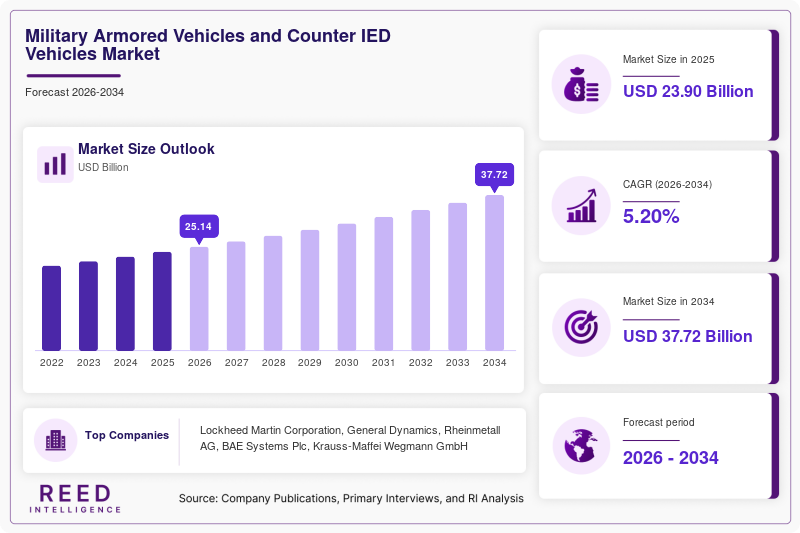
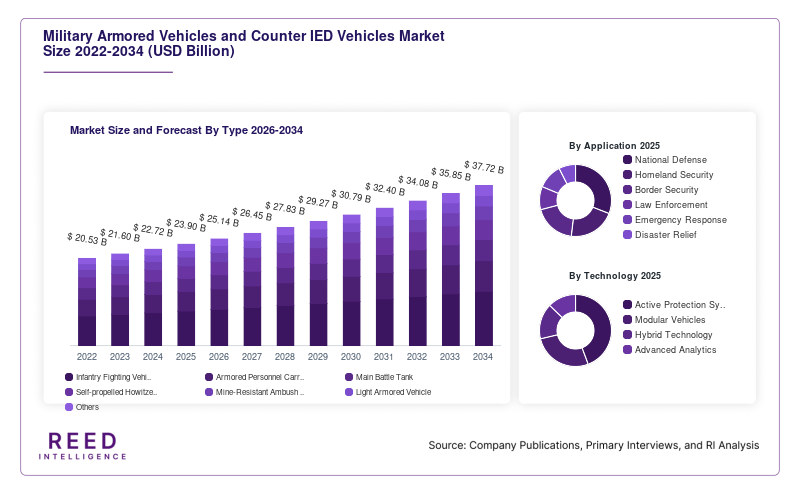
The global military armored vehicles and counter IED vehicles market was valued at USD 23.90 billion in 2025 and is projected to grow from USD 25.14 billion in 2026 to USD 37.72 billion by 2034, registering a CAGR of 5.20% during the forecast period from 2026 to 2034. The market is supported by military modernization, rising asymmetric warfare threats, border-security requirements, increasing adoption of active protection systems, and growing investment in advanced armored platforms.
The military armored vehicles and counter IED vehicles market includes protected military platforms designed to transport personnel, deliver firepower, support artillery operations, withstand explosive threats, and improve survivability in contested environments. The market covers Infantry Fighting Vehicles (IFVs), Armored Personnel Carriers (APCs), Main Battle Tanks (MBTs), Self-propelled Howitzers, Mine-Resistant Ambush Protected (MRAP) vehicles, Light Armored Vehicles, and specialized platforms.
Military Armored Vehicles and Counter IED Vehicles Market Drivers
Geopolitical tensions and regional conflicts are encouraging governments to accelerate military modernization and replace aging armored fleets. Increased concerns about territorial security are particularly supporting procurement of MBTs, IFVs, APCs, and specialized protected vehicles.
Many countries operate armored vehicles that have reached or are approaching the end of their original service lives. Fleet replacement and life-extension programs are creating recurring demand for new platforms, upgraded armor, improved electronics, and modern weapon systems.
The continuing use of improvised explosive devices and asymmetric warfare tactics is increasing demand for protected mobility platforms, MRAP vehicles, mine-resistant systems, explosive-threat detection technologies, and specialized counter-IED vehicles.
Countries facing challenging borders are increasing investment in protected patrol vehicles, tactical armored platforms, surveillance systems, and rapid-response vehicles.
Military Armored Vehicles and Counter IED Vehicles Market Restraints
Advanced armored vehicles require expensive armor, powertrains, weapon systems, electronics, sensors, communications, and protection systems. High acquisition costs can delay procurement programs, particularly in emerging economies.
Heavy tracked vehicles and technologically advanced armored platforms require specialized maintenance facilities, spare parts, trained personnel, and long-term logistical support.
Military vehicle programs typically involve extensive testing, certification, government approval, and multi-year procurement processes. These factors can delay revenue realization for manufacturers.
Specialized armor materials, semiconductors, sensors, propulsion components, and weapon-system components can create supply-chain risks for vehicle manufacturers.
Military Armored Vehicles and Counter IED Vehicles Market Opportunities
Replacement programs for legacy armored fleets are creating substantial opportunities for manufacturers developing next-generation combat vehicles with enhanced survivability, mobility, sensors, and network integration.
Growing anti-armor threats create opportunities for APS manufacturers and armored vehicle suppliers capable of integrating hard-kill and soft-kill protection technologies.
Hybrid-electric propulsion offers opportunities to reduce fuel consumption while supporting high electrical loads required by sensors, communications, directed-energy systems, and autonomous technologies.
Autonomous and remotely operated platforms can reduce personnel exposure to high-risk environments and create new opportunities in reconnaissance, logistics, surveillance, and combat support.
Military Armored Vehicles and Counter IED Vehicles Market Segmental Analysis
By Type
Armored Personnel Carriers are the dominant vehicle type, accounting for 28.5% of the market. APCs are widely deployed for protected troop transportation and provide a balance of mobility, survivability, and operational flexibility. Their demand is supported by military modernization, peacekeeping operations, border security, and rapid deployment requirements.
Infantry Fighting Vehicles account for 22.3%, supported by requirements for protected infantry mobility combined with integrated firepower.
Mine-Resistant Ambush Protected vehicles account for 18.7%, reflecting sustained demand for platforms designed to protect personnel against mines and improvised explosive devices.
Main Battle Tanks represent 15.4%, while Light Armored Vehicles account for 8.9%. Self-propelled Howitzers and other specialized platforms represent smaller portions of the market.
The fastest-growing type is not separately confirmed in the market-specific source, so no unsupported CAGR is assigned to an individual vehicle category.
By Application
National Defense is the dominant application, accounting for 39.2% market share. Demand is supported by military fleet modernization, territorial defense, mechanized infantry requirements, and increasing investment in protected mobility.
Homeland Security and Border Security collectively account for 31.8%, reflecting increasing requirements for protected patrol vehicles and specialized platforms.
Law Enforcement represents 13.7%, while Emergency Response and Disaster Relief account for 15.3%.
The fastest-growing application is not separately verified in the exact market-specific source, and therefore a specific CAGR is not assigned.
By Technology
Active Protection Systems dominate the technology segment with 31.4% market share. APS adoption is supported by the increasing threat posed by anti-armor weapons and the need to improve vehicle survivability.
Modular Vehicles represent 28.6%, allowing operators to configure vehicles for different missions and protection requirements.
Hybrid Technology accounts for 22.8%, while Advanced Analytics represents 17.2%. The increasing use of digital battlefield systems and advanced sensors is expected to support the latter segments.
The fastest-growing technology segment cannot be reliably confirmed from the available exact-market source, so no unsupported CAGR is provided.
By Propulsion
Wheeled vehicles dominate the propulsion segment with 48.3% market share. Wheeled platforms provide strong road mobility, comparatively lower operating costs, and greater strategic mobility, making them suitable for patrol, troop transport, border security, and rapid-response missions.
Tracked vehicles account for 39.2%, supported primarily by MBTs, IFVs, and other heavy combat platforms where cross-country mobility and high payload capacity are important.
Hybrid vehicles represent 12.5%, with demand supported by growing interest in fuel efficiency and high onboard electrical power requirements.
The fastest-growing propulsion segment is not separately confirmed by the available market-specific source.
Military Armored Vehicles and Counter IED Vehicles Market Regional Analysis
North America Military Armored Vehicles and Counter IED Vehicles Market
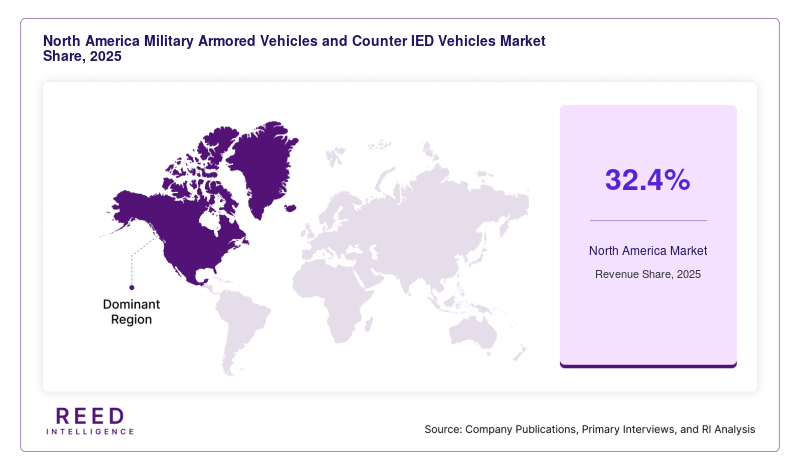
North America is the dominant region, accounting for 32.4% of global military armored vehicles and counter IED vehicles market revenue. The United States represents the largest regional demand center, supported by military modernization, replacement of legacy vehicles, continued investment in protected mobility, and development of next-generation combat platforms.
The region benefits from strong defense-industrial capabilities and major manufacturers including General Dynamics, BAE Systems, Oshkosh Defense, and Lockheed Martin. Demand is supported by fleet modernization, Active Protection Systems, advanced electronics, network integration, and new combat vehicle development.
Europe Military Armored Vehicles and Counter IED Vehicles Market
Europe represents a major market for armored vehicles because of increased defense spending, NATO capability requirements, fleet modernization, and the need to improve ground-force readiness. Eastern European countries have particularly increased procurement and modernization of armored platforms.
European manufacturers are also expanding their production capabilities and developing advanced platforms featuring modular armor, active protection, improved sensors, and digital battlefield integration. Rheinmetall, BAE Systems, KNDS, and other defense companies remain important participants.
Asia Pacific Military Armored Vehicles and Counter IED Vehicles Market
Asia Pacific is one of the fastest-expanding regional markets, supported by territorial disputes, border-security requirements, military modernization, and increasing defense expenditure. India, China, Japan, and South Korea are major demand centers.
The region is also increasingly focused on indigenous defense production. Domestic armored vehicle development and local manufacturing programs are creating opportunities for regional manufacturers while reducing dependence on imported platforms.
Latin America Military Armored Vehicles and Counter IED Vehicles Market
Latin America represents an emerging market driven by border security, counter-narcotics operations, internal security, and military modernization. Brazil, Mexico, and Colombia represent important markets for specialized armored vehicles.
Demand is particularly relevant for wheeled armored vehicles, tactical vehicles, and protected platforms capable of operating in urban and challenging terrain.
Middle East & Africa Military Armored Vehicles and Counter IED Vehicles Market
The Middle East & Africa region is supported by counterterrorism operations, border-security requirements, military modernization, and regional security challenges. Saudi Arabia, the UAE, and South Africa represent important markets.
Demand includes MBTs, APCs, MRAP vehicles, tactical armored platforms, and specialized vehicles for security and counterterrorism operations. The market-specific source estimates the region at approximately 5.5% of global revenue.
Military Armored Vehicles and Counter IED Vehicles Market Competitive Landscape
The Military Armored Vehicles and Counter IED Vehicles Market is characterized by strong competition among major defense contractors with extensive vehicle portfolios, government relationships, engineering capabilities, and established manufacturing infrastructure.
Major companies are competing through next-generation combat vehicle programs, vehicle modernization, active protection systems, modular architectures, autonomous technologies, hybrid propulsion, and advanced battlefield electronics.
Key Market Players
- Lockheed Martin Corporation
- General Dynamics
- Rheinmetall AG
- BAE Systems Plc
- Krauss-Maffei Wegmann GmbH
- Oshkosh Defense
- Nexter Group
- Hyundai Motor Corp.
- Mahindra
- Denel Dynamics
- China North Industries
- Otokar
Military Armored Vehicles and Counter IED Vehicles Market Recent Developments
- October, 2026 BAE Systems: BAE Systems successfully completed live trials of its Anti Threat System (BATS) in Scotland, demonstrating an integrated “sense, decide, effect” capability against unmanned aerial threats. The development is relevant to armored and counter-IED vehicle modernization because it strengthens integrated threat-detection and counter-drone capabilities.
- September, 2026 KONGSBERG / Oshkosh Defense: KONGSBERG signed an agreement with Oshkosh Defense Europe to supply PROTECTOR RS4 remote weapon stations with Counter-UAS capability, which will be integrated on Oshkosh JLTVs for the Royal Netherlands Armed Forces.
Military Armored Vehicles and Counter IED Vehicles Market Segments
By Type
- Infantry Fighting Vehicle
- Armored Personnel Carrier
- Main Battle Tank
- Self-propelled Howitzer
- Mine-Resistant Ambush Protected
- Light Armored Vehicle
- Others
By Application
- National Defense
- Homeland Security
- Border Security
- Law Enforcement
- Emergency Response
- Disaster Relief
By Technology
- Active Protection Systems
- Modular Vehicles
- Hybrid Technology
- Advanced Analytics
By Propulsion
- Wheeled
- Tracked
- Hybrid
By Region
- North America
- Europe
- APAC
- Middle East and Africa
- LATAM