Military Belt Market Size, Share & Demand Report By Product Type (Tactical Belts, Duty Belts, Modular Battle Belts, Rigger Belts), By Material (Nylon, Leather, Composite Materials, Polymer-Based Materials), By End User (Army Forces, Navy Forces, Air Force Personnel, Special Operations Units, Military Police), By Region & Segment Forecasts, 2026–2034
USD 3950
Market Overview
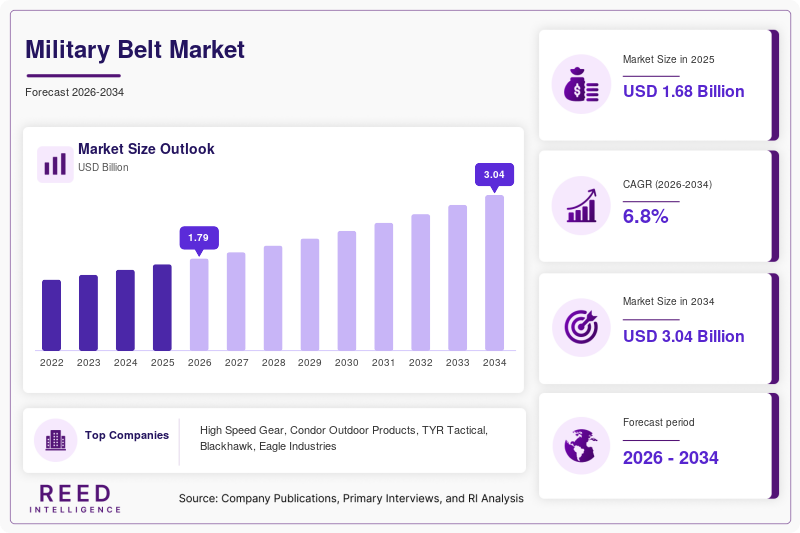
The global Military Belt Market size was valued at approximately USD 1.68 billion in 2026 and is projected to reach USD 2.84 billion by 2034, expanding at a CAGR of 6.8% during 2026–2034. The market continues to evolve as defense agencies focus on enhancing soldier mobility, load-bearing efficiency, and operational readiness across diverse combat environments. Military belts have become an essential component of modern tactical gear, supporting the integration of ammunition pouches, communication devices, medical kits, holsters, and other mission-critical equipment.
Growing investments in military modernization programs across developed and emerging economies have supported market expansion. Armed forces are increasingly replacing traditional utility belts with modular and lightweight tactical systems that improve comfort and functionality during extended operations. The adoption of advanced materials such as reinforced nylon composites, high-strength polymers, and lightweight metal alloys has further improved durability and operational performance.
Key Highlights
- North America dominated the market with a 35.1% share in 2025.
- while Asia Pacific is expected to grow at the fastest CAGR of 8.5% during 2026–2034.
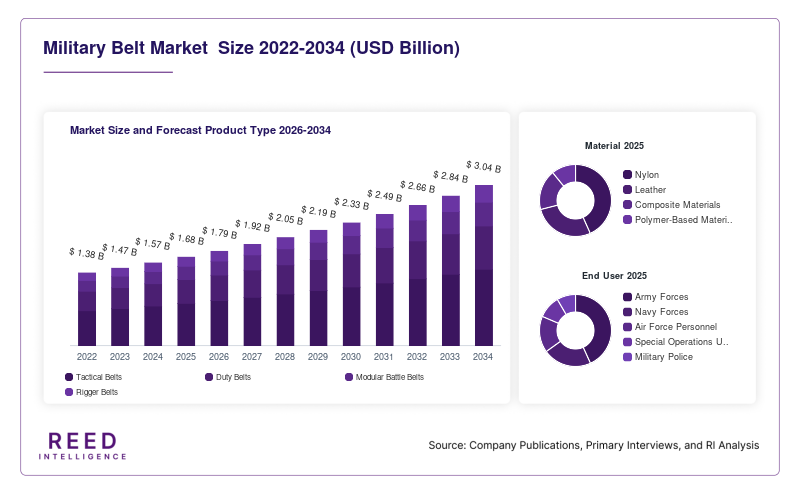
- By product type, tactical belts accounted for the largest share of 46.8%.
- while modular battle belts are projected to grow at a CAGR of 8.9%.
- By material, nylon belts held the leading share of 52.7%.
- whereas composite material belts are expected to expand at a CAGR of 9.1%.
- By end user, army forces led with a 58.4% share.
- while special operations units are expected to grow at a CAGR of 9.3%.
- The United States remained the dominant country, with market values of USD 510 million in 2024 and USD 552 million in 2025.
Military Belt Market Trends
Growing Adoption of Modular Tactical Equipment Systems
One of the most influential trends shaping the Military Belt Market is the increasing adoption of modular tactical equipment systems. Modern military operations require soldiers to carry multiple mission-specific tools while maintaining agility and comfort. As a result, defense organizations are investing in modular belt systems that allow personnel to customize equipment placement based on operational needs. These belts support interchangeable pouches, communication devices, ammunition carriers, hydration accessories, and medical kits. The flexibility offered by modular systems improves battlefield efficiency and reduces physical strain. Manufacturers are responding by introducing advanced attachment mechanisms, enhanced load distribution designs, and compatibility with body armor systems. This trend is particularly visible among special forces and rapid deployment units that require adaptable equipment configurations for varying combat scenarios.
Integration of Lightweight and High-Performance Materials
The use of lightweight and high-performance materials is becoming increasingly important across military equipment procurement programs. Defense agencies are seeking gear that reduces soldier fatigue while maintaining durability under demanding environmental conditions. Military belt manufacturers are incorporating reinforced nylon, composite fibers, thermoplastic polymers, and aerospace-grade alloys into product designs. These materials provide superior tensile strength, corrosion resistance, and wear performance without adding unnecessary weight. Lightweight construction improves mobility and endurance during prolonged missions. Additionally, advances in textile engineering are enabling the production of belts with enhanced moisture resistance and temperature tolerance. The growing focus on soldier survivability and operational effectiveness is expected to accelerate the adoption of next-generation materials throughout the forecast period.
Military Belt Market Drivers
Rising Defense Modernization Programs Worldwide
Military modernization initiatives continue to drive substantial demand for advanced tactical equipment, including military belts. Governments across North America, Europe, Asia Pacific, and the Middle East are increasing defense budgets to strengthen national security capabilities. Modern armed forces require integrated soldier systems that enhance operational efficiency and support evolving combat strategies. Military belts play a vital role within these systems by enabling effective equipment management and load-bearing functionality. Procurement agencies are increasingly prioritizing ergonomic and modular belt solutions that improve comfort during extended deployments. Large-scale modernization programs often involve replacing aging equipment inventories with advanced tactical gear. As armed forces expand their focus on mobility, readiness, and mission effectiveness, demand for technologically advanced military belts is expected to remain strong throughout the forecast period.
Expanding Demand from Special Operations and Border Security Units
The growing importance of special operations forces and border security agencies is another significant growth driver for the Military Belt Market. These units frequently operate in challenging environments that require highly durable and adaptable equipment systems. Tactical belts serve as critical platforms for carrying essential gear while ensuring rapid accessibility during missions. Increasing investments in counterterrorism operations, border surveillance, and rapid response capabilities are encouraging procurement of advanced load-bearing equipment. Many governments are expanding specialized security units to address evolving security threats and regional instability. This expansion is generating demand for premium military belt systems designed for intensive operational use. Continuous upgrades in tactical gear specifications further support long-term market growth.
Military Belt Market Restraints
Budget Constraints and Extended Procurement Cycles
Despite favorable growth prospects, the Military Belt Market faces challenges associated with budget limitations and lengthy defense procurement processes. Military purchasing decisions often involve complex evaluation procedures, extensive testing requirements, and multiple approval stages. These factors can significantly delay product adoption and contract awards. In many developing nations, defense budgets are allocated primarily toward major weapon systems, vehicles, and surveillance technologies, reducing available funding for personal tactical equipment upgrades. Furthermore, military organizations tend to use equipment over extended operational lifecycles, limiting replacement frequency. Economic uncertainty and shifting government priorities can also postpone procurement programs. For example, a planned modernization initiative may be delayed due to broader fiscal constraints, affecting demand for tactical gear suppliers. Such factors may moderate short-term market expansion despite strong underlying demand drivers.
Military Belt Market Opportunities
Emergence of Smart Soldier Systems
The development of smart soldier systems presents a substantial opportunity for manufacturers operating in the Military Belt Market. Modern defense programs increasingly emphasize digital connectivity, real-time situational awareness, and integrated wearable technologies. Military belts can serve as platforms for incorporating power distribution units, communication devices, biometric monitoring systems, and location-tracking technologies. These capabilities improve command coordination and operational decision-making. As defense agencies invest in network-centric warfare strategies, demand for technologically integrated tactical equipment is expected to increase. Manufacturers that develop compatible belt systems capable of supporting advanced electronics may gain competitive advantages. The integration of smart technologies into soldier equipment is likely to create new revenue opportunities across both developed and emerging defense markets.
Increasing Procurement in Emerging Economies
Emerging economies are creating significant growth opportunities through expanding military modernization and security enhancement programs. Countries across Asia Pacific, Latin America, Africa, and parts of the Middle East are increasing investments in defense infrastructure and personnel equipment. Rising geopolitical tensions, border management requirements, and internal security concerns are encouraging governments to upgrade tactical gear inventories. Military belts represent a relatively cost-effective component of broader soldier modernization initiatives, making them attractive procurement targets. Domestic manufacturing initiatives in several countries are also supporting market development by encouraging local production capabilities. As defense spending continues to rise in these regions, suppliers are expected to benefit from new contract opportunities and expanding customer bases.
Segmental Analysis
By Product Type
Tactical belts represented the dominant subsegment within the Military Belt Market, accounting for approximately 46.8% of total revenue in 2024. Their widespread adoption stems from versatility, durability, and compatibility with a broad range of military accessories. Tactical belts are commonly used across conventional military forces, law enforcement units, and security organizations. They provide reliable load-bearing capabilities while supporting efficient equipment organization. Manufacturers continue to introduce ergonomic designs and reinforced construction materials to enhance operational performance. The segment benefits from extensive procurement activity because tactical belts serve as standard equipment for numerous military personnel categories. Continuous replacement demand and broad application across military operations contribute significantly to the segment’s leading position.
Modular battle belts are projected to be the fastest-growing subsegment, expanding at a CAGR of 8.9% through 2034. Growth is driven by increasing demand for customizable tactical equipment capable of adapting to mission-specific requirements. These belts allow users to attach and reposition accessories efficiently, improving flexibility during operations. Military organizations increasingly favor modular configurations because they enhance mobility while reducing unnecessary equipment loads. Advances in attachment systems, weight distribution technologies, and compatibility with body armor platforms are further supporting adoption. Growing procurement by special operations forces and rapid response units is expected to sustain strong growth momentum throughout the forecast period.
By Material
Nylon belts dominated the market with a 52.7% share in 2024, making them the preferred material category across military applications. Nylon offers an effective combination of durability, flexibility, moisture resistance, and cost efficiency. These characteristics make it suitable for deployment across diverse environmental conditions, including desert, tropical, and cold-weather operations. Military organizations value nylon belts for their proven reliability and long service life. Manufacturers continue to improve performance through reinforced weaving techniques and enhanced abrasion-resistant coatings. The material’s widespread availability and established production infrastructure further contribute to its dominant market position.
Composite material belts are expected to register the fastest growth, achieving a CAGR of 9.1% during the forecast period. Increasing demand for lightweight yet highly durable tactical equipment is driving adoption of advanced composite materials. These belts provide superior strength-to-weight ratios compared with conventional alternatives while maintaining resistance to wear and environmental stress. Defense agencies are prioritizing equipment that minimizes soldier fatigue and improves operational endurance. Continued innovation in composite manufacturing technologies is enabling production of belts with enhanced performance characteristics. As military modernization initiatives increasingly emphasize lightweight tactical systems, demand for composite material belts is anticipated to rise significantly.
By End User
Army forces constituted the largest end-user subsegment, accounting for approximately 58.4% of market revenue in 2024. Conventional military forces represent the largest consumer base for tactical belts due to extensive personnel numbers and ongoing equipment replacement requirements. Army units rely on military belts for carrying ammunition, communication devices, medical supplies, and other mission-critical gear. Large-scale modernization programs implemented by defense organizations worldwide continue to support procurement activity. Manufacturers frequently develop products tailored to army operational requirements, including durability, comfort, and compatibility with broader soldier systems. These factors contribute to the segment’s sustained market leadership.
Special operations units are projected to experience the fastest growth, with a CAGR of 9.3% through 2034. These elite forces require advanced tactical equipment capable of supporting highly specialized missions conducted in diverse environments. Military belts designed for special operations applications often incorporate modular configurations, lightweight materials, and enhanced load-bearing performance. Growing investments in counterterrorism, reconnaissance, and rapid deployment capabilities are driving procurement within this segment. Defense agencies increasingly recognize the strategic importance of specialized forces, leading to greater spending on premium tactical gear. This trend is expected to accelerate market growth for military belt manufacturers serving the special operations community.
Regional Analysis
North America
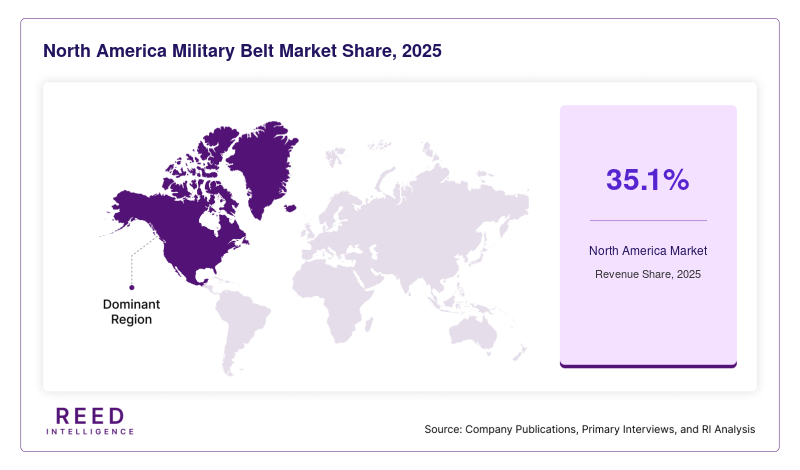
North America accounted for approximately 35.1% of the Military Belt Market share in 2025, making it the leading regional market. The region benefits from substantial defense budgets, advanced military infrastructure, and continuous investments in soldier modernization programs. Demand remains strong across military branches seeking enhanced load-bearing systems and tactical equipment solutions. The regional market is projected to expand at a CAGR of 6.2% through 2034, supported by ongoing procurement initiatives and technological innovation within defense equipment manufacturing.
The United States remains the dominant country within North America due to its large military expenditure and extensive modernization efforts. A key growth factor is the adoption of integrated soldier systems that combine wearable technologies with tactical gear. Military agencies continue to emphasize operational efficiency, mobility enhancement, and ergonomic equipment design. These priorities are encouraging procurement of advanced military belts compatible with evolving combat and communication requirements.
Europe
Europe represented approximately 26.4% of the global Military Belt Market in 2025 and is anticipated to register a CAGR of 6.5% during the forecast period. Growing defense cooperation among regional nations and increased military preparedness initiatives are supporting market growth. Several countries are expanding procurement budgets to strengthen defense capabilities amid changing geopolitical conditions. Demand for advanced tactical equipment is increasing as armed forces modernize soldier gear and improve operational readiness.
The United Kingdom serves as a leading market within Europe due to ongoing defense modernization investments and tactical equipment upgrades. A unique growth factor is the region’s emphasis on multinational military interoperability. Defense agencies are increasingly procuring standardized equipment systems that support joint operations among allied forces. This trend is creating opportunities for manufacturers offering adaptable and internationally compatible military belt solutions.
Asia Pacific
Asia Pacific held approximately 22.8% of the Military Belt Market in 2025 and is expected to record the fastest CAGR of 8.5% through 2034. Rapid military modernization, expanding defense budgets, and rising regional security concerns are contributing to market growth. Governments across the region are increasing investments in soldier equipment, tactical readiness, and border protection capabilities. These initiatives are generating sustained demand for military belts and related load-bearing systems.
China remains the dominant country in the region owing to extensive defense spending and large-scale military modernization programs. One important growth factor is the expansion of domestic defense manufacturing capabilities. Local producers are increasing production of tactical gear to reduce import dependency and support national procurement objectives. This development is enhancing product availability while encouraging technological advancement within the regional market.
Middle East & Africa
The Middle East & Africa accounted for approximately 9.2% of global market revenue in 2025 and is forecast to grow at a CAGR of 7.1% during 2026–2034. Demand is supported by ongoing security challenges, border management requirements, and investments in defense preparedness. Several countries are modernizing military equipment inventories to improve operational effectiveness and strengthen national defense capabilities. Military belts form part of broader procurement initiatives focused on soldier mobility and equipment integration.
Saudi Arabia is the dominant country within the region due to its substantial defense spending and modernization programs. A distinctive growth factor is the increasing emphasis on advanced tactical equipment for specialized military and security forces. Procurement agencies are seeking durable and high-performance gear capable of supporting operations in demanding desert environments. This requirement is encouraging adoption of advanced military belt systems designed for extreme operational conditions.
Latin America
Latin America captured approximately 6.5% of the Military Belt Market share in 2025 and is projected to expand at a CAGR of 5.9% through 2034. Market growth is supported by military modernization initiatives, internal security operations, and investments in tactical equipment upgrades. Several governments are focusing on enhancing border surveillance and law enforcement capabilities, creating additional demand for military-grade gear. Procurement programs are increasingly targeting durable and cost-effective equipment solutions.
Brazil represents the leading country in Latin America due to its sizeable defense sector and expanding security requirements. A notable growth factor is the increased deployment of military personnel for border monitoring and public security operations. These activities require reliable load-bearing equipment capable of supporting diverse mission profiles. As operational requirements continue to evolve, demand for modern military belt systems is expected to rise steadily across the country.
Competitive Landscape
The Military Belt Market is characterized by the presence of established tactical equipment manufacturers competing through product innovation, defense contracts, and strategic partnerships. Companies are increasingly focusing on lightweight materials, modular designs, and enhanced durability to meet evolving military requirements. Product customization and compatibility with broader soldier modernization systems remain key competitive factors.
High Speed Gear maintains a leading position due to its extensive tactical equipment portfolio and strong relationships with military and law enforcement customers. The company recently expanded its modular tactical gear offerings to support changing operational requirements. Other prominent participants include Condor Outdoor Products, TYR Tactical, Blackhawk, and Eagle Industries, each emphasizing advanced load-bearing solutions and ergonomic product development.
Competitive intensity is expected to increase as emerging manufacturers enter the market with innovative materials and integrated equipment platforms. Partnerships with defense agencies and participation in modernization programs will remain important strategies for securing long-term growth and market share.
Key Players
- High Speed Gear
- Condor Outdoor Products
- TYR Tactical
- Blackhawk
- Eagle Industries
- 5.11 Tactical
- Safariland Group
- Crye Precision
- Blue Force Gear
- Tactical Tailor
- London Bridge Trading
- FirstSpear
- SORD Australia
- Warrior Assault Systems
- ATS Tactical Gear
Recent Developments
- High Speed Gear introduced an upgraded modular military belt platform featuring improved load distribution and lightweight construction.
- TYR Tactical expanded production capacity to support increasing demand from military modernization programs across multiple regions.
- Blackhawk launched a next-generation tactical belt series designed for enhanced compatibility with integrated soldier systems.
- Eagle Industries developed advanced attachment mechanisms to improve modular equipment customization for special operations forces.
- FirstSpear introduced new composite-reinforced belt designs aimed at reducing weight while maintaining operational durability.
Military Belt Market Segments
Product Type
- Tactical Belts
- Duty Belts
- Modular Battle Belts
- Rigger Belts
Material
- Nylon
- Leather
- Composite Materials
- Polymer-Based Materials
End User
- Army Forces
- Navy Forces
- Air Force Personnel
- Special Operations Units
- Military Police
Distribution Channel
- Direct Government Procurement
- Defense Contractors
- Military Equipment Distributors
- Online Procurement Platforms
By Region
- North America
- Europe
- APAC
- Middle East and Africa
- LATAM