Military Fixed Wing Market Size, Share & Trends Analysis Report By Aircraft Type (Fighter Aircraft, Transport Aircraft, Trainer Aircraft, Special Mission Aircraft), By Application (Combat, Transport, Training, Surveillance & Reconnaissance, Others), By End User (Defense, Homeland Security) and By Region (North America, Europe, Asia Pacific, Latin America, Middle East & Africa) Forecasts, 2026–2034
USD 3950
Military Fixed Wing Market Size
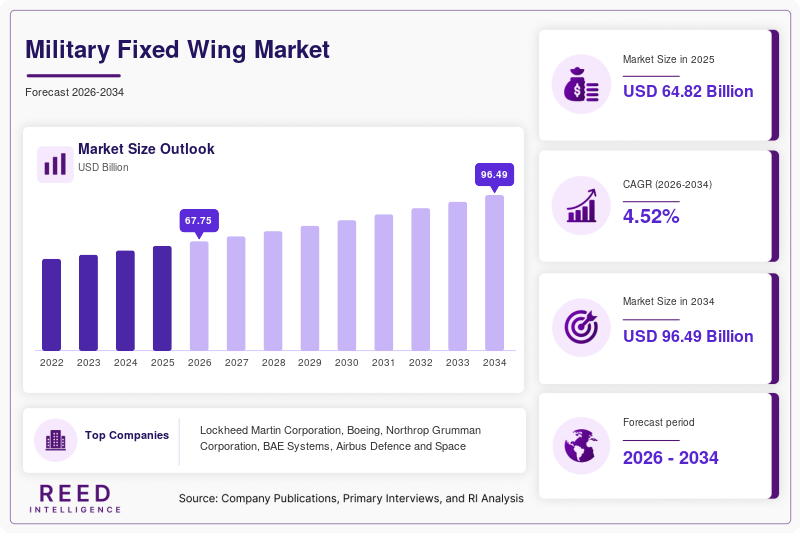
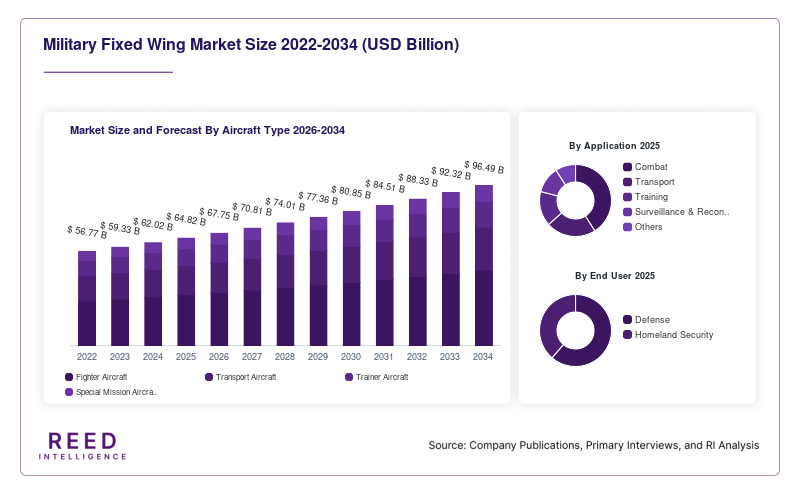
The global military fixed wing market was valued at USD 64.82 billion in 2025 and is projected to grow from USD 67.75 billion in 2026 to USD 96.49 billion by 2034, registering a CAGR of 4.52% during the forecast period from 2026 to 2034.
Military fixed wing aircraft are powered aircraft with fixed wings designed for defense and security missions. The market encompasses fighter aircraft, military transport aircraft, trainer aircraft and special mission platforms used for combat, troop and equipment transportation, pilot training, intelligence, surveillance, reconnaissance, maritime patrol, electronic warfare and other specialized military operations.
Military Fixed Wing Market Drivers
The replacement of aging military aircraft is one of the strongest drivers of the market. Aging fighters, transport aircraft and trainers require increasingly expensive maintenance and upgrades, encouraging defense organizations to procure new-generation platforms.
Increasing geopolitical competition is encouraging countries to strengthen air superiority, long-range strike, surveillance and strategic mobility capabilities. Governments are therefore increasing investment in modern fixed-wing aircraft.
The emergence of sixth-generation fighter initiatives is creating substantial long-term demand for aircraft, engines, avionics, sensors, electronic warfare systems and advanced materials.
Modern military operations increasingly rely on interconnected platforms capable of exchanging information in real time. Fixed-wing aircraft are being equipped with secure communications, data links, sensor fusion and advanced mission-management systems.
Military Fixed Wing Market Restraints
Military fixed-wing aircraft require substantial investments in development, procurement, infrastructure and lifecycle support. Advanced fighters and special-mission platforms can require particularly high capital expenditure.
New military aircraft programs commonly require years of research, testing, certification and production ramp-up. Technical delays can increase development costs and postpone deliveries.
Aircraft production depends on specialized components, engines, semiconductor systems, avionics and advanced materials. Supply shortages can affect production schedules and increase costs.
Military aircraft are subject to strict export controls and technology-transfer regulations. These restrictions can limit the potential customer base for certain advanced platforms.
Military Fixed Wing Market Opportunities
The development of autonomous aircraft and Collaborative Combat Aircraft creates significant opportunities for fixed-wing manufacturers, software companies and avionics suppliers.
The development of carrier-based unmanned fixed-wing aircraft is creating a new product category within naval aviation.
Countries seeking greater defense self-reliance are creating opportunities for domestic aircraft manufacturers and international technology partnerships.
Aircraft modernization, avionics upgrades, radar replacement, electronic warfare integration and life-extension programs provide recurring opportunities beyond new-aircraft production.
Military Fixed Wing Market Segmental Analysis
Fighter Aircraft
Fighter aircraft represent the dominant aircraft-type segment of the military fixed wing market. Demand is supported by air-superiority requirements, fleet replacement programs, fifth-generation fighter procurement and emerging sixth-generation aircraft initiatives. Modern fighter platforms increasingly combine stealth, advanced radar, electronic warfare, sensor fusion, precision weapons and network connectivity.
The fighter segment is expected to remain strategically important throughout the forecast period as governments modernize combat aviation fleets and strengthen air-defense capabilities.
Transport Aircraft
Military transport aircraft support troop movement, logistics, humanitarian operations, strategic mobility and tactical airlift. Demand is driven by the need to replace aging transport fleets and improve strategic mobility.
Modern transport aircraft increasingly emphasize payload capacity, range, operational flexibility and compatibility with austere operating environments.
Trainer Aircraft
Trainer aircraft are essential for developing and maintaining military pilot capabilities. Countries modernizing fighter fleets also require advanced training platforms capable of preparing pilots for increasingly complex aircraft.
The segment is supported by replacement of aging trainers and the transition toward digital flight training and advanced simulation-linked aircraft.
Special Mission Aircraft
Special mission aircraft include platforms configured for surveillance, reconnaissance, maritime patrol, airborne early warning, electronic warfare, aerial refueling and other specialized missions.
The segment benefits from increasing demand for persistent intelligence, surveillance and reconnaissance capabilities and advanced battlespace awareness.
Application Analysis
Combat represents the core application area because fighter aircraft and other combat-oriented fixed-wing platforms remain central to national airpower. Transport applications are also significant because strategic mobility is essential for military logistics.
Training applications are supported by continued pilot requirements, while surveillance and reconnaissance demand is increasing because modern militaries require continuous intelligence and situational awareness.
End-User Analysis
Defense is the dominant end-user category because national armed forces account for the majority of fixed-wing military aircraft procurement. Defense organizations are increasing spending on combat aviation, transport, surveillance and specialized aircraft.
Homeland security represents a smaller but important application area, particularly for surveillance, border monitoring, maritime security and reconnaissance missions.
Military Fixed Wing Market Regional Analysis
North America Military Fixed Wing Market
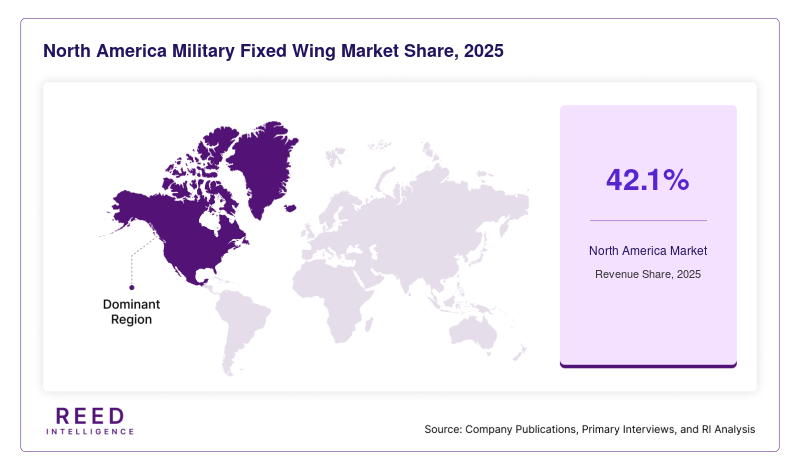
North America is the dominant regional market, with a reported 42.1% revenue share in the broader military fixed-wing aircraft market definition used by the cited market source. The region's leadership is supported primarily by the United States, which maintains extensive fighter, transport, trainer, tanker, surveillance and special-mission aircraft programs. Major manufacturers including Boeing, Lockheed Martin and Northrop Grumman contribute to a large domestic aerospace ecosystem.
The region is also at the forefront of next-generation aircraft development, including sixth-generation fighter programs, autonomous aircraft experimentation and carrier-based unmanned aviation. Continued fleet modernization, high defense expenditure and investment in advanced aircraft technologies are expected to maintain North America's leading position.
Europe Military Fixed Wing Market
Europe represents a major market for military fixed-wing aircraft, supported by NATO modernization requirements, fleet replacement and multinational aircraft development programs. European countries are increasing investment in advanced fighters, transport aircraft, trainers and special-mission platforms.
Programs such as the Future Combat Air System and Global Combat Air Programme are strengthening Europe's long-term fixed-wing aerospace development capabilities. Demand is also supported by modernization of existing fighter and transport fleets.
Asia Pacific Military Fixed Wing Market
Asia Pacific is expected to remain one of the most strategically important regions for military fixed-wing aircraft. China, India, Japan, South Korea and Australia are investing in fighter modernization, transport aircraft, surveillance platforms and indigenous aerospace programs.
Regional security concerns and increasing defense modernization are encouraging countries to strengthen airpower capabilities. India is also expanding domestic aircraft production through programs involving HAL and other defense-industry participants.
Latin America Military Fixed Wing Market
Latin America's military fixed-wing market is comparatively smaller but continues to generate demand for transport, surveillance, training and light combat aircraft. Budget constraints encourage several countries to prioritize aircraft modernization, life-extension programs and cost-effective platforms.
Border security, disaster response, maritime surveillance and counter-narcotics missions provide additional demand for military and security aviation.
Middle East & Africa Military Fixed Wing Market
The Middle East & Africa region is supported by military modernization, border-security requirements, regional conflicts and the replacement of aging aircraft fleets. Middle Eastern countries continue to invest in advanced combat aircraft and surveillance capabilities.
African countries generally place greater emphasis on transport, training, surveillance and cost-effective combat aircraft. Long-term opportunities exist through fleet modernization, maintenance programs and technology-transfer partnerships.
Military Fixed Wing Market Competitive Landscape
The military fixed wing market is highly competitive and technology intensive. Leading companies compete through aircraft performance, stealth capabilities, avionics, sensor integration, weapons compatibility, range, lifecycle support and production capacity.
The industry includes major U.S., European and Asian aerospace manufacturers. Competition is increasingly influenced by the ability to integrate artificial intelligence, autonomous systems, electronic warfare, advanced sensors and network-centric capabilities into aircraft platforms.
Key Market Players
- Lockheed Martin Corporation
- Boeing
- Northrop Grumman Corporation
- BAE Systems
- Airbus Defence and Space
- Dassault Aviation
- Saab AB
- Leonardo S.p.A.
- Embraer
- General Dynamics
- RTX
Military Fixed Wing Market Recent Developments
- September, 2026 Boeing: The U.S. Navy selected Boeing for the F/A-XX sixth-generation fighter program. Boeing will design, build and deliver the next-generation carrier-based fighter intended to replace the F/A-18 Super Hornet. The aircraft is expected to incorporate advanced mission systems, open architecture and increased operational reach.
- September, 2026 Government of India / HAL: India announced the planned handover of LCA Tejas FOC twin-seater trainers and HTT-40 basic trainer aircraft to the Indian Air Force. The milestone supports India's indigenous military fixed-wing aircraft manufacturing capabilities and broader aerospace self-reliance initiatives.
Military Fixed Wing Market Segments
By Aircraft Type
- Fighter Aircraft
- Transport Aircraft
- Trainer Aircraft
- Special Mission Aircraft
By Application
- Combat
- Transport
- Training
- Surveillance & Reconnaissance
- Others
By End User
- Defense
- Homeland Security
By Region
- North America
- Europe
- APAC
- Middle East and Africa
- LATAM