Military GNSS Anti Jamming and Anti Spoof Solutions Market Size, Share & Trends Analysis Report By Type (Anti-Jam Solutions, Anti-Spoof Solutions), By Application (Unmanned Platform, Ground Platform, Naval Platform, Airborne Platform) and By Region (North America, Europe, Asia Pacific, Latin America, Middle East & Africa) Forecasts, 2026–2034
USD 3950
Military GNSS Anti Jamming and Anti Spoof Solutions Market Size
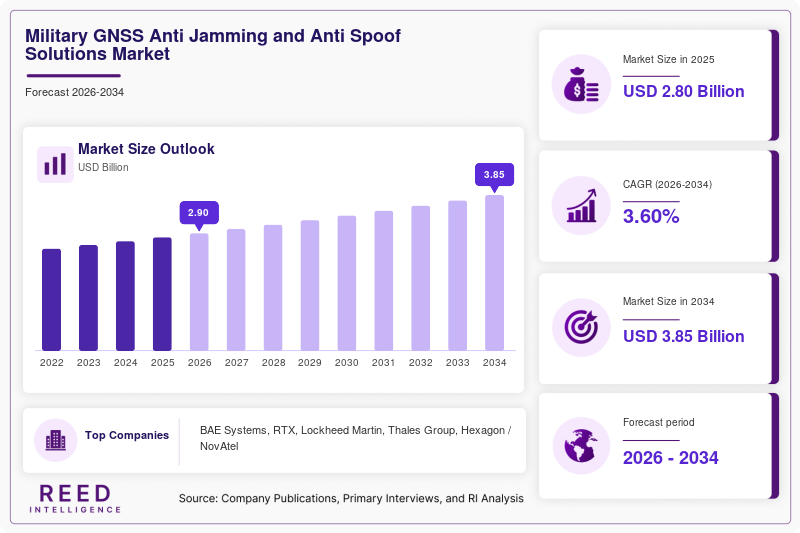
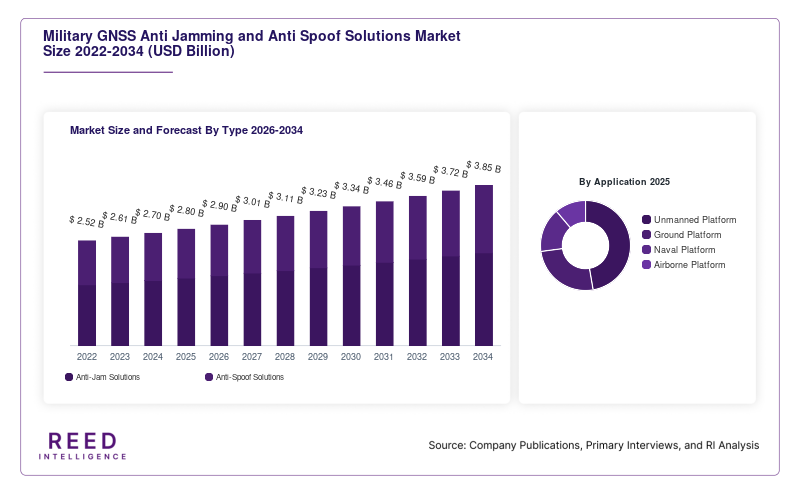
The global military GNSS anti jamming and Anti spoof solutions market was valued at USD 2.80 billion in 2025 and is projected to grow from USD 2.90 billion in 2026 to USD 3.85 billion by 2034, registering a CAGR of 3.60% during the forecast period from 2026 to 2034.
Military GNSS Anti Jamming and Anti Spoof Solutions are technologies designed to protect military navigation and timing systems against intentional signal disruption and deception. Jamming attempts to overpower or disrupt legitimate GNSS signals, while spoofing transmits deceptive signals that can cause a receiver to calculate an incorrect position, velocity or time.
These technologies are becoming increasingly important as military forces rely on GNSS for navigation, precision targeting, communications synchronization, autonomous systems, aircraft operations, naval navigation and ground-force mobility.
Military GNSS Anti Jamming and Anti Spoof Solutions Market Drivers
The growing use of electronic warfare and GNSS interference is one of the strongest market drivers. Military platforms operating in contested environments require navigation systems capable of identifying and mitigating deliberate interference.
Defense organizations are upgrading legacy navigation systems and incorporating resilient PNT technologies into aircraft, naval vessels, ground vehicles and unmanned platforms.
The increasing deployment of UAVs and other autonomous platforms is increasing the importance of reliable navigation. GNSS protection is essential for maintaining operational effectiveness when satellite signals are deliberately disrupted.
The modernization of the GPS constellation with M-Code-enabled satellites is supporting demand for compatible receivers and associated anti-jamming technologies.
Military GNSS Anti Jamming and Anti Spoof Solutions Market Restraints
Advanced anti-jamming antennas, protected receivers and multi-sensor navigation architectures require significant engineering and integration investment.
Integrating GNSS protection into aircraft, naval vessels and military vehicles requires compatibility with existing navigation, communications, mission-computing and electronic-warfare systems.
Anti-jamming and anti-spoof systems must continuously evolve because adversaries can modify interference techniques and signal characteristics.
Even highly resilient GNSS solutions remain connected to satellite-based infrastructure. This encourages military organizations to develop complementary non-GNSS navigation technologies.
Military GNSS Anti Jamming and Anti Spoof Solutions Market Opportunities
Artificial intelligence and machine learning can help identify abnormal signal patterns and distinguish legitimate GNSS signals from interference and spoofing attempts.
Vision-aided navigation, terrain-relative navigation, inertial systems, magnetic navigation and other technologies offer opportunities for integrated resilient-PNT solutions.
The expansion of autonomous aircraft, ground vehicles and maritime platforms creates additional demand for protected positioning and navigation.
Retrofitting anti-jamming and anti-spoofing technologies into existing military platforms represents a substantial opportunity because complete platform replacement is not always economically practical.
Military GNSS Anti Jamming and Anti Spoof Solutions Market Segmental Analysis
Anti-Jam Solutions
Anti-Jam Solutions represent the dominant type segment, accounting for approximately 58.2% of market share in 2025. These solutions protect GNSS receivers against deliberate interference by suppressing or mitigating unwanted RF signals. Technologies include controlled reception pattern antennas, beamforming, nulling, adaptive filtering and protected receiver architectures.
Demand is particularly strong across military aircraft, ground vehicles, naval platforms and other systems operating in contested electromagnetic environments. Anti-jamming capabilities are also increasingly integrated with M-Code and broader assured-PNT architectures.
Anti-Spoof Solutions
Anti-Spoof Solutions protect military systems against deceptive GNSS signals intended to manipulate a receiver's calculated position, velocity or timing. These technologies can use signal authentication, multi-frequency validation, signal-quality monitoring and cross-checking against inertial or other navigation sources.
The increasing sophistication of spoofing techniques is encouraging defense organizations to combine spoofing detection with alternative navigation and sensor-fusion technologies.
A reliable market-specific source reviewed for this report does not provide a comparable numeric CAGR for the fastest-growing type segment; therefore, no unsupported fastest-growing percentage is stated.
Unmanned Platforms
Unmanned platforms represent an increasingly important application for GNSS protection because autonomous aircraft, unmanned ground vehicles and maritime systems depend on accurate navigation and timing.
GNSS resilience is particularly important for autonomous systems operating beyond direct human control. Navigation failures caused by jamming or spoofing can affect route planning, mission execution and safe recovery.
Ground Platforms
Ground platforms include military vehicles, tactical systems and mobile command platforms. GNSS anti-jamming and anti-spoof technologies enable these platforms to maintain navigation and positioning in environments where satellite signals are intentionally disrupted.
The U.S. Army's continuing development of assured PNT capabilities demonstrates the importance of resilient navigation for tactical ground forces.
Naval Platforms
Naval platforms require reliable PNT for navigation, maneuvering, weapons employment and synchronization. Naval vessels can be particularly exposed to GNSS interference because maritime operations depend heavily on satellite-based navigation over large areas.
India's 2026 procurement of enhanced-capability GNSS jammers also demonstrates the increasing importance of electronic-warfare capabilities within naval operations.
Airborne Platforms
Military aircraft require highly reliable navigation for flight operations, precision weapons, formation operations and mission execution. Airborne anti-jamming and anti-spoofing technologies are therefore closely linked with advanced avionics, inertial navigation and secure military GPS capabilities.
BAE Systems' 2026 M-Code development for the U.S. Navy's Joint Precision Approach and Landing System demonstrates continued integration of protected GPS into advanced airborne and carrier-landing operations.
Military GNSS Anti Jamming and Anti Spoof Solutions Market Regional Analysis
North America Military GNSS Anti Jamming and Anti Spoof Solutions Market
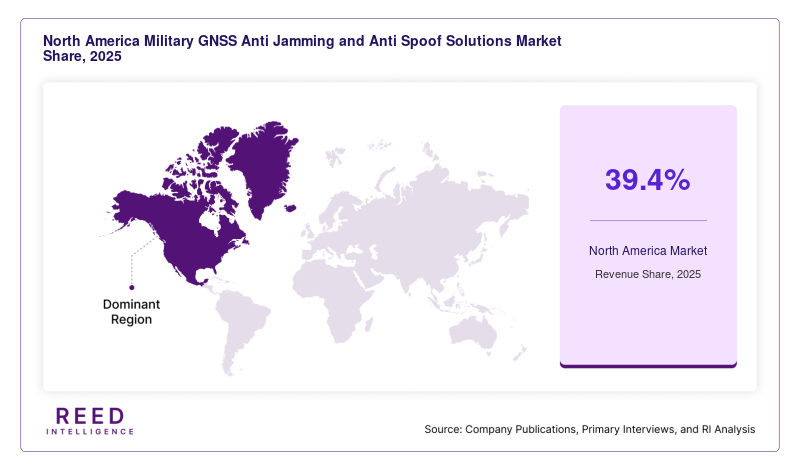
North America is the dominant region, accounting for 39.4% of global Military GNSS Anti Jamming and Anti Spoof Solutions revenue in 2025. The region generated approximately USD 1.1 billion in revenue, supported primarily by U.S. defense modernization, GPS resilience programs, M-Code deployment and military investment in assured PNT.
The United States is the principal market in the region. The U.S. military is investing in resilient navigation for aircraft, vehicles, naval platforms and other systems operating in contested electromagnetic environments. The modernization of the GPS III and GPS IIIF constellation is also strengthening the underlying infrastructure supporting military PNT.
Europe Military GNSS Anti Jamming and Anti Spoof Solutions Market
Europe represents an important market because NATO members increasingly recognize GNSS interference as an operational and security concern. Military forces are investing in resilient navigation, protected receivers and complementary PNT technologies.
The region is also experiencing increased attention to GNSS interference because of disruptions around conflict zones. European aviation authorities have established coordinated measures to improve resilience against GNSS interference, reflecting the broader strategic importance of navigation resilience.
Asia Pacific Military GNSS Anti Jamming and Anti Spoof Solutions Market
Asia Pacific is an important growth market because countries including India, China, Japan, South Korea and Australia are strengthening military navigation and electronic-warfare capabilities.
India is expanding domestic GNSS-related defense capabilities, while regional military modernization and autonomous-platform adoption are increasing demand for resilient PNT technologies. India's June 2026 contract for 20 enhanced-capability GNSS jammers further demonstrates growing investment in military GNSS electronic-warfare systems.
Latin America Military GNSS Anti Jamming and Anti Spoof Solutions Market
Latin America's market remains smaller than North America, Europe and Asia Pacific. Demand is primarily associated with military modernization, secure navigation, surveillance and communications requirements.
Adoption is expected to develop gradually as governments modernize defense fleets and incorporate more advanced navigation and electronic-warfare technologies.
Middle East & Africa Military GNSS Anti Jamming and Anti Spoof Solutions Market
The Middle East & Africa region presents opportunities because military forces operate in environments where GNSS interference and electronic warfare are increasingly relevant.
Demand is supported by defense modernization, border security, unmanned systems and the requirement for resilient navigation in contested environments. However, a reliable comparable market-share figure for this region was not identified in the market-specific sources reviewed, so no percentage is stated.
Fastest-growing regional CAGR: A reliable comparable CAGR identifying the fastest-growing region within the exact market definition was not available in the reviewed market-specific sources. Accordingly, no unsupported regional CAGR is presented.
Military GNSS Anti Jamming and Anti Spoof Solutions Market Competitive Landscape
The military GNSS anti jamming and Anti spoof solutions market is technologically competitive, with companies differentiating through antenna performance, receiver architecture, signal-processing algorithms, M-Code compatibility, multi-constellation support, SWaP optimization and integration with broader resilient-PNT systems.
Competition is increasingly shifting from standalone GPS protection toward integrated navigation architectures combining GNSS, inertial navigation, alternative PNT technologies, AI-based signal analysis and secure communications.
Key Market Players
- BAE Systems
- RTX
- Lockheed Martin
- Thales Group
- Hexagon / NovAtel
- L3Harris Technologies
- Chemring Group
- Cobham
- Rockwell Collins
- Tallysman Wireless
- Orolia
- Furuno Electric
Military GNSS Anti Jamming and Anti Spoof Solutions Market Recent Developments
- October, 2026 BAE Systems: BAE Systems was awarded a USD 16 million contract from Collins Aerospace to develop an M-Code GPS solution for the U.S. Navy's Joint Precision Approach and Landing System (JPALS). The DIGAR-500M receiver will provide assured positioning, navigation and timing with advanced anti-jamming and anti-spoofing protection for carrier-based aircraft.
- September, 2026 Lockheed Martin: Lockheed Martin secured USD 114 million in U.S. Space Force task orders to modernize the GPS ground segment. The work includes upgrades supporting GPS IIIF satellites and a technology refresh intended to strengthen GPS security, reliability and resilience. The upgraded ground infrastructure will support additional M-Code-enabled satellites and stronger anti-jamming capabilities.
Military GNSS Anti Jamming and Anti Spoof Solutions Market Segments
By Type
- Anti-Jam Solutions
- Anti-Spoof Solutions
By Application
- Unmanned Platform
- Ground Platform
- Naval Platform
- Airborne Platform
By Region
- North America
- Europe
- APAC
- Middle East and Africa
- LATAM