Military GPS Receiver Market Size, Share & Demand Report By Platform (Ground, Airborne, Naval, Unmanned Systems), By Receiver Type (Encrypted GPS Receivers, Anti-Jamming GPS Receivers, Standard Military GPS Receivers), By Application (Navigation and Positioning, Target Tracking), By End Use (Defense Forces, Homeland Security Agencies, Special Operations Units), By Distribution Channel (Direct Government Contracts, Defense System Integrators, Military Equipment Suppliers), By Region & Segment For
USD 3950
Market Overview
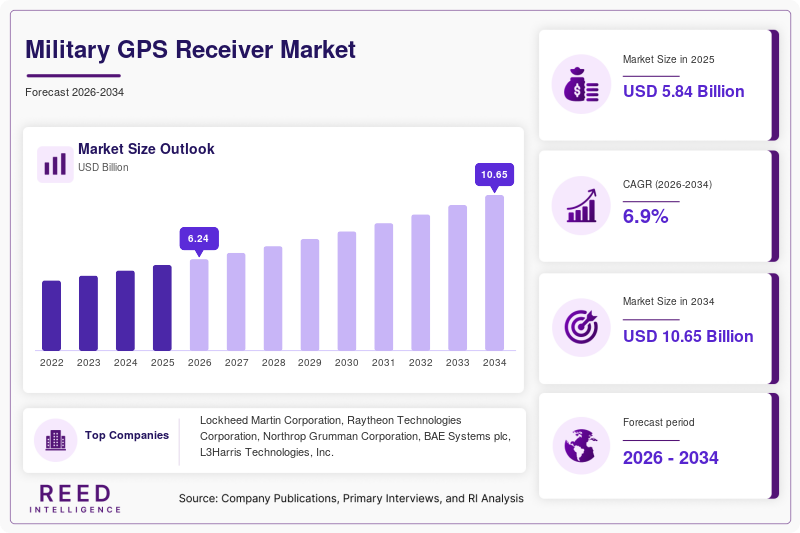
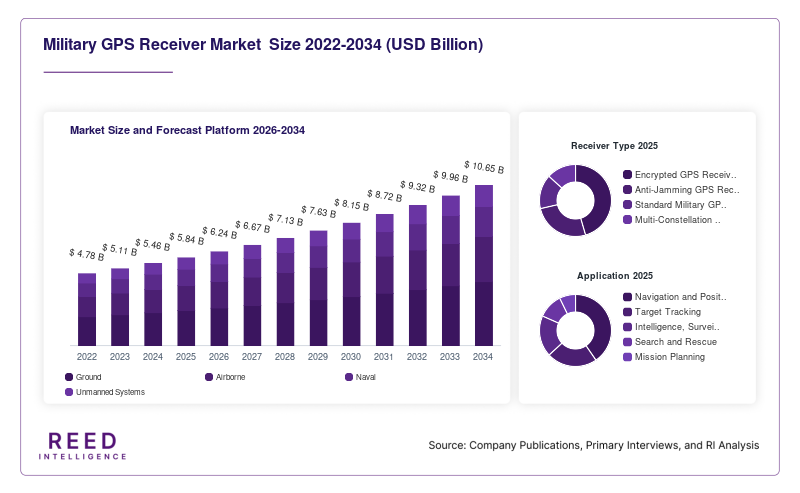
The Military GPS Receiver Market size was valued at USD 5.84 billion in 2026 and is projected to reach USD 9.97 billion by 2034, expanding at a CAGR of 6.9% during the forecast period from 2026 to 2034. The market growth has been supported by rising investments in modern battlefield communication systems and increasing defense spending focused on navigation accuracy, real-time tracking, and secure positioning technologies. Military organizations across developed and emerging economies are integrating advanced GPS receiver systems into land vehicles, aircraft, naval platforms, unmanned systems, and soldier modernization programs to strengthen operational efficiency and mission coordination. The growing demand for secure navigation in contested environments has significantly accelerated the adoption of anti-jamming and encrypted GPS technologies. Defense agencies are increasingly emphasizing resilient positioning, navigation, and timing systems capable of operating under electronic warfare conditions. In addition, cross-border tensions, rising military modernization initiatives, and growing investments in autonomous combat systems have positively influenced the Military GPS Receiver Market outlook.
Advanced receivers equipped with multi-frequency capabilities and compatibility with satellite constellations are also contributing to market expansion.Technological advancements in compact military electronics, rugged communication systems, and integrated battlefield management platforms are supporting the development of next-generation military GPS receivers. Defense contractors are introducing lightweight receivers with improved signal reliability, lower power consumption, and enhanced interoperability with command and control systems. The increasing deployment of unmanned aerial vehicles, precision-guided weapons, and network-centric warfare platforms is expected to create sustained demand for advanced navigation technologies throughout the forecast period.
Market Trends
Integration of Anti-Jamming and Anti-Spoofing Technologies
Military organizations are increasingly adopting GPS receivers equipped with anti-jamming and anti-spoofing capabilities to improve navigation reliability in electronic warfare environments. Modern military operations require uninterrupted positioning accuracy even in contested regions where signal disruption attempts are common. As a result, defense manufacturers are developing resilient GPS solutions with encrypted communication protocols, adaptive signal processing, and interference detection technologies. The adoption of these advanced systems is improving battlefield communication and strengthening operational security across defense platforms.
Rising Deployment of GPS Receivers in Autonomous Military Systems
The growing use of autonomous military vehicles, drones, and robotic combat systems is emerging as a major trend in the Military GPS Receiver Market. Defense agencies are integrating advanced navigation technologies into unmanned systems to improve surveillance, reconnaissance, and tactical mission execution. GPS receivers capable of multi-constellation compatibility and real-time tracking are increasingly used in autonomous systems to support precision targeting and route optimization. This trend is expected to create sustained market opportunities as unmanned defense technologies continue to expand globally.
Market Drivers
Increasing Defense Modernization Programs
Governments worldwide are investing heavily in defense modernization initiatives to improve battlefield efficiency and operational readiness. Military GPS receivers play a critical role in modern warfare systems by enabling accurate positioning, navigation, and communication across land, air, and naval platforms. Rising procurement of advanced armored vehicles, fighter aircraft, missile systems, and unmanned platforms has significantly increased demand for high-performance GPS receivers. In addition, military modernization programs focused on digital warfare and integrated command systems are supporting long-term market growth.
Growing Demand for Precision-Guided Military Operations
The increasing use of precision-guided weapons and real-time battlefield intelligence systems is driving the demand for military-grade GPS receivers. Modern defense strategies emphasize accurate targeting and coordinated tactical operations, which require reliable navigation technologies. GPS receivers are widely integrated into missiles, drones, artillery systems, and soldier communication devices to improve mission accuracy and reduce operational risks. The expansion of network-centric warfare strategies is expected to further strengthen the Military GPS Receiver Market growth during the forecast period.
Market Restraint
Vulnerability to Electronic Warfare Attacks
Despite technological advancements, military GPS systems remain vulnerable to electronic jamming and spoofing attacks in conflict zones. Sophisticated interference technologies can reduce navigation reliability and affect mission performance during military operations. Developing highly secure and interference-resistant systems involves substantial research and procurement costs, which may limit adoption among smaller defense budgets.
Market Opportunities
Expansion of Multi-Constellation Navigation Systems
The integration of GPS receivers with multiple satellite constellations such as Galileo, GLONASS, and BeiDou is creating new growth opportunities in the market. Multi-constellation receivers improve navigation accuracy, signal availability, and operational resilience in challenging environments. Defense agencies are increasingly investing in interoperable navigation systems capable of functioning across different global satellite networks.
Rising Adoption of Soldier Modernization Programs
Military modernization programs focused on enhancing soldier mobility and battlefield communication are creating demand for portable and wearable GPS receiver systems. Advanced handheld receivers integrated with secure communication technologies are being deployed to improve troop coordination and tactical navigation. The increasing emphasis on connected soldier systems is expected to support future market expansion.
Segmental Analysis
By Platform
The airborne segment dominated the Military GPS Receiver Market with a 34.9% share in 2025 due to increasing deployment of GPS receivers in fighter aircraft, helicopters, and surveillance drones. Military aviation platforms require highly accurate navigation systems to support tactical operations, route planning, and target acquisition. Rising procurement of advanced aircraft and modernization of airborne defense systems contributed significantly to segment growth.
The unmanned systems segment is projected to grow at the fastest CAGR of 8.8% during the forecast period. Increasing use of autonomous drones and robotic defense systems for surveillance, reconnaissance, and combat missions is expected to drive segment expansion. Defense organizations are investing in GPS-enabled unmanned platforms to improve operational flexibility and reduce human risk during military missions.
By Receiver Type
Encrypted military GPS receivers accounted for 57.2% of the market share in 2025 due to growing emphasis on secure communication and protected navigation systems. Defense agencies increasingly preferred encrypted receivers to ensure operational security and prevent unauthorized signal interception. These systems are widely used in critical military applications requiring high data protection standards.
Anti-jamming GPS receivers are anticipated to expand at a CAGR of 8.6% during 2026–2034. Rising electronic warfare threats and increasing incidents of signal interference are expected to encourage demand for resilient navigation technologies. Advanced anti-jamming systems provide reliable positioning accuracy under hostile operational environments.
By Application
Navigation and positioning applications dominated the market with a 41.6% share in 2025 because military GPS receivers are extensively used for troop movement, route planning, and tactical mission coordination. Accurate navigation systems remain essential for modern military operations across land, air, and naval platforms.
Intelligence, surveillance, and reconnaissance applications are projected to witness the fastest CAGR of 8.4% during the forecast period. Increasing deployment of drones, satellite-based monitoring systems, and real-time battlefield intelligence platforms is expected to support segment growth. Advanced GPS technologies improve surveillance accuracy and operational efficiency during defense missions.
By End Use
Defense forces represented the largest end-use segment in 2025 with a market share of 63.5% due to high procurement of advanced military navigation systems. National defense agencies continued investing in secure communication infrastructure and battlefield modernization programs to strengthen operational capabilities.
Homeland security agencies are expected to grow at a CAGR of 7.8% during the forecast period. Increasing focus on border surveillance, emergency response systems, and counterterrorism operations is expected to support demand for GPS-enabled defense technologies.
Regional Analysis
North America
North America held 38.7% of the Military GPS Receiver Market share in 2025 due to extensive defense modernization programs and strong investments in advanced navigation systems. The region has maintained a significant presence in military technology development, supported by large-scale procurement of secure communication and positioning systems. Increasing deployment of autonomous defense platforms and precision-guided weapon systems also contributed to regional market growth.
The United States dominated the regional market due to high military expenditure and continued investment in electronic warfare technologies. The country focused on strengthening secure battlefield navigation infrastructure and upgrading legacy military communication systems. Canada also supported market growth through defense modernization initiatives and rising procurement of advanced surveillance technologies.
Europe
Europe accounted for 24.1% of the Military GPS Receiver Market share in 2025 and is expected to grow at a CAGR of 6.4% during the forecast period. Increasing geopolitical tensions and regional security concerns encouraged European countries to invest in advanced defense navigation systems. The region also witnessed growing demand for interoperable military communication platforms and encrypted GPS technologies.
Germany emerged as the dominant country in Europe due to increasing investment in defense digitization and armored vehicle modernization programs. The country emphasized secure navigation infrastructure and battlefield connectivity technologies to improve operational efficiency.
Asia Pacific
Asia Pacific represented 22.8% of the Military GPS Receiver Market share in 2025 and is projected to expand at the fastest CAGR of 8.2% during 2026–2034. Rising defense budgets, border security concerns, and increasing investments in indigenous military technologies supported regional market growth. Several countries across the region accelerated procurement of surveillance drones, missile systems, and naval defense equipment integrated with advanced GPS receivers.
China dominated the regional market due to large-scale military modernization initiatives and extensive investments in satellite navigation infrastructure. The country emphasized the development of integrated defense communication systems and autonomous military technologies.
Middle East & Africa
The Middle East & Africa held 8.1% of the Military GPS Receiver Market share in 2025 and is anticipated to grow at a CAGR of 6.1% during the forecast period. Increasing investments in border security systems and rising geopolitical instability contributed to regional demand for advanced military navigation technologies.
Saudi Arabia emerged as the leading country in the region due to rising defense expenditure and military infrastructure development projects. The country focused on improving surveillance systems, tactical communication technologies, and integrated defense platforms.
Latin America
Latin America accounted for 6.3% of the Military GPS Receiver Market share in 2025 and is expected to grow at a CAGR of 5.7% during 2026–2034. Growing investments in defense communication systems and modernization of military transport fleets supported regional market expansion.
Brazil dominated the regional market due to increasing procurement of military aircraft and naval defense systems. The country also focused on improving tactical navigation systems for border monitoring and defense operations.

Competitive Landscape
The Military GPS Receiver Market remains highly competitive due to the presence of established defense technology manufacturers and specialized navigation system providers. Companies are focusing on advanced encryption technologies, anti-jamming capabilities, and integration with modern battlefield communication systems to strengthen their market position. Strategic partnerships with defense agencies and long-term military contracts continue to shape competitive dynamics across the industry.
Lockheed Martin Corporation maintained a strong market position due to its extensive defense electronics portfolio and advanced military navigation technologies. The company continued expanding its GPS modernization capabilities through investments in secure positioning systems and integrated battlefield communication platforms. Its recent development involved the introduction of upgraded anti-jamming GPS receiver modules designed for next-generation military aircraft and unmanned systems.
Raytheon Technologies Corporation focused on resilient navigation technologies and secure military communication systems. Northrop Grumman Corporation expanded its defense navigation portfolio through integrated electronic warfare solutions and advanced GPS modules. BAE Systems emphasized lightweight military navigation technologies for tactical operations and soldier modernization programs. L3Harris Technologies strengthened its market presence by developing portable encrypted GPS receivers for defense communication systems.
Increasing investments in research and development, strategic acquisitions, and collaboration with defense ministries are expected to intensify market competition over the forecast period. Companies are also prioritizing compact receiver technologies, cybersecurity integration, and interoperability with multi-constellation satellite systems.
Key Players List
- Lockheed Martin Corporation
- Raytheon Technologies Corporation
- Northrop Grumman Corporation
- BAE Systems plc
- L3Harris Technologies, Inc.
- General Dynamics Corporation
- Thales Group
- Collins Aerospace
- Honeywell International Inc.
- Safran Electronics & Defense
- Leonardo S.p.A.
- Garmin Ltd.
- Trimble Inc.
- Cobham Limited
- Elbit Systems Ltd.
Recent Developments
- In February 2025, Lockheed Martin Corporation introduced upgraded anti-jamming GPS receiver modules for military aircraft applications.
- In June 2025, Raytheon Technologies Corporation expanded its encrypted navigation technology portfolio for defense communication systems.
- In September 2024, Northrop Grumman Corporation announced a new GPS integration program for autonomous military platforms.
- In January 2025, BAE Systems launched compact tactical GPS receivers designed for soldier modernization programs.
- In August 2024, L3Harris Technologies secured a defense contract for advanced military navigation and communication systems.
- In March 2025, Thales Group developed next-generation multi-constellation military GPS receivers for naval defense applications.
- In November 2024, Safran Electronics & Defense expanded production capacity for secure military navigation systems.
Military GPS Receiver Market Segments
Platform
- Ground
- Airborne
- Naval
- Unmanned Systems
Receiver Type
- Encrypted GPS Receivers
- Anti-Jamming GPS Receivers
- Standard Military GPS Receivers
- Multi-Constellation Receivers
Application
- Navigation and Positioning
- Target Tracking
- Intelligence, Surveillance, and Reconnaissance
- Search and Rescue
- Mission Planning
End Use
- Defense Forces
- Homeland Security Agencies
- Special Operations Units
- Military Intelligence Organizations
Distribution Channel
- Direct Government Contracts
- Defense System Integrators
- Military Equipment Suppliers
- Authorized Defense Distributors
By Region
- North America
- Europe
- APAC
- Middle East and Africa
- LATAM