Military Ground Vehicles Market Size, Share & Trends Analysis Report By Type (Light Protected Vehicles, Armored Personnel Carriers, Infantry Fighting Vehicles, Main Battle Tanks, Others) and By Application (Defense, Transportation) and By Region (North America, Europe, Asia Pacific, Latin America, Middle East & Africa) Forecasts, 2026–2034
USD 3950
Military Ground Vehicles Market Size
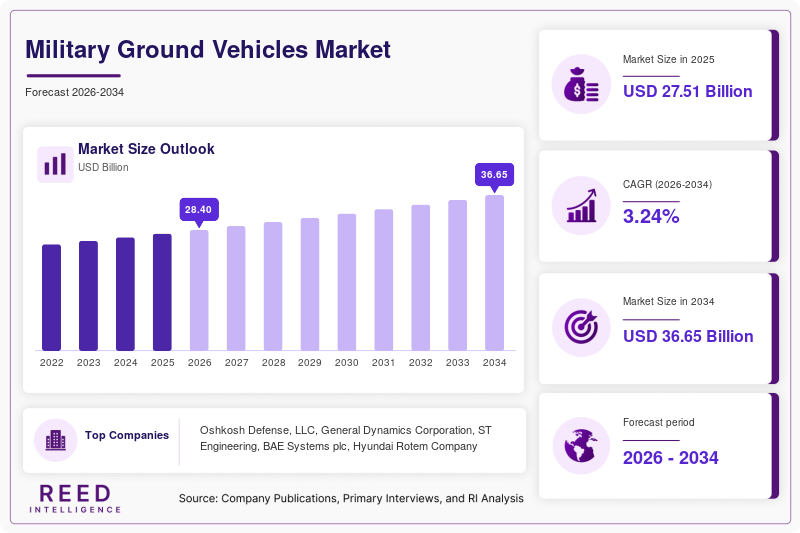
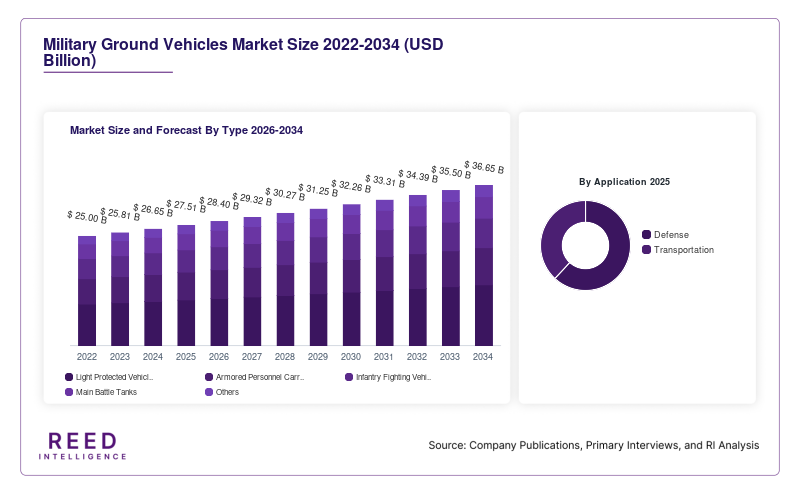
The global military ground vehicles market was valued at USD 27.51 billion in 2025 and is projected to grow from USD 28.40 billion in 2026 to USD 36.65 billion by 2034, registering a CAGR of 3.24% during the forecast period from 2026 to 2034. Asia Pacific accounted for the dominant regional share of 38.42% in 2025.
Military ground vehicles are specialized platforms designed to provide mobility, protection, logistics support, troop transportation, reconnaissance and combat capabilities during land-based military operations. The market includes combat platforms such as infantry fighting vehicles, armored personnel carriers and main battle tanks, as well as light protected and other supporting military vehicles.
Military Ground Vehicles Market Drivers
Increasing defense budgets are one of the primary drivers of military ground vehicle procurement. Governments are allocating additional resources toward modernization, replacement of aging platforms and development of advanced combat capabilities. Rising geopolitical uncertainty is further encouraging countries to strengthen land-force readiness. Global military expenditure reached USD 2.887 trillion in 2025, according to SIPRI.
Many armed forces are replacing aging armored vehicles, tanks, tactical vehicles and logistical platforms with more capable systems. Modernization programs create long-term procurement opportunities for manufacturers while also supporting upgrade, maintenance and lifecycle-service markets.
Modern battlefields require vehicles with improved firepower, survivability, mobility and situational awareness. The integration of advanced sensors, digital systems, active protection and precision weapon interfaces is increasing the technological content of military ground vehicles.
Heightened geopolitical tensions and changing security environments are encouraging countries to increase military readiness and strengthen armored and mechanized formations. These conditions support demand for both new platforms and modernization of existing fleets.
Military Ground Vehicles Market Restraints
Military ground vehicles require extensive engineering, testing, specialized materials, advanced electronics and strict qualification procedures. The resulting development and manufacturing costs can restrict procurement, particularly among countries with constrained defense budgets.
Advanced military vehicles require specialized maintenance infrastructure, trained personnel, spare parts and lifecycle support. Increased technological complexity can increase the cost and difficulty of maintaining vehicle fleets.
Defense procurement programs generally involve lengthy requirements definition, testing, certification and contract processes. These long cycles can delay revenue realization for manufacturers and create uncertainty around project schedules.
Military Ground Vehicles Market Opportunities
Autonomous systems represent a significant opportunity for manufacturers. AI-enabled navigation, autonomous convoy operations, unmanned logistics and robotic reconnaissance can expand the range of missions performed by ground platforms.
Hybrid-electric architectures provide opportunities to reduce fuel consumption while simultaneously supplying electrical power for increasingly energy-intensive battlefield systems. This is particularly relevant for sensors, communications, electronic warfare and counter-UAS technologies.
Modular platforms can accommodate different weapons, sensors, protection systems and mission equipment. This enables militaries to adapt vehicles to changing operational requirements without replacing the entire platform.
Large installed fleets of legacy vehicles provide opportunities for manufacturers offering retrofit packages, digital upgrades, improved protection, powertrain modernization, sensors and lifecycle support.
Military Ground Vehicles Market Segmental Analysis
By Type
Infantry Fighting Vehicles represent the dominant type segment in the global military ground vehicles market. IFVs combine protected infantry transportation with direct fire support, making them particularly relevant to mechanized and armored formations. Their versatility across different battlefield environments and ability to integrate advanced turrets, cannons, missiles, remote weapon stations, sensors and digital systems support their strong position in the market.
Armored Personnel Carriers remain an important category because they provide protected troop transportation and battlefield mobility. Wheeled and tracked APCs are used across a broad range of military operations, including troop movement, logistics and protected deployment.
Main Battle Tanks continue to represent a strategically important category because of their combination of protection, mobility and heavy firepower. Modern tank programs increasingly emphasize digital architecture, active protection, improved sensors and upgradeability.
Light Protected Vehicles are important for reconnaissance, patrol, command, logistics and mobility missions where lower weight and greater tactical flexibility are required.
The available market-specific source confirms IFVs as the dominant type but does not provide a sufficiently comparable numeric CAGR for each remaining type. Therefore, a fastest-growing type is not assigned without verified supporting data.
By Application
Defense is the dominant application segment. Military ground vehicles are fundamentally deployed to support combat, reconnaissance, border security, troop mobility and other national-defense missions. The increasing emphasis on combat readiness and military modernization strengthens demand within this segment.
Transportation includes logistical and mobility functions such as movement of personnel, equipment and supplies. Modern military transportation platforms increasingly incorporate enhanced protection, communications, digital systems and improved off-road mobility.
The available market-specific source confirms Defense as the dominant application but does not provide a reliable comparable CAGR for identifying the fastest-growing application. Therefore, no fastest-growing application is assigned.
Military Ground Vehicles Market Regional Analysis
Asia Pacific Military Ground Vehicles Market
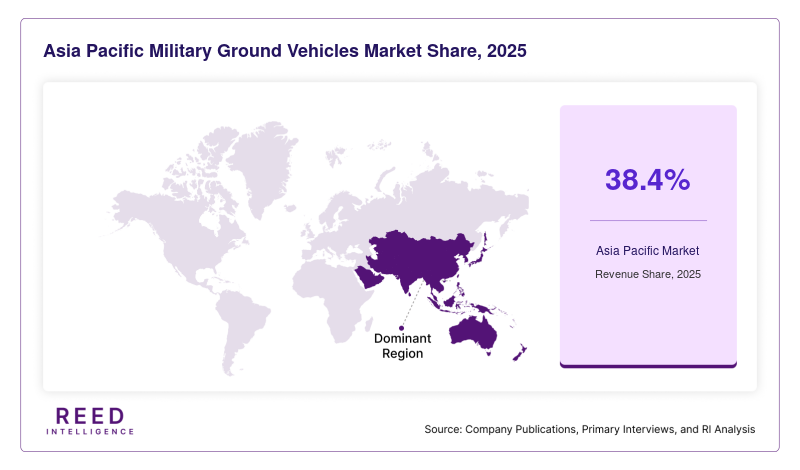
Asia Pacific is the dominant regional market, accounting for 38.42% of the global Military Ground Vehicles Market in 2025. This numeric share is directly reported by the market-specific source and is therefore used without estimation.
The region's strong position is supported by military modernization programs, increasing defense budgets and geopolitical tensions. China, India and Japan are among the major countries contributing to regional demand, while several other Asian countries are strengthening armored mobility, tactical transportation and mechanized capabilities.
North America Military Ground Vehicles Market
North America is identified by the market-specific source as the fastest-growing regional market, with the United States representing the principal contributor. However, the source does not provide a comparable numeric CAGR for North America; therefore, no regional CAGR is stated here to avoid unsupported estimation.
The region benefits from substantial U.S. defense expenditure, extensive fleet modernization programs and investments in autonomous systems, advanced combat vehicles, hybrid propulsion and digital battlefield technologies. Recent development programs involving XM30, AMPV and JLTV platforms demonstrate continuing investment in next-generation ground mobility.
Europe Military Ground Vehicles Market
Europe represents an important market for military ground vehicles as NATO members modernize armored formations and strengthen defense capabilities. Procurement programs for infantry fighting vehicles, main battle tanks and protected mobility platforms are supporting demand across the region.
The modernization of European fleets is increasingly linked to improved survivability, digital connectivity and interoperability. BAE Systems' CV90 programs and Rheinmetall's Challenger 3 program demonstrate continued investment in advanced armored vehicle capabilities.
Latin America Military Ground Vehicles Market
Latin America represents a smaller but strategically relevant market, supported primarily by modernization of aging fleets, border-security requirements and demand for protected mobility. Procurement priorities vary considerably among countries because of differences in defense budgets and security requirements.
Demand is expected to remain concentrated on cost-effective armored vehicles, tactical platforms and fleet modernization rather than very large-scale acquisition programs. The available market-specific source does not provide a verified comparable numeric market share or CAGR for Latin America; therefore, no unsupported figures are presented.
Middle East & Africa Military Ground Vehicles Market
The Middle East & Africa market is supported by national security requirements, border protection, military modernization and the need for vehicles capable of operating in demanding terrain and climatic conditions.
Demand encompasses armored combat vehicles, protected mobility platforms, logistics vehicles and specialized systems. Countries with larger defense budgets provide important procurement opportunities, while the region's diverse security requirements create demand for multiple vehicle configurations.
Competitive Landscape
The military ground vehicles market is characterized by the presence of established defense contractors with capabilities spanning vehicle design, armored systems, weapons integration, electronics, propulsion and lifecycle support. Competition is increasingly centered on modularity, survivability, digital architecture, autonomous capabilities, hybrid propulsion and the ability to provide localized manufacturing and long-term support.
Leading manufacturers are also expanding international partnerships and local production arrangements to satisfy national industrial requirements. This is particularly visible in European and Asia Pacific procurement programs, where technology transfer, domestic production and localized maintenance are increasingly important procurement criteria.
Key Market Players
- Oshkosh Defense, LLC
- General Dynamics Corporation
- ST Engineering
- BAE Systems plc
- Hyundai Rotem Company
- Ashok Leyland
- China North Industries Corporation (NORINCO)
- Thales Australia
- Mitsubishi Heavy Industries
- Hanwha Defense
- PT Pindad
Military Ground Vehicles Market Recent Developments
- October, 2026, Oshkosh Defense announced a second direct commercial sales order for Morocco covering 50 HET A1 tractors and 50 MN573 heavy-duty trailers, together with parts, services and training. The platforms are intended to strengthen Morocco's heavy-equipment transport and armored-force mobility capabilities.
- September, 2026, BAE Systems announced delivery of new AMPV 30mm Infantry Fighting Vehicles to a U.S. Army Transformation in Contact unit. The vehicles were developed using USD 17 million of company internal R&D funding and underwent field evaluation and live-fire testing.
Military Ground Vehicles Market Segments
By Type
- Light Protected Vehicles
- Armored Personnel Carriers
- Infantry Fighting Vehicles
- Main Battle Tanks
- Others
By Application
- Defense
- Transportation
By Region
- North America
- Europe
- APAC
- Middle East and Africa
- LATAM