Military Land Vehicle Electronics Market Size, Share & Trends Analysis Report By Component (Communication Systems, Navigation Systems, Display Systems, Power Systems), By Vehicle Type (Armored Vehicles, Unmanned Ground Vehicles, Light Tactical Vehicles), By Application (Command and Control, Intelligence, Surveillance and Reconnaissance, Electronic Warfare), By End User (Defense, Homeland Security) Forecasts, 2026–2034
USD 3950
Military Land Vehicle Electronics Market Size
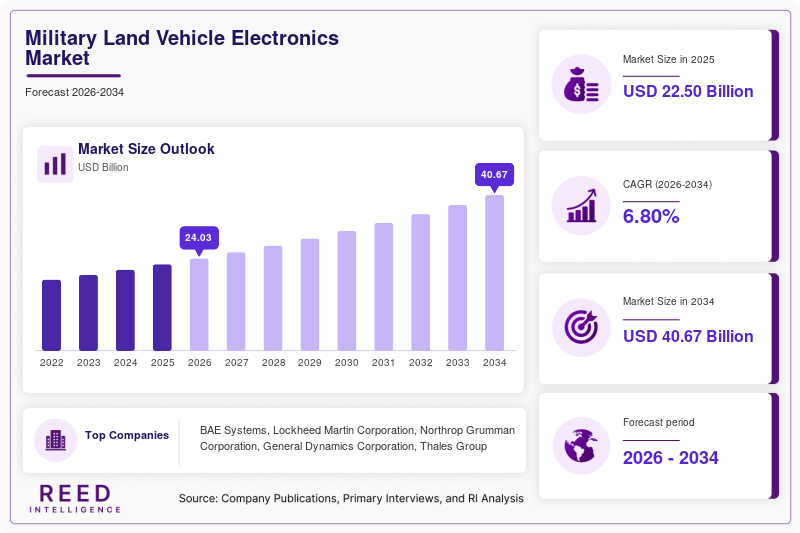
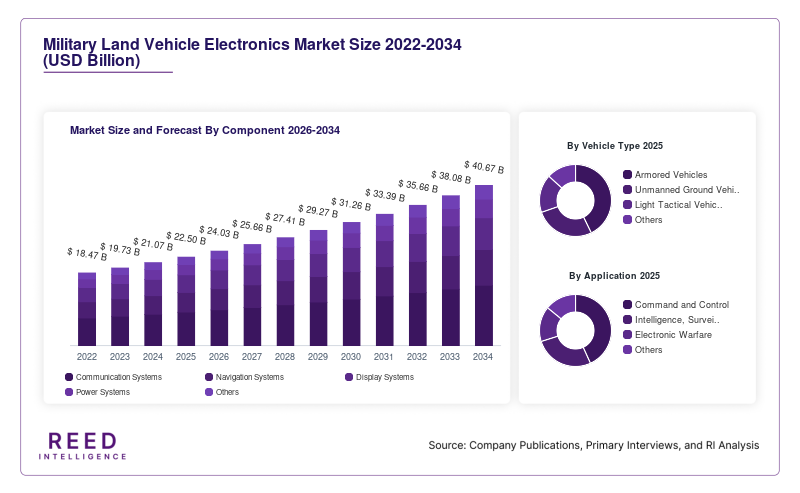
The global military land vehicle electronics market was valued at USD 22.50 billion in 2025 and is projected to reach USD 40.67 billion by 2034, registering a CAGR of 6.80% during the forecast period from 2026 to 2034. The market is estimated at USD 24.03 billion in 2026.
Military Land Vehicle Electronics, commonly referred to as vetronics, comprises the electronic systems and subsystems integrated into military ground vehicles. These systems include communications, navigation, displays, power management, vehicle health monitoring, command and control, electronic warfare, sensor integration, and other mission-critical electronics.
The increasing digitalization of military forces is transforming armored vehicles and tactical platforms into highly connected battlefield systems. Modern military vehicles increasingly operate as networked nodes capable of sharing information among vehicles, command centers, sensors, unmanned systems, and other battlefield assets.
Military Land Vehicle Electronics Market Drivers
Defense forces worldwide are upgrading legacy fleets and procuring next-generation armored vehicles, tactical vehicles, and unmanned ground systems. These modernization programs increasingly emphasize digital command systems, advanced communications, sensor integration, navigation, electronic warfare, and vehicle protection electronics.
Modern battlefield operations require rapid access to information from multiple sensors and communication networks. Integrated displays, command systems, sensor-fusion platforms, and high-speed processing electronics allow crews and commanders to receive and interpret battlefield information more efficiently.
The increasing use of unmanned ground vehicles for reconnaissance, logistics, surveillance, explosive ordnance disposal, and other missions is creating additional demand for autonomous navigation, remote-control communications, computing, sensors, and vehicle-management electronics.
The increasing sophistication of electronic threats is encouraging defense organizations to equip military vehicles with electronic warfare and active protection capabilities. These systems require advanced signal processing, communications, sensors, threat detection, and countermeasure electronics.
Military Land Vehicle Electronics Market Restraints
Military-grade electronics require extensive engineering, environmental testing, cybersecurity validation, electromagnetic compatibility testing, and platform integration. These requirements increase development costs and lengthen procurement cycles.
Many military fleets remain in service for decades. Integrating modern electronics into older platforms can require extensive modifications to power systems, wiring, cooling systems, software, communications architecture, and vehicle interfaces.
Military electronics depend on specialized semiconductors, processors, sensors, displays, connectors, power components, and communication equipment. Geopolitical tensions and component shortages can create procurement risks.
Electronic components and computing technologies can become obsolete faster than military vehicle platforms. Maintaining technology relevance over long vehicle lifecycles creates additional upgrade and sustainment requirements.
Military Land Vehicle Electronics Market Opportunities
Artificial intelligence can improve sensor fusion, threat detection, predictive maintenance, autonomous navigation, and decision-support capabilities.
Upgrading existing military vehicles with modern communication, navigation, electronic warfare, display, and computing systems offers significant opportunities because electronics modernization can extend vehicle operational life without requiring complete vehicle replacement.
Autonomous military logistics vehicles are emerging as an important opportunity for reducing personnel exposure and improving supply-chain efficiency.
Hybrid and electric military vehicle development will create demand for battery-management systems, power converters, energy-storage electronics, high-voltage distribution systems, and advanced thermal-management technologies.
Military Land Vehicle Electronics Market Segmental Analysis
By Component
Communication Systems dominated the component segment with a 28.5% market share in 2025. Demand is supported by secure tactical communications, software-defined radios, vehicle-to-vehicle networking, data links, and network-centric battlefield architectures.
Navigation Systems represented 22.3% of the component segment, supported by demand for GPS-resilient and inertial navigation capabilities.
Display Systems accounted for 19.8%, reflecting increasing requirements for integrated tactical displays capable of presenting sensor, navigation, communication, and weapon-system information.
Power Systems accounted for 15.6%, driven by increasing electrical loads and the growing complexity of military vehicle power architectures.
Others represented 13.8% and include specialized electronics such as vehicle health monitoring and integration systems.
Communication Systems are therefore the dominant component segment, while navigation, display, and power electronics remain important growth areas as vehicle architectures become increasingly digital.
By Vehicle Type
Armored Vehicles dominated the vehicle-type segment with a 38.2% market share in 2025. The segment includes tanks, infantry fighting vehicles, armored personnel carriers, and other heavily protected platforms requiring sophisticated fire-control, communication, sensor, protection, and command systems.
Unmanned Ground Vehicles represented 26.5% and are expected to remain an important growth area because of increasing autonomous reconnaissance, logistics, surveillance, and EOD applications.
Light Tactical Vehicles accounted for 23.7%, supported by demand for modular communications, surveillance, command, and mission systems.
Armored Vehicles are the dominant vehicle type, while Unmanned Ground Vehicles represent a key high-growth opportunity.
By Application
Command and Control dominated the application segment with a 31.4% market share in 2025. These systems integrate battlefield information, communications, sensor data, tactical displays, and decision-support capabilities.
Intelligence, Surveillance and Reconnaissance accounted for 28.7%, supported by increasing deployment of electro-optical, infrared, radar, and multi-spectral sensors.
Electronic Warfare represented 21.4% and is gaining importance because of growing threats involving communications disruption, GPS interference, radar detection, and counter-UAS operations.
Others accounted for 18.5%.
Command and Control is the dominant application, while Electronic Warfare is a strategically important growth segment.
By End User
Defense dominated the end-user segment with a 72.3% market share in 2025. Defense organizations remain the principal purchasers of military land vehicle electronics for combat vehicles, tactical vehicles, reconnaissance platforms, and fleet modernization programs.
Homeland Security accounted for 27.7%, with demand arising from border security, law enforcement, emergency response, surveillance, and tactical vehicle applications.
Defense is therefore the dominant end-user segment.
Military Land Vehicle Electronics Market Regional Analysis
North America
North America represents a major military protected vehicles market, supported primarily by the United States' substantial defense expenditure, extensive armored vehicle fleet, modernization programs, and advanced defense-industrial base. The region continues to invest in enhanced protection, mobility, network integration, and next-generation military vehicle technologies. An exact comparable global market-share percentage for North America is not reliably verifiable on the same market-size basis used in this report.
Europe
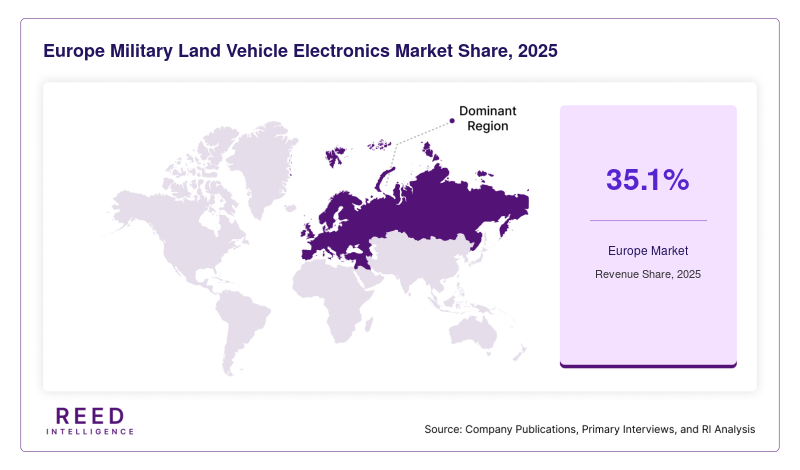
Europe is the dominant region in the Military Protected Vehicles Market, accounting for 35.1% of the global market share in 2024, according to The Insight Partners. The region's leading position is supported by extensive armored vehicle programs, military modernization, NATO-related capability requirements, and increasing emphasis on land-force readiness.
Asia Pacific
Asia Pacific represents a major and rapidly expanding military protected vehicles market, supported by military modernization programs, territorial disputes, increasing defense expenditure, and domestic production capabilities. The region's military protected vehicles market was valued at US$10,931.5 million in 2024 and is projected to reach US$15,836.6 million by 2031, registering a 5.6% CAGR.
Latin America
Latin America represents a developing market for military protected vehicles, with demand influenced by internal security requirements, border protection, peacekeeping activities, counter-insurgency operations, and modernization of aging military fleets. Countries with established defense industries are increasingly seeking protected platforms that can provide mobility and personnel protection without the procurement costs associated with the heaviest armored systems.
Middle East & Africa
The Middle East & Africa region has sustained demand for protected vehicles because of regional security challenges, border conflicts, counterterrorism requirements, peacekeeping operations, and the need for protected mobility across harsh environments. Vehicle requirements vary from light patrol platforms to heavily protected combat and tactical vehicles.
Military Land Vehicle Electronics Market Competitive Landscape
The military land vehicle electronics market is highly competitive and characterized by large defense contractors with established military relationships, extensive integration capabilities, cybersecurity expertise, and long-term procurement contracts.
Competition increasingly focuses on open-system architectures, software-defined vehicles, artificial intelligence, autonomous systems, electronic warfare, communications, sensor fusion, and modular electronics.
Key Market Players
- BAE Systems
- Lockheed Martin Corporation
- Northrop Grumman Corporation
- General Dynamics Corporation
- Thales Group
- Rheinmetall AG
- Leonardo S.p.A.
- Elbit Systems Ltd.
- Saab AB
- L3Harris Technologies
Military Land Vehicle Electronics Market Recent Developments
- July , 2026, Rheinmetall announced a €100 million call-off under Germany's Digitisation of Land-Based Operations (D-LBO) framework. The order includes 5,000 adapter plate sets and 11,000 rugged pin pads, together with additional industrial integration and support services for digital command and communication systems across Bundeswehr vehicles.
- May , 2026, BAE Systems announced that it had been awarded the U.S. Army's Soft Kill Active Protection System program of record for combat vehicles. The system uses electronic warfare capabilities to counter threats including unmanned aerial systems and anti-tank guided missiles, strengthening the electronic protection component of military ground vehicles.
Military Land Vehicle Electronics Market Segments
By Component
- Communication Systems
- Navigation Systems
- Display Systems
- Power Systems
- Others
By Vehicle Type
- Armored Vehicles
- Unmanned Ground Vehicles
- Light Tactical Vehicles
- Others
By Application
- Command and Control
- Intelligence, Surveillance and Reconnaissance
- Electronic Warfare
- Others
By End User
- Defense
- Homeland Security
By Region
- North America
- Europe
- APAC
- Middle East and Africa
- LATAM