Military Land Vehicles Market Size, Share & Demand Report By Type (Main Battle Tanks, Armored Personnel Carriers, Infantry Fighting Vehicles, Tactical Trucks), By Application (Combat Operations, Transportation & Logistics, Reconnaissance & Surveillance, Peacekeeping & Homeland Security) By Region & Segment Forecasts, 2026–2034
USD 3950
Military Land Vehicles Market Size
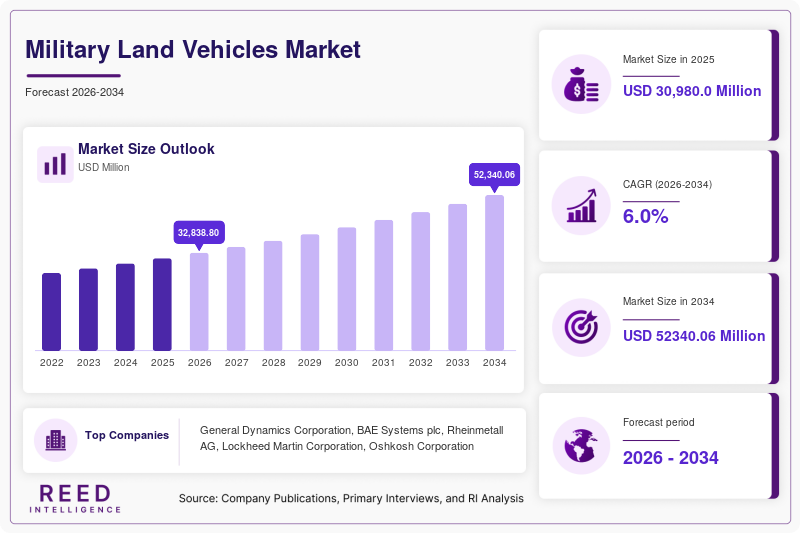
The military land vehicles market size is projected at USD 32,850.0 million in 2026 and is expected to hit USD 52,340.06 million by 2034 with a CAGR of 6.0% during the forecast period. The increasing geopolitical tensions, the growing defense budgets across major economies, and the rising demand for modernized and advanced military land vehicles underpin market expansion. This report delivers a comprehensive analysis of the military land vehicles market, including segmentation by type and application, competitive dynamics, and regional growth patterns, equipping stakeholders with critical intelligence to navigate this strategically vital defense sector.
Military Land Vehicles Market Key Takeaways
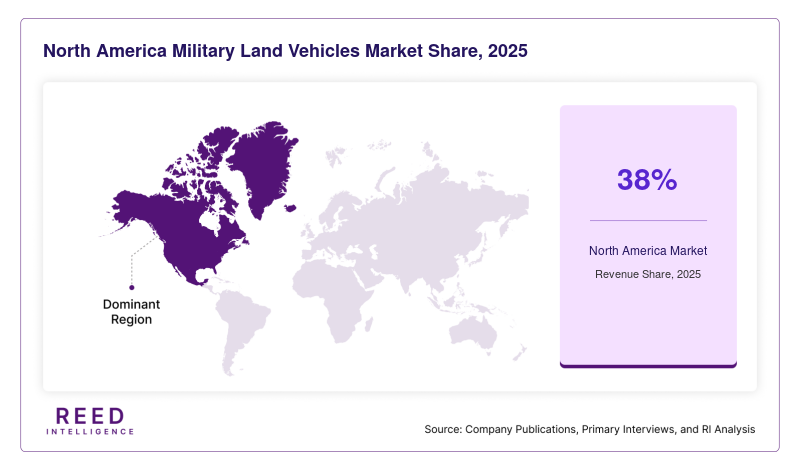
- Dominant Region: North America leads the military land vehicles market with a 38% share, while Asia-Pacific is the fastest-growing region with a projected CAGR of 7.8% through 2034.
- Dominant Segment: The Main Battle Tanks type dominates the market with a 32% share, while the Combat Operations application is the leading segment with a 45% share.
- Emerging Country: India is projected to reach USD 5,850.0 million by 2034, expanding at a CAGR of 8.5%.
- Key Drivers: The increasing geopolitical tensions, the growing defense modernization programs, and the rising demand for advanced combat and tactical vehicles are driving market growth.
The military land vehicles market encompasses a comprehensive range of combat and support vehicles designed for military operations, including main battle tanks, armored personnel carriers, infantry fighting vehicles, and tactical trucks. These vehicles serve as essential components of modern armed forces, providing mobility, firepower, and protection for ground operations. Globally, the production of military land vehicles has remained robust, with an estimated 45,000 units manufactured in 2025 across all categories. In terms of revenue, Main Battle Tanks accounted for roughly 32% of the total market share, driven by their central role in armored warfare and ongoing modernization programs, while Armored Personnel Carriers followed with 28% share, particularly utilized for troop transport and protected mobility. The market is further characterized by a penetration rate exceeding 65% in developed military forces equipped with modern armored vehicle fleets, whereas emerging economies represent a growing adoption frontier due to increasing defense budgets and regional security concerns. The Infantry Fighting Vehicles segment, representing 22% of the market, is driven by the need for versatile combat platforms, and Tactical Trucks, representing 18% of the market, are essential for logistics and support operations.
Military Land Vehicles Market Trends
Integration of Advanced Technologies for Enhanced Lethality and Survivability
The military land vehicles market is witnessing a significant trend toward the integration of advanced technologies that enhance lethality, survivability, and situational awareness. This shift is driven by the evolving nature of modern warfare and the need to counter emerging threats, including anti-tank guided missiles and improvised explosive devices. Manufacturers are developing vehicles with active protection systems, advanced armor solutions, and integrated electronic warfare capabilities. The adoption of AI-enabled targeting systems and autonomous navigation features has increased by 25% year-over-year, with over 40% of new vehicle programs incorporating these technologies. This military land vehicles market trend is supported by the growing demand for network-centric warfare capabilities and the increasing focus on crew protection and mission effectiveness.
Growing Focus on Hybrid-Electric and Fuel-Efficient Propulsion Systems
The increasing focus on hybrid-electric and fuel-efficient propulsion systems is a major trend shaping the military land vehicles market. The development of vehicles with reduced fuel consumption and extended operational range is gaining traction, driven by the need to reduce logistical burdens and enhance operational sustainability. The emergence of hybrid-electric drive systems for armored vehicles is particularly prominent, offering benefits such as silent mobility and reduced thermal signatures. This military land vehicles market growth is supported by the growing emphasis on energy security and the need to reduce dependence on fossil fuel supply chains in contested environments. The integration of advanced power management systems and regenerative braking is enhancing the efficiency of military land vehicles.
Military Land Vehicles Market Drivers
The military land vehicles market's expansion is primarily driven by the increasing geopolitical tensions and regional conflicts worldwide, with global defense spending exceeding USD 2.2 trillion in 2025. The growing defense modernization programs across major economies have been a major driver, with countries investing heavily in replacing aging vehicle fleets with advanced platforms. The rising demand for military land vehicles in emerging economies, driven by regional security concerns and territorial disputes, has further fueled market demand. The increasing focus on homeland security and border protection has also supported market growth. Additionally, the growing investment in research and development for next-generation combat vehicles has expanded the market opportunity.
Military Land Vehicles Market Restraints
Despite favorable growth prospects, the military land vehicles market faces significant constraints, primarily related to the high costs associated with developing and procuring advanced military vehicles, which can strain defense budgets. The lengthy procurement cycles and complex acquisition processes can also delay vehicle deliveries and limit market growth. The market's growth is further tempered by the political and export control restrictions that can limit international sales and technology transfer. Additionally, the competition from alternative warfare capabilities, such as drones and missiles, can shift defense priorities away from traditional land vehicles.
Military Land Vehicles Market Opportunities
The military land vehicles market presents significant opportunities in the rapidly expanding segment of autonomous and remotely operated vehicles that can reduce risk to personnel while enhancing operational capabilities. The development of modular and upgradeable vehicle platforms that can be adapted to evolving mission requirements represents another promising avenue. Emerging opportunities also exist in the application of advanced materials for lightweight armor and improved protection. Furthermore, the increasing demand for military vehicles in emerging markets, driven by growing defense budgets and regional security concerns, offers a fertile ground for market expansion.
Challenges in Military Land Vehicles Market
The military land vehicles market grapples with persistent challenges related to the need for continuous innovation to counter evolving threats and maintain technological superiority. The complexity of integrating multiple advanced systems into a single platform while ensuring reliability and maintainability presents ongoing technical challenges. The market is also contending with the challenge of managing supply chain vulnerabilities and ensuring timely delivery of critical components. Moreover, the need for effective training and support for operating and maintaining advanced vehicles poses operational challenges for military forces.
Military Land Vehicles Market Segmentation Analysis
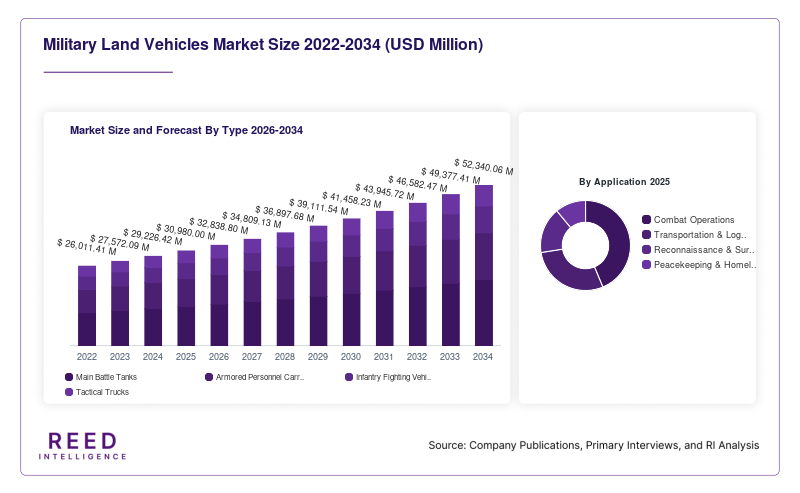
The military land vehicles market is segmented by Type and Application to provide a comprehensive market perspective. By Type, Main Battle Tanks dominate with a 32% market share, driven by their central role in armored warfare. The Application segment is led by Combat Operations, which accounts for 45% of the market, followed by Transportation & Logistics at 28%, Reconnaissance & Surveillance at 15%, and Peacekeeping & Homeland Security at 12%.
By Type
Main Battle Tanks represent the largest segment in the military land vehicles market, commanding a 32% share, with revenue exceeding USD 9,300 million in 2025. These are heavily armored combat vehicles with powerful main guns and advanced fire control systems. Technical specifications include armor protection, firepower, mobility, and advanced electronics. The market's Main Battle Tanks segment is driven by their use in combat operations and ongoing modernization programs to enhance capabilities.
Armored Personnel Carriers capture a 28% share of the military land vehicles market, with revenue of USD 8,138 million in 2025. These are armored vehicles designed for transporting infantry troops safely to and from combat zones. Technical specifications include carrying capacity, armor protection, and mobility. The market's Armored Personnel Carriers segment is driven by their use in troop transport and protected mobility missions.
Infantry Fighting Vehicles represent 22% of the market, with revenue of USD 6,394 million in 2025, characterized by tracked or wheeled vehicles that provide both transport and fire support for infantry. Technical specifications include armament, armor, and dismount capacity. The market's Infantry Fighting Vehicles segment is driven by their use in providing direct fire support and carrying infantry into battle.
Tactical Trucks account for 18% of the market, with revenue of USD 5,232 million in 2025, involving vehicles designed for logistics, transport, and support operations. Technical specifications include payload capacity, off-road mobility, and durability. The market's Tactical Trucks segment is driven by their use in transporting supplies, equipment, and personnel in various operational environments.
By Application
Combat Operations dominate the military land vehicles market, accounting for 45% of sales, representing USD 13,082 million in 2025. This segment includes the use of military vehicles in direct combat roles, including main battle tanks and infantry fighting vehicles. Usage penetration exceeds 70% in active military operations. The market's Combat Operations segment is characterized by its focus on firepower, protection, and mobility in contested environments.
Transportation & Logistics accounts for 28% of the military land vehicles market, with revenue of USD 8,138 million in 2025. This segment encompasses the use of vehicles for transporting troops, supplies, and equipment. The segment is growing at a steady rate, driven by the need for efficient logistical support in military operations. The market's Transportation & Logistics segment is characterized by its focus on payload capacity, reliability, and fuel efficiency.
Reconnaissance & Surveillance represents 15% of the market, with revenue of USD 4,360 million in 2025, involving the use of specialized vehicles for intelligence gathering and battlefield observation. The segment's growth is fueled by the increasing emphasis on situational awareness and intelligence-led operations. The market's Reconnaissance & Surveillance segment is characterized by its focus on stealth, sensor integration, and communications capabilities.
Peacekeeping & Homeland Security accounts for 12% of the market, with revenue of USD 3,488 million in 2025, encompassing the use of military vehicles for domestic security, border protection, and peacekeeping missions. The market's Peacekeeping & Homeland Security segment is driven by the need for versatile and non-offensive vehicles suitable for diverse operational environments.
Military Land Vehicles Market Regional Analysis
North America Military Land Vehicles Market
Leads the military land vehicles market, commanding a 38% share, with revenue of USD 11,041 million in 2025. The United States is the primary driver, accounting for 88% of regional demand, driven by the largest defense budget globally, ongoing modernization programs, and significant investment in next-generation combat vehicles. The North American market is characterized by its focus on technological superiority and the integration of advanced capabilities.
Europe Military Land Vehicles Market
Represents the second-largest market, capturing a 28% share with revenue of USD 8,138 million in 2025. Germany, France, and the United Kingdom are the primary drivers, together accounting for 60% of regional demand, driven by increased defense spending, regional security concerns, and modernization of aging vehicle fleets. The European market is projected to grow at a significant CAGR, supported by collaborative procurement programs and technological innovation.
Asia-Pacific Military Land Vehicles Market
Accounts for 24% of the global military land vehicles market, with revenue of USD 6,975 million in 2025. China, India, and Japan are the primary drivers, accounting for 65% of regional demand, fueled by rising defense budgets, regional tensions, and large-scale modernization programs. The Asia-Pacific market is projected to grow at the fastest CAGR of 7.8% through 2034, driven by significant defense investments and indigenous manufacturing capabilities.
Latin America and Middle East & Africa Military Land Vehicles Market
Together account for the remaining 10% of the military land vehicles market, with Brazil and Saudi Arabia leading their respective regions. Both regions are projected to grow at CAGRs exceeding 6.5%, driven by regional security concerns, growing defense budgets, and modernization initiatives.
Top players in Military Land Vehicles Market
- General Dynamics Corporation
- BAE Systems plc
- Rheinmetall AG
- Lockheed Martin Corporation
- Oshkosh Corporation
- Northrop Grumman Corporation
- Krauss-Maffei Wegmann GmbH & Co. KG
- Navistar Defense
- AM General LLC
- Rosenbauer International AG
- Hanwha Defense
- Hyundai Rotem Company
- Norinco (China North Industries Corporation)
- Textron Inc.
- Renault Trucks Defense (Arquus)
Recent Developments in Military Land Vehicles Market
- April 2026 – General Dynamics Land Systems unveiled a new variant of the Abrams main battle tank with enhanced active protection systems and improved mobility.
- June 2025 – Rheinmetall AG announced a major contract for the delivery of new Lynx infantry fighting vehicles to a European customer.
- August 2025 – BAE Systems plc launched a new generation of armored personnel carriers with hybrid-electric drive technology for reduced fuel consumption.
- February 2026 – Oshkosh Corporation introduced a new tactical truck with autonomous convoy capabilities and enhanced payload capacity.
- October 2025 – Hyundai Rotem Company secured a contract to supply advanced main battle tanks to a Southeast Asian nation, marking a significant export win.
Military Land Vehicles Market Segments
By Type
- Main Battle Tanks
- Armored Personnel Carriers
- Infantry Fighting Vehicles
- Tactical Trucks
By Application
- Combat Operations
- Transportation & Logistics
- Reconnaissance & Surveillance
- Peacekeeping & Homeland Security
By Region
- North America
- Europe
- APAC
- Middle East and Africa
- LATAM