Military Laser Designator Market Size, Share & Demand Report By Platform (Ground-Based, Airborne, Naval), By Application (Defense and Military, Homeland Security), By Range (Short Range, Medium Range, Long Range), By Technology (Solid-State Laser, Fiber Laser, Gas Laser) By Region & Segment Forecasts, 2026–2034
USD 3950
Market Overview
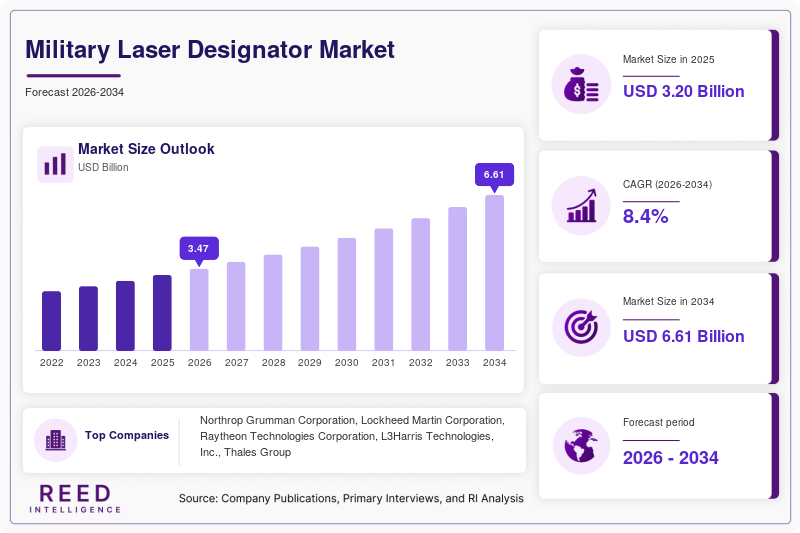
The Military Laser Designator Market size was valued at USD 3.2 billion in 2026 and is projected to reach USD 6.1 billion by 2034, expanding at a CAGR of 8.4% during the forecast period (2026–2034). The market growth is being supported by the increasing adoption of precision-guided munitions across modern warfare systems, which rely heavily on accurate target designation technologies. The integration of advanced targeting systems with real-time data transmission capabilities has further strengthened the adoption of laser designators in defense operations.
Rising geopolitical tensions and defense modernization programs across both developed and developing economies have contributed significantly to the expansion of the Military Laser Designator Market. Governments are investing in advanced battlefield technologies to enhance operational efficiency, reduce collateral damage, and improve mission accuracy. These factors are expected to sustain long-term growth in the market.
Key Highlights
- North America dominated the market with a share of 38.5% in 2025, while Asia Pacific is projected to grow at the fastest CAGR of 9.6% during 2026–2034
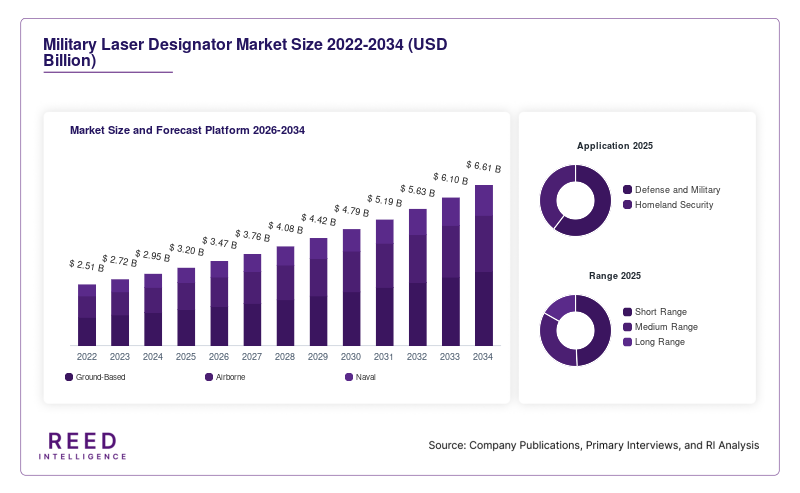
- Ground-based laser designators accounted for the largest share of 44.2% in 2025, while airborne laser designators are expected to grow at a CAGR of 9.1%
- Defense and military application remained the dominant segment with 68.7% share, while homeland security applications are expected to grow at 8.9% CAGR
- The United States recorded market values of USD 0.95 billion in 2024 and USD 1.02 billion in 2025
Market Trends
Integration of Laser Designators with Network-Centric Warfare Systems
The Military Laser Designator Market is witnessing a trend toward integration with network-centric warfare systems. Modern military operations increasingly depend on interconnected platforms, including drones, satellites, and ground units. Laser designators are being integrated with communication networks to enable seamless data sharing and real-time targeting. This enhances situational awareness and allows for coordinated strikes across multiple platforms.
Adoption of Compact and Lightweight Laser Designators
Another notable trend is the shift toward compact, lightweight, and portable laser designator systems. These devices are being developed to support dismounted soldiers and special operations forces. Advances in miniaturization and battery efficiency have enabled the production of highly portable systems without compromising performance, making them suitable for a wide range of tactical scenarios.
Market Drivers
Increasing Demand for Precision-Guided Weapon Systems
The growing reliance on precision-guided munitions is a key driver of the Military Laser Designator Market. Laser designators play a critical role in guiding missiles and bombs to their intended targets with high accuracy. This reduces collateral damage and improves mission success rates. As defense forces prioritize precision strike capabilities, the demand for advanced laser designators continues to rise.
Expansion of Defense Budgets and Modernization Programs
Rising global defense expenditures are fueling the growth of the Military Laser Designator Market. Countries are allocating significant budgets to upgrade their military infrastructure and adopt advanced targeting technologies. Modernization programs focused on enhancing surveillance, reconnaissance, and targeting systems are driving the procurement of laser designators across various defense segments.
Market Restraint
High Cost of Advanced Laser Designator Systems
The high cost associated with advanced laser designator systems remains a major restraint for the Military Laser Designator Market. These systems involve sophisticated components such as high-energy lasers, optics, and electronic subsystems, which increase overall costs. Budget constraints in certain regions may limit adoption, particularly among smaller defense forces.
Market Opportunities
Growing Use of Unmanned Systems in Military Operations
The increasing deployment of unmanned aerial vehicles (UAVs) and unmanned ground vehicles presents a significant opportunity for the Military Laser Designator Market. These platforms require compact and efficient targeting systems, including laser designators, to perform surveillance and strike missions. Integration with UAVs is expected to drive demand in the coming years.
Technological Advancements in Laser Systems
Advancements in laser technologies, including improved beam quality, range, and energy efficiency, are creating new growth opportunities. Innovations such as solid-state lasers and fiber lasers are enhancing system performance while reducing size and power consumption. These developments are expected to expand the application scope of laser designators.
Segmental Analysis
By Platform
Ground-based laser designators dominated the Military Laser Designator Market with a share of 44.2% in 2025, driven by their extensive use in field operations and fixed installations. These systems provide reliable targeting capabilities for ground forces.
Airborne laser designators are expected to grow at the fastest CAGR of 9.1% during the forecast period. Their integration with fighter jets and UAVs enables enhanced targeting accuracy and extended operational range, making them increasingly valuable in modern warfare.
By Application
The defense and military segment accounted for the largest share of 68.7% in 2025, as laser designators are essential components of combat operations. Their role in guiding precision munitions and supporting reconnaissance missions has strengthened their adoption.
Homeland security applications are anticipated to grow at a CAGR of 8.9%. The increasing need for surveillance, border control, and counter-terrorism operations is driving the use of laser designators in non-combat scenarios.
By Range
Short-range laser designators dominated the market with a share of 39.5% in 2025, owing to their suitability for tactical operations and urban environments.
Long-range laser designators are expected to grow at the fastest CAGR of 9.3%, driven by the need for extended targeting capabilities in large-scale military operations and remote missions.
By Technology
Solid-state laser technology held the dominant share of 52.1% in 2025 due to its reliability and efficiency in various operational conditions.
Fiber laser technology is projected to grow at a CAGR of 9.5%, supported by its advantages such as higher efficiency, compact design, and improved performance.
Regional Analysis
North America
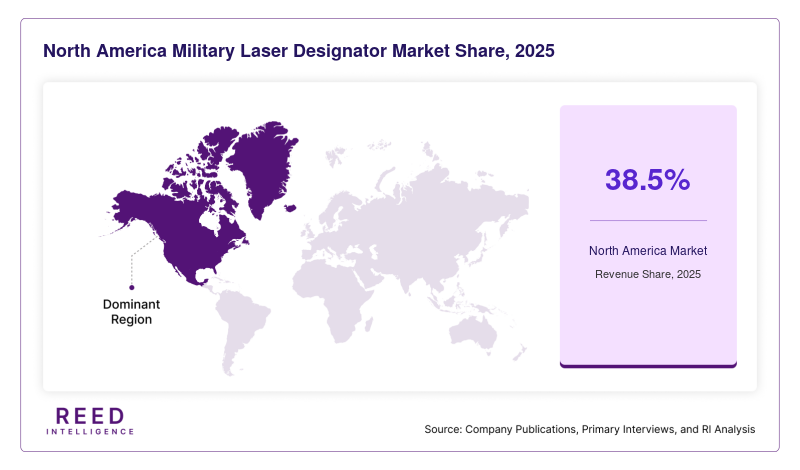
North America accounted for a market share of 38.5% in 2025 and is expected to maintain steady growth with a CAGR of 7.9% during the forecast period. The United States remains the dominant country due to continuous investment in advanced military technologies. The presence of well-established defense contractors and ongoing research initiatives supports regional growth.
Europe
Europe held a market share of 24.3% in 2025 and is projected to grow at a CAGR of 7.6% during 2026–2034. The United Kingdom is a key contributor, driven by defense modernization programs and participation in joint military operations. Increasing collaboration among European defense agencies is supporting the adoption of laser designator systems.
Asia Pacific
Asia Pacific accounted for 21.7% of the market share in 2025 and is anticipated to grow at the fastest CAGR of 9.6%. China leads the region due to its focus on strengthening military capabilities and investing in indigenous defense technologies. The expansion of defense budgets across countries such as India and Japan is contributing to regional growth.
Middle East & Africa
The Middle East & Africa region held a market share of 9.2% in 2025 and is expected to grow at a CAGR of 8.8%. Saudi Arabia is the dominant country, supported by high defense spending and procurement of advanced military equipment. Regional conflicts and security concerns are driving the demand for precision targeting systems.
Latin America
Latin America accounted for 6.3% of the market share in 2025 and is projected to grow at a CAGR of 7.2%. Brazil leads the region due to its efforts to modernize defense infrastructure and enhance surveillance capabilities. Increasing focus on border security and anti-narcotics operations is supporting market growth.
Competitive Landscape
The Military Laser Designator Market is moderately consolidated, with key players focusing on technological innovation and strategic collaborations. Northrop Grumman Corporation is a leading player, known for its advanced targeting systems and continuous investment in research and development. The company recently introduced an upgraded laser designator system with enhanced range and accuracy.
Lockheed Martin Corporation offers a wide range of laser targeting solutions integrated with advanced weapon systems. Raytheon Technologies Corporation focuses on precision-guided systems and has expanded its product portfolio with next-generation laser designators. L3Harris Technologies, Inc. provides portable and airborne systems designed for diverse military applications. Thales Group is recognized for its expertise in defense electronics and advanced targeting solutions. These companies are strengthening their market position through innovation, partnerships, and expansion into emerging markets.
Key Players List
- Northrop Grumman Corporation
- Lockheed Martin Corporation
- Raytheon Technologies Corporation
- L3Harris Technologies, Inc.
- Thales Group
- Leonardo S.p.A.
- Elbit Systems Ltd.
- Saab AB
- Rheinmetall AG
- BAE Systems plc
- FLIR Systems, Inc.
- Safran S.A.
- General Dynamics Corporation
- Israel Aerospace Industries Ltd.
- ASELSAN A.S.
Recent Developments
- In 2025, a major defense contractor launched a next-generation airborne laser designator system with improved targeting precision and extended range.
- In 2024, advancements in fiber laser technology enabled the development of compact and energy-efficient designators for UAV applications.
- In 2025, several defense agencies initiated procurement programs for portable laser designators to enhance ground force capabilities.
- In 2024, collaborative agreements between defense companies led to the integration of laser designators with advanced communication systems.
- In 2025, investments in research and development resulted in improved durability and performance of laser designator systems under extreme environmental conditions.
Military Laser Designator Market Segments
Platform
- Ground-Based
- Airborne
- Naval
Application
- Defense and Military
- Homeland Security
Range
- Short Range
- Medium Range
- Long Range
Technology
- Solid-State Laser
- Fiber Laser
- Gas Laser
By Region
- North America
- Europe
- APAC
- Middle East and Africa
- LATAM