Military Protected Vehicles Market Size, Share & Trends Analysis Report By Type (Light, Medium, Heavy) and By Application (Defence, Transportation, Other) and By Region (North America, Europe, Asia Pacific, Latin America, Middle East & Africa) Forecasts, 2026–2034
USD 3950
Military Protected Vehicles Market Size
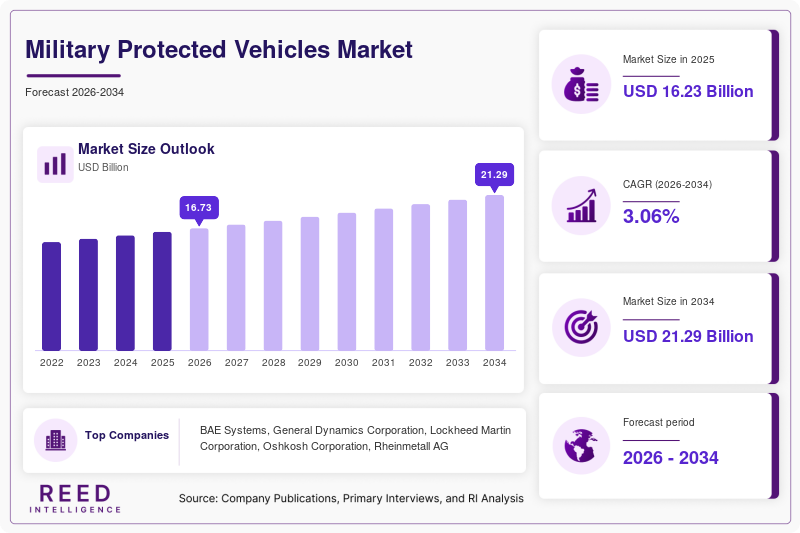
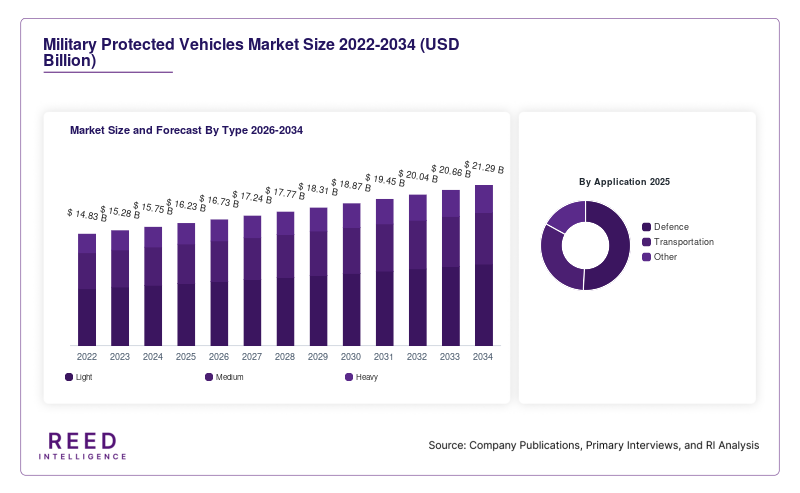
The global military protected vehicles market size is projected to grow from USD 16.23 billion in 2026 to USD 20.66 billion by 2034, registering a CAGR of 3.06% during the forecast period from 2026 to 2034.
The global military protected vehicles market is experiencing steady expansion as defense forces increasingly prioritize survivability, mobility, and operational flexibility. Governments are investing in new armored platforms and upgrading existing fleets to respond to changing battlefield conditions, including improvised explosive devices, drones, artillery fragments, small-arms fire, and other asymmetric threats.
The market encompasses light protected vehicles, medium protected vehicles, and heavy protected vehicles, with applications spanning defense, transportation, and other specialized military and security requirements. Defense remains the principal application because protected vehicles are essential for troop mobility, combat support, reconnaissance, logistics, command, and force protection.
Military Protected Vehicles Market Drivers
Military modernization is one of the major factors supporting demand for protected vehicles. Armed forces across developed and emerging economies are replacing aging armored fleets with platforms offering improved survivability, mobility, communication, firepower, and situational awareness. Modernization programs are increasingly focused on acquiring vehicle families that can perform multiple missions rather than single-purpose platforms.
Growing geopolitical tensions, territorial disputes, regional conflicts, insurgencies, and asymmetric warfare are encouraging governments to strengthen ground-force capabilities. Protected vehicles provide personnel with greater survivability in environments exposed to mines, roadside explosives, ballistic threats, and other battlefield hazards.
Military forces increasingly prioritize personnel survivability because modern combat environments expose troops to a wider range of threats. This is driving adoption of vehicles equipped with improved ballistic armor, blast-resistant hulls, modular protection systems, energy-absorbing seats, and mine-resistant configurations.
Integration of advanced sensors, digital communication systems, remote weapon stations, active protection systems, electronic warfare technologies, and autonomous driving capabilities is increasing the operational value of protected vehicles. These technologies enable vehicles to operate more effectively in highly contested and information-intensive environments.
Military Protected Vehicles Market Restraints
Military protected vehicles require sophisticated armor, propulsion, suspension, electronics, communications, and survivability technologies. The resulting development and procurement costs can be substantial, particularly for countries operating under constrained defense budgets.
Advanced protected vehicles contain complex mechanical, electronic, communication, and protection systems. Maintaining these systems requires specialized personnel, spare parts, training, and logistics infrastructure, increasing lifecycle costs for military operators.
Increasing armor protection can add substantial vehicle weight, potentially affecting fuel consumption, acceleration, maneuverability, transportability, and off-road performance. Manufacturers must therefore balance protection requirements with mobility and payload requirements.
Military Protected Vehicles Market Opportunities
Advanced composite materials, ceramics, high-strength alloys, and other lightweight protection technologies provide opportunities to improve vehicle survivability without proportionally increasing vehicle weight. Lightweight protection can enhance mobility, fuel efficiency, and operational range.
Autonomous technologies offer significant opportunities for reducing personnel exposure in high-risk missions. Protected vehicles can increasingly incorporate autonomous navigation, remote operation, convoy automation, and unmanned mission capabilities.
Modular platforms allow militaries to configure vehicles for reconnaissance, troop transportation, command, medical evacuation, logistics, border security, and other missions. This flexibility can increase platform utilization and reduce the need to operate multiple specialized vehicle families.
Countries are increasingly developing domestic protected vehicle capabilities through partnerships between government defense organizations and private manufacturers. Indigenous manufacturing can create opportunities for local production, technology transfer, export development, and long-term maintenance programs.
Military Protected Vehicles Market Segmental Analysis
By Type
Medium military protected vehicles are expected to represent a significant segment of the market, supported by their ability to balance protection, payload, mobility, and operational flexibility. Medium platforms can perform multiple missions without the weight and deployment limitations associated with heavier vehicles.
Light military protected vehicles are expected to witness strong growth as armed forces increasingly require agile and rapidly deployable platforms for reconnaissance, patrol, border security, special operations, and urban warfare. The shift toward lighter, modular, and multi-role protected platforms is strengthening demand for this category.
Exact comparable global market-share percentages for the Light, Medium, and Heavy segments are not reliably verifiable from publicly available sources on the same market-size basis used for this report.
By Application
Defence is the dominant application segment, driven by military modernization, force-protection requirements, armored mobility programs, and continuing demand for survivable combat and support vehicles. The defense segment is expected to remain the principal revenue contributor throughout the forecast period.
Transportation is expected to maintain steady demand as military organizations increasingly require protected logistics and personnel transportation capabilities in contested operational environments. However, a reliable comparable CAGR for the Transportation and Other segments is not publicly verifiable on the same basis.
Military Protected Vehicles Market Regional Analysis
North America Military Protected Vehicles Market
North America represents a major military protected vehicles market, supported primarily by the United States' substantial defense expenditure, extensive armored vehicle fleet, modernization programs, and advanced defense-industrial base. The region continues to invest in enhanced protection, mobility, network integration, and next-generation military vehicle technologies. An exact comparable global market-share percentage for North America is not reliably verifiable on the same market-size basis used in this report.
The United States is the principal market in the region because of continued fleet modernization, procurement of advanced armored platforms, and investments in survivability and autonomous technologies. The region is expected to maintain strong demand for protected vehicles during the forecast period, supported by military readiness initiatives and replacement of aging platforms. A directly comparable regional CAGR for 2026–2034 is not reliably verifiable.
Europe Military Protected Vehicles Market
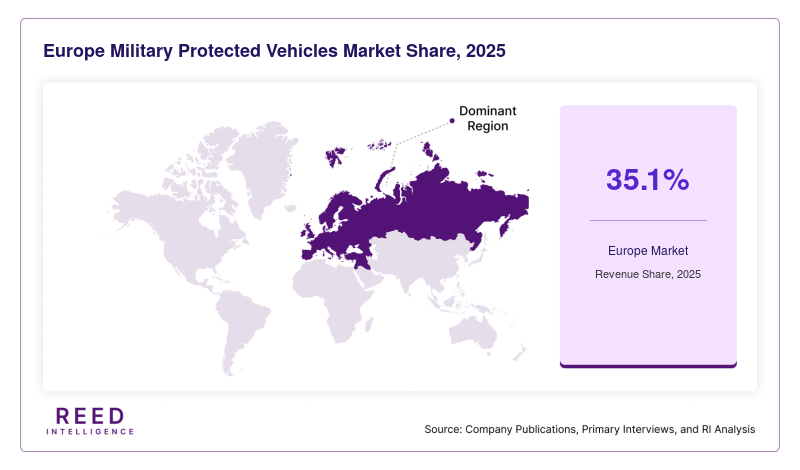
Europe is the dominant region in the military protected vehicles market, accounting for 35.1% of the global market share in 2024, according to The Insight Partners. The region's leading position is supported by extensive armored vehicle programs, military modernization, NATO-related capability requirements, and increasing emphasis on land-force readiness.
Europe is also experiencing substantial investment in protected mobility and armored vehicle capabilities. Recent procurement and production programs demonstrate continued demand: in June 2026, Rheinmetall announced a replacement order for 23 Bergepanzer 3 armored recovery vehicles for the German Bundeswehr, while Team Boxer UK delivered its 100th Boxer Mechanised Infantry Vehicle to the British Army.
Asia Pacific Military Protected Vehicles Market
Asia Pacific represents a major and rapidly expanding military protected vehicles market, supported by military modernization programs, territorial disputes, increasing defense expenditure, and domestic production capabilities. The region's military protected vehicles market was valued at US$10,931.5 million in 2024 and is projected to reach US$15,836.6 million by 2031, registering a 5.6% CAGR.
China, India, Japan, South Korea, and Australia are important contributors to regional demand. The region is also increasingly focused on modular armor, lightweight protection, advanced communications, automation, and multi-role vehicle architectures. Asia Pacific is expected to remain one of the fastest-growing regional markets, although its growth rate should not be substituted for the global 3.06% CAGR supplied for this report.
Latin America Military Protected Vehicles Market
Latin America represents a developing market for military protected vehicles, with demand influenced by internal security requirements, border protection, peacekeeping activities, counter-insurgency operations, and modernization of aging military fleets. Countries with established defense industries are increasingly seeking protected platforms that can provide mobility and personnel protection without the procurement costs associated with the heaviest armored systems.
The region provides opportunities for light and medium protected vehicles because these platforms can support diverse operational requirements across difficult terrain and internal security environments. A reliable comparable market-share percentage and CAGR for Latin America for 2026–2034 are not publicly verifiable on the same basis as the supplied global forecast.
Middle East & Africa Military Protected Vehicles Market
The Middle East & Africa region has sustained demand for protected vehicles because of regional security challenges, border conflicts, counterterrorism requirements, peacekeeping operations, and the need for protected mobility across harsh environments. Vehicle requirements vary from light patrol platforms to heavily protected combat and tactical vehicles.
Manufacturers are increasingly targeting the region with modular platforms that can be adapted for desert mobility, troop transport, reconnaissance, command, and force-protection missions. Local assembly and industrial partnerships can further support market development. A directly comparable global market share and CAGR for the region for 2026–2034 are not reliably verifiable.
Military Protected Vehicles Market Competitive Landscape
The military protected vehicles market is characterized by the presence of large global defense contractors, specialized armored vehicle manufacturers, military vehicle manufacturers, and regional defense companies. Competition is primarily based on protection capability, mobility, payload, survivability, technological integration, platform modularity, production capacity, lifecycle support, and the ability to meet country-specific military requirements.
BAE Systems is one of the major global defense companies involved in armored and protected vehicle systems. The company participates in military vehicle modernization programs and develops platforms integrating advanced protection, mobility, mission electronics, and survivability technologies. In May 2026, BAE Systems was awarded the U.S. Army's Soft Kill Active Protection System program of record for ground vehicles, supporting protection against threats including unmanned aerial systems and anti-tank guided missiles.
Key Market Players
- BAE Systems
- General Dynamics Corporation
- Lockheed Martin Corporation
- Oshkosh Corporation
- Rheinmetall AG
- IVECO Group
- Elbit Systems
- INKAS Armored Vehicle Manufacturing
- International Armored Group
- Krauss-Maffei Wegmann GmbH & Co. KG
- Lenco Industries
Recent Market Developments
-
January 2026: Oshkosh Defense announced that the Netherlands Ministry of Defence had placed an order valued at USD 25–30 million for additional Dutch Expeditionary Patrol Vehicles, known as Kaaiman. The vehicles are designed with an open systems approach to accommodate emerging technologies and mission systems.
-
May 2026: BAE Systems announced that it had been awarded the U.S. Army's Soft Kill Active Protection System program of record for combat vehicles. The program uses the company's ROOK system to counter threats including unmanned aerial systems and anti-tank guided missiles.
Military Protected Vehicles Market Segments
By Type
- Light
- Medium
- Heavy
By Application
- Defence
- Transportation
- Other
By Region
- North America
- Europe
- APAC
- Middle East and Africa
- LATAM