Military Radar Systems Industry Market Size, Share & Trends Analysis Report By Platform (Ground-Based, Naval, Airborne, Space-Based) and By Application (Air & Missile Defense, Intelligence, Surveillance & Reconnaissance, Navigation & Weapon Guidance, Space Situational Awareness, Other Applications) and By Region (North America, Europe, Asia Pacific, Latin America, Middle East & Africa) Forecasts, 2026–2034
USD 3950
Military Radar Systems Industry Market Size
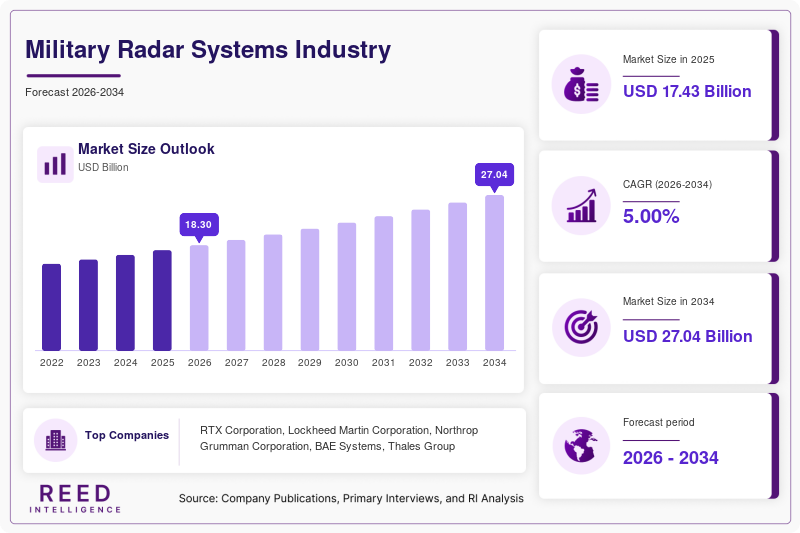
The global Military Radar Systems Industry Market size is projected to grow from USD 17.43 billion in 2026 to USD 25.75 billion by 2034, registering a CAGR of 5.00% during the forecast period from 2026 to 2034.
The global Military Radar Systems Industry Market is experiencing steady expansion as defense organizations increase investment in advanced detection and tracking capabilities. Radar systems remain fundamental to modern military operations because they enable forces to detect and monitor aircraft, missiles, ships, ground targets, drones, and other threats under challenging operating conditions.
The market includes ground-based, naval, airborne, and space-based radar platforms. Ground-based radar systems remain particularly important for integrated air defense, battlefield surveillance, early warning, and missile detection, while airborne radar systems provide advanced detection and tracking capabilities for fighter aircraft, airborne early warning platforms, and unmanned systems.
Military Radar Systems Industry Market Drivers
Increasing Military Modernization Programs
Military modernization programs are one of the major factors supporting demand for advanced radar systems. Armed forces are replacing legacy surveillance and tracking systems with digitally integrated radar architectures capable of supporting modern air defense, missile defense, maritime surveillance, battlefield management, and multi-domain operations.
Rising Geopolitical Tensions and Advanced Threats
Growing geopolitical tensions and the emergence of sophisticated threats are increasing demand for advanced detection and tracking systems. Hypersonic weapons, ballistic missiles, cruise missiles, stealth aircraft, drones, and electronic warfare systems are encouraging defense organizations to invest in radar technologies with improved sensitivity, speed, range, and resistance to interference.
Growing Demand for Integrated Air and Missile Defense
Integrated air and missile defense networks require multiple radar sensors operating together to detect, track, classify, and engage threats. Increasing investment in layered defense architectures is therefore creating sustained demand for surveillance, fire-control, early-warning, and multifunction radar systems.
Expansion of Unmanned Systems
The rapid expansion of military drones and autonomous platforms is increasing the need for radar systems capable of detecting small and difficult-to-track targets. Radar is increasingly being combined with electro-optical, infrared, electronic warfare, and other sensing technologies to improve counter-UAS and battlefield surveillance capabilities.
Military Radar Systems Industry Market Restraints
High Development and Procurement Costs
Advanced military radar systems require sophisticated antennas, transmitters, receivers, signal processors, cooling systems, software, electronic protection, and integration infrastructure. These requirements increase development and procurement costs and can limit adoption among countries with constrained defense budgets.
Complex System Integration
Military radar systems must often integrate with existing command-and-control, communication, weapon, electronic warfare, and sensor networks. Integration complexity can increase deployment timelines, testing requirements, cybersecurity risks, and lifecycle costs.
Electronic Warfare and Cybersecurity Challenges
Modern radar systems operate in increasingly contested electromagnetic environments. Jamming, spoofing, cyberattacks, and other electronic warfare techniques can reduce radar effectiveness, requiring continuous investment in electronic protection, frequency agility, adaptive processing, and cybersecurity.
Military Radar Systems Industry Market Opportunities
Development of AESA and GaN-Based Radar Systems
AESA radar technology provides opportunities to improve target detection, tracking, electronic protection, and multi-function performance. Gallium nitride technology can further improve power efficiency and radar performance, creating opportunities for next-generation systems.
AI-Enabled Radar Processing
Artificial intelligence and machine learning can improve target classification, anomaly detection, clutter rejection, and automated threat assessment. Integration of AI with radar processing can support faster decision-making and improve performance against complex and low-observable targets.
Counter-Drone Radar Systems
The proliferation of military and commercial drones is creating significant demand for specialized counter-UAS radar systems. These systems require high-resolution detection and tracking of small targets and can be integrated with electronic warfare and kinetic interception systems.
Space-Based Radar Capabilities
Space-based radar systems offer opportunities for persistent surveillance and wide-area monitoring. Advances in satellite technology, synthetic aperture radar, and distributed sensing are expanding the potential role of space-based systems in military intelligence and situational awareness.
Military Radar Systems Industry Market Segmental Analysis
By Platform
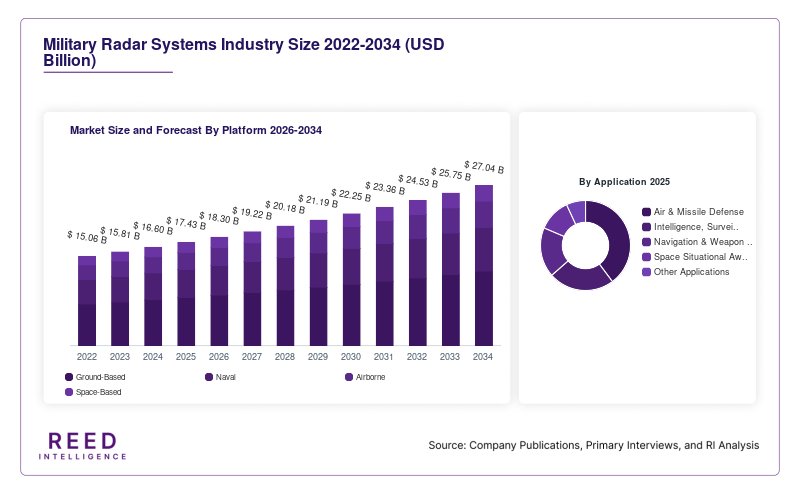
Ground-based radar systems are the dominant platform segment, accounting for approximately 39.7% of the military radars market in 2025, according to IMARC. Their dominance is supported by widespread deployment in integrated air defense systems, battlefield surveillance, border monitoring, early warning, and missile defense.
Airborne radar systems are expected to be among the fastest-growing platform segments, supported by increasing demand for advanced fighter aircraft, airborne early warning systems, unmanned platforms, and next-generation surveillance capabilities. Mordor Intelligence projects airborne military radar applications to grow at approximately 6.15% CAGR through 2031 in its comparable market assessment.
By Application
Air and missile defense represents a dominant application area because radar systems are essential for detecting, tracking, classifying, and supporting engagement of aircraft, missiles, drones, and other airborne threats. Increasing deployment of layered defense networks is expected to sustain demand throughout the forecast period.
Counter-UAS and advanced surveillance applications are expected to experience strong growth as military forces increasingly require radar systems capable of detecting small, low-observable, and maneuverable targets. However, an exact comparable global application CAGR for the 2026–2034 period is not reliably verifiable.
Military Radar Systems Industry Market Regional Analysis
North America Military Radar Systems Industry Market
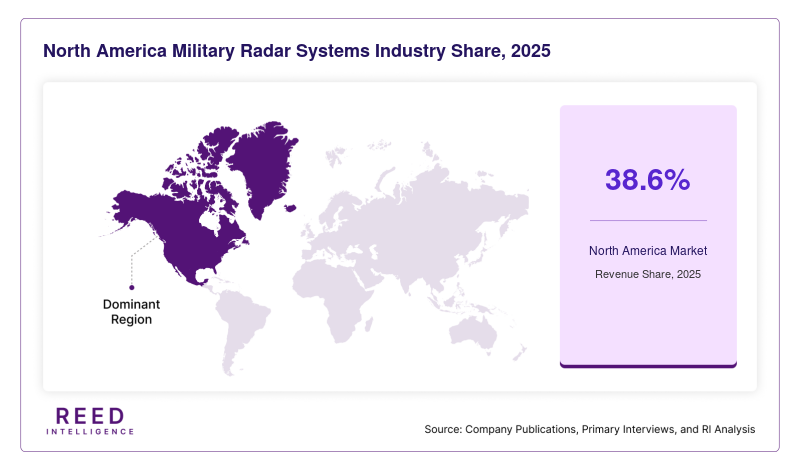
North America is the dominant region in the Military Radar Systems Industry Market, accounting for 38.6% of the global market share in 2025, according to Straits Research. The region's leadership is primarily supported by the United States' large defense budget, extensive radar modernization programs, advanced defense-industrial ecosystem, and deployment of sophisticated air and missile defense systems.
The United States remains the principal market in the region, supported by programs covering air defense, missile warning, naval radar, airborne surveillance, and battlefield sensing. Continued investment in multifunction AESA radar, integrated air and missile defense, counter-UAS capabilities, and network-centric warfare is expected to sustain regional demand. North America's exact CAGR on the same 2026–2034 market-size basis is not separately verifiable.
Europe Military Radar Systems Industry Market
Europe represents a major Military Radar Systems Industry Market, supported by defense modernization, NATO capability requirements, increased emphasis on integrated air and missile defense, and growing demand for sovereign defense technologies. Countries including Germany, France, the United Kingdom, Italy, and Sweden are investing in advanced radar and sensor capabilities.
European demand is also being strengthened by modernization of air defense and naval platforms. HENSOLDT reported that its Sensors segment order intake increased 57.6% in the first half of 2026, driven partly by orders for Eurofighter Mk1 radars and additional TRML-4D radar orders. A directly comparable European market-share percentage and 2026–2034 CAGR are not reliably verifiable on the same basis as the supplied global forecast.
Asia Pacific Military Radar Systems Industry Market
Asia Pacific is a major and fastest-growing regional market for military radar systems. Growth is being supported by increasing defense expenditure, military modernization, territorial disputes, development of indigenous radar technologies, and rising demand for airborne and naval surveillance. Research and Markets identifies Asia Pacific as the fastest-growing region, with a reported 6.86% CAGR in its comparable military radars market assessment.
China, India, Japan, South Korea, and Australia are key contributors to regional demand. Increasing investment in AESA radar, integrated air defense, naval surveillance, airborne early warning, and counter-drone capabilities is expected to create substantial opportunities. The regional growth rate cited above relates to a different forecast period and therefore is not substituted for the global 5.00% CAGR in this report.
Latin America Military Radar Systems Industry Market
Latin America represents a developing Military Radar Systems Industry Market, with demand driven by border surveillance, airspace monitoring, maritime security, counter-narcotics operations, and modernization of defense infrastructure. Countries in the region are increasingly seeking radar systems capable of improving situational awareness and monitoring large geographic areas.
The adoption of mobile ground-based radar and integrated surveillance networks is expected to create opportunities for international radar manufacturers. However, a directly comparable regional market share and CAGR for 2026–2034 are not reliably verifiable on the same basis as the supplied global forecast.
Middle East & Africa Military Radar Systems Industry Market
The Middle East & Africa region represents an important opportunity for military radar system suppliers because of high requirements for air defense, missile detection, border surveillance, maritime monitoring, and protection of strategic infrastructure. Countries in the region continue to invest in advanced surveillance and integrated air defense capabilities.
Demand is particularly influenced by regional security concerns, ballistic missile threats, drone proliferation, and modernization of military infrastructure. Foreign military sales and technology partnerships remain important procurement mechanisms. A directly comparable regional market share and CAGR for 2026–2034 are not reliably verifiable.
Military Radar Systems Industry Market Competitive Landscape
The Military Radar Systems Industry Market is characterized by competition among large defense contractors, specialized radar manufacturers, aerospace companies, and defense electronics suppliers. Companies compete based on detection performance, range, resolution, electronic protection, multi-function capability, AESA technology, software integration, platform compatibility, lifecycle support, and the ability to meet country-specific military requirements.
RTX, through Raytheon, is a leading military radar supplier with capabilities spanning naval, land-based, air defense, surveillance, and missile-defense radar systems. The company's SPY-6 and LTAMDS programs demonstrate its focus on next-generation multifunction radar architectures. In June 2026, Raytheon received a $515 million U.S. Navy contract for the SPY-6 family of radars.
Key Market Players
- RTX Corporation
- Lockheed Martin Corporation
- Northrop Grumman Corporation
- BAE Systems
- Thales Group
- Leonardo S.p.A.
- HENSOLDT AG
- Saab AB
- Raytheon Technologies Corporation
- L3Harris Technologies
Military Radar Systems Industry Market Recent Developments
- May 2026: Raytheon, an RTX business, received an order for 120 SharpSight radars from Blue Raven, representing the largest single order for the system to date. The multi-domain surveillance radar is designed for manned and unmanned platforms and supports missions including anti-surface warfare, border protection, coastal monitoring, and long-range surveillance.
- July 2026: HENSOLDT reported that its Sensors segment order intake increased 57.6% in the first half of 2026, with further orders for TRML-4D radars and contracts related to Eurofighter Mk1 radar programs contributing to growth.
Military Radar Systems Industry Segments
By Platform
- Ground-Based
- Naval
- Airborne
- Space-Based
By Application
- Air & Missile Defense
- Intelligence, Surveillance & Reconnaissance
- Navigation & Weapon Guidance
- Space Situational Awareness
- Other Applications
By Region
- North America
- Europe
- APAC
- Middle East and Africa
- LATAM