Military Radars Market Size, Share & Trends Analysis Report By Platform (Ground-Based, Naval, Airborne, Space-Based) and By Application (Air & Missile Defense, Intelligence, Surveillance & Reconnaissance, Navigation & Weapon Guidance, Space Situational Awareness, Other Applications) and By Region (North America, Europe, Asia Pacific, Latin America, Middle East & Africa) Forecasts, 2026–2034
USD 3950
Military Radars Market Size
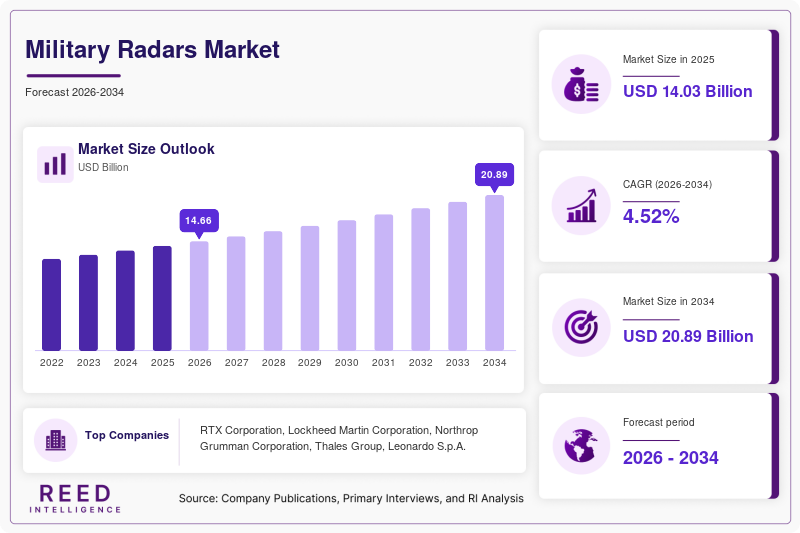
The global Military Radars Market size is projected to grow from USD 14.66 billion in 2026 to USD 20.89 billion by 2034, registering a CAGR of 4.52% during the forecast period from 2026 to 2034. The market was valued at USD 14.03 billion in 2025.
Military radars are critical sensing systems used by armed forces to detect, identify, track, classify, and monitor aircraft, missiles, ships, unmanned systems, and other threats. Modern military radar architectures increasingly combine electronically scanned arrays, digital signal processing, software-defined functionality, artificial intelligence, electronic protection, and multi-sensor data fusion to improve situational awareness and response times.
The market is being shaped by increasing defense modernization, growing geopolitical tensions, counter-drone requirements, missile-defense programs, maritime surveillance requirements, and the need to replace aging radar infrastructure. Multi-function AESA radars and modular architectures are gaining importance because they can perform several missions while allowing software and hardware upgrades without complete system replacement.
Military Radars Market Drivers
Governments are accelerating modernization of air-defense, missile-defense, naval surveillance, and battlefield sensing capabilities. Military organizations are replacing legacy radar systems with AESA, GaN-enabled, software-defined, and multi-function platforms capable of addressing increasingly complex aerial and missile threats.
Growing geopolitical tensions and regional security concerns are encouraging countries to expand surveillance coverage and strengthen early-warning networks. Radar procurement is increasingly focused on detecting low-observable aircraft, cruise missiles, hypersonic threats, unmanned aerial systems, and other emerging threats.
Integrated air and missile defense networks require interconnected radar sensors capable of providing continuous target detection and tracking. The increasing deployment of layered defense architectures is therefore generating demand for long-range surveillance, fire-control, multifunction, and missile-warning radar systems.
The rapid proliferation of drones has increased demand for radars capable of detecting small, low-altitude, and low-speed targets. Military organizations are integrating radar with electronic warfare, command-and-control, and interceptor systems to create layered counter-UAS solutions. Recent U.S. military testing has further demonstrated the growing operational importance of radar-enabled counter-drone systems.
Military Radars Market Restraints
Advanced military radar systems require substantial investments in antennas, transmitters, receivers, processors, cooling systems, software, testing infrastructure, and integration. High acquisition and maintenance costs can restrict procurement among countries with constrained defense budgets.
Military radars increasingly need to integrate with command-and-control systems, missiles, aircraft, naval combat systems, satellites, electronic warfare systems, and other sensors. Integration complexity can increase development time, testing requirements, cybersecurity exposure, and lifecycle costs.
Radar technologies frequently involve sensitive defense capabilities and are subject to export controls, security restrictions, and government approval procedures. These restrictions can limit international market access and complicate multinational radar programs.
Military Radars Market Opportunities
Artificial intelligence and machine learning can improve target classification, clutter suppression, anomaly detection, and sensor fusion. AI-enabled signal processing is expected to create opportunities for radar manufacturers to provide higher detection accuracy and faster decision support.
Open architectures allow militaries to upgrade processors, waveforms, software, and other capabilities without replacing complete radar systems. This approach can reduce lifecycle costs while accelerating the introduction of new capabilities.
Increasing demand for persistent surveillance and missile-warning capabilities is encouraging investment in space-based sensing. Space-based radar architectures can provide wider geographic coverage and support strategic intelligence and early-warning missions.
Asia Pacific represents an important expansion opportunity as countries increase defense expenditure and modernize air-defense, naval surveillance, and border-monitoring capabilities. The region is identified as the fastest-growing regional market by several industry sources.
Military Radars Market Segmental Analysis
By Platform
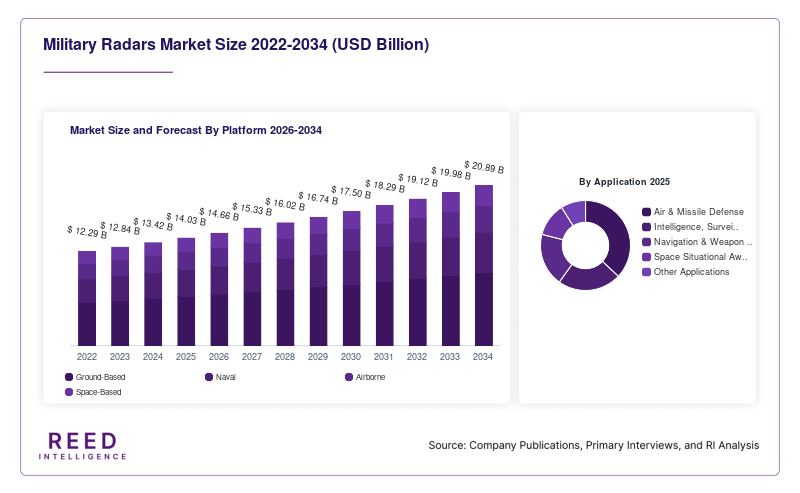
Ground-Based radar systems represent the dominant platform segment, accounting for approximately 39.7% of the global military radars market in 2025 according to IMARC. Their dominance is supported by widespread deployment in integrated air-defense systems, early-warning networks, border surveillance, battlefield monitoring, counter-UAS operations, and missile-defense architectures. Ground-based radar also benefits from continuous modernization involving phased-array antennas, digital processing, and software-defined architectures.
Naval radars support maritime surveillance, surface search, air-defense, missile tracking, and fire-control missions. Modern naval vessels increasingly require multifunction radar architectures capable of simultaneously tracking multiple aerial and surface threats.
Airborne radar systems are used on fighter aircraft, airborne early-warning platforms, maritime patrol aircraft, and other special-mission aircraft. Airborne platforms are the fastest-growing platform segment, with Mordor Intelligence estimating approximately 6.15% CAGR through 2031. Growth is supported by demand for AESA radars, electronic warfare capabilities, advanced target tracking, and multi-mission airborne sensing.
Space-Based radar applications are developing around strategic surveillance, missile warning, intelligence, and persistent monitoring. Their growth is supported by increasing interest in space-domain awareness and distributed sensing architectures, although deployment remains constrained by high development and launch costs.
By Application
Air & Missile Defense is a leading application area because radar remains a fundamental sensor within layered defense architectures. Demand is increasing for systems capable of detecting aircraft, cruise missiles, ballistic missiles, hypersonic targets, and unmanned systems.
Intelligence, Surveillance & Reconnaissance applications require persistent detection and tracking over large geographic areas. Military forces are increasingly combining radar information with electro-optical, infrared, electronic intelligence, and satellite-derived information.
Navigation & Weapon Guidance radar applications support target engagement, precision tracking, aircraft navigation, maritime operations, and fire-control functions. The shift toward multifunction radar systems is increasing the ability of individual platforms to support several missions.
Space Situational Awareness is gaining importance as military organizations seek to monitor satellites, debris, and other objects in increasingly congested orbital environments.
Other Applications include counter-battery operations, counter-UAS missions, ground surveillance, border monitoring, and specialized battlefield sensing.
Military Radars Market Regional Analysis
North America Military Radars Market
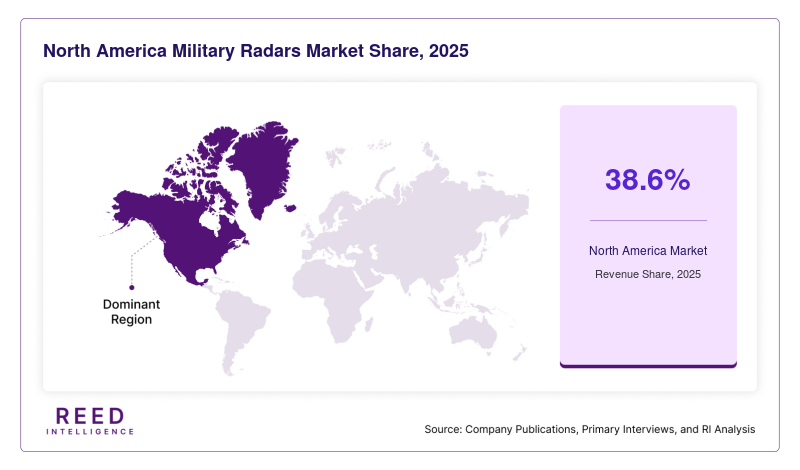
North America is the dominant regional market, accounting for 38.6% of the global military radars market in 2025. The region's leadership is supported by high defense expenditure, extensive military modernization programs, large-scale missile-defense investments, and the presence of major radar manufacturers. The United States remains the principal demand center because of procurement programs spanning land-based air defense, naval SPY-series radars, airborne systems, and strategic missile-warning infrastructure.
The region is also a major center for advanced radar R&D, including AESA, GaN-based systems, multifunction radar, software-defined architectures, and integrated sensor networks. Recent U.S. Navy awards for Raytheon's SPY-6 family demonstrate continued investment in advanced naval radar infrastructure.
Europe Military Radars Market
Europe represents a significant military radar market because NATO members are strengthening air-defense and surveillance capabilities. Increasing defense budgets, modernization of fighter aircraft, naval platforms, integrated air-defense networks, and missile-defense requirements are supporting procurement.
European manufacturers including Thales, Leonardo, HENSOLDT, Saab, BAE Systems, and Rheinmetall are developing and supplying radar systems for national and multinational programs. HENSOLDT reported substantial growth in radar-related demand during 2026, including additional TRML-4D and Eurofighter Mk1 radar orders.
Asia Pacific Military Radars Market
Asia Pacific is the fastest-growing regional market. Industry research identifies the region as the fastest-growing geography, driven by rising defense budgets, regional geopolitical tensions, naval modernization, border surveillance requirements, and demand for advanced air-defense systems.
Countries including China, India, Japan, South Korea, and Australia are strengthening radar capabilities across airborne, naval, ground-based, and strategic surveillance applications. The Asia Pacific military radar market is also experiencing increased procurement of phased-array systems and advanced surveillance technologies, with MarketsandMarkets estimating regional growth of 4.8% CAGR from 2024 to 2029 in its regional assessment.
Latin America Military Radars Market
Latin America represents a smaller but developing market for military radar systems. Demand is primarily connected with border surveillance, airspace monitoring, maritime security, counter-narcotics operations, and modernization of aging military infrastructure.
Countries are increasingly seeking mobile and cost-effective radar systems that can improve coverage across large territories. Opportunities are emerging for manufacturers offering modular ground-based systems, tactical surveillance radars, coastal monitoring systems, and counter-UAS solutions.
Middle East & Africa Military Radars Market
The Middle East & Africa market is supported by air-defense modernization, border protection, missile-defense requirements, and the need to monitor increasingly complex aerial threats. Gulf countries in particular continue to invest in advanced surveillance and integrated defense architectures.
Demand is also emerging for mobile radar systems, long-range surveillance radars, counter-UAS systems, and multifunction sensors. Procurement is increasingly focused on integrating radar with command-and-control and interceptor systems rather than deploying standalone radar assets.
Military Radars Market Competitive Landscape
The Military Radars Market is highly competitive, with major defense contractors competing through radar performance, detection range, AESA technology, GaN-based electronics, software-defined architectures, electronic protection, sensor fusion, and long-term support capabilities. The competitive environment includes large U.S. defense contractors, European radar specialists, Israeli technology providers, and increasingly capable Asian manufacturers.
RTX Corporation, through Raytheon, is one of the industry's leading radar suppliers. Its portfolio includes advanced naval and air-defense radar technologies, with the SPY-6 family representing a major naval radar program. In June 2026, Raytheon received a $515 million U.S. Navy contract supporting the SPY-6 family, followed by a $1.8 billion contract extension in July 2026 for SPY-6 hardware production and sustainment.
Key Market Players
- RTX Corporation
- Lockheed Martin Corporation
- Northrop Grumman Corporation
- Thales Group
- Leonardo S.p.A.
- BAE Systems plc
- Saab AB
- HENSOLDT AG
- Israel Aerospace Industries
- Elbit Systems Ltd.
Military Radars Market Recent Developments
-
February 2026 Lockheed Martin: Lockheed Martin delivered the first Sentinel A4 radar from Low-Rate Initial Production Lot 2 to the U.S. Army and completed the first phase of Initial Operational Test and Evaluation, moving the program toward full-rate production.
-
March 2026 Lockheed Martin: Lockheed Martin completed the first live target-tracking exercise using the SPY-7 radar for Japan's Aegis System Equipped Vessel program.
Military Radars Market Segments
By Platform
- Ground-Based
- Naval
- Airborne
- Space-Based
By Application
- Air & Missile Defense
- Intelligence, Surveillance & Reconnaissance
- Navigation & Weapon Guidance
- Space Situational Awareness
- Other Applications
By Region
- North America
- Europe
- APAC
- Middle East and Africa
- LATAM