Military Rotary Electrical Collector Market Size, Share & Trends Analysis Report By Type (Through-Bore Rotary Electrical Collectors, Capsule Rotary Electrical Collectors, Pancake Rotary Electrical Collectors) and By Application (Military Vehicles, Turret Systems) and By Region (North America, Europe, Asia Pacific, Latin America, Middle East & Africa) Forecasts, 2026–2034
USD 3950
Military Rotary Electrical Collector Market Size
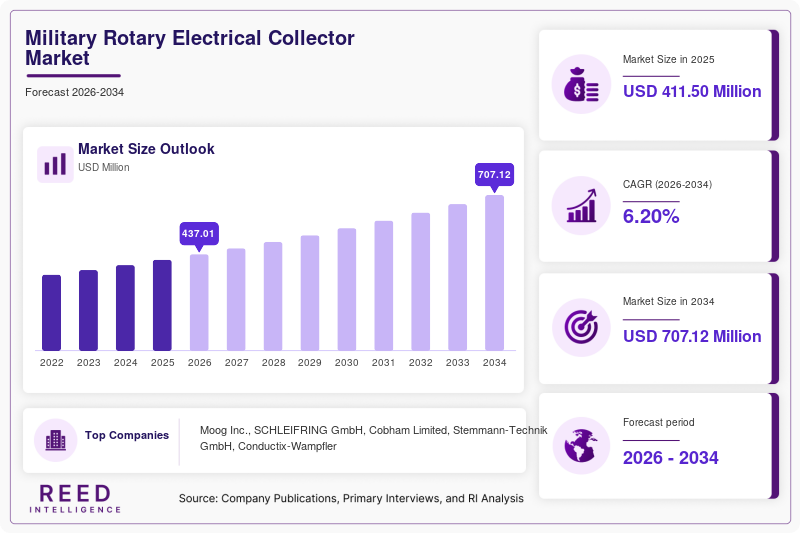
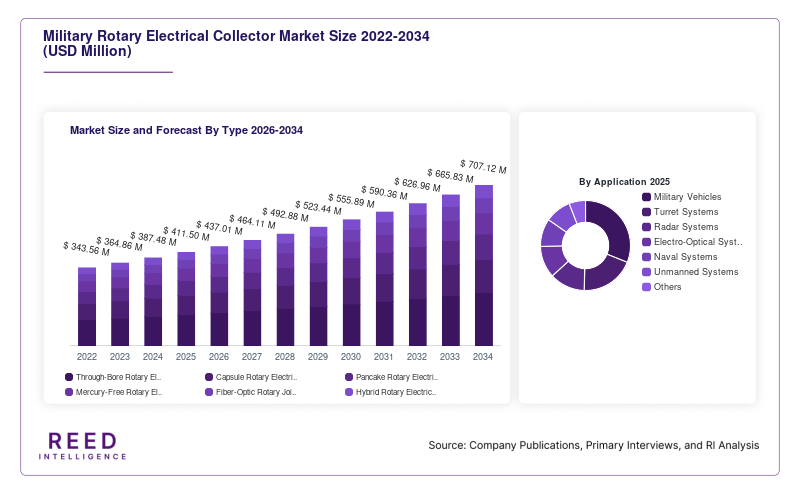
The global military rotary electrical collector market was valued at USD 411.50 million in 2025 and is projected to grow from USD 437.01 million in 2026 to USD 707.12 million by 2034, registering a CAGR of 6.20% during the forecast period from 2026 to 2034.
Military rotary electrical collectors provide electrical connectivity between stationary and rotating structures while allowing unrestricted rotation. They are essential in applications such as armored-vehicle turrets, remote weapon stations, radar antennas, electro-optical payloads, aircraft systems, naval equipment, and unmanned platforms.
The market is shifting toward higher-density, higher-bandwidth, compact, ruggedized, and customized rotary interfaces. Modern military systems increasingly combine power, electrical signals, RF channels, fiber-optic data, cooling, and other interfaces within limited installation spaces. SCHLEIFRING highlights the increasing need for more transmission technology, power, and faster data transmission within unchanged installation spaces, including its development of higher-density periscope slip-ring solutions.
Military Rotary Electrical Collector Market Drivers
Modern armored vehicles increasingly incorporate stabilized turrets, remote weapon stations, electro-optical sensors, targeting systems, and communications equipment. These systems require reliable rotary transmission of electrical power and data, creating recurring demand for rugged military rotary electrical collectors.
Ground-based, naval, airborne, and mobile radar systems require continuous rotation while maintaining uninterrupted transmission of power, control signals, RF signals, and data. The increasing sophistication of radar and sensor platforms is consequently supporting demand for higher-performance rotary electrical interfaces.
UAVs, UGVs, unmanned surface vessels, robotic systems, and remote weapon platforms increasingly use cameras, sensors, antennas, and rotating payloads. Compact rotary electrical collectors help these systems transmit power and signals without restricting mechanical movement.
Replacement of legacy military platforms and upgrades to existing tanks, armored vehicles, aircraft, naval systems, and radar installations are generating demand for new-generation rotary interfaces capable of supporting higher electrical loads and higher-speed communications.
Military Rotary Electrical Collector Market Restraints
Military rotary electrical collectors must withstand shock, vibration, temperature extremes, humidity, dust, electromagnetic interference, and other harsh operating conditions. Meeting defense qualification requirements increases engineering, testing, and production costs.
Military platforms frequently require application-specific dimensions, circuit configurations, power levels, data channels, sealing systems, and environmental protection. Extensive customization can increase development time and reduce economies of scale.
Military equipment programs typically involve lengthy qualification, testing, procurement, and integration cycles. Consequently, suppliers may face long periods between initial engineering engagement and large-scale production.
Military Rotary Electrical Collector Market Opportunities
Modern defense platforms increasingly require high-bandwidth video, sensor, radar, and communications data. Integration of fiber-optic rotary joints and high-speed electrical channels creates opportunities for advanced hybrid rotary electrical collectors.
Space-constrained military systems require more circuits and higher power/data capacity without significant increases in physical dimensions. Suppliers that can increase circuit density while maintaining reliability can capture higher-value applications.
The growth of autonomous ground vehicles, unmanned aircraft, naval drones, and robotic weapon platforms creates new applications for miniature and lightweight rotary electrical collectors.
Large fleets of legacy military equipment require replacement and refurbishment of electromechanical components. Sustainment programs can therefore provide recurring demand independent of new platform production.
Military Rotary Electrical Collector Market Segmental Analysis
By Type
Through-Bore Rotary Electrical Collectors are expected to represent the dominant type segment because they provide a practical architecture for transmitting electrical power and signals through rotating assemblies while accommodating mechanical structures, shafts, and integrated components. Their suitability for military vehicle turrets, radar systems, stabilized platforms, and other rotating assemblies supports broad adoption.
Hybrid Rotary Electrical Collectors are expected to be among the fastest-growing categories as modern defense platforms increasingly require simultaneous transmission of electrical power, high-speed data, RF signals, and other interfaces. SCHLEIFRING's defense solutions demonstrate this trend through hybrid assemblies combining power, data, fiber optics, RF channels, and other interfaces for radar and defense applications.
By Application
Military Vehicles and Turret Systems represent the dominant application group because armored vehicles, tanks, remote weapon stations, and stabilized turrets require continuous transmission between rotating turrets and stationary vehicle structures. Moog specifically identifies vehicular slip rings as critical interfaces for tanks, Bradley Fighting Vehicles, Stryker vehicles, light armored vehicles, artillery vehicles, missile launchers, and other military platforms.
Unmanned Systems are expected to be among the fastest-growing application areas as UAVs, unmanned ground vehicles, autonomous naval systems, and robotic platforms increasingly integrate rotating cameras, sensors, antennas, weapon systems, and payloads. Moog's miniature military slip-ring solutions specifically identify UAV applications, while SCHLEIFRING provides rotary solutions for airborne surveillance and remote weapon systems.
By Application Technology
Electrical Power and Signal Transmission remains the fundamental application technology because military rotary collectors must provide continuous connectivity between stationary and rotating assemblies. Modern systems increasingly combine power transmission with data, RF, and optical communication channels.
High-Speed Data and Hybrid Transmission is expected to be the fastest-growing technology direction. Increasing use of high-resolution electro-optical sensors, radar, video feeds, digital fire-control systems, and networked weapons requires significantly greater data-transfer capability. SCHLEIFRING reports fiber-optic rotary solutions supporting high data rates and defense applications requiring power, data, and video transmission.
Military Rotary Electrical Collector Market Regional Analysis
North America Military Rotary Electrical Collector Market
North America is expected to remain the dominant regional market, supported by high military expenditure, extensive defense-industrial capabilities, large armored-vehicle fleets, advanced aircraft programs, naval modernization, radar deployment, and increasing investment in unmanned systems. The region benefits from established rotary-interface suppliers and long-term relationships between component manufacturers and defense prime contractors.
The U.S. defense market provides substantial recurring demand through both new-platform procurement and sustainment programs. Moog supplies slip-ring solutions for military vehicles, aircraft, radar systems, remote weapon systems, and unmanned platforms. In July 2026, the U.S. Navy also issued a follow-on procurement for Moog slip-ring assemblies, demonstrating continuing defense sustainment demand.
Europe Military Rotary Electrical Collector Market
Europe represents a significant market because of modernization programs for armored vehicles, main battle tanks, radar systems, naval platforms, electro-optical systems, and remote weapon stations. Germany and other European defense manufacturing centers have established expertise in high-reliability rotary interfaces.
SCHLEIFRING's military rotary-joint technology is used in defense systems including Leopard 2 tank turrets and periscopes. Its current defense portfolio covers remote weapon stations, radar, airborne surveillance, naval systems, periscopes, and missile applications, demonstrating the region's strong technology base in military rotary interfaces.
Asia Pacific Military Rotary Electrical Collector Market
Asia Pacific is expected to register strong growth as countries increase defense modernization, indigenous weapons manufacturing, naval expansion, military radar deployment, and unmanned-system development. China, India, Japan, South Korea, and Australia are key markets for advanced defense electronics and rotating-platform technologies.
Growing regional investment in armored vehicles, naval systems, airborne surveillance, radar, and autonomous platforms is increasing the need for reliable power and data transmission across rotating assemblies. However, a verified comparable percentage of global market share and corresponding market value for this specific Military Rotary Electrical Collector dataset is not available, so no unsupported regional value is estimated.
Latin America Military Rotary Electrical Collector Market
Latin America represents a smaller but developing market for military rotary electrical collectors. Demand is associated with modernization of armored vehicles, surveillance systems, naval equipment, helicopters, and defense electronics. Countries seeking to extend the operational life of existing platforms also create opportunities for replacement rotary electrical interfaces.
The market is expected to benefit from modernization of defense equipment and increased adoption of stabilized electro-optical and surveillance systems. However, a directly comparable exact-market market-share percentage and regional CAGR are unavailable from sufficiently reliable sources.
Middle East & Africa Military Rotary Electrical Collector Market
The Middle East & Africa market is supported by military modernization, armored vehicle procurement, missile-defense investments, surveillance requirements, radar deployment, and increasing adoption of remote weapon systems. Harsh environmental conditions make ruggedized rotary electrical interfaces particularly important for regional defense applications.
Demand is increasingly moving toward high-reliability systems capable of operating under high temperatures, dust, vibration, and continuous-duty conditions. However, a verified exact-market global share percentage and compatible regional market value are unavailable and therefore are not estimated.

Military Rotary Electrical Collector Market Competitive Landscape
The Military Rotary Electrical Collector Market is characterized by specialized engineering requirements, long qualification cycles, high reliability standards, and close relationships between suppliers and defense-system integrators. Competition is focused on electrical reliability, mechanical durability, compact packaging, high-speed data transmission, environmental protection, customization, and integration of fiber-optic, RF, and fluid-transfer technologies.
Moog Inc. is a major supplier of military slip rings and rotary electrical interfaces. Its portfolio covers vehicular slip rings, miniature slip-ring capsules, aerospace and military systems, radar, remote weapons, unmanned vehicles, and other defense platforms. Moog states that its slip rings have been selected for multiple military vehicle programs, including M1/A2 and M60 tanks, Bradley Fighting Vehicles, Stryker, LAVs, and V150 vehicles.
Key Market Players
- Moog Inc.
- SCHLEIFRING GmbH
- Cobham Limited
- Stemmann-Technik GmbH
- Conductix-Wampfler
- Mersen
- DSTI (Dynamic Sealing Technologies, Inc.)
- United Equipment Accessories (UEA)
- Moflon Technology Co., Ltd.
- RUAG International
- Morgan Advanced Materials
Military Rotary Electrical Collector Market Recent Developments
- September 2026 Moog expands modular military turret integration for air-defense applications
Moog showcased its RIwP system integrated with the Boxer 8×8 vehicle at DVD 2026. The integration demonstrates growing demand for advanced rotating military platforms requiring reliable transmission of power, signals and data between stationary and rotating assemblies. - 2025–2026 U.S. Navy sustains demand for V-22 Osprey slip-ring assemblies
The U.S. Department of Defense awarded Moog approximately $28.9 million for a long-term contract to repair V-22 aircraft slip-ring assemblies. The contract demonstrates continued military demand for high-reliability rotary electrical transmission components used in aircraft systems.
Military Rotary Electrical Collector Market Segments
By Type
- Through-Bore Rotary Electrical Collectors
- Capsule Rotary Electrical Collectors
- Pancake Rotary Electrical Collectors
- Mercury-Free Rotary Electrical Collectors
- Fiber-Optic Rotary Joints
- Hybrid Rotary Electrical Collectors
By Application
- Military Vehicles
- Turret Systems
- Radar Systems
- Electro-Optical Systems
- Naval Systems
- Unmanned Systems
- Others
By Region
- North America
- Europe
- APAC
- Middle East and Africa
- LATAM