Military Shelter Market Size, Share & Trends Analysis Report By Type (Expandable, Personnel, Vehicle Mounted, Command Post, Container) and By Material (Composites, Metals) and By Application (Military, Humanitarian Aid) and By Region (North America, Europe, Asia Pacific, Latin America, Middle East & Africa) Forecasts, 2026–2034
USD 3950
Military Shelter Market Size
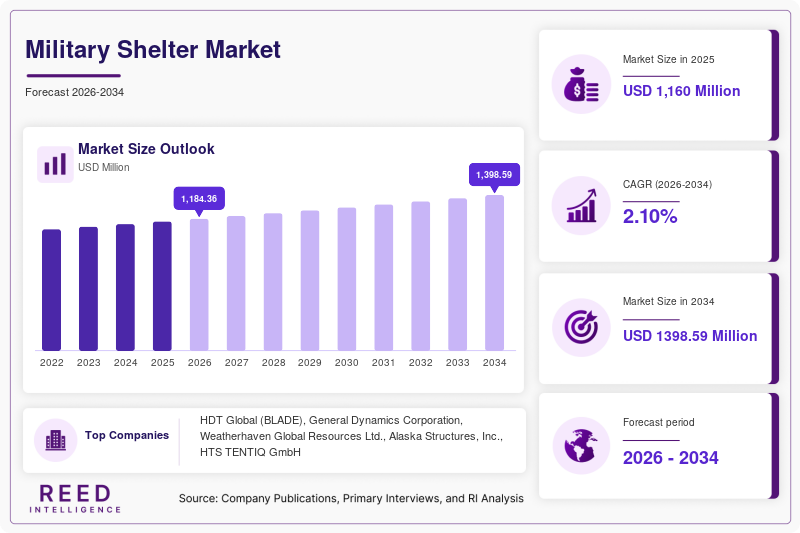
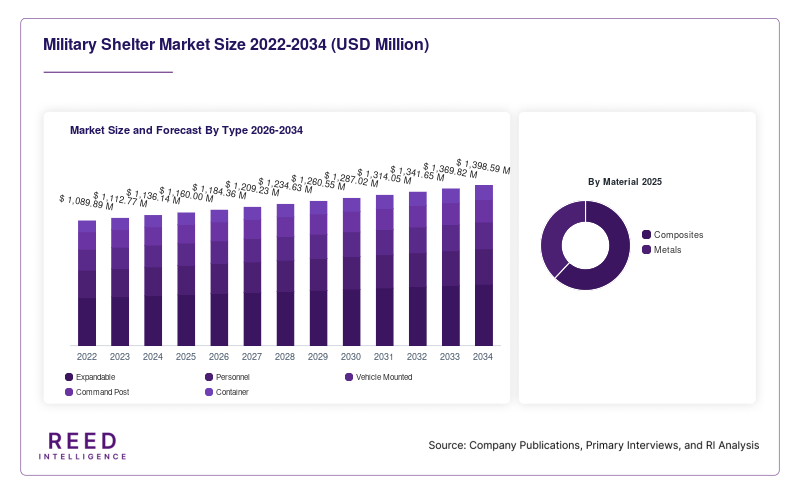
The global Military Shelter Market size is projected to grow from USD 1,184.36 million in 2026 to USD 1,398.59 million by 2034, registering a CAGR of 2.10% during the forecast period from 2026 to 2034. The market was valued at USD 1,160 million in 2025. These figures align with the supplied market estimates and the current published Military Shelter Market assessment.
Military shelters are specialized temporary or semi-permanent structures designed to provide accommodation, command and control, medical support, equipment protection, maintenance, storage, and operational infrastructure for military personnel in deployed and austere environments. They can be rapidly transported, assembled, expanded, and configured according to mission requirements.
Modern military shelter systems increasingly emphasize lightweight construction, modularity, energy efficiency, rapid deployment, environmental protection, and compatibility with communications, power-generation, heating, ventilation, and air-conditioning systems. The U.S. Army's Army Standard Family of Rigid Wall Shelters program, for example, emphasizes standardized, modular, energy-efficient shelters suitable for billeting, command posts, maintenance, medical facilities, and other missions.
Military Shelter Market Drivers
Defense forces are modernizing expeditionary infrastructure alongside weapons, vehicles, communications, and surveillance systems. Modern shelters provide rapidly deployable facilities for command, medical, maintenance, logistics, and personnel requirements, supporting multi-domain military operations.
Higher defense budgets in major military powers are supporting investment in deployable infrastructure. Countries are allocating resources not only to combat platforms but also to the logistics and support infrastructure required to sustain forces in remote and contested environments.
Military operations increasingly require forces to establish functional bases quickly. Expandable shelters, rigid-wall shelters, air-beam systems, and modular structures reduce setup time and can be transported between operational locations.
Military organizations frequently support disaster relief, humanitarian assistance, emergency medical operations, and evacuation missions. Shelters provide rapidly deployable infrastructure for field hospitals, accommodation, logistics, command centers, and emergency response.
Military Shelter Market Restraints
Advanced military shelters incorporate specialized fabrics, composite materials, structural systems, insulation, environmental-control equipment, electrical systems, and protection technologies. These features increase procurement and lifecycle costs compared with conventional temporary structures.
Large shelters can require specialized transportation and handling equipment. Weight, packed dimensions, deployment personnel requirements, and transportation infrastructure can affect the suitability of particular shelter systems for remote operations.
Military shelters may need to operate in extreme cold, heat, humidity, sandstorms, heavy rainfall, and high-wind conditions. Designing shelters that can withstand these environments while remaining lightweight and rapidly deployable increases engineering complexity.
Military Shelter Market Opportunities
Composite materials can reduce structural weight while maintaining durability and environmental resistance. Greater adoption of advanced composites creates opportunities for manufacturers to develop lighter shelters with improved transportation and deployment characteristics.
Energy-efficient insulation, climate-control systems, power-management technologies, and renewable-energy integration can reduce the logistical burden associated with operating temporary military bases.
Integration of communications, sensors, power management, environmental monitoring, cybersecurity systems, and battlefield networks can transform shelters into connected operational nodes.
Military modernization and heightened security requirements are supporting investments in deployable infrastructure across Asia Pacific and Europe. Fortune Business Insights identifies Asia Pacific as the largest regional market, while Europe is projected to experience strong growth during the forecast period.
Military Shelter Market Segmental Analysis
By Type
Command Post shelters represent the dominant type segment, accounting for approximately 29.74% of the global market in 2026 according to Fortune Business Insights. Their strong position is linked to the increasing requirement for rapidly deployable command, communications, coordination, and battlefield management infrastructure. Command-post shelters can accommodate communications equipment, operational personnel, computers, power systems, and other mission-critical assets.
Expandable shelters provide a flexible solution where transportation efficiency and rapid deployment are important. Their ability to increase usable floor space after deployment makes them suitable for command centers, medical facilities, accommodation, maintenance, and logistics.
Personnel shelters are designed primarily to provide accommodation and working areas for deployed military personnel. Their use remains important for temporary bases, training exercises, forward operating locations, and humanitarian operations.
Vehicle-mounted shelters combine shelter functionality with tactical mobility. They are particularly useful when communications, command, maintenance, medical, or technical functions must remain mobile.
Container shelters provide robust and standardized infrastructure that can be transported using established military and commercial logistics systems. They are suitable for equipment storage, technical operations, communications, and other applications requiring stronger structural protection.
By Material
Composites are increasingly important because manufacturers seek to reduce shelter weight while maintaining structural strength, insulation, durability, and environmental resistance. Lightweight materials can reduce transportation requirements and improve deployability.
Metals remain widely used for structural frames, rigid-wall systems, containers, connectors, and other load-bearing components. Metal-based shelters provide durability and structural rigidity and remain important for applications requiring enhanced protection.
By Application
Military applications dominate the market, representing approximately 75.88% of global market revenue in 2026 according to Fortune Business Insights. Military shelters are used for accommodation, command posts, medical operations, maintenance, logistics, communications, equipment protection, and forward operating bases.
Humanitarian Aid represents an important secondary application. Military shelter systems can be deployed during natural disasters, refugee crises, emergency medical missions, and other situations where permanent infrastructure is unavailable or damaged.
Military Shelter Market Regional Analysis
North America Military Shelter Market
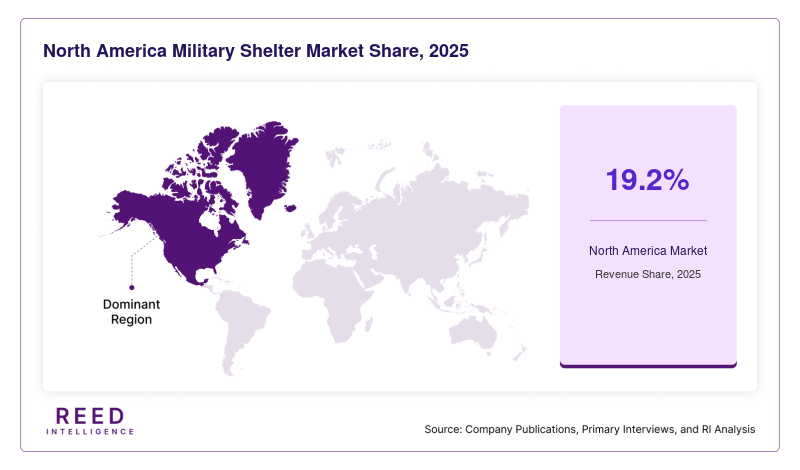
North America is a major Military Shelter Market, accounting for 19.20% of global market revenue in 2025. The United States represents the principal demand center, supported by extensive defense expenditure, expeditionary operations, military modernization, and continued development of standardized shelter infrastructure.
The region has a mature ecosystem of military shelter manufacturers and defense suppliers. The U.S. Department of Defense maintains established shelter procurement programs covering systems from companies including HDT, Alaska Structures, CAMSS Shelters, Celina Tent, Litefighter, Outdoor Venture, UTS Systems, and Weatherhaven.
Europe Military Shelter Market
Europe accounted for approximately 26.40% of the global Military Shelter Market in 2025, making it one of the largest regional markets. Demand is being supported by increased defense spending, NATO readiness requirements, border-security concerns, and the modernization of military infrastructure.
Europe is also expected to be one of the fastest-growing regional markets during the forecast period. The requirement for rapidly deployable military infrastructure is increasing as European defense organizations strengthen operational readiness and expeditionary capabilities.
Asia Pacific Military Shelter Market
Asia Pacific is the dominant regional market, accounting for 41.90% of the global Military Shelter Market in 2025. The region generated approximately USD 0.48 billion in market value during 2025, with demand supported by rising defense budgets in China, India, Japan, and South Korea.
Military modernization, border-security requirements, high-altitude operations, disaster-response capabilities, and increasing deployment of rapidly deployable bases are creating opportunities throughout the region. China, India, Japan, and South Korea are particularly important markets, with India alone projected to reach approximately USD 0.111 billion in 2026 according to Fortune Business Insights.
Latin America Military Shelter Market
Latin America represents a smaller but developing market for military shelter systems. Demand is associated with border operations, military training, disaster response, humanitarian missions, and temporary operational infrastructure.
Countries in the region can benefit from modular and rapidly deployable shelter systems that can support military exercises, emergency response, medical operations, and logistics in remote areas. Cost-effective lightweight shelters are likely to remain particularly attractive.
Middle East & Africa Military Shelter Market
The Middle East & Africa market is supported by defense modernization, military deployments, border surveillance, humanitarian operations, and requirements for infrastructure capable of functioning in hot, dry, and challenging environments.
The region offers opportunities for shelters with advanced insulation, climate control, dust protection, rapid deployment, and low-energy operation. Military and humanitarian organizations require flexible infrastructure capable of supporting personnel and equipment in locations where permanent facilities are unavailable.
Military Shelter Market Competitive Landscape
The Military Shelter Market is moderately fragmented and includes specialized military shelter manufacturers, defense contractors, expeditionary infrastructure suppliers, and companies specializing in tents, rigid-wall systems, modular structures, and deployable facilities. Competition is primarily based on rapid deployment, weight, durability, environmental performance, modularity, energy efficiency, transportability, and lifecycle cost.
HDT Global, now operating as BLADE, is one of the major suppliers of military shelter systems. The company has supplied the U.S. military with rigid-wall, rapidly deployable, and tactical shelter solutions. In April 2024, HDT announced a $432.605 million U.S. Army contract for the Army Standard Family of Rigid Wall Shelters Phase 1, covering 60 shelter variants.
Key Market Players
- HDT Global (BLADE)
- General Dynamics Corporation
- Weatherhaven Global Resources Ltd.
- Alaska Structures, Inc.
- HTS TENTIQ GmbH
- AAR Mobility Systems
- Losberger De Boer
- Marshall Aerospace and Defence Group
- UTS Systems LLC
- CAMSS Shelters
- Gichner Shelter Systems
- Outdoor Venture Corporation
Military Shelter Market Recent Developments
-
April 2024 – HDT Global: HDT Global announced a $432.605 million U.S. Army contract to supply Army Standard Family of Rigid Wall Shelters Phase 1. The program covers 60 individual shelter variants designed to improve operational energy efficiency, commonality, sustainability, and lifecycle economics.
-
December 2025 – U.S. Army: The Army published updated shelter guidance describing emergency shelter and preparedness requirements for Army personnel and installations, highlighting the continuing importance of deployable and emergency protection infrastructure.
Military Shelter Market Segments
By Type
- Expandable
- Personnel
- Vehicle Mounted
- Command Post
- Container
By Material
- Composites
- Metals
By Region
- North America
- Europe
- APAC
- Middle East and Africa
- LATAM