Military Slip Ring Market Size, Share & Trends Analysis Report By Type (Electro-Optic Slip Rings, Fiber Optic Slip Rings, Hybrid Slip Rings, Others) and By Application (Radar Systems, Weapon Systems, Armored Vehicles, UAVs) and By Material (Gold-to-Gold, Silver-to-Silver, Others) and By End User (Army, Navy, Air Force) and By Region (North America, Europe, Asia Pacific, Latin America, Middle East & Africa) and Forecasts 2026–2034
USD 3950
Military Slip Ring Market Size
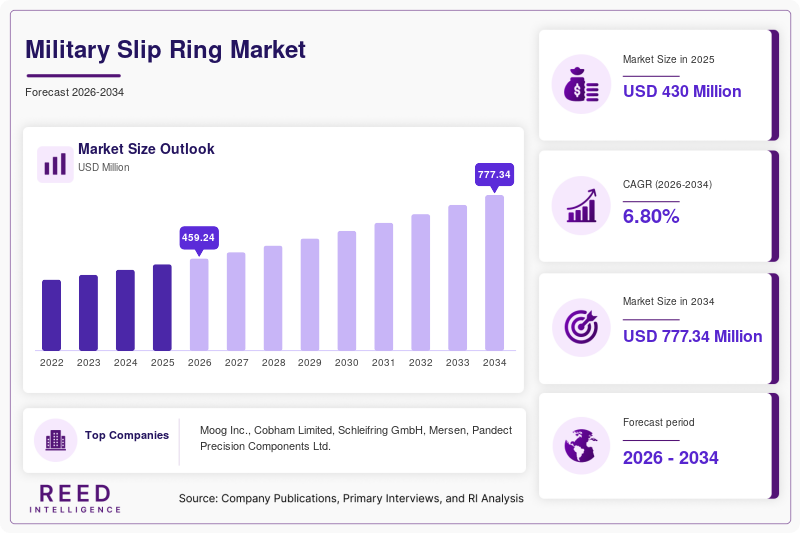
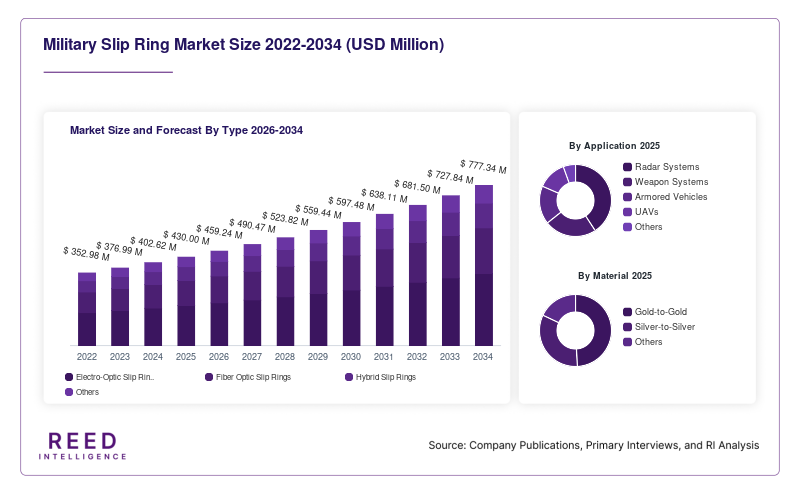
The global military slip ring market was valued at USD 430 million in 2025 and is projected to grow from USD 459.24 million in 2026 to USD 779.50 million by 2034, registering a CAGR of 6.80% during the forecast period from 2026 to 2034.
The Military Slip Ring Market represents a specialized segment of the defense electromechanical components industry. Military slip rings enable continuous transmission of electrical power and signals between stationary and rotating components without restricting mechanical rotation. Their applications include radar antennas, electro-optic systems, weapon stations, armored vehicle turrets, aircraft systems, naval equipment, UAVs, and surveillance platforms.
Modern defense systems are increasing the technical requirements placed on slip rings. High-bandwidth communications, electro-optic sensors, infrared systems, stabilized weapon stations, and digital control architectures require slip rings capable of transmitting larger quantities of power and data while maintaining signal integrity. Moog, for example, identifies applications spanning electro-optic systems, target acquisition, tank turrets, manned and unmanned vehicles, helicopter systems, and propeller de-icing systems.
Military Slip Ring Market Drivers
Defense modernization programs are increasing demand for advanced rotary electrical interfaces. New generations of radar systems, armored vehicles, missile systems, aircraft, naval platforms, and unmanned systems contain more electronic sensors and rotating subsystems than legacy platforms. Military slip rings provide the continuous power and data transmission required by these systems, supporting market expansion.
Modern military platforms increasingly depend on electro-optic and infrared sensors for surveillance, targeting, reconnaissance, and fire control. These systems require continuous transmission of high volumes of data and power through rotating axes. Moog notes that sophisticated gimbaled electro-optic systems have driven development of high-bandwidth slip rings, fiber-optic rotary joints, twist capsules, and multiplexing technologies.
The increasing deployment of UAVs, UGVs, autonomous vehicles, and remotely operated weapon platforms is generating additional demand for lightweight and reliable rotary interfaces. These systems require continuous electrical and data connections for sensors, cameras, communications equipment, propulsion-related components, and payloads.
Radar antennas and surveillance systems frequently require continuous rotation while maintaining electrical and data connections. The increasing deployment of advanced air-defense, battlefield surveillance, naval radar, and target-acquisition systems is therefore supporting demand for high-performance slip rings.
Military Slip Ring Market Restraints
Military slip rings must operate reliably under extreme vibration, shock, temperature, humidity, dust, electromagnetic interference, and other environmental conditions. Meeting defense qualification and certification requirements increases development costs and extends product-development cycles.
Military platforms frequently require application-specific slip-ring configurations. Dimensions, number of circuits, current capacity, signal type, rotational speed, environmental protection, and integration requirements can differ substantially between platforms. High customization can increase engineering costs and limit production economies of scale.
Traditional electrical slip rings rely on physical contacts that can experience wear over time. Brush replacement, contact degradation, electrical noise, and maintenance requirements can increase lifecycle costs, particularly in applications where equipment availability is critical.
Military Slip Ring Market Opportunities
Hybrid slip rings that combine electrical power transmission with fiber-optic rotary joints provide an opportunity to support increasingly data-intensive defense platforms. High-bandwidth electro-optic sensors, radar systems, and digital communications create demand for rotary interfaces capable of handling both power and high-speed data.
Autonomous military vehicles and robotic systems require compact and reliable interfaces for sensors, cameras, communications equipment, and rotating payloads. Increasing adoption of autonomous systems is therefore expected to create new application opportunities for specialized slip-ring manufacturers.
Space-constrained military platforms require smaller components with higher circuit density. Manufacturers developing miniature, lightweight, high-speed, and high-bandwidth slip rings can benefit from increasing requirements for compact defense electronics.
Military Slip Ring Market Segmental Analysis
By Type
Electro-Optic Slip Rings represented the dominant type segment, accounting for approximately 32.5% of the global market in 2025. Their leadership is associated with widespread use in electro-optic targeting, surveillance, infrared sensing, stabilized weapon stations, and other systems requiring continuous transmission of power and high-bandwidth data across rotating axes.
Hybrid Slip Rings are positioned among the fastest-growing product categories as defense platforms increasingly combine conventional power and signal transmission with fiber-optic data transmission. The exact comparable CAGR for the hybrid segment is not independently verified and is therefore not stated. The broader technology trend toward hybrid electrical and fiber-optic rotary interfaces is supported by increasing data requirements in electro-optic and radar systems.
By Application
Radar Systems represent a major application segment because radar antennas require continuous rotation while maintaining power, signal, and data connectivity. Slip rings are used in radar and surveillance systems where high reliability and uninterrupted transmission are essential. Schleifring specifically identifies radar and reconnaissance systems among safety and defense applications for its rotary transmission technologies.
UAVs represent one of the fastest-expanding application opportunities because unmanned aircraft increasingly incorporate stabilized electro-optic payloads, surveillance sensors, communications systems, and rotating assemblies. A precise market-wide CAGR for the UAV application segment is unavailable from sufficiently comparable public data and is therefore not estimated.
By Material
Gold-to-Gold contact systems represent the dominant material category due to their favorable electrical conductivity, contact reliability, and suitability for low-level signal transmission in precision applications. Gold-based contact systems are particularly relevant where signal integrity and stable electrical performance are critical.
Others, including advanced composite and specialized contact materials, offer growth opportunities as manufacturers seek improved wear resistance, reduced maintenance, extended operating life, and higher reliability. A reliable comparable CAGR for this segment is unavailable.
By End User
Army represents the dominant end-user segment, supported by extensive deployment of slip rings in armored vehicles, turret systems, stabilized weapon stations, target-acquisition systems, mobile missile launchers, and battlefield surveillance equipment. Moog identifies tanks, light armored vehicles, armored personnel carriers, artillery vehicles, command vehicles, and reconnaissance vehicles among applications for its vehicular slip-ring technologies.
Air Force represents a high-growth end-user opportunity because military aircraft, helicopters, UAVs, targeting pods, and electro-optic systems require high-performance rotary interfaces. Moog's aerospace and defense portfolio includes helicopter, propeller, electro-optic, and other aerospace slip-ring applications.
Military Slip Ring Market Regional Analysis
North America Military Slip Ring Market
North America is one of the most important military slip-ring markets because of the region's large defense-industrial base, advanced military electronics ecosystem, and sustained procurement of radar, aircraft, armored vehicles, naval systems, and unmanned platforms. The United States represents the primary demand center, supported by extensive deployment of high-performance military platforms requiring precision rotary interfaces.
The region also benefits from established suppliers such as Moog and long-standing relationships with defense primes and government agencies. A precise North American market-share percentage comparable with the supplied USD 430 million global dataset is not independently verified, so a regional market value is not derived. Recent U.S. Navy procurement activity further demonstrates continuing demand for military slip-ring components.
Europe Military Slip Ring Market
Europe represents a significant military slip-ring market supported by defense modernization, aerospace manufacturing, radar development, naval programs, and increasing investment in surveillance and autonomous systems. Germany, the United Kingdom, France, Italy, and other European countries maintain established defense and precision-engineering ecosystems.
European manufacturers such as Schleifring contribute to the region's specialized rotary-interface capabilities. Schleifring identifies radar systems and reconnaissance and surveillance systems as important safety and defense applications for its slip-ring technologies. The exact regional market share and market value for the military-only segment are unavailable from a sufficiently comparable source.
Asia Pacific Military Slip Ring Market
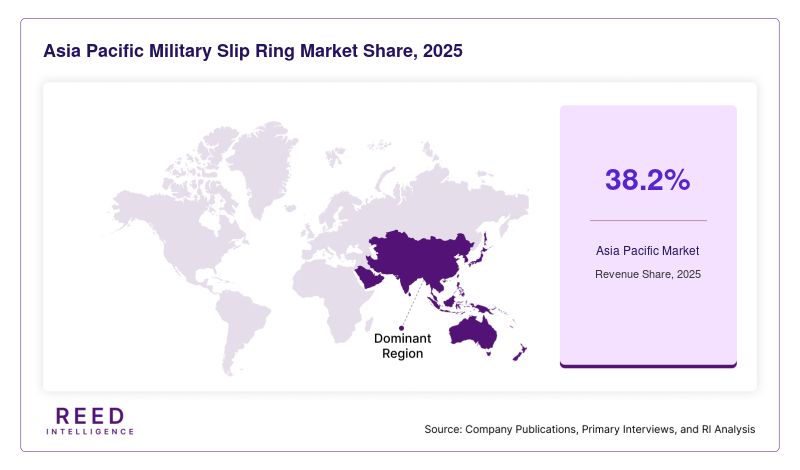
Asia Pacific is the dominant regional market, accounting for approximately 38.2% of global military slip-ring revenue in 2025, equivalent to about USD 164.3 million. The regional leadership is supported by defense modernization in China, India, Japan, South Korea, and other countries, together with increasing development of indigenous aircraft, naval platforms, radar systems, UAVs, and armored vehicles.
Asia Pacific is also expected to remain among the fastest-growing regional markets as governments increase domestic defense manufacturing and invest in advanced military electronics. India, China, Japan, and South Korea are particularly important markets because of expanding radar, aerospace, naval, and unmanned-system programs. The exact regional CAGR is not stated because a directly comparable public forecast was not verified.
Latin America Military Slip Ring Market
Latin America represents a smaller military slip-ring market, but demand is supported by modernization of military aircraft, naval systems, surveillance platforms, armored vehicles, and communications equipment. Countries with active defense modernization programs provide opportunities for specialized suppliers and distributors.
Growth is expected to remain focused on replacement, modernization, and upgrading of existing defense platforms rather than the large-scale procurement volumes observed in North America, Europe, or Asia Pacific. A precise regional market share, market value, and CAGR for the military slip-ring segment are unavailable from comparable verified datasets.
Middle East & Africa Military Slip Ring Market
The Middle East & Africa market is supported by defense modernization, surveillance requirements, air-defense systems, military aircraft, armored vehicles, and naval equipment. Demand for high-reliability rotary interfaces is expected to increase as regional militaries invest in advanced sensors, radar, electro-optic systems, and unmanned platforms.
Military Slip Ring Market Competitive Landscape
The global Military Slip Ring Market is characterized by a specialized competitive structure in which established suppliers compete through engineering expertise, defense certifications, customized product development, reliability, and long-term relationships with defense contractors. Moog Inc. is identified as the leading company, with approximately 18% global market share, followed by Cobham Limited at approximately 14% and Schleifring GmbH at approximately 11%.
Moog Inc. is a leading supplier of military and aerospace slip-ring technologies. Its portfolio includes electro-optic, vehicular, helicopter, propeller, and other specialized slip rings. The company supports applications ranging from tank turrets and armored vehicles to electro-optic targeting systems and unmanned platforms.
Key Market Players
- Moog Inc.
- Cobham Limited
- Schleifring GmbH
- Mersen
- Pandect Precision Components Ltd.
- Mercotac Inc.
- Rotac Co., Ltd.
- Electro-Miniatures Corporation
- Hangzhou Prosper Mechanical & Electrical Technology Co., Ltd.
- Jinpat Electronics Co., Ltd.
Military Slip Ring Market Recent Developments
- September 2026 Moog’s MR SLED Defense Platform Advances Army Modernization
Moog announced on September, 2026, that its MR SLED (Reconfigurable Self-Loading Equipment Dock) mission equipment package was nominated for the 2026 AUSA Best New Product/Service Award. The platform integrates multiple sensors, radars, weapons, electronic-warfare systems, and command-and-control equipment for Army air-defense and counter-UAS applications. The development is relevant to the military slip-ring market because Moog supplies ruggedized slip rings for rotating military vehicle and turret applications. - August 2026 U.S. Defense Logistics Agency Seeks Military Helicopter Slip Ring
On August, 2026, the U.S. Department of Defense's Defense Logistics Agency Aviation published a presolicitation for an NSN 1650-01-314-7849 special slip-ring rotor for the H-60/Seahawk helicopter. The requirement demonstrates continuing military demand for replacement and sustainment of specialized rotary electrical components used in defense aviation platforms.
Military Slip Ring Market Segments
By Type
- Electro-Optic Slip Rings
- Fiber Optic Slip Rings
- Hybrid Slip Rings
- Others
By Application
- Radar Systems
- Weapon Systems
- Armored Vehicles
- UAVs
- Others
By Material
- Gold-to-Gold
- Silver-to-Silver
- Others
By End User
- Army
- Navy
- Air Force
- Others
By Region
- North America
- Europe
- APAC
- Middle East and Africa
- LATAM