Military UAVs Market Size, Share & Trends Analysis Report By Type (Fixed-Wing, Rotary-Wing, Hybrid) and By Operation Mode (Remotely Piloted, Partially Autonomous, Fully Autonomous) and By Range (Visual Line of Sight, Beyond Visual Line of Sight) and By Application (Intelligence, Surveillance & Reconnaissance, Combat Operations, Target Acquisition, Electronic Warfare) Forecasts, 2026–2034
USD 3950
Military UAVs Market Size
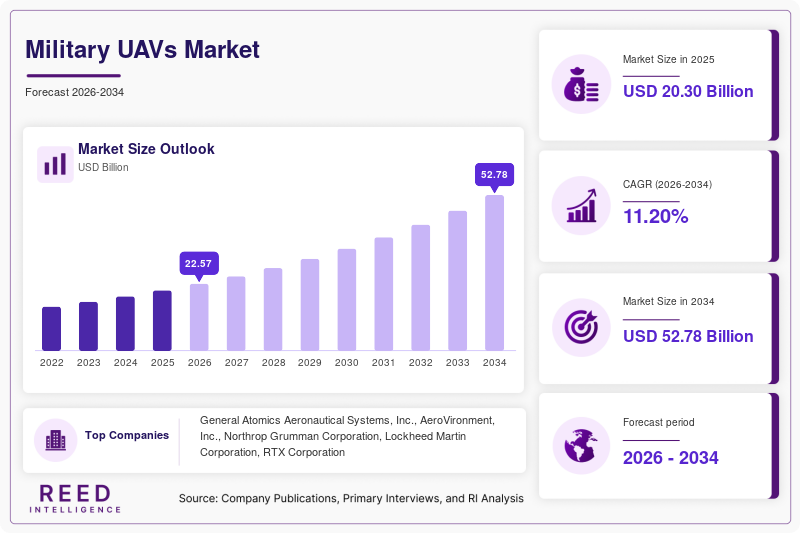
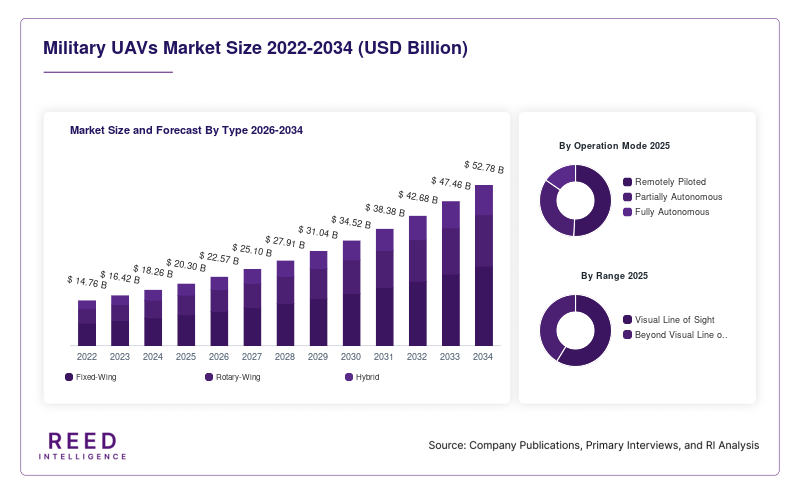
The global Military UAVs Market size is projected to grow from USD 22.57 billion in 2026 to USD 52.78 billion by 2034, registering a CAGR of 11.20% during the forecast period from 2026 to 2034. The market was valued at USD 20.30 billion in 2025.
Military unmanned aerial vehicles (UAVs) are remotely operated, partially autonomous, or fully autonomous aircraft used for intelligence, surveillance, reconnaissance, target acquisition, combat, communications, electronic warfare, logistics, and other defense missions. Their ability to provide persistent coverage while reducing direct risks to military personnel has made UAVs an increasingly important component of modern defense architectures.
The market is moving beyond conventional remotely piloted surveillance platforms toward autonomous, networked, multi-mission systems. Artificial intelligence, machine learning, advanced sensors, satellite communications, secure data links, autonomous navigation, swarming, and collaborative combat capabilities are becoming increasingly important in military UAV development.
Military UAVs Market Drivers
Growing defense budgets are enabling governments to procure larger numbers of UAVs for surveillance, reconnaissance, precision strike, border monitoring, and tactical battlefield operations. UAVs provide militaries with scalable capabilities without requiring the same level of investment associated with conventional crewed aircraft.
Persistent ISR remains one of the most important military UAV missions. Long-endurance UAVs can monitor large geographic areas for extended periods while transmitting intelligence to command centers and deployed forces in near real time.
Artificial intelligence and autonomous flight technologies are transforming UAV operations. Autonomous navigation, target recognition, collaborative mission planning, and automated decision-support capabilities are enabling UAVs to perform increasingly complex missions with reduced operator workload.
Military organizations are developing uncrewed aircraft capable of operating alongside crewed fighter aircraft. The U.S. Air Force's Collaborative Combat Aircraft program is a major example, with General Atomics and Anduril receiving production contracts in 2026 for the first fleet of semi-autonomous combat aircraft.
Military UAVs Market Restraints
Advanced military UAVs require sophisticated airframes, propulsion, sensors, communications, autonomous software, electronic-warfare protection, satellite links, and ground-control infrastructure. These requirements can substantially increase acquisition and lifecycle costs.
Military UAVs depend heavily on communication, navigation, and data links. Electronic jamming, spoofing, cyberattacks, and other forms of electronic warfare can disrupt UAV operations and reduce mission effectiveness.
Military UAV operations require secure airspace management, communications coordination, and appropriate operating procedures. Increasing UAV activity also creates challenges related to identification, deconfliction, and integration with conventional aircraft.
Advanced UAV production requires specialized semiconductors, sensors, propulsion systems, batteries, composite materials, communication components, and precision manufacturing capabilities. Supply-chain disruptions can affect production schedules and deployment timelines.
Military UAVs Market Opportunities
AI offers substantial opportunities for autonomous navigation, target classification, mission planning, threat detection, swarm coordination, and adaptive operations. These capabilities can increase mission effectiveness while reducing operator workload.
Swarming allows multiple UAVs to operate as coordinated groups. Distributed UAV formations can provide surveillance, deception, electronic warfare, targeting, and strike capabilities while complicating adversary defenses.
The proliferation of military UAVs is simultaneously increasing demand for systems capable of detecting and defeating hostile drones. This creates opportunities for manufacturers offering integrated UAV and counter-UAS technologies.
Naval forces are increasingly using UAVs for maritime surveillance, anti-submarine warfare support, communications relay, shipborne reconnaissance, and long-range intelligence. General Atomics' MQ-9B SeaGuardian development demonstrates the expanding role of UAVs in maritime missions.
Military UAVs Market Segmental Analysis
By Type
Fixed-Wing UAVs are the dominant type segment, accounting for approximately 66% of the global military drone market in 2025 according to Grand View Research. Their dominance is supported by superior endurance, range, payload capacity, and suitability for persistent ISR missions. Fixed-wing platforms are extensively deployed for border surveillance, battlefield intelligence, maritime patrol, communications relay, and long-range reconnaissance.
Rotary-Wing UAVs provide vertical takeoff and landing capabilities and can operate from confined environments, ships, forward operating bases, and urban locations. Their hovering capability makes them particularly useful for tactical reconnaissance and localized surveillance.
Hybrid UAVs combine characteristics of fixed-wing and rotary-wing platforms. Their vertical takeoff and landing capabilities combined with efficient forward flight make them attractive for missions where runway independence and longer endurance are both required. Hybrid systems represent the fastest-growing type category in several current military-drone assessments.
By Operation Mode
Remotely Piloted UAVs remain the dominant operating mode because most deployed military UAVs continue to depend on human operators for mission planning, navigation, target engagement, and operational decision-making. Mature systems such as the MQ-9 family demonstrate the continuing importance of remotely piloted architectures.
Partially Autonomous UAVs are increasingly adopted as militaries introduce automated navigation, obstacle avoidance, sensor management, and mission execution while retaining human oversight.
Fully Autonomous UAVs represent an emerging high-growth category. Advances in artificial intelligence, machine learning, onboard computing, and collaborative autonomy are enabling systems to perform increasingly complex tasks with reduced direct operator control.
By Range
Beyond Visual Line of Sight (BVLOS) UAVs represent the dominant range category for advanced military operations because they can support long-range surveillance, strategic reconnaissance, maritime patrol, and extended battlefield missions. Satellite communications and secure long-range data links are essential to these operations.
Visual Line of Sight (VLOS) systems remain important for tactical missions where operators require direct control and immediate visual awareness. Small reconnaissance UAVs and short-range tactical systems frequently operate within this range.
By Application
Intelligence, Surveillance & Reconnaissance (ISR) represents the dominant application segment. Military UAVs provide persistent surveillance and intelligence collection while carrying electro-optical, infrared, radar, signals-intelligence, and other sensor payloads. Grand View Research identifies ISR as the largest military drone application segment.
Combat Operations are rapidly expanding as UAVs increasingly incorporate precision weapons, loitering capabilities, autonomous targeting, and collaborative combat functions.
Target Acquisition applications use UAV sensors to identify, track, classify, and designate targets for artillery, missiles, aircraft, and other weapon systems.
Electronic Warfare UAVs are increasingly being developed to conduct electronic intelligence, communications disruption, deception, and electromagnetic-spectrum operations.
Other Applications include communications relay, logistics, battle-damage assessment, maritime surveillance, search and rescue, and specialized tactical missions.
Military UAVs Market Regional Analysis
North America Military UAVs Market
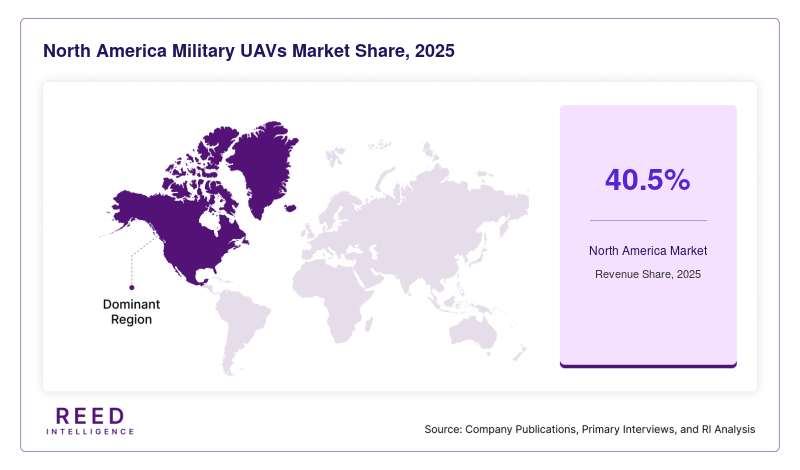
North America is the dominant regional market, accounting for approximately 40.49% of the global military drone market in 2025 according to Fortune Business Insights. The region's leadership is supported by high U.S. defense expenditure, extensive UAV procurement programs, advanced aerospace and defense infrastructure, and significant investment in autonomous systems.
The United States remains the principal regional market, with major programs spanning MQ-9 systems, tactical UAVs, loitering systems, autonomous aircraft, carrier-based UAVs, and Collaborative Combat Aircraft. Boeing received a U.S. Navy contract in September 2026 for three additional MQ-25A Stingray aircraft, bringing the total under contract to 14 aircraft.
Europe Military UAVs Market
Europe represents a significant and increasingly important military UAV market as NATO members increase defense spending and seek greater intelligence, surveillance, reconnaissance, and autonomous warfare capabilities. European militaries are also emphasizing domestic and multinational UAV development to strengthen strategic autonomy.
European demand spans tactical reconnaissance UAVs, MALE systems, loitering munitions, maritime UAVs, and autonomous aircraft. AeroVironment announced in July 2026 that Germany's Bundeswehr had selected its Puma UAS family for the LARUS airborne reconnaissance program under a NATO Support and Procurement Agency framework.
Asia Pacific Military UAVs Market
Asia Pacific is the fastest-growing regional market, driven by rising defense expenditure, geopolitical tensions, border-security requirements, maritime surveillance, and rapid development of indigenous unmanned systems. Grand View Research identifies Asia Pacific as the fastest-growing regional military drone market through 2033.
The region accounted for approximately 27.1% of global military drone revenue in 2025 according to Grand View Research's Asia Pacific outlook. India, China, Japan, South Korea, and Australia are important demand centers. India's Ministry of Defence signed a contract in August 2026 with General Atomics for leasing two MQ-9B SeaGuardian HALE RPAS for the Indian Navy, strengthening maritime-domain awareness across the Indian Ocean Region.
Latin America Military UAVs Market
Latin America represents a developing market for military UAVs, primarily driven by border surveillance, counter-narcotics operations, maritime monitoring, disaster response, and intelligence gathering. Smaller tactical UAVs are particularly attractive because they can provide persistent surveillance without the operating costs associated with crewed aircraft.
Countries are increasingly exploring UAVs for monitoring remote borders, coastlines, critical infrastructure, and areas affected by organized crime. Demand is expected to favor cost-effective systems with modular sensors, extended endurance, and simple field deployment.
Middle East & Africa Military UAVs Market
The Middle East & Africa region represents an important market because of ongoing security challenges, border-monitoring requirements, military modernization, and demand for persistent surveillance and precision-strike capabilities.
Middle Eastern countries are investing in long-endurance UAVs, armed systems, tactical reconnaissance platforms, and autonomous technologies. International manufacturers are also pursuing regional manufacturing and technology partnerships. In January 2026, General Atomics and UAE-based Calidus signed an agreement covering prospective co-production of MQ-9B and Gambit Collaborative Combat Aircraft in the UAE.
Military UAVs Market Competitive Landscape
The Military UAVs Market is highly competitive and includes established aerospace and defense companies alongside specialized autonomous-systems manufacturers. Competition is increasingly based on endurance, payload capacity, autonomy, sensor integration, survivability, communications, artificial intelligence, weapons integration, production scalability, and lifecycle support.
General Atomics Aeronautical Systems is one of the world's leading military UAV manufacturers, with its MQ-9 family forming a major part of the medium-altitude long-endurance UAV market. The company is expanding MQ-9B capabilities into maritime surveillance, airborne early warning, long-range weapons, and multinational operations. In 2026, GA-ASI completed MQ-9B AEW pod flight testing and continued development of additional mission capabilities.
Key Market Players
- General Atomics Aeronautical Systems, Inc.
- AeroVironment, Inc.
- Northrop Grumman Corporation
- Lockheed Martin Corporation
- RTX Corporation
- The Boeing Company
- Anduril Industries, Inc.
- BAE Systems plc
- Elbit Systems Ltd.
- Israel Aerospace Industries Ltd.
- Thales Group
Military UAVs Market Recent Developments
- January 2026 General Atomics: General Atomics Aeronautical Systems and Calidus signed an MOU covering prospective co-production of MQ-9B remotely piloted aircraft and Gambit Collaborative Combat Aircraft in the UAE, together with command-and-control and battle-management systems.
- April 2026 AeroVironment: AeroVironment received a $14.6 million U.S. Army production contract for its VAPOR Compact Long Endurance VTOL UAS under the Army's Medium Range Reconnaissance initiative.
Military UAVs Market Segments
By Type
- Fixed-Wing
- Rotary-Wing
- Hybrid
By Operation Mode
- Remotely Piloted
- Partially Autonomous
- Fully Autonomous
By Range
- Visual Line of Sight
- Beyond Visual Line of Sight
By Application
- Intelligence, Surveillance & Reconnaissance
- Combat Operations
- Target Acquisition
- Electronic Warfare
- Other Applications
By Region
- North America
- Europe
- APAC
- Middle East and Africa
- LATAM