Military Unmanned Ground Vehicle Market Size, Share & Trends Analysis Report By Application (Combat, Intelligence, Surveillance & Reconnaissance, Explosive Ordnance Disposal, Logistics & Resupply, Engineering & Route Clearance) and By Mobility Platform (Wheeled, Tracked, Legged, Hybrid) and By Mode of Operation (Tele-Operated, Semi-Autonomous, Fully Autonomous) and By Weight Class (Micro, Small, Medium, Heavy) Forecasts, 2026–2034
USD 3950
Military Unmanned Ground Vehicle Market Size
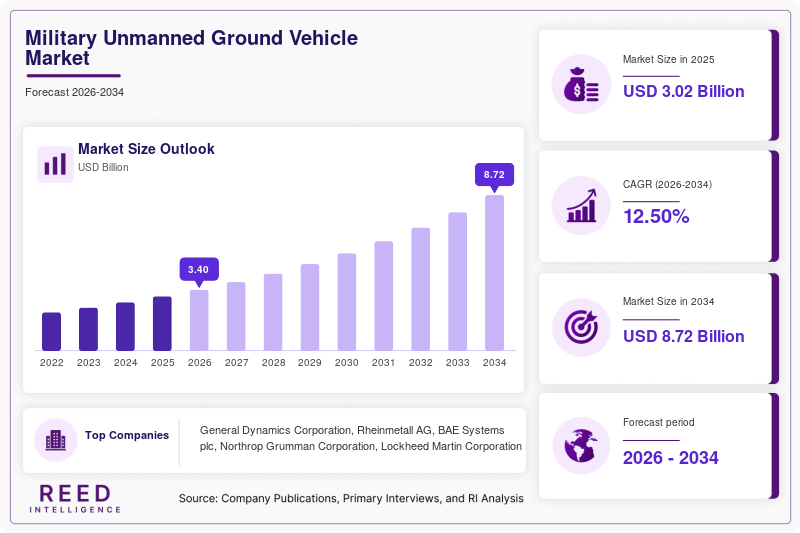
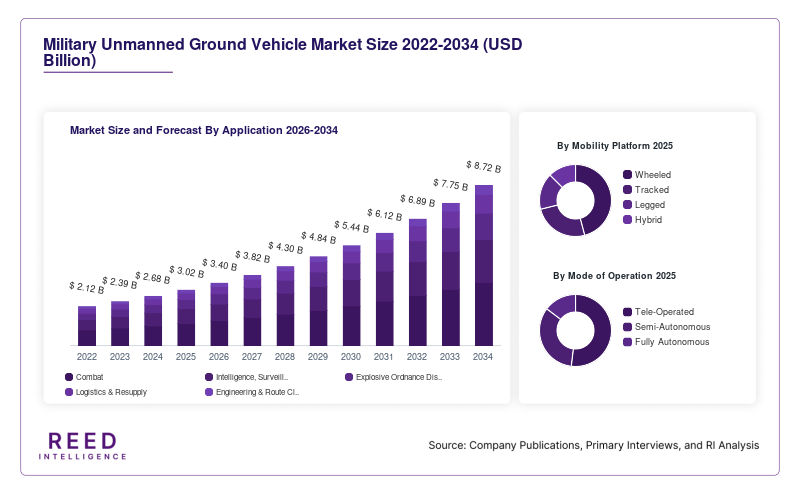
The global Military Unmanned Ground Vehicle Market size was valued at USD 3.02 billion in 2025 and is projected to grow from USD 3.40 billion in 2026 to USD 8.79 billion by 2034, registering a CAGR of 12.50% during the forecast period from 2026 to 2034.
Military unmanned ground vehicles are robotic land platforms designed to perform military missions without an onboard human operator. Depending on mission requirements, UGVs can be tele-operated, semi-autonomous, or fully autonomous and can carry surveillance equipment, robotic manipulators, communication systems, weapons, logistics payloads, and engineering equipment.
Demand is being supported by the growing emphasis on soldier survivability and the ability to conduct hazardous missions without exposing personnel. Military organizations increasingly deploy UGVs for explosive ordnance disposal, reconnaissance, surveillance, logistics, casualty evacuation, mine clearance, and tactical combat support.
Military Unmanned Ground Vehicle Market Drivers
Increasing defense expenditure and military modernization programs are encouraging governments to invest in unmanned and autonomous ground systems. Defense organizations increasingly view UGVs as force multipliers that can perform dangerous missions, transport supplies, conduct surveillance, and provide tactical support while reducing personnel exposure.
Military UGVs allow personnel to operate dangerous missions from a safer distance. EOD, mine clearance, reconnaissance, route clearance, and logistics applications particularly benefit from robotic deployment because the platforms can enter hazardous areas before human personnel.
AI, computer vision, sensor fusion, GNSS-denied navigation, machine learning, and edge computing are improving UGV autonomy. These technologies enable vehicles to identify obstacles, navigate complex terrain, follow routes, coordinate with other systems, and perform selected missions with reduced operator intervention.
Defense forces are increasingly experimenting with robotic wingmen that operate alongside conventional armored vehicles and infantry. These systems can extend reconnaissance range, carry additional payloads, provide fire support, and conduct high-risk missions without placing additional soldiers directly in danger.
Military Unmanned Ground Vehicle Market Restraints
Military UGVs require sophisticated mobility systems, sensors, communications, autonomy software, cyber protection, and mission payloads. Integrating these technologies while satisfying military reliability and interoperability requirements can increase development and procurement costs.
Tele-operated and networked UGVs can be affected by communication disruption, electronic warfare, jamming, spoofing, and cyberattacks. Maintaining reliable command-and-control links in contested environments remains a major technical challenge.
Although autonomy is advancing, militaries continue to retain human supervision for many sensitive missions. Concerns surrounding reliability, rules of engagement, autonomous decision-making, and battlefield identification can limit rapid adoption of fully autonomous systems.
Military Unmanned Ground Vehicle Market Opportunities
Autonomous cargo vehicles can transport ammunition, food, fuel, medical supplies, and other equipment through hazardous areas while reducing the requirement for crewed logistics convoys. The U.S. Army's Project Sustainment illustrates this direction through development of autonomous UGVs for tactical sustainment missions.
The development of armed robotic vehicles and robotic wingmen creates opportunities for UGV manufacturers. Modular weapon stations, advanced sensors, electronic warfare payloads, and autonomous navigation can transform UGVs from support robots into broader tactical assets.
Military modernization, regional security concerns, and increased investment in autonomous systems are creating opportunities outside North America. European procurement is particularly supported by higher defense spending and operational lessons emerging from the Russia-Ukraine conflict.
Military Unmanned Ground Vehicle Market Segmental Analysis
By Application
Explosive Ordnance Disposal (EOD) represents the dominant application segment, accounting for approximately 44.12% of the military UGV market in 2025. EOD UGVs remain widely deployed for bomb disposal, mine detection, hazardous-object inspection, and route clearance because they allow military personnel to investigate explosive threats remotely.
Intelligence, Surveillance & Reconnaissance (ISR) is expected to record the fastest growth, with an estimated 10.05% CAGR through 2031. Increasing requirements for persistent battlefield surveillance, sensor-based reconnaissance, and autonomous information collection are supporting demand for ISR-oriented UGVs.
By Mobility Platform
Tracked UGVs dominate the mobility platform segment, representing approximately 59.10% of the market in 2025. Tracked systems provide superior traction, stability, obstacle-crossing capability, and performance across mud, rubble, sand, and other difficult military environments.
Wheeled UGVs are expected to expand rapidly because of their road mobility, lower operational complexity, and suitability for logistics and reconnaissance. Wheeled platforms are projected to record approximately 8.21% CAGR through 2031.
By Mode of Operation
Tele-Operated UGVs accounted for approximately 68.10% of the military UGV market in 2025, making them the dominant operating mode. Direct human supervision remains particularly important for EOD, reconnaissance, hazardous-material handling, and other missions requiring precise operator control.
Semi-Autonomous UGVs are expected to experience the fastest growth, with an estimated 8.25% CAGR through 2031. Semi-autonomous systems can perform navigation, obstacle avoidance, route following, and selected mission functions while retaining human oversight.
By Weight Class
Small UGVs held the largest share at approximately 44.00% in 2025. Their relatively low weight, portability, maneuverability, and ability to carry useful sensor and robotic payloads make them suitable for reconnaissance, EOD, urban operations, and infantry support.
Medium UGVs are expected to grow rapidly as military organizations seek platforms capable of carrying larger payloads while maintaining tactical mobility. Their potential applications include logistics, reconnaissance, casualty evacuation, weapon integration, and manned-unmanned teaming.
Military Unmanned Ground Vehicle Market Regional Analysis
North America Military Unmanned Ground Vehicle Market
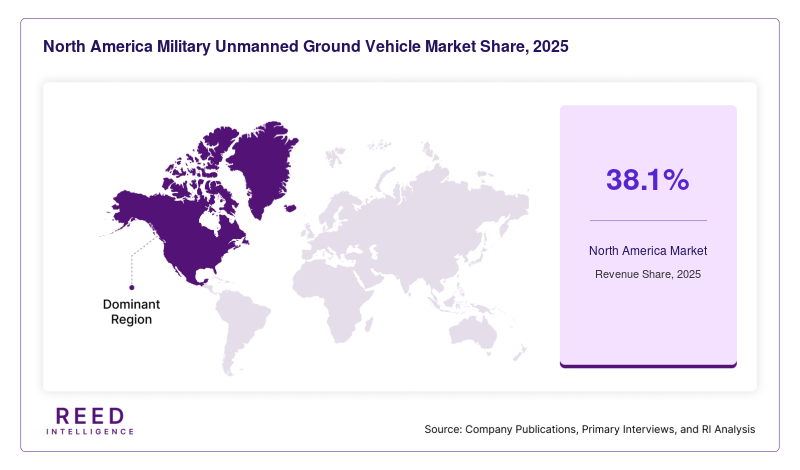
North America is the dominant region, accounting for 38.10% of global Military Unmanned Ground Vehicle Market revenue in 2025. The region benefits from large U.S. defense budgets, established military robotics programs, advanced defense-industrial capabilities, and sustained development of autonomous ground systems. Mordor Intelligence identifies North America as the leading geographic market with a 38.10% share of 2025 military UGV revenue.
The United States remains the principal regional market because of continued investment in autonomous logistics, robotic combat vehicles, EOD systems, reconnaissance platforms, and manned-unmanned teaming. The maturity of U.S. military robotics programs and the presence of major defense contractors further reinforce North America's leading position.
Europe Military Unmanned Ground Vehicle Market
Europe represents a major military UGV market supported by defense modernization, NATO interoperability requirements, and increasing emphasis on autonomous systems. Countries including Germany, the United Kingdom, France, Estonia, Poland, and Italy are developing or procuring robotic ground platforms for logistics, reconnaissance, combat support, and hazardous missions.
Europe is also among the fastest-growing regional markets, with Mordor Intelligence estimating approximately 8.29% CAGR through 2031. Increased defense spending and operational lessons from the Russia-Ukraine conflict are accelerating interest in unmanned logistics and combat platforms.
Asia Pacific Military Unmanned Ground Vehicle Market
Asia Pacific is experiencing strong demand for military UGVs as countries strengthen border surveillance, logistics, reconnaissance, and autonomous warfare capabilities. China, Japan, South Korea, India, and Australia are investing in robotics, AI, autonomous navigation, and military modernization.
The region is expected to maintain strong growth as defense organizations seek indigenous robotic capabilities and greater operational resilience. Increasing defense expenditure and regional security requirements are supporting investments in autonomous and remotely operated ground systems.
Latin America Military Unmanned Ground Vehicle Market
Latin America remains a smaller military UGV market, with opportunities concentrated in border surveillance, explosive ordnance disposal, security operations, and specialized reconnaissance missions. Budget limitations can constrain procurement of sophisticated autonomous platforms, but falling sensor costs and increasing availability of modular robotic systems may support gradual adoption.
Demand is expected to remain focused on cost-effective systems capable of performing hazardous missions without requiring extensive infrastructure. EOD, surveillance, and tactical reconnaissance represent the most practical near-term applications.
Middle East & Africa Military Unmanned Ground Vehicle Market
The Middle East & Africa market is supported by counterterrorism requirements, border security, mine clearance, reconnaissance, and defense modernization. Israel, the UAE, Saudi Arabia, and other regional defense markets are developing or acquiring advanced robotic and autonomous systems.
Demand is expected to increasingly shift toward systems capable of operating in desert environments, supporting surveillance, transporting supplies, and performing high-risk missions. Regional defense-industry localization programs are also creating opportunities for partnerships between international UGV manufacturers and local defense companies.
Military Unmanned Ground Vehicle Market Competitive Landscape
The Military Unmanned Ground Vehicle Market is moderately competitive, with major defense primes competing alongside specialized robotics companies. Competition is increasingly centered on autonomous navigation, modular mission payloads, rugged mobility, human-machine interfaces, secure communications, and interoperability with existing military command-and-control architectures.
General Dynamics Corporation maintains a strong position through its land-systems capabilities, robotic combat vehicle development, armored vehicle expertise, and integration of unmanned systems into broader ground-force architectures.
Key Market Players
- General Dynamics Corporation
- Rheinmetall AG
- BAE Systems plc
- Northrop Grumman Corporation
- Lockheed Martin Corporation
- L3Harris Technologies, Inc.
- QinetiQ Group plc
- Milrem Robotics
- Teledyne FLIR LLC
- Israel Aerospace Industries Ltd.
Military Unmanned Ground Vehicle Market Recent Developments
- September 2026 Rheinmetall: American Rheinmetall received a $7.28 million contract to manufacture and deliver 12 Mission Master SP autonomous unmanned ground vehicles and five amphibious kits to the U.S. Marine Corps. The systems will support operational evaluation, autonomous logistics, and expeditionary mobility initiatives.
- August 2026 U.S. Army / HDT Robotics: The U.S. Army DEVCOM Armaments Center supported the delivery of an armed Hunter WOLF unmanned ground vehicle to the 3rd Mobile Brigade, 101st Airborne Division, under a technical demonstration. The UGV was originally developed for logistics and supply transport and was demonstrated with a remotely operated .50-caliber weapon system.
Military Unmanned Ground Vehicle Market Segments
By Application
- Combat
- Intelligence, Surveillance & Reconnaissance
- Explosive Ordnance Disposal
- Logistics & Resupply
- Engineering & Route Clearance
By Mobility Platform
- Wheeled
- Tracked
- Legged
- Hybrid
By Mode of Operation
- Tele-Operated
- Semi-Autonomous
- Fully Autonomous
By Weight Class
- Micro
- Small
- Medium
- Heavy
By Region
- North America
- Europe
- APAC
- Middle East and Africa
- LATAM