Milk Beverage Market Size, Share & Trends Analysis Report By Product Type (Flavored Milk, Milkshakes, Yogurt Drinks) and By Application (Retail, Food Service) and By End Use (Household, Commercial) and By Region (North America, Europe, Asia Pacific, Latin America, Middle East & Africa) Forecasts, 2026–2034
USD 3950
Milk Beverage Market Size
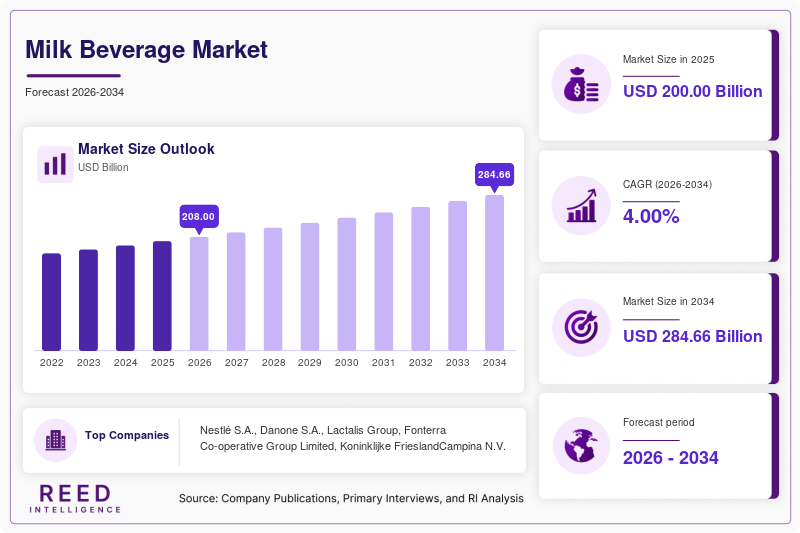
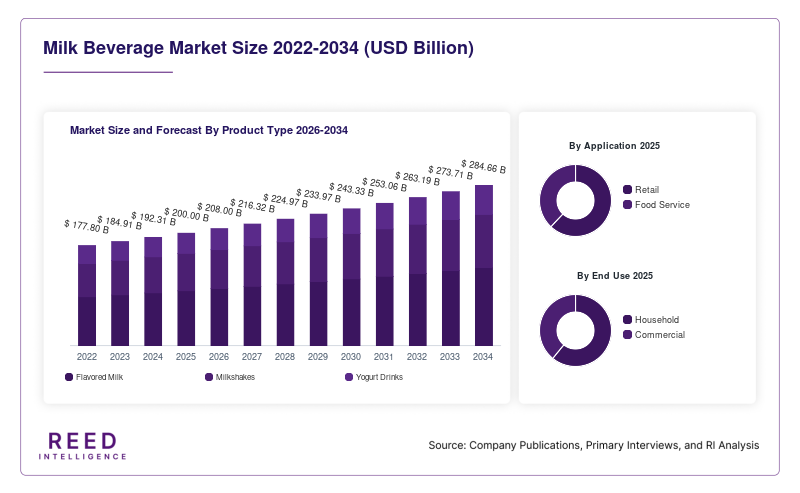
The global Milk Beverage Market size was valued at USD 200.00 billion in 2025 and is projected to grow from USD 208.00 billion in 2026 to USD 284.66 billion by 2034, registering a CAGR of 4.00% during the forecast period from 2026 to 2034.
The global Milk Beverage Market encompasses a broad range of dairy-based and milk-derived beverage products consumed through retail and food-service channels. Key product categories include flavored milk, milkshakes, and yogurt drinks. Manufacturers are increasingly positioning milk beverages around nutrition, convenience, protein content, indulgence, and functional health benefits.
Flavored milk remains a major category because of its strong appeal among children, young consumers, and consumers seeking convenient indulgent beverages. According to available market-specific research, flavored milk accounted for approximately 45% of the market in 2024, making it the leading product-type segment. Milkshakes are identified as the fastest-growing product type, supported by increasing demand for indulgent beverages, customized formulations, and café-style consumption occasions.
Milk Beverage Market Drivers
Milk beverages naturally provide protein, calcium, vitamins, and other nutrients, supporting their positioning as convenient nutritional products. Growing consumer interest in protein intake, sports nutrition, active lifestyles, and balanced diets is encouraging manufacturers to develop protein-enriched milk and yogurt beverages. Arla reported particularly strong demand for protein and sports nutrition during the first half of 2026, highlighting the broader opportunity for dairy-based nutritional beverages.
Urbanization, changing lifestyles, longer working hours, and increased on-the-go consumption are strengthening demand for convenient milk beverages. Ready-to-drink flavored milk, yogurt beverages, milkshakes, and other portable formats provide consumers with quick nutrition and refreshment without requiring preparation.
Manufacturers are introducing new flavors, fortified formulations, high-protein products, reduced-sugar variants, and functional milk beverages to expand consumption occasions. Innovation is particularly important among younger consumers, where flavored milk and indulgent milk-based beverages can bridge nutrition and taste preferences.
Milk Beverage Market Restraints
Milk prices are affected by feed costs, weather conditions, livestock productivity, energy prices, transportation costs, and supply-demand imbalances. Volatility in raw-material costs can pressure manufacturers' margins and make pricing more difficult, particularly in price-sensitive developing markets.
Plant-based milk beverages made from oat, almond, soy, coconut, and other sources are increasingly competing for consumer spending. Plant-based products appeal to consumers seeking lactose-free, vegan, flexitarian, and sustainability-oriented options. The rapid growth of the plant-based milk beverage category creates additional competitive pressure on conventional dairy beverages.
Milk beverage manufacturers must comply with food-safety, nutritional-labeling, ingredient, health-claim, and product-quality requirements. Changes in regulations can increase compliance costs and restrict the use of certain nutritional or functional claims.
Milk Beverage Market Opportunities
Functional milk beverages incorporating protein, vitamins, minerals, probiotics, fiber, and other nutritional components provide manufacturers with opportunities to move beyond conventional milk consumption. Rising demand for products positioned around immunity, digestive health, muscle recovery, and general wellness can support premium pricing.
Premium flavored milk, organic milk beverages, lactose-free products, specialty yogurt drinks, and high-protein formulations provide opportunities for differentiation. Consumers increasingly accept premium products when they provide clear nutritional, sensory, convenience, or functional benefits.
Asia Pacific, particularly China, India, and Southeast Asian markets, offers substantial opportunities because of its large population base, expanding middle class, urbanization, improving modern retail infrastructure, and growing demand for packaged dairy products. Asia Pacific is also identified as the fastest-growing region for the broader Milk Beverage Market, with a reported 5.5% CAGR in available market-specific research.
Milk Beverage Market Segmental Analysis
By Product Type
Flavored Milk is the dominant product-type segment in the Milk Beverage Market. It accounted for approximately 45% of the global market in 2024, supported by strong consumer acceptance, particularly among children and young adults. Product diversification through chocolate, strawberry, vanilla, coffee, and other flavors continues to strengthen the segment.
Milkshakes represent the fastest-growing product-type segment, with available market-specific research indicating a 5.2% CAGR during the forecast period. Growth is supported by rising demand for indulgent beverages, customization, café consumption, and new combinations of fruits, dairy, chocolate, nuts, and functional ingredients.
Yogurt Drinks are gaining traction because of their association with probiotics, digestive health, convenience, and nutritional value. The segment is increasingly being positioned as a snack, breakfast replacement, or functional beverage, particularly among health-conscious consumers.
By Application
Retail is expected to remain the dominant application segment because supermarkets, hypermarkets, convenience stores, grocery retailers, and online channels provide broad consumer access to packaged milk beverages. Retail distribution also supports product visibility and enables manufacturers to introduce new flavors, functional variants, and premium formats.
Food Service is an important growth channel as cafés, restaurants, quick-service outlets, hotels, and specialized beverage chains increasingly incorporate milkshakes, flavored milk drinks, yogurt beverages, and customized milk-based beverages into their menus.
By End Use
Household consumption represents the dominant end-use segment because milk beverages remain integrated into everyday consumption patterns, breakfast occasions, children's nutrition, snacking, and family consumption.
Commercial consumption is expected to experience continued growth through restaurants, cafés, institutional foodservice, hospitality, schools, healthcare facilities, and workplace consumption. Expansion of food-service infrastructure is increasing the number of occasions in which milk beverages are consumed outside the home.
Milk Beverage Market Regional Analysis
North America Milk Beverage Market
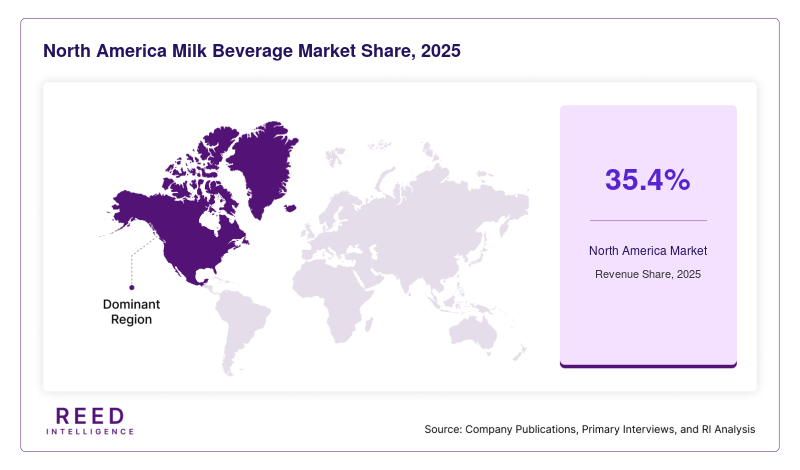
North America is the dominant region in the Milk Beverage Market, accounting for 35.4% of the global market in 2024. The region's leadership is supported by its well-established dairy production base, advanced processing infrastructure, extensive cold-chain networks, and strong consumer demand for flavored milk and yogurt drinks. The United States represents the principal market within the region, supported by high dairy consumption and established retail distribution.
The regional market is also benefiting from increasing demand for protein-rich, functional, lactose-free, and convenient dairy beverages. Mature supermarket, convenience-store, food-service, and e-commerce channels provide manufacturers with broad distribution opportunities. Although the verified market-specific source reports the 35.4% share for 2024 rather than 2025, this is the latest directly comparable dominant-region percentage identified for the Milk Beverage Market and should be used rather than an unsupported 2025 estimate.
Europe Milk Beverage Market
Europe represents a mature Milk Beverage Market supported by established dairy consumption, sophisticated food-processing capabilities, extensive retail networks, and strong demand for premium and functional dairy products. Consumers increasingly seek protein-enriched, reduced-sugar, organic, lactose-free, and nutritionally differentiated beverages.
The region is also experiencing increased emphasis on sustainability, responsible sourcing, packaging efficiency, and product reformulation. Dairy companies are expanding their portfolios through functional beverages and premium products, while mature retail infrastructure allows manufacturers to introduce differentiated milk-based products across supermarkets, convenience stores, and food-service channels.
Asia Pacific Milk Beverage Market
Asia Pacific is one of the most important growth markets for milk beverages, supported by its large population, rising disposable incomes, urbanization, expanding modern retail infrastructure, and increasing demand for packaged dairy products. China and India are particularly important markets because of their large consumer bases and expanding dairy-processing industries.
For the broader dairy beverages category, Asia Pacific accounted for 35.18% of global market share in 2025, according to Mordor Intelligence, and is supported by increasing consumer purchasing power and improving cold-chain infrastructure. This figure applies to the broader dairy-beverages market rather than the narrower Milk Beverage Market, so it should not be presented as the Milk Beverage Market's share.
Latin America Milk Beverage Market
Latin America represents an established and developing market for milk beverages, supported by strong dairy consumption traditions, expanding packaged-food distribution, and growing urban populations. Brazil, Mexico, Argentina, and other major markets provide opportunities for flavored milk, UHT milk beverages, yogurt drinks, and value-oriented dairy products.
Growing modern retail penetration and improvements in food-processing infrastructure are increasing access to packaged milk beverages. However, an exact, directly comparable global Milk Beverage Market share for Latin America could not be reliably verified from the available market-specific sources; therefore, no unsupported percentage is assigned.
Middle East & Africa Milk Beverage Market
Middle East & Africa offers significant long-term opportunities because of population growth, urbanization, increasing disposable incomes, and rising demand for convenient and nutritionally valuable beverages. Shelf-stable and UHT milk beverages are particularly relevant in markets where cold-chain limitations can affect fresh dairy distribution.
Milk Beverage Market Competitive Landscape
The global Milk Beverage Market is moderately fragmented, with major multinational dairy companies competing alongside regional dairy processors and specialized beverage manufacturers. Competition is centered on product innovation, brand recognition, nutritional positioning, pricing, distribution reach, sustainability, and the development of differentiated milk-based beverages.
Nestlé S.A. is a major participant across dairy, nutrition, beverage, and plant-based categories, with broad international distribution and significant R&D capabilities. The company continues to explore nutritional and beverage innovation across dairy and dairy-alternative categories.
Key Market Players
- Nestlé S.A.
- Danone S.A.
- Lactalis Group
- Fonterra Co-operative Group Limited
- Koninklijke FrieslandCampina N.V.
- Arla Foods amba
- Dairy Farmers of America, Inc.
- Saputo Inc.
- The Kraft Heinz Company
- China Mengniu Dairy Company Limited
- Yili Group
Milk Beverage Market Recent Developments
- June 2026 Arla Foods and DMK Group: Arla Foods and DMK Group officially completed their merger on June, 2026, creating Europe's leading farmer-owned dairy cooperative. The combination brings together dairy production, brands, processing capabilities, and farmer supply networks, strengthening the group's scale and ability to invest in dairy production and innovation.
- April 2026 FrieslandCampina Engro Pakistan: FrieslandCampina Engro Pakistan reported 10.4% year-on-year net-sales growth to PKR 28.7 billion in Q1 2026. Its Dairy-Based Products segment generated PKR 25.5 billion, up 8.2%, while the company continued investing in its Olper's UHT milk brand and expanding its value-added portfolio
Milk Beverage Market Segments
By Product Type
- Flavored Milk
- Milkshakes
- Yogurt Drinks
By Application
- Retail
- Food Service
By End Use
- Household
- Commercial
By Region
- North America
- Europe
- APAC
- Middle East and Africa
- LATAM