Milk Bottle Brush Market Size, Share & Trends Analysis Report By Product Type (Nylon Bristles, Sponge Brushes, Silicone Brushes, Others) and By Application (Household, Commercial) and By Distribution Channel (Online Stores, Supermarkets/Hypermarkets, Specialty Stores, Others) and By End User (Residential, Commercial) and By Region (North America, Europe, Asia Pacific, Latin America, Middle East & Africa) Forecasts, 2026–2034
USD 3950
Milk Bottle Brush Market Size
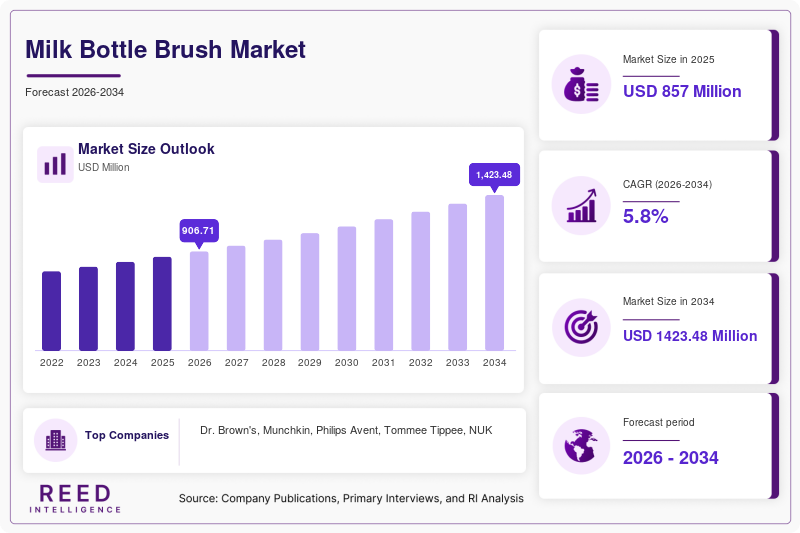
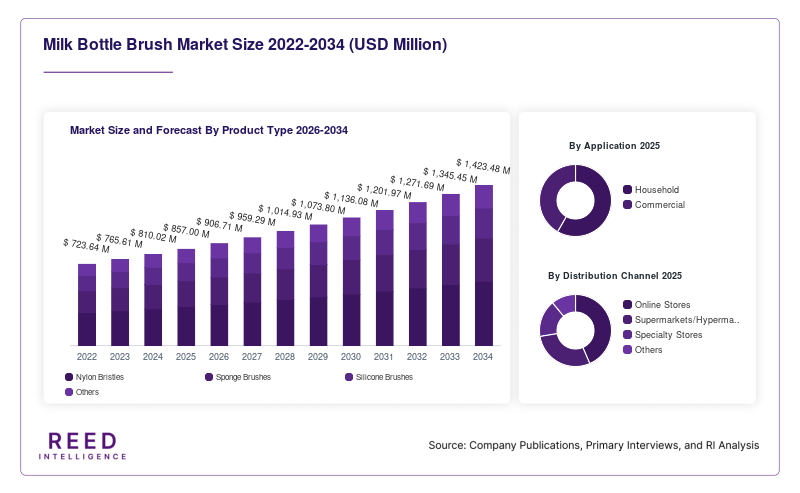
The global milk bottle brush market size was valued at USD 857 million in 2025 and is projected to grow from USD 906.71 million in 2026 to USD 1,423.48 million by 2034, registering a CAGR of 5.8% during the forecast period from 2026 to 2034. The 2025 market value and 2034 forecast are also reported by Dataintelo.
The Milk Bottle Brush Market comprises specialized cleaning tools designed for milk bottles, feeding bottles, nipples, breast-pump components, and related infant-feeding equipment. The market includes conventional bristle brushes, sponge-based brushes, silicone brushes, and multifunctional cleaning sets.
Nylon bristle brushes currently represent the leading product category, accounting for 38.5% of the global market in 2025, supported by durability, affordability, and established consumer acceptance. Silicone brushes represent another significant category, accounting for 31.2%, while sponge brushes account for 22.3%.
Milk Bottle Brush Market Drivers
Growing awareness of proper bottle and feeding-equipment hygiene is a fundamental market driver. Parents increasingly use dedicated cleaning equipment rather than conventional kitchen brushes because narrow bottle necks, nipples, valves, and pump components can be difficult to clean thoroughly with standard household tools.
Consumers are increasingly willing to pay more for durable, hygienic, ergonomic, and multifunctional baby-care products. Silicone brushes are benefiting from this trend because they are positioned around durability, easy cleaning, sterilization compatibility, and reduced bristle shedding.
Online marketplaces have substantially expanded consumer access to specialized bottle-cleaning products. Consumers can compare materials, designs, prices, ratings, and reviews before purchasing. This is particularly beneficial for niche products such as bottle brushes that may have limited shelf space in physical stores.
Milk Bottle Brush Market Restraints
Bottle brushes are consumable household accessories and require periodic replacement. Munchkin, for example, recommends replacing its Sponge Bottle Brush every 30–45 days, illustrating the recurring replacement requirement but also creating an ongoing cost consideration for consumers.
The market faces competition from inexpensive generic brushes sold through supermarkets, discount retailers, and online marketplaces. Low-cost alternatives can make it difficult for branded manufacturers to justify premium pricing unless products provide clear advantages in durability, hygiene, functionality, or convenience.
Silicone, specialized plastics, antimicrobial materials, and complex multi-brush designs can increase manufacturing costs. Changes in plastic, silicone, packaging, transportation, and labor costs can place pressure on margins, particularly for manufacturers competing in price-sensitive markets.
Milk Bottle Brush Market Opportunities
Silicone brushes provide manufacturers with an opportunity to differentiate through durability, sterilization compatibility, flexible cleaning surfaces, and multifunctional designs. Dataintelo estimates silicone brushes at 31.2% market share and identifies an 8.4% CAGR, making this a particularly attractive product category.
Manufacturers can capitalize on increasing consumer interest in sustainable baby products by introducing recycled materials, reduced-plastic packaging, longer-lasting brushes, and alternative handle materials.
Bottle brushes that incorporate nipple cleaners, straw cleaners, pump-part brushes, and other accessories can increase average selling prices and improve consumer convenience. Such systems also provide opportunities for manufacturers to build broader infant-care product ecosystems.
Milk Bottle Brush Market Segmental Analysis
By Product Type
Nylon Bristles are the dominant product-type segment, accounting for 38.5% of the global Milk Bottle Brush Market in 2025. Their leading position is supported by affordability, durability, established consumer familiarity, and effective removal of milk and formula residue.
Silicone Brushes are the fastest-growing major product category, with an estimated 8.4% CAGR. Their growth is supported by demand for durable, easy-to-clean, sterilization-compatible, and premium bottle-cleaning products. Dr. Brown's has also expanded its silicone brush offering, including a three-piece silicone brush set designed for bottles, glassware, and straws.
By Application
Household applications dominate the market, accounting for approximately 87.4% of market revenue in 2025. Household demand is supported by parents and caregivers cleaning bottles, nipples, breast-pump components, and children's drinking accessories at home.
Commercial applications include childcare facilities, healthcare environments, maternity facilities, hospitality establishments, and other institutions requiring specialized bottle-cleaning equipment. The segment remains smaller but provides recurring replacement opportunities because brushes used in high-frequency cleaning environments generally experience faster wear.
By Distribution Channel
Online Stores are the dominant distribution channel, accounting for 38.7% of the market in 2025. Online sales benefit from extensive product selection, consumer reviews, competitive pricing, subscription possibilities, and home delivery. The channel is also estimated to be the fastest-growing distribution channel at approximately 9.8% annually.
Supermarkets/Hypermarkets represent another major channel, accounting for approximately 34.2% of the market. Physical retail remains important because consumers can purchase bottle brushes alongside bottles, formula, diapers, and other infant-care products.
Specialty Stores remain important for premium infant-care products and brands that rely on specialist recommendations and product education. These outlets can provide stronger opportunities for premium silicone and multifunctional brush systems.
By End User
Residential end users dominate the market, accounting for approximately 83.3% of market revenue in 2025. Residential demand is directly linked to the number of households using infant feeding bottles, breast pumps, sippy cups, and related equipment.
Commercial end users include childcare centers, healthcare institutions, maternity facilities, and other organizations managing infant-feeding equipment. While the segment is smaller, institutional users can generate repeat purchases because of higher cleaning frequency and replacement requirements.
Milk Bottle Brush Market Regional Analysis
North America Milk Bottle Brush Market
North America represents the second-largest regional market, accounting for 28.3% of global Milk Bottle Brush Market revenue in 2025. The region benefits from high consumer awareness of infant hygiene, established baby-care brands, strong retail infrastructure, and widespread e-commerce adoption. Consumers also demonstrate relatively strong demand for premium silicone brushes, ergonomic handles, and multifunctional cleaning sets.
The United States represents the principal market in the region, supported by established brands including Dr. Brown's, Munchkin, OXO Tot, and NUK. Premiumization remains an important regional trend, with consumers increasingly selecting products based on durability, sterilization compatibility, material quality, and specialized cleaning functionality.
Europe Milk Bottle Brush Market
Europe accounts for approximately 18.7% of global Milk Bottle Brush Market revenue in 2025. The market benefits from high consumer awareness, established infant-care product distribution, and strong demand for products aligned with sustainability and food-contact safety requirements. Western Europe and Scandinavian markets are particularly receptive to premium and environmentally conscious baby-care products.
Manufacturers are increasingly focusing on plastic reduction, durable materials, recyclable packaging, and multifunctional products. Online retail is also expanding the availability of specialist bottle brushes, allowing consumers to access international brands and niche products that may not be widely stocked in traditional stores.
Asia Pacific Milk Bottle Brush Market
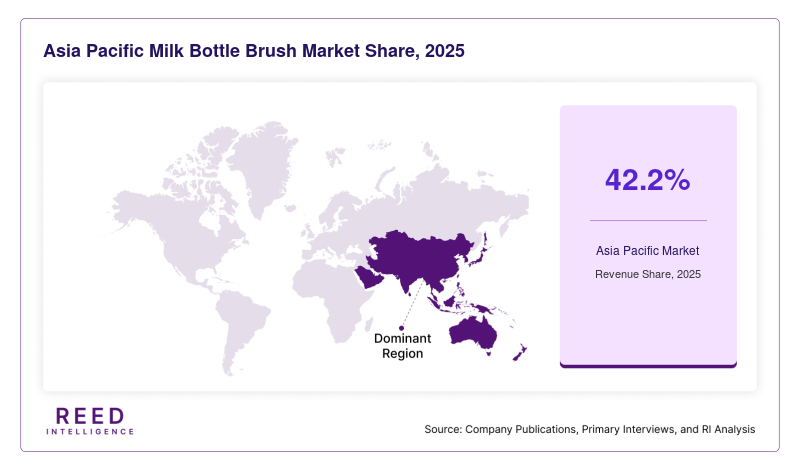
Asia Pacific is the dominant region in the Milk Bottle Brush Market, accounting for 42.2% of global market revenue in 2025. The region's leadership is supported by its large consumer base, significant infant population, rapid urbanization, rising disposable incomes, increasing awareness of childcare hygiene, and strong e-commerce penetration. Dataintelo estimates the regional market at approximately USD 362 million in 2025.
China represents a major regional market, while India and Southeast Asian countries provide substantial growth opportunities because of expanding middle-class populations and increasing adoption of specialized infant-care products. The expansion of platforms such as Alibaba and Shopee has also improved access to specialized bottle-cleaning products.
Latin America Milk Bottle Brush Market
Latin America represents an emerging market supported by rising middle-class populations, increasing awareness of infant hygiene, and expanding online retail infrastructure. Brazil and Mexico are among the important markets because of their population size, growing organized retail networks, and increasing access to international baby-care brands.
The region represents a smaller portion of global market revenue than Asia Pacific, North America, and Europe. However, increasing household spending on infant-care products and the expansion of e-commerce are expected to create opportunities for branded bottle brushes and multifunctional cleaning sets.
Middle East & Africa Milk Bottle Brush Market
The Middle East & Africa represents an emerging opportunity for milk bottle brushes, supported by population growth, urbanization, increasing disposable incomes, and rising awareness of modern childcare practices. Urban markets are particularly receptive to branded infant-care products distributed through pharmacies, supermarkets, specialty retailers, and online marketplaces.
Demand is expected to increase as modern retail and e-commerce infrastructure expands. However, price sensitivity and uneven distribution infrastructure remain important constraints in several markets, creating opportunities for manufacturers offering affordable, durable, and multifunctional products.
Milk Bottle Brush Market Competitive Landscape
The global Milk Bottle Brush Market is characterized by competition among established infant-care companies, specialized cleaning-product manufacturers, and regional brands. Competitive differentiation is increasingly based on material innovation, ergonomic design, multifunctionality, durability, sterilization compatibility, and brand reputation.
Dr. Brown's is a major participant in the market with a broad portfolio of infant feeding products and complementary cleaning accessories. Its silicone brush range demonstrates the industry's movement toward durable, multifunctional, and easy-to-sanitize cleaning products.
Key Market Players
- Dr. Brown's
- Munchkin
- Philips Avent
- Tommee Tippee
- NUK
- OXO Tot
- Nuby
- Chicco
- Comotomo
- Medela
- Evenflo
Milk Bottle Brush Market Recent Developments
- August 2026 Momcozy: Momcozy launched the DeepClean Bottle Washer (D8) on August 21, 2026, introducing precision cleaning for baby bottles, breast-pump components, nipples, valves, caps, and other small feeding accessories. The system uses targeted spray jets and automated cleaning functions, reflecting the industry's movement toward more specialized and convenient bottle-cleaning solutions.
- July 2026 Munchkin: Munchkin announced a next-generation cup portfolio on July 14, 2026, introducing redesigned drinking products focused on easier cleaning, functionality, and changing parent preferences. The development is relevant to the bottle-cleaning accessories market because it expands the range of infant and toddler feeding products requiring dedicated cleaning solutions.
Milk Bottle Brush Market Segments
By Product Type
- Nylon Bristles
- Sponge Brushes
- Silicone Brushes
- Others
By Application
- Household
- Commercial
By Distribution Channel
- Online Stores
- Supermarkets/Hypermarkets
- Specialty Stores
- Others
By End User
- Residential
- Commercial
By Region
- North America
- Europe
- APAC
- Middle East and Africa
- LATAM