Milk Market Size, Share & Trends Analysis Report By Product Type (Skimmed Milk Powder, Liquid Milk, Whey Protein, Whey Milk Powder, Yogurt, Cheese, Butter, Others) and By Distribution Channel (Convenience Stores, Supermarkets & Hypermarkets, Online and Others) and By Region (North America, Europe, Asia Pacific, Latin America, Middle East & Africa) Forecasts, 2026–2034
USD 3950
Milk Market Size
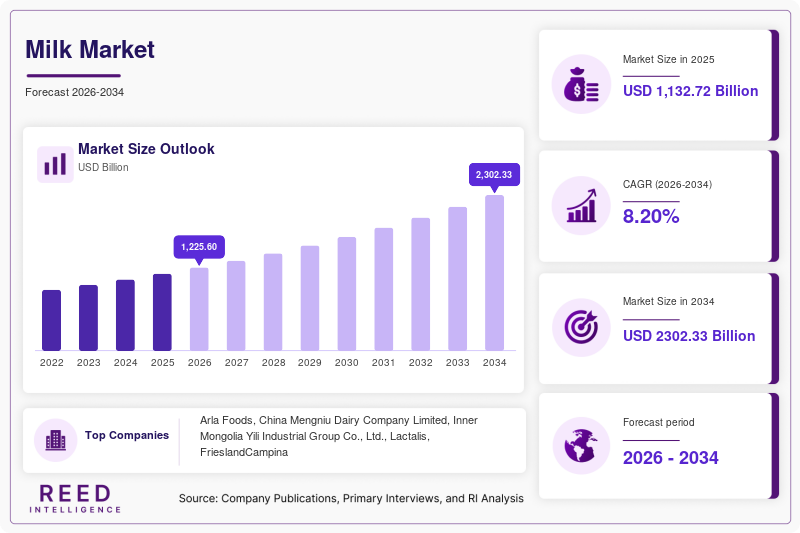
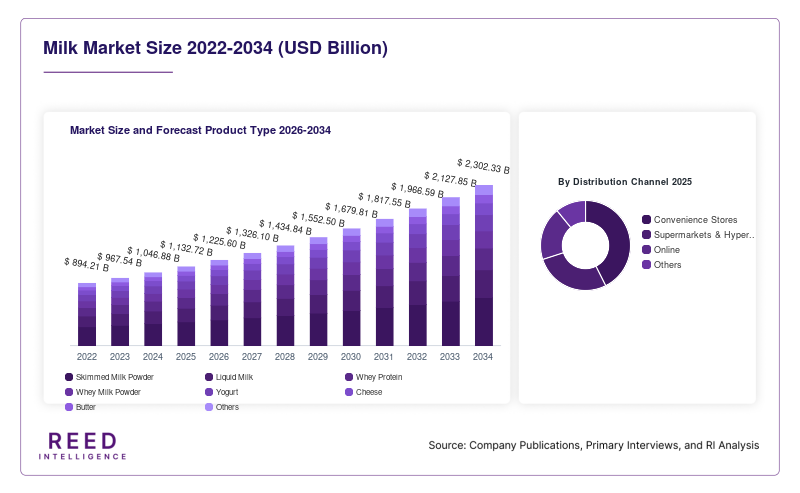
The global milk market size was valued at USD 1,132.72 billion in 2025 and is projected to grow from USD 1,225.60 billion in 2026 to USD 2,302.33 billion by 2034, registering a CAGR of 8.20% during the forecast period from 2026 to 2034. The market is supported by population growth, rising disposable incomes, increasing demand for dairy-based nutrition, modernization of dairy farming, and expanding consumption of value-added dairy products.
Milk remains one of the world's most important agricultural and nutritional commodities, serving as a core input for liquid milk, milk powders, yogurt, cheese, butter, whey ingredients, infant nutrition, and other dairy-based products. The global market is characterized by a combination of large-scale conventional milk consumption and rapid premiumization across specialized categories.
Milk Market Drivers
Population growth, urbanization, and increasing household incomes are supporting long-term milk consumption. Developing economies in Asia, Latin America, and Africa are particularly important because growing middle-class populations are transitioning toward packaged and branded dairy products. Rising awareness of milk's protein, calcium, vitamin, and micronutrient content further supports household consumption.
Consumers are increasingly prioritizing protein as part of healthy diets, sports nutrition, active lifestyles, and functional nutrition. This trend is supporting demand for milk and dairy-derived ingredients such as whey protein and milk proteins. Major dairy companies are consequently increasing investments in higher-value nutritional categories.
The dairy industry is moving beyond conventional liquid milk into yogurt, cheese, butter, whey protein, fortified milk, lactose-reduced milk, and other specialty products. These categories allow manufacturers to improve product differentiation, increase consumer engagement, and capture higher-value demand.
Technological improvements in dairy farming, automated milking, herd management, feed optimization, digital monitoring, processing automation, and cold-chain infrastructure are improving production efficiency. These technologies support higher-quality milk supply and enable manufacturers to manage increasingly complex global dairy networks.
Milk Market Restraints
Milk prices are influenced by feed costs, energy prices, weather conditions, livestock productivity, global supply-demand conditions, and geopolitical developments. Periods of oversupply can place downward pressure on farmer returns, while higher production costs can increase processor and consumer prices.
Lactose intolerance and consumer dietary preferences can reduce conventional milk consumption in certain markets. This is encouraging manufacturers to expand lactose-free, lactose-reduced, plant-based, and alternative dairy products.
Dairy production faces increasing scrutiny regarding greenhouse-gas emissions, water use, land requirements, animal welfare, and agricultural sustainability. Producers and processors are therefore under pressure to improve farm-level efficiency and reduce environmental impacts across the supply chain.
Milk Market Opportunities
Lactose-reduced and functional milk products provide manufacturers with opportunities to address consumers who experience digestive discomfort or seek additional nutritional benefits. Arla Foods, for example, launched DANO Lacto Reduced Filled Milk Powder in Bangladesh in April 2026, positioning the product around improved digestibility.
Online grocery platforms are creating additional distribution opportunities for milk and specialty dairy products. Improvements in cold-chain logistics, subscription models, direct-to-consumer distribution, and digital grocery infrastructure are increasing the accessibility of premium and differentiated milk products.
Demand for high-protein and premium dairy products provides manufacturers with opportunities to move beyond conventional commodity positioning. Rising interest in sports nutrition, healthy aging, weight management, and functional nutrition is creating additional demand for protein-rich dairy.
India, China, Southeast Asia, Latin America, and parts of Africa offer substantial opportunities because expanding processing infrastructure, modern retail, cold chains, and branded dairy distribution can increase packaged milk penetration.
Milk Market Segmental Analysis
By Product Type
Liquid Milk represents the dominant product category, supported by its widespread household consumption, nutritional importance, and established presence across retail and foodservice channels. Liquid milk remains a foundational dairy product in both mature and emerging economies, while packaged formats such as pasteurized and UHT milk continue to expand distribution reach. The exact global market-share percentage for liquid milk within the supplied Milk Market dataset is not independently verified and is therefore not stated.
Value-added dairy products, particularly whey protein, cheese, and yogurt, represent the fastest-growing product opportunity as consumers increasingly seek protein-rich, convenient, functional, and premium nutritional products. Current industry evidence supports strong investment in protein-oriented dairy categories, although a directly comparable CAGR for the combined value-added segment of this exact Milk Market is unavailable.
By Distribution Channel
Supermarkets & Hypermarkets represent the dominant distribution channel because of their broad product assortment, established refrigerated infrastructure, high consumer traffic, and ability to offer multiple milk brands and product formats. The exact global percentage share for this channel in the supplied Milk Market dataset is not independently verified and is therefore not stated.
Online retail is the fastest-growing distribution channel, supported by increasing online grocery penetration, home delivery, digital payment adoption, and improvements in refrigerated and controlled-temperature logistics. Market research identifies online/e-commerce as the fastest-expanding distribution route for milk and dairy products, although an exact CAGR for the entire Milk Market channel is not consistently reported across comparable sources.
Milk Market Regional Analysis
North America Milk Market
North America is a mature and technologically advanced milk market characterized by high dairy-processing capacity, strong cold-chain infrastructure, established retail networks, and significant demand for conventional, organic, lactose-free, fortified, and premium milk products. The United States represents the region's largest consumption market, while Canada maintains a well-developed dairy production and distribution ecosystem.
North America continues to benefit from strong consumer purchasing power and widespread supermarket penetration. However, conventional milk demand faces pressure from plant-based alternatives, changing dietary preferences, and lactose intolerance. Growth opportunities are increasingly concentrated in differentiated milk formats, functional nutrition, premium dairy, and online grocery distribution.
Europe Milk Market
Europe represents a highly developed milk market supported by established dairy farming systems, sophisticated processing infrastructure, strong food-safety standards, and major international dairy companies. Consumers increasingly prioritize quality, sustainability, animal welfare, nutritional value, and traceability, encouraging manufacturers to strengthen premium and environmentally responsible product portfolios.
The region is also experiencing significant industry consolidation and capacity investment. The June 2026 completion of the Arla Foods and DMK Group merger created Europe's leading farmer-owned dairy cooperative, combining approximately 11,200 farmers, 28,800 employees, an annual milk pool of about 19.4 billion kg, and pro forma revenue exceeding EUR 20 billion.
Asia Pacific Milk Market
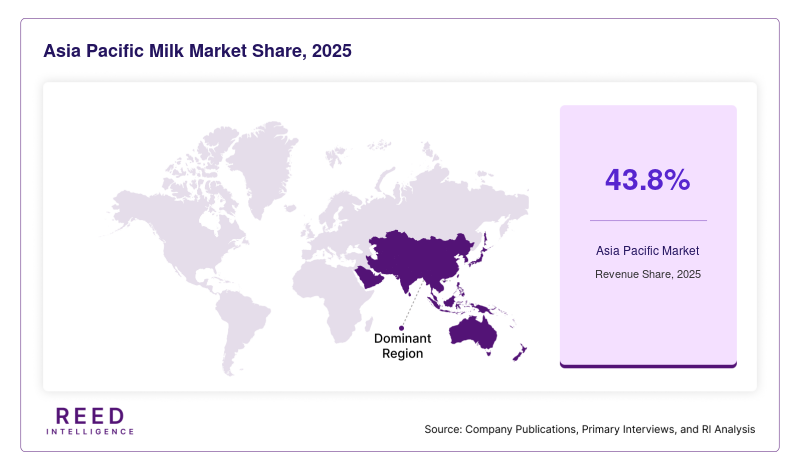
Asia Pacific is the dominant regional Milk Market, accounting for approximately 43.8% of global market share in 2025. The region's leadership is supported by its enormous population, growing dairy consumption, expanding processing capacity, and rising demand in India, China, Southeast Asia, and other developing economies.
Asia Pacific is also among the most attractive growth regions because of urbanization, rising disposable income, changing dietary habits, and increasing consumption of packaged dairy. China and India are particularly important demand centers, while premium, UHT, fortified, protein-rich, and specialty milk products are expanding opportunities. The region's large population and increasing dairy penetration make it a major contributor to future global milk demand.
Latin America Milk Market
Latin America represents an important milk-producing and consuming region, supported by major dairy industries in countries such as Brazil, Mexico, Argentina, Chile, and Colombia. Rising urbanization and modern retail penetration are supporting greater adoption of packaged and branded milk products.
The region also provides opportunities for dairy processors to expand premium milk, functional dairy, UHT products, and modern distribution formats. However, economic volatility, currency fluctuations, agricultural costs, and differences in dairy infrastructure between countries remain important market considerations.
Middle East & Africa Milk Market
The Middle East & Africa market is supported by population growth, urbanization, increasing demand for nutritious food, and the expansion of modern retail and dairy-processing infrastructure. Several markets remain dependent on imported dairy products, creating opportunities for local production, processing investment, and supply-chain development.
Demand for long-life milk, milk powders, fortified products, and convenient packaged dairy is particularly relevant because of climatic conditions and cold-chain limitations in some markets. Market development remains uneven across countries, with the strongest opportunities concentrated in larger urban centers and rapidly developing economies.
Milk Market Competitive Landscape
The global Milk Market is highly competitive and includes multinational dairy companies, regional cooperatives, specialized dairy processors, and vertically integrated milk producers. Competition is increasingly focused on product innovation, nutritional differentiation, supply-chain efficiency, sustainability, brand strength, and geographic expansion.
Arla Foods is one of the world's major farmer-owned dairy cooperatives and maintains a broad portfolio spanning milk, cheese, butter, protein ingredients, and other dairy categories. In 2026, Arla strengthened its scale through the completion of its merger with DMK Group and continued significant investments across its dairy operations.
Key Market Players
- Arla Foods
- China Mengniu Dairy Company Limited
- Inner Mongolia Yili Industrial Group Co., Ltd.
- Lactalis
- FrieslandCampina
- Nestlé S.A.
- Danone S.A.
- Dairy Farmers of America, Inc.
- Fonterra Co-operative Group Limited
- GCMMF (Amul)
Milk Market Recent Market Developments
- October 2026 Arla Foods: Arla Foods announced an investment of more than EUR 63 million to expand skyr and cottage cheese production in Germany and Sweden. The investment responds to rising consumer demand for protein-rich dairy and demonstrates continued capacity expansion in higher-value dairy categories.
- August 2026 China Mengniu Dairy: Mengniu reported 7.8% year-on-year revenue growth to RMB 44.8 billion in the first half of 2026. Its fresh milk, milk powder, and cheese businesses each achieved growth of more than 30%, while fresh milk expanded through online and offline channel development.
Milk Market Segments
Product Type
- Skimmed Milk Powder
- Liquid Milk
- Whey Protein
- Whey Milk Powder
- Yogurt
- Cheese
- Butter
- Others
By Distribution Channel
- Convenience Stores
- Supermarkets & Hypermarkets
- Online
- Others
By Region
- North America
- Europe
- APAC
- Middle East and Africa
- LATAM