Milk Powder for Adults Market Size, Share & Trends Analysis Report By Type (Cow Milk, Goat Milk, Camel Milk) and By Application (Nutritional Supplements, Meal Replacements, Sports Nutrition) and By Distribution Channel (Online Retail, Supermarkets, Specialty Stores, Others) and Region (North America, Europe, Asia Pacific, Latin America, Middle East & Africa) Forecasts, 2026–2034
USD 3950
Milk Powder for Adults Market Size
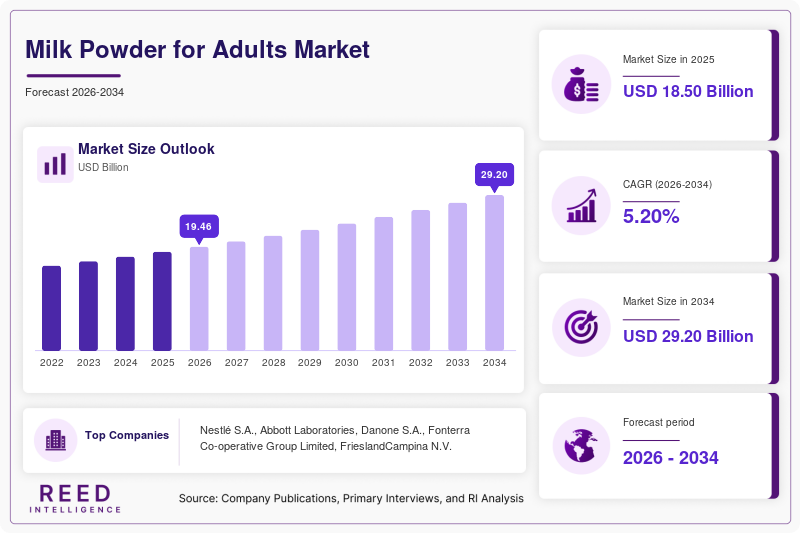
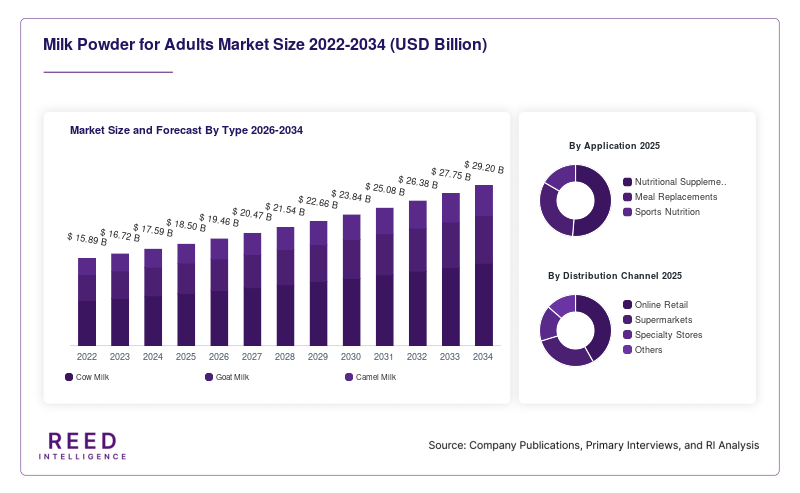
The global milk powder for adults market size was valued at USD 18.50 billion in 2025 and is projected to grow from USD 19.46 billion in 2026 to USD 28.30 billion by 2034, registering a CAGR of 5.20% during the forecast period from 2026 to 2034.
Milk powder for adults refers to powdered dairy-based nutritional products formulated specifically for adult consumers rather than infants and young children. These products provide concentrated sources of proteins, carbohydrates, fats, vitamins, minerals, and other functional nutrients and are increasingly positioned as convenient daily nutrition solutions.
The market is benefiting from demographic aging, preventive healthcare awareness, nutritional deficiencies, changing lifestyles, and increasing consumer interest in functional foods. Product innovation is also shifting toward specialized formulations for healthy aging, muscle support, bone health, cardiovascular wellness, immunity, and active lifestyles.
Milk Powder for Adults Market Drivers
The increasing global population of middle-aged and elderly consumers is a major driver of the market. Older consumers increasingly seek convenient nutritional products containing calcium, vitamin D, protein, and other nutrients associated with maintaining bone, muscle, and overall physical health.
Consumers are becoming more aware of nutritional deficiencies and the importance of preventive nutrition. This has increased demand for fortified milk powders designed to provide additional protein, vitamins, minerals, and functional ingredients beyond conventional dairy nutrition. The market-specific research identifies aging populations, rising health consciousness, nutritional deficiencies, and premiumization as important growth catalysts.
Milk powder manufacturers are increasingly positioning products around specific health benefits, including bone strength, joint health, cardiovascular wellness, immune support, muscle maintenance, and energy metabolism. Nestlé's CARNATION adult portfolio illustrates this shift through formulations focused on calcium, joint health, omega fatty acids, reduced fat, and other targeted nutritional benefits.
Milk Powder for Adults Market Restraints
Fortified and specialized adult milk powders generally command higher prices than conventional milk powder. Premium pricing can limit penetration among price-sensitive consumers in developing economies, particularly where conventional dairy products remain more affordable.
Adult milk powders compete with protein supplements, ready-to-drink nutritional beverages, plant-based nutrition products, meal replacements, and other functional foods. Consumers with specific nutritional objectives may increasingly choose specialized alternatives.
Lactose intolerance, dairy allergies, dietary restrictions, sugar concerns, and changing consumer preferences can limit the addressable market for conventional dairy-based adult milk powders.
Milk Powder for Adults Market Opportunities
The increasing focus on personalized nutrition creates opportunities for formulations designed around age, lifestyle, activity level, nutritional deficiencies, and specific wellness requirements.
Online retail provides manufacturers with greater geographic reach and enables consumers in semi-urban and rural locations to access specialized adult nutrition products. The market-specific research highlights e-commerce expansion as an important structural opportunity.
Products enriched with protein, calcium, vitamin D, probiotics, omega fatty acids, and other functional ingredients offer manufacturers opportunities to differentiate products and target specific consumer groups.
Milk Powder for Adults Market Segmental Analysis
By Type
Cow milk is the dominant type segment in the Milk Powder for Adults Market because of its broad availability, established consumer acceptance, comparatively competitive pricing, and extensive manufacturing infrastructure. Cow-milk-based formulations also provide a familiar nutritional profile and are widely used across conventional and fortified adult nutrition products.
Goat milk represents an important alternative for consumers seeking differentiated dairy nutrition and products perceived as easier to digest. Camel milk remains a comparatively specialized segment, supported by interest in premium and differentiated nutritional products. However, reliable market-specific comparable share and CAGR figures for these two segments are not independently confirmed and therefore are not assigned.
By Application
Nutritional Supplements represent the dominant application segment, supported by increasing consumer emphasis on preventive nutrition, healthy aging, protein intake, bone health, and micronutrient supplementation.
Meal replacements benefit from growing demand for convenient nutrition among working adults and consumers following structured dietary programs. Sports nutrition represents an expanding application as consumers increasingly seek protein-rich and nutrient-dense products for active lifestyles. Exact comparable market-share and CAGR figures for these subsegments are not independently verified.
By Distribution Channel
Online Retail is the dominant distribution channel, benefiting from increased e-commerce penetration, wider product availability, direct-to-consumer marketing, product comparison capabilities, and convenience. Online channels are particularly important for specialized nutritional products that may not be stocked extensively in conventional retail outlets.
Supermarkets and specialty stores remain important because consumers often prefer established retail environments for nutritional and dairy products. Specialty stores can provide additional credibility for premium and functional formulations, while other channels include pharmacies, direct distribution, and institutional channels.
By Age Group
The 36–55 Years segment is the dominant age group, supported by rising preventive-health awareness, increased spending on nutritional products, and growing interest in maintaining muscle, bone, energy, and metabolic health before advanced aging.
The 55 Years and Above segment is the fastest-growing age group, driven by population aging and increasing demand for products focused on healthy aging, bone strength, joint mobility, protein intake, and overall nutritional support. Nestlé and Abbott both demonstrate the industry's increasing focus on nutrition products addressing age-related nutritional requirements.
Milk Powder for Adults Market Regional Analysis
North America Milk Powder for Adults Market
North America represents a mature market supported by high consumer awareness of nutritional supplements, established healthcare and retail infrastructure, and strong demand for functional foods. Consumers increasingly seek high-protein, low-sugar, fortified, and specialized nutritional formulations. The region also benefits from established brands and broad availability through supermarkets, pharmacies, specialty nutrition stores, and e-commerce platforms.
North America remains one of the major regional markets, although an exact comparable 2025 market-share percentage and regional market value from the same dataset supporting the USD 18.50 billion global market are not independently verified. Therefore, a numerical regional value is not assigned to avoid mixing incompatible market datasets.
Europe Milk Powder for Adults Market
Europe benefits from an aging population, strong awareness of preventive nutrition, established dairy consumption patterns, and demand for premium and functional nutritional products. Consumers increasingly prioritize products with high protein, reduced sugar, added vitamins, minerals, probiotics, and other targeted nutritional characteristics.
The region remains an important market for adult nutritional milk powder, but an exact comparable 2025 regional market share and market value aligned with the supplied USD 18.50 billion global valuation are unavailable from the verified dataset. Accordingly, no unsupported regional revenue figure is provided.
Asia Pacific Milk Powder for Adults Market
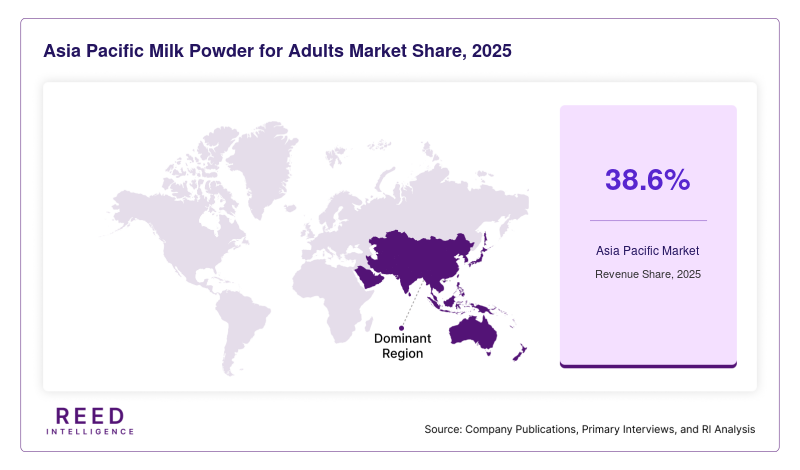
Asia Pacific is the dominant regional Milk Powder for Adults Market, accounting for approximately 38.6% of global market share in 2025. The region generated approximately USD 7.14 billion in market value in 2025.
The region's leadership is supported by its large population base, rapidly aging populations in countries such as Japan and South Korea, expanding middle-class purchasing power in China and India, increasing awareness of preventive nutrition, and rising e-commerce penetration. The available market-specific source identifies Asia Pacific as the region with the strongest absolute growth through 2034. A separate Asia-Pacific-focused study reports a 7.2% CAGR for the regional market, while identifying India as a high-growth market and China as the largest market within Asia Pacific.
Latin America Milk Powder for Adults Market
Latin America presents growth opportunities as urbanization, disposable income, health awareness, and access to modern retail and e-commerce channels improve. Adult consumers are increasingly interested in nutritional products that provide convenient sources of protein, calcium, vitamins, and other essential nutrients.
The market is comparatively smaller than Asia Pacific, North America, and Europe. However, increasing demand for convenient nutritional products and premium dairy formulations can support long-term expansion. Exact comparable 2025 market share, market value, and CAGR figures for the region are not independently verified from the same dataset as the supplied global valuation.
Middle East & Africa
The Middle East & Africa market is supported by improving retail infrastructure, urbanization, changing dietary patterns, and rising interest in nutritional and functional food products. Demand is concentrated in urban consumer markets where premium imported and locally produced nutritional products have stronger distribution.
Market development is also influenced by income differences, import dependence in selected markets, and varying levels of modern retail penetration. Exact comparable regional market share, market value, and CAGR figures aligned with the USD 18.50 billion global market are unavailable from the verified source and are therefore not estimated.
Milk Powder for Adults Market Competitive Landscape
The Milk Powder for Adults Market is characterized by competition among global dairy companies, nutritional-healthcare companies, and regional dairy manufacturers. Competitive strategies increasingly emphasize functional formulations, protein enrichment, micronutrient fortification, healthy-aging positioning, digital distribution, and localized product development.
Nestlé maintains a strong position in adult nutritional milk powder through its CARNATION portfolio and broader nutrition capabilities. Its adult milk powder offerings include products positioned around calcium, bone health, joint health, heart health, reduced fat, and other nutritional benefits. The company's portfolio demonstrates the market's movement toward specialized functional adult nutrition.
Key Market Players
- Nestlé S.A.
- Abbott Laboratories
- Danone S.A.
- Fonterra Co-operative Group Limited
- FrieslandCampina N.V.
- Arla Foods
- Yili Group
- China Mengniu Dairy Company Limited
- Amul
- Meiji Holdings Co., Ltd.
- Morinaga Milk Industry Co., Ltd.
Milk Powder for Adults Market Recent Developments
- May 2026 Abbott Laboratories: Abbott launched Ensure Strength Pro in India, a new adult nutrition formulation designed to support healthy aging. The product contains 31 nutrients, including 30 grams of high-quality protein, with nutrients supporting muscles, bones, heart, blood cells, immune function, metabolism, and the nervous system.
- February 2026 Nestlé: Nestlé introduced Nestlé Vital, a new nutritional drink range targeting consumers in midlife and beyond. The products provide 26 essential nutrients, including high-quality protein, fiber, vitamins, minerals, and bioactives, and are positioned around strength, energy, focus, sleep, and healthy aging.
Milk Powder for Adults Market Segments
By Type
- Cow Milk
- Goat Milk
- Camel Milk
By Application
- Nutritional Supplements
- Meal Replacements
- Sports Nutrition
By Distribution Channel
- Online Retail
- Supermarkets
- Specialty Stores
- Others
By Region
- North America
- Europe
- APAC
- Middle East and Africa
- LATAM