Milk Powder Market Size, Share & Demand Report By Product Type (Whole Milk Powder, Skim Milk Powder, Infant Milk Powder, Dairy Whitener, Specialty Milk Powder), By Application (Food and Beverages, Nutritional Products, Infant Formula, Bakery and Confectionery, Dairy Products, Animal Nutrition), By Distribution Channel (Business-to-Business, Supermarkets and Hypermarkets, Convenience Stores, Specialty Stores, Online Retail), By Region & Segment Forecasts, 2026–2034
USD 3950
Market Overview
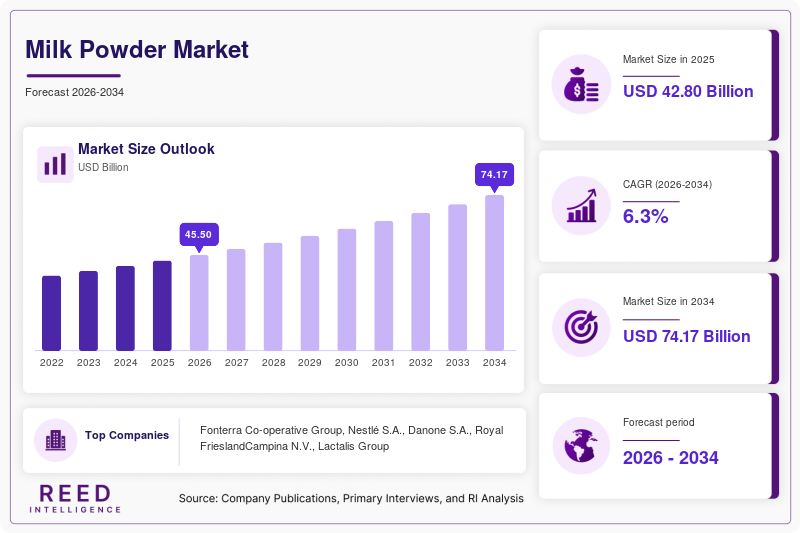
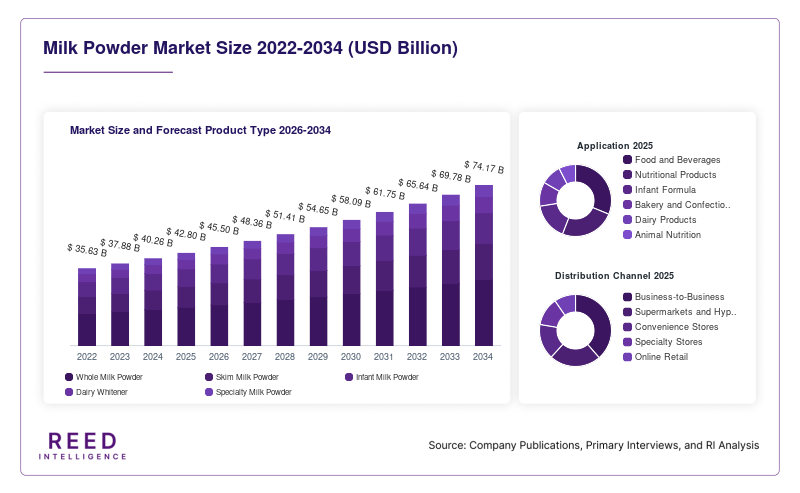
The global Milk Powder Market size was valued at USD 42.8 billion in 2026 and is projected to reach USD 69.7 billion by 2034, expanding at a CAGR of 6.3% during 2026–2034. The market continues to evolve as food manufacturers, beverage producers, infant nutrition brands, and bakery companies increase their utilization of milk powder as a versatile dairy ingredient. Milk powder offers longer shelf life, simplified transportation, reduced storage costs, and improved product stability compared to liquid milk, making it a preferred ingredient across multiple industrial applications.
Growing urbanization, expanding middle-class populations, and changing dietary preferences are contributing to the steady demand for milk powder worldwide. Manufacturers are increasingly incorporating milk powder into confectionery products, dairy beverages, bakery items, nutritional supplements, and ready-to-eat foods. The rise of modern retail channels and e-commerce platforms has also improved product accessibility, supporting consumption across both developed and emerging economies. A significant factor supporting market growth is the continued expansion of the global processed food industry. Food manufacturers increasingly depend on milk powder to ensure consistent product quality and stable ingredient supply throughout the year. In addition, advancements in spray-drying technologies and improvements in dairy processing efficiency have enhanced product quality, nutritional retention, and production scalability.
Key Highlights
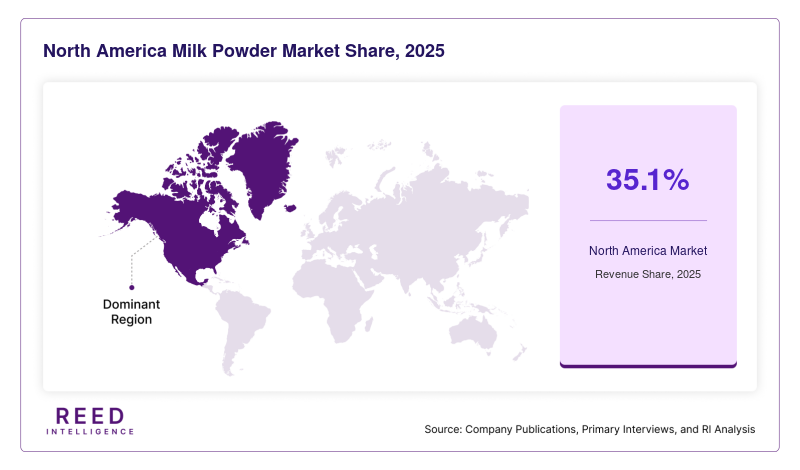
- North America dominated the market with a 35.1% share in 2025, while Asia Pacific is expected to grow at the fastest CAGR of 8.4% during 2026–2034.
- By product type, whole milk powder accounted for the largest share of 39.8%, while infant milk powder is projected to grow at a CAGR of 8.9%.
- By application, food and beverages led with a 47.3% share, whereas nutritional products are expected to expand at a CAGR of 8.6%.
- By distribution channel, business-to-business sales held the largest share of 61.5%, while online retail is forecast to grow at a CAGR of 9.3%.
- The United States remained the dominant country, with market values of USD 6.4 billion in 2024 and USD 6.8 billion in 2025.
Market Trends
Growing Demand for Infant and Specialized Nutrition Products
The demand for infant milk powder and specialized nutritional formulations continues to increase across both developed and emerging economies. Consumers are becoming more aware of nutritional requirements during early childhood, driving purchases of fortified milk powder products containing vitamins, minerals, probiotics, and protein-enhancing ingredients. Manufacturers are responding by introducing premium formulations designed for different age groups and dietary needs. The trend is particularly visible in urban regions where working parents seek convenient nutritional solutions. Growing healthcare awareness and rising disposable incomes are supporting premiumization within the milk powder market, creating opportunities for product differentiation and value-added offerings.
Expansion of Clean-Label and Functional Dairy Ingredients
Food manufacturers are increasingly seeking clean-label ingredients to satisfy changing consumer preferences. Milk powder producers are investing in processing methods that preserve nutritional quality while minimizing artificial additives. Functional milk powder products enriched with protein, calcium, immune-support ingredients, and digestive health components are gaining popularity across sports nutrition, healthy snacks, and meal replacement categories. Consumers are also paying closer attention to ingredient transparency and product traceability. This trend is encouraging dairy processors to adopt advanced quality assurance systems and sustainable sourcing practices, helping strengthen consumer trust and expand market penetration across health-conscious demographic groups.
Market Drivers
Rising Consumption of Processed and Convenience Foods
The increasing consumption of processed foods represents a major growth driver for the milk powder market. Manufacturers of bakery products, confectionery items, dairy beverages, desserts, sauces, and ready meals rely heavily on milk powder because it offers consistency, ease of storage, and long shelf life. As urban populations expand and lifestyles become busier, consumers are spending more on convenient food products that require minimal preparation. This shift is encouraging food manufacturers to expand production capacities and secure reliable dairy ingredient supplies. Milk powder remains an important ingredient because it helps maintain product texture, flavor, nutritional value, and manufacturing efficiency across diverse food categories.
Growth of Dairy Ingredient Applications Across Industries
Milk powder usage has expanded beyond traditional dairy products into pharmaceutical, nutritional, cosmetic, and animal feed applications. The ingredient provides proteins, minerals, and functional properties that support multiple formulation requirements. Sports nutrition products, dietary supplements, and protein-enriched beverages increasingly utilize milk powder as a key ingredient. Pharmaceutical manufacturers also employ specialized milk powder formulations in selected nutritional preparations. As industries continue to diversify their product portfolios, demand for high-quality milk powder is expected to increase. Continuous innovation in dairy processing technologies further supports application expansion and enhances the commercial value of milk powder products worldwide.
Market Restraint
Volatility in Raw Milk Prices and Supply Chain Challenges
Fluctuations in raw milk prices remain a significant challenge for participants in the milk powder market. Dairy production is influenced by weather conditions, feed costs, livestock health, labor availability, and regulatory changes. Variations in any of these factors can affect milk supply and production costs, creating uncertainty for manufacturers and distributors. Price volatility often impacts profit margins and complicates long-term procurement planning.
In addition, global supply chains continue to experience periodic disruptions related to transportation costs, trade restrictions, geopolitical developments, and logistics bottlenecks. Milk powder producers operating across international markets must manage inventory levels carefully to maintain stable product availability. For example, adverse weather conditions affecting major dairy-producing regions can reduce milk output and increase processing costs, ultimately influencing product pricing. Such uncertainties may limit investment decisions and create challenges for smaller market participants with limited financial flexibility.
Market Opportunities
Increasing Demand in Emerging Economies
Emerging economies present substantial opportunities for milk powder manufacturers due to rapid population growth, urbanization, and rising household incomes. Consumers in countries across Asia, Africa, and Latin America are increasingly incorporating dairy products into their daily diets. Improved retail infrastructure and wider product availability are supporting market penetration in previously underserved regions. Government initiatives promoting nutritional awareness and food security are also encouraging dairy consumption. As purchasing power improves, consumers are becoming more willing to spend on premium nutritional products, creating favorable conditions for market expansion. Companies that establish localized distribution networks and affordable product offerings can benefit from long-term growth opportunities.
Technological Advancements in Dairy Processing
Continuous innovation in dairy processing technologies creates opportunities for manufacturers to improve product quality, operational efficiency, and profitability. Modern spray-drying systems help preserve nutritional content while enhancing product consistency and shelf stability. Advanced packaging solutions also contribute to longer product life and reduced waste. Digital monitoring technologies are improving quality control and production efficiency across dairy facilities. Furthermore, manufacturers are investing in research and development to create customized milk powder formulations for specific industrial applications. These innovations enable companies to address changing consumer preferences while improving production economics, strengthening competitiveness across global markets.
Segmental Analysis
By Product Type
Whole milk powder represented the dominant subsegment and accounted for approximately 39.8% of market revenue in 2024. Its widespread use across food processing, confectionery manufacturing, bakery production, and dairy beverages contributed significantly to market leadership. Whole milk powder offers balanced nutritional content, including proteins, fats, vitamins, and minerals, making it suitable for diverse applications. Manufacturers favor this product due to its ability to enhance flavor, texture, and product consistency. Strong demand from both industrial buyers and retail consumers continues to support sales growth. In addition, long shelf life and ease of transportation provide operational advantages that strengthen adoption across global markets.
Infant milk powder is expected to be the fastest-growing subsegment, expanding at a CAGR of 8.9% during the forecast period. Rising awareness of infant nutrition, increasing birth rates in selected emerging economies, and growing consumer preference for premium nutritional products are driving demand. Manufacturers continue to invest in research and development activities aimed at improving nutritional composition and product safety. Advanced formulations enriched with probiotics, vitamins, minerals, and specialized nutrients are gaining acceptance among consumers. Expanding healthcare awareness programs and higher spending on child nutrition products are expected to create favorable growth conditions for this subsegment throughout the forecast period.
By Application
The food and beverages segment accounted for the largest share of approximately 47.3% in 2024. Milk powder remains a widely utilized ingredient in bakery products, confectionery items, desserts, dairy beverages, sauces, and ready-to-eat foods. Manufacturers rely on milk powder because it provides stable quality, convenient storage, and consistent functionality throughout production processes. Growing demand for processed and convenience foods continues to support segment expansion. The ability of milk powder to improve texture, flavor, and nutritional value makes it a preferred ingredient across various food categories. Increasing product innovation within the packaged food sector further strengthens demand from industrial buyers.
Nutritional products are projected to register the fastest CAGR of 8.6% through 2034. The growth is primarily driven by increasing consumer interest in health and wellness, sports nutrition, and dietary supplementation. Milk powder provides high-quality protein and essential nutrients, making it suitable for nutritional formulations targeting different age groups and lifestyles. Manufacturers are developing specialized products designed for athletes, elderly consumers, and individuals seeking balanced nutrition. Rising health awareness and expanding demand for protein-enriched foods and beverages continue to create opportunities. Continuous innovation in functional nutrition products is expected to accelerate growth within this application segment.
By Distribution Channel
Business-to-business sales held the dominant position and captured approximately 61.5% of market revenue in 2024. Large food manufacturers, beverage producers, bakeries, confectionery companies, and nutritional product manufacturers represent the primary customer base. Bulk purchasing agreements and long-term supply contracts contribute to strong sales volumes within this channel. Milk powder remains a critical industrial ingredient because it supports production efficiency and ensures consistent product quality. The widespread integration of milk powder into multiple food processing operations continues to reinforce the importance of business-to-business distribution. Strong relationships between dairy processors and industrial customers further support segment leadership.
Online retail is anticipated to emerge as the fastest-growing distribution channel, expanding at a CAGR of 9.3% during the forecast period. Digital commerce platforms are increasing product accessibility and enabling consumers to compare products conveniently. Rising internet penetration, smartphone adoption, and improvements in logistics infrastructure continue to support e-commerce growth. Consumers increasingly purchase infant nutrition products, specialty milk powders, and nutritional supplements through online channels due to convenience and broader product selection. Manufacturers are also strengthening direct-to-consumer strategies and digital marketing initiatives. These developments are expected to accelerate online retail adoption and contribute significantly to future market expansion.
Regional Analysis
North America
North America accounted for approximately 35.1% of the global milk powder market in 2025, making it the leading regional market. The region benefits from advanced dairy infrastructure, established food processing industries, and high consumption of nutritional products. Demand remains strong across bakery, confectionery, infant nutrition, and dairy beverage applications. Market participants continue to invest in production modernization and export capabilities. The regional market is projected to expand at a CAGR of 5.4% through 2034 as manufacturers focus on value-added dairy ingredients and premium nutritional formulations.
The United States dominates the regional market due to its large dairy industry and strong export network. A unique growth factor supporting the market is the increasing adoption of protein-enriched foods and beverages among health-conscious consumers. Food manufacturers continue to launch products featuring dairy-based protein ingredients, creating consistent demand for milk powder. The presence of large-scale dairy processors and extensive distribution channels further strengthens the country's position within the global market.
Europe
Europe represented approximately 28.4% of global market revenue in 2025 and remains a significant contributor to milk powder production and exports. The region benefits from established dairy farming practices, advanced processing capabilities, and strong quality standards. Demand is supported by applications in bakery products, dairy desserts, nutritional supplements, and infant formula. European producers are increasingly focusing on sustainable production methods and premium dairy ingredients. The market is expected to register a CAGR of 5.7% during the forecast period.
Germany remains the dominant country within the European market. A distinctive growth factor is the increasing emphasis on sustainable dairy production and environmentally responsible processing practices. Dairy companies are investing in energy-efficient technologies, carbon reduction initiatives, and supply chain transparency. These efforts align with evolving consumer expectations and regulatory requirements, helping manufacturers strengthen brand value while supporting continued market growth throughout the region.
Asia Pacific
Asia Pacific held approximately 22.8% of the global milk powder market in 2025 and is expected to record the fastest growth during the forecast period. Rising disposable incomes, population expansion, and changing dietary habits are driving demand across multiple product categories. Urban consumers increasingly seek convenient and nutritious food options, supporting higher milk powder consumption. The region is forecast to expand at a CAGR of 8.4% between 2026 and 2034, supported by growing investments in dairy processing and distribution infrastructure.
China remains the largest market within Asia Pacific. A unique growth factor is the strong demand for infant nutrition products and premium dairy formulations. Consumers increasingly prioritize product quality, safety, and nutritional value, encouraging manufacturers to develop advanced formulations. Expanding e-commerce channels and improved cold-chain logistics also contribute to wider product accessibility, supporting continued growth in both urban and semi-urban markets throughout the country.
Middle East & Africa
The Middle East & Africa accounted for approximately 7.2% of global market revenue in 2025. Demand is growing steadily as governments focus on food security, nutritional improvement, and dairy product accessibility. Milk powder serves as an important ingredient in various food products due to its long shelf life and storage convenience. The market is projected to grow at a CAGR of 6.8% through 2034 as regional food manufacturing industries continue to expand and diversify.
Saudi Arabia leads the regional market owing to strong investments in food processing and dairy distribution infrastructure. A distinctive growth factor is the increasing focus on reducing dependence on imported finished dairy products through local manufacturing initiatives. Government-backed investments in food production capabilities and nutritional programs continue to create favorable conditions for milk powder consumption across multiple end-use industries within the country.
Latin America
Latin America captured approximately 6.5% of the global milk powder market in 2025. The region benefits from growing dairy consumption, expanding food manufacturing activities, and improving retail distribution networks. Increasing urbanization and changing dietary patterns are supporting demand for processed food products containing milk powder. Market growth is further supported by rising awareness regarding nutritional products and fortified food formulations. The regional market is expected to achieve a CAGR of 6.1% during the forecast period.
Brazil represents the dominant market within Latin America. A unique growth factor is the rapid expansion of domestic food processing industries utilizing milk powder as a cost-effective and versatile dairy ingredient. Manufacturers continue to increase production of bakery products, confectionery items, and nutritional beverages, creating stable demand. Improvements in agricultural productivity and dairy sector investments are expected to strengthen the country's market position over the coming years.
Competitive Landscape
The global milk powder market is moderately consolidated, with major dairy processors competing through product innovation, capacity expansion, quality assurance, and geographic diversification. Companies focus on strengthening supply chains, improving processing efficiency, and expanding premium product portfolios to address changing consumer preferences. Fonterra Co-operative Group remains one of the leading participants in the global market due to its extensive dairy sourcing network, strong export presence, and broad product portfolio. The company continues to invest in advanced processing technologies and sustainable production initiatives. Other major competitors including Nestlé, Danone, FrieslandCampina, and Lactalis maintain strong market positions through continuous innovation and strategic partnerships.
A notable recent development involved several leading dairy manufacturers expanding specialized nutrition product lines to address increasing demand for infant nutrition and functional dairy ingredients. Market participants are also increasing investments in digital supply chain management and environmentally responsible production practices. As competition intensifies, companies are expected to focus on premiumization, operational efficiency, and regional market expansion to strengthen their positions.
Key Players
- Fonterra Co-operative Group
- Nestlé S.A.
- Danone S.A.
- Royal FrieslandCampina N.V.
- Lactalis Group
- Arla Foods
- Dairy Farmers of America
- Saputo Inc.
- Glanbia plc
- Murray Goulburn
- Amul
- Yili Group
- Mengniu Dairy
- Meiji Holdings Co., Ltd.
- Morinaga Milk Industry Co., Ltd.
Recent Developments
- In 2025, a major dairy ingredients manufacturer expanded its milk powder processing capacity to address growing global demand from infant nutrition, bakery, and food processing industries.
- In 2025, several dairy companies launched fortified milk powder formulations enriched with proteins, vitamins, and minerals to meet increasing consumer demand for functional nutrition products.
- In 2024, a leading dairy producer introduced a premium milk powder range featuring enhanced nutritional profiles and improved solubility for beverage and nutritional applications.
- In 2024, manufacturers increased investments in advanced spray-drying technologies to improve production efficiency, product consistency, and nutrient retention during processing.
- In 2025, strategic collaborations between dairy processors and food manufacturers accelerated the development of customized milk powder ingredients for bakery, confectionery, and ready-to-drink product applications.
Milk Powder Market Segments
Product Type
- Whole Milk Powder
- Skim Milk Powder
- Infant Milk Powder
- Dairy Whitener
- Specialty Milk Powder
Application
- Food and Beverages
- Nutritional Products
- Infant Formula
- Bakery and Confectionery
- Dairy Products
- Animal Nutrition
Distribution Channel
- Business-to-Business
- Supermarkets and Hypermarkets
- Convenience Stores
- Specialty Stores
- Online Retail
By Region
- North America
- Europe
- APAC
- Middle East and Africa
- LATAM