Milk Protein Isolate (MPI) Market Size, Share & Trends Analysis Report By Product Type (Whey Protein Isolate, Micellar Casein Isolate, Milk Protein Blend, Others) and By Application (Sports Nutrition, Clinical Nutrition, Food & Beverage, Others) and By Region (North America, Europe, Asia Pacific, Latin America, Middle East & Africa) Forecasts, 2026–2034
USD 3950
Milk Protein Isolate (MPI) Market Size
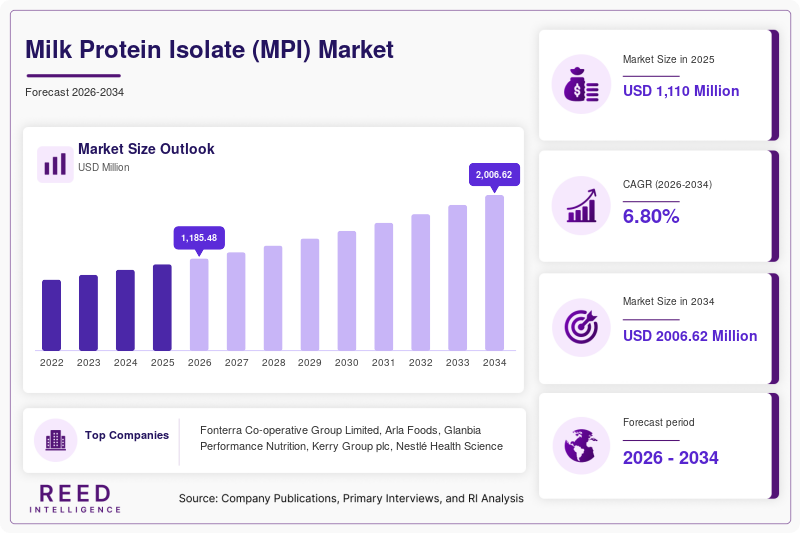
The global Milk Protein Isolate (MPI) Market size was valued at USD 1,110 million in 2025 and is projected to grow from USD 1,185.48 million in 2026 to USD 2,006.62 million by 2034, registering a CAGR of 6.80% during the forecast period from 2026 to 2034.
Milk Protein Isolate (MPI) is a dairy-derived protein ingredient produced by removing much of the non-protein components of milk while retaining a high proportion of the milk's natural protein. Its nutritional profile and functional properties make it suitable for sports nutrition, medical and clinical nutrition, protein bars, beverages, yogurt, ice cream, and other fortified food applications.
The market is increasingly moving toward high-purity and premium protein ingredients. Sports nutrition remains the largest application because athletes and fitness consumers seek concentrated protein sources for muscle development and recovery. At the same time, clinical nutrition is expanding as healthcare providers increasingly use high-quality proteins in formulations addressing protein deficiency, muscle wasting, recovery, and healthy aging.
Milk Protein Isolate (MPI) Market Drivers
The growing emphasis on protein intake across sports, wellness, and general nutrition is a primary market driver. Milk protein isolates provide complete proteins containing essential amino acids, making them attractive to consumers seeking efficient protein supplementation.
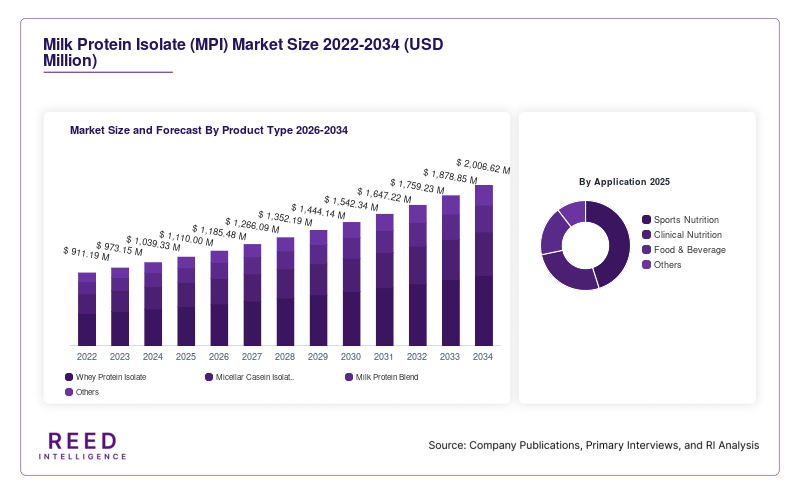
The global fitness industry continues to increase demand for protein powders, bars, ready-to-drink beverages, and recovery products. The sports nutrition application accounted for 42.5% of the MPI market in 2025, making it the largest application segment.
Clinical applications are expanding as nutritional products increasingly target sarcopenia, post-surgical recovery, muscle loss, and other conditions where adequate protein intake is important. Clinical nutrition represented 28.3% of the market in 2025 and is projected to grow at a 6.2% CAGR through 2034.
Milk protein isolates are increasingly used in clean-label and protein-fortified formulations because they provide high protein content while supporting desirable texture and nutritional characteristics. Food manufacturers are incorporating MPI into yogurts, protein beverages, bars, ice cream, and functional foods.
Milk Protein Isolate (MPI) Market Restraints
Milk protein isolate requires sophisticated filtration and purification technologies, increasing production costs compared with conventional dairy proteins and lower-purity protein ingredients.
Milk availability and dairy commodity prices directly influence the cost structure of MPI manufacturers. Changes in milk supply, weather conditions, feed costs, and global dairy prices can affect ingredient margins.
Plant-based proteins such as pea, soy, rice, and hemp proteins increasingly compete with dairy-derived protein ingredients. Improving taste, functionality, nutritional profiles, and consumer acceptance of alternative proteins can create competitive pressure.
MPI production depends on specialized dairy processing infrastructure and consistent milk supplies. Energy costs, transportation constraints, and disruptions in dairy processing can affect production and pricing.
Milk Protein Isolate (MPI) Market Opportunities
India, China, Southeast Asia, Latin America, and the Middle East offer significant growth opportunities as middle-class populations expand and consumers increasingly adopt sports nutrition and protein-fortified products.
Increasing global demand for healthy-aging products provides opportunities for micellar casein and other milk protein ingredients used in products targeting muscle maintenance and nutritional support.
Ready-to-drink protein beverages, smoothies, fortified dairy drinks, and protein-enhanced waters are creating new applications for MPI.
Grass-fed, organic, traceable, and sustainably sourced milk protein isolates offer opportunities for premium positioning. Manufacturers can differentiate products through provenance, processing technology, purity, and sustainability attributes.
Milk Protein Isolate (MPI) Market Segmental Analysis
By Product Type
Whey Protein Isolate is the dominant product type, accounting for 48.3% of the global MPI market in 2025. Its leadership is supported by rapid absorption, high protein purity, strong branched-chain amino-acid content, and extensive use in sports nutrition, protein powders, bars, and ready-to-drink products. The segment is projected to grow at a 7.1% CAGR from 2026 to 2034.
Micellar Casein Isolate represented 32.1% of the market in 2025 and is growing at a 6.9% CAGR, supported by sustained amino-acid release and expanding clinical, bone-health, and nighttime nutrition applications. Milk Protein Blend accounted for 15.2%, while Others represented 4.4%.
By Application
Sports Nutrition is the dominant application, accounting for 42.5% of the market in 2025 and growing at a 7.2% CAGR through 2034. Its leadership is driven by increasing fitness participation, sports supplementation, post-workout recovery demand, and the adoption of protein-rich formulations among professional and recreational athletes.
Clinical Nutrition accounted for 28.3% and is projected to grow at 6.2% CAGR, while Food & Beverage represented 22.4% and is projected to expand at 6.3% CAGR. Other applications accounted for 6.8% and include specialized and emerging uses.
Milk Protein Isolate (MPI) Market Regional Analysis
North America Milk Protein Isolate (MPI) Market
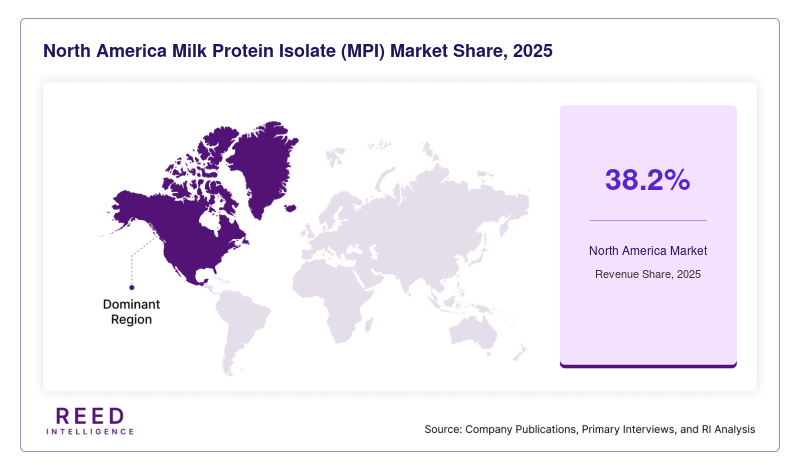
North America is the dominant regional Milk Protein Isolate Market, accounting for approximately 38.2% of global market share in 2025. Based on the supplied global market size of USD 1,110 million in 2025, this share corresponds to an estimated regional market value of approximately USD 424.02 million. The value is mathematically derived from the market-specific 38.2% regional share and the supplied 2025 global market value. The source identifies North America as the largest regional market, supported by its established sports nutrition industry, high consumer spending on health supplements, and strong protein powder manufacturing base.
The United States and Canada benefit from sophisticated e-commerce networks, specialist sports nutrition retailers, mainstream grocery distribution, and established dairy ingredient suppliers. Demand is particularly strong in protein powders, sports nutrition products, functional beverages, and premium nutritional formulations. North America's advanced dairy processing infrastructure and strong relationships between ingredient suppliers and finished-product manufacturers further reinforce regional leadership.
Europe Milk Protein Isolate (MPI) Market
Europe is the second-largest regional market, accounting for approximately 28.7% of global market share in 2025. The region benefits from established dairy-processing capabilities, strict food-quality standards, strong demand for functional nutrition, and expanding clinical nutrition applications.
Germany, France, Scandinavia, the United Kingdom, and other major European markets are important consumers and processors of milk protein ingredients. Clinical nutrition applications are particularly significant, with milk protein isolates being incorporated into formulations supporting recovery, healthy aging, and specialized nutritional requirements.
Asia Pacific Milk Protein Isolate (MPI) Market
Asia Pacific is the fastest-growing regional market, accounting for approximately 19.4% of global market share in 2025. The region's expansion is supported by rising disposable incomes, rapid urbanization, increasing fitness participation, growing awareness of protein consumption, and expanding demand for premium nutritional products in China, India, and Australia.
China remains an important regional contributor, while India is emerging as a high-potential market as local dairy companies and ingredient manufacturers expand protein-processing capabilities. The source identifies Asia Pacific as having the fastest regional growth trajectory; however, a specific comparable regional CAGR is not independently stated in the source and is therefore not assigned.
Latin America Milk Protein Isolate (MPI) Market
Latin America accounted for approximately 8.2% of the global market in 2025. Brazil and Mexico are the region's principal growth centers, supported by expanding sports nutrition markets, increasing protein consumption, and growing use of milk protein isolates in beverages and functional dairy products.
The region provides opportunities for local food and beverage manufacturers seeking premium protein ingredients. Expanding fitness culture, modern retail infrastructure, and e-commerce penetration are expected to support additional adoption of MPI-based products.
Middle East & Africa Milk Protein Isolate (MPI) Market
The Middle East & Africa accounted for approximately 5.5% of the global market in 2025. Growth opportunities are emerging particularly in Gulf Cooperation Council markets, where rising healthcare expenditure, premium nutrition demand, and expanding fitness culture are supporting adoption of specialized protein ingredients.
Clinical nutrition and healthy-aging applications represent additional opportunities because healthcare providers increasingly emphasize adequate protein intake among older consumers and patients recovering from illness or surgery. However, regional market maturity varies considerably across individual countries.
Milk Protein Isolate (MPI) Market Competitive Landscape
The Milk Protein Isolate Market is moderately consolidated, with leading dairy ingredient companies benefiting from integrated milk supply chains, advanced protein-processing capabilities, established customer relationships, and global distribution networks. Competitive strategies increasingly focus on production capacity, premium protein ingredients, specialized formulations, sustainability, and expansion into sports and clinical nutrition.
Fonterra is a leading global supplier of dairy proteins and maintains the largest reported share among the major MPI competitors at approximately 17.2%. Its competitive strength comes from vertically integrated dairy operations, grass-fed milk sourcing, advanced processing capabilities, and distribution across North America, Europe, and Asia Pacific.
Key Market Players
- Fonterra Co-operative Group Limited
- Arla Foods
- Glanbia Performance Nutrition
- Kerry Group plc
- Nestlé Health Science
- Abbott Nutrition
- China Mengniu Dairy Company Limited
- Inner Mongolia Yili Industrial Group Co., Ltd.
- Lactalis Ingredients
- FrieslandCampina
- Milk Specialties Global
- Agropur
- Hilmar Ingredients
Milk Protein Isolate (MPI) Market Recent Developments
- September 2026 Fonterra: Fonterra announced an incremental NZD 1 billion investment over the next three years to expand its South Island protein manufacturing network. The company said the investment will increase capacity for high-value products and advanced proteins and help shift milk away from commodity products toward higher-value dairy ingredients.
- August 2026 Arla Foods: Arla reported 19.3% revenue growth to EUR 867 million in its Arla Foods Ingredients business during H1 2026, supported by strong global demand across protein and nutrition segments. Arla also reported particularly strong momentum in protein and sports nutrition, reinforcing demand for dairy protein ingredients
Milk Protein Isolate (MPI) Market Segments
By Product Type
- Whey Protein Isolate
- Micellar Casein Isolate
- Milk Protein Blend
- Others
By Application
- Sports Nutrition
- Clinical Nutrition
- Food & Beverage
- Others
By Region
- North America
- Europe
- APAC
- Middle East and Africa
- LATAM